The Underground George Osborne

Paul Krugman has taken on the Conservatives’ new budget, which proposes tax cuts, spending increases (until the election) and reducing the budget deficit in some unspecified way.

Osborne produces a ludicrous budget, and even commentators who acknowledge that it’s ludicrous give him credit for showing

a keen understanding of the constraints facing the country

Think about that: someone says that 2+2=5, and gets credit, because it shows that he recognizes how hard it is to live within the constraint of 2+2 just equalling 4.

Admittedly, it looks like vote-grubbing flimflam, but maybe we’re misunderestimating (to use a phrase popular among conservative Georges) the Chancellor of the Exchequer. Maybe, when you look past the snazzy new haircut we would see a soul in existential crisis, who would cry out from the floor of the Commons like Dostoyevsky’s Underground Man:

“Upon my word, they will shout at you, it is no use protesting: it is a case of twice two makes four! Nature does not ask your permission, she has nothing to do with your wishes, and whether you like her laws or dislike them, you are bound to accept her as she is, and consequently all her conclusions. A wall, you see, is a wall … and so on, and so on.”

Merciful Heavens! but what do I care for the laws of nature and arithmetic, when, for some reason I dislike those laws and the fact
that twice two makes four? Of course I cannot break through the wall by battering my head against it if I really have not the strength to knock it down, but I am not going to be reconciled to it simply because it is a stone wall and I have not the strength.

As though such a stone wall really were a consolation, and really did contain some word of conciliation, simply because it is as true as twice two makes four. Oh, absurdity of absurdities! How much better it is to understand it all, to recognise it all, all the impossibilities and the stone wall; not to be reconciled to one of those impossibilities and stone walls if it disgusts you to be reconciled to it; by the way of the most inevitable, logical combinations to reach the most revolting conclusions on the everlasting theme, that even for the stone wall you are yourself somehow to blame, though again it is as clear as day you are not to blame in the least…

Political talk therapy

Two apparently unrelated items from Nick Clegg’s speech at the Liberal Democrats’ party congress: First the BBC quoted his exhortation to the party soldiers, that they should

go to the next election with their “heads held high”.

Then came his announcement of

the first national waiting time targets for people with mental health problems.

People with depression should begin “talking therapy” treatments within 18 weeks, from April.

Let’s see: If the depressed Liberal Democrats can get their talk therapy started in April, maybe they’ll hold their heads a bit higher by the 7 May election.

David Cameron’s other operation

Headline in the Guardian:

David Cameron: I will not resign if Scotland votes for independence

It reminds me of the Monty Python sketch about hapless gangsters, the Piranha brothers:

they began to operate what they called ‘The Operation’. They would select a victim and then threaten to beat him up if he paid the so-called protection money. Four months later they started another operation which the called ‘The Other Operation’. In this racket they selected another victim and threatened not to beat him up if he didn’t pay them. One month later they hit upon ‘The Other Other Operation’. In this the victim was threatened that if he didn’t pay them, they would beat him up. This for the Piranha brothers was the turning point.

If Cameron really wants to preserve the union, he needs to switch to the other other operation, promising that he will resign if Scotland votes to stay in the UK.

Logical crisis in Parliament

One of my favourite logical paradoxes (What, doesn’t everyone have a favourite logical paradox?) is the Unexpected Hanging. I first read about it from Martin Gardner, but you can read a summary here. A recent article in the Oxford Times, about the career plans of a local MP, raised a corresponding problem in the political realm:

Conservative Tony Baldry MP has announced he will stand down at the next General Election.

In a statement Sir Tony said: “One of the consequences of now having five year fixed term Parliaments is that if I succeed in being re-elected at the forthcoming general election, given my age, most people will assume that Parliament will be my last.

“I think this creates a danger that I may be unable to be as effective as I would wish to be; and that the constituency will be distracted from more important issues by the need to choose my successor.”

We might summarise his argument as beginning with three axioms:

  1. It is irresponsible for a politician to stand for parliament if the strong expectation is that this would be his or her last term.
  2. There is a strong expectation that someone will not stand for parliament past age 70.
  3. Terms are now fixed at five years.

Consider, now, the position of a responsible politician, whom we will call Tony65, who who will be, shall we say, 65 years old at the next election. He could stand for parliament now, but he will be 70 at the next election (axiom 3), and so the strong expectation is that he will not stand at the next election (axiom 2). Hence, by axiom 1, and the fact that he is responsible, he should not stand in this election.

But now consider Tony’s younger colleague; call him Tony60, who will be 60 years old at the next election. If Tony60 is elected, he will be 65 at the following election. As a responsible politician, like Tony65, he will stand down at that age. Thus this would be his last term, so by axiom 1 he will not stand at this election either.

By the same reasoning, Tony55 will not stand, since we know that he won’t stand again when he is 60. And so, we can keep backing it up to Tony20, who also can’t stand, because he won’t stand again when he is 25. (18 is the minimum age for election to the House of Commons.) Thus, we have proved:

Theorem: No responsible politician can stand for election to the House of Commons.

This theorem does not apply, for obvious reasons, to the House of Lords, so there will still be space for responsible (if unelected) government.


Mutually reinforcing headlines in Munich

I’m spending a couple of weeks in Munich, and I had to burst out laughing when I saw this tabloid on sale from a stand. The headlines seem to be unintentionally commenting upon one another:

New war in Iraq

followed by

This is your true legacy!

TZ headline

(I have to admit that my translation above, while literally more or less correct, and corresponds to the way I first read it due to the juxtaposition, is not really idiomatic. In the context of large tabloid headlines it’s clear that an appropriate translation would be “This is the right way to leave an inheritance”, and the article is all about how to write your will and avoid paying inheritance tax.)

Bayesian Fables: The Trojan Horse

I was talking recently to a friend who said he saw the story of the Trojan horse as an object lesson in the failure of governance. “Wasn’t there anyone who could say, wait a minute, maybe it’s just not a good idea to bring that horse in here, even if the Greeks seem to have all left?”

I said it was a fable about the inaccessibility of Bayesian reasoning. Laocoön warned them that the prior probability for a net benefit from a Greek gift was low (timeō Danaōs et dōna ferentēs). But the Trojans placed more credence in new information, particularly private information that they hold exclusively, particularly when they seem to have won the information at great effort, by their own ingenuity, by torturing the captured Sinon. (This lesson was learned by the British spies in WWII who conceived Operation Mincemeat.) Laocoön was punished for insisting on his strong prior, being crushed to death by the clever serpents sent by the Goddess of Worldly Wisdom. And the Trojans celebrated their ingenious victory, until they were overrun by reality, in the form of well-muscled Achaean warriors who were not impressed by their highly significant rejection of the likelihood of a subterfuge.

More self-deconstructing clichés: Bill of Rights edition

The UK government is now all hot on pushing through a “British Bill of Rights”, which bears the same relation to what one ordinarily thinks of as a “Bill of Rights” as “Soviet realism” bears to realism, or “French letters” to letters: The emphasis is definitely on the “British”, rather than on the “Rights”. The goal is to limit rights (by preventing appeals to any authority above the UK parliament), rather than to expand or guarantee them. Anyway, Dominic Grieve, the now suddenly former Attorney General, who was fired along with all other opponents of this approach within the government, referred to it as

legal car crash with a built-in time delay.

If there is a time delay, then is it really a “car crash”? I’m having trouble picturing how this works, purely automotively. Perhaps this particular colourful expression would be better reserved for something that has more of a sudden and unexpected quality. And perhaps there is some other tired expression that a politician could trot out for a dangerous — perhaps even explosive — situation with a built-in time-delay fuse… Oh, I’m sure it will come to me…

For German self-deconstructing political clichés see here.

Why are the one percent only 1%?

Have the years of unremitting oppression cut short their lifespans and suppressed their fertility? Is it because they’ve been hunted nearly to extinction?

These are questions that naturally come to mind in reading the novel genre, pioneered by the Wall Street Journal editorial page, of billionaire lamentations, the most recent of which is this cri de coeur of trust fund Croesus and libertarian political manipulator Charles Koch, with the title “I’m Fighting to Restore a Free Society”. He accuses his opponents, the nameless beasts called “Collectivists”, of acting like “20th century despots” by engaging in “character assassination”, which, as we all know, is exactly the sort of thing that 20th century despots were famous for, except for the “character” part. But character assassination is almost exactly the same as assassination, except without the bombs and stuff, and except for the fact that it’s sometimes hard to distinguish from “criticism”, which people might think a natural part of a “Free Society”. But, in case you’re not sure of how perfidious are these Collectivists who “discredit and intimidate”, Koch informs us that this approach is one that “Arthur Schopenhauer described in the 19th century”, which pretty much settles the issue, as far as I’m concerned.

Sure, it seems natural to look at the increasing concentration of wealth in the US (and not just in the US) and see a tiny oligarchy enriching itself at the expense of the rest of us. But you could look at the same numbers and see an oppressed and shrinking minority of wealth producers, slowly evaporating like a brackish pool in the sun, with its salt (wealth) concentration rising as it shrinks.

Where some of us see an opulent gated community, the reality (Charles Koch tells us) is just a gilded concentration camp. Where his character gets assassinated EVERY DAY. (True story.)

The Guardian got tired of waiting for France to elect a woman president

… so they decided to change the sex of the current one.

Guardian headline mentioning "Françoise Hollande"
Presumably Françoise is the one in the photo

I’m guessing that European Press Award they mention wasn’t for the excellence of their copyediting. I wonder if there’s some subliminally intentional slur in the way the Guardian made the French president a woman, while the NY Times made the German chancellor a man.

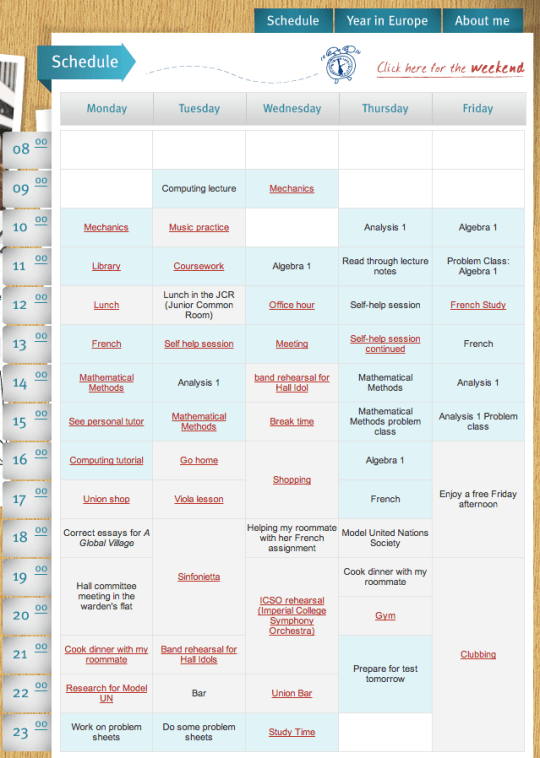
The overscheduled maths student

… at Imperial College.

Some say that young people today are overscheduled, but I didn’t realise how bad it had gotten until someone showed me the sample student timetable posted by the maths department at Imperial College. Some highlights:

  1. The student spends up to 6 hours on music practice on some days.
  2. Working on problem sheets starts only at 11 pm, and lasts for an hour, and only on Mondays and Tuesdays (and maybe Wednesdays, when “study time” is planned).
  3. Monday and Tuesday are also the only days on which lunch is planned.
  4. Two hours of “self-help” are planned on Thursdays, perhaps a therapy group to cope with the stress and lack of sleep.

On the weekend (schedule available here) she spends hours on French assignments, but again doesn’t get around to doing her problem sheets until 11 pm on Sunday night. Five straight hours of orchestra rehearsals, though.

student timetable