
Actors and financiers

The New Statesman has published an extended interview of Tony Blair by… the Welsh actor Michael Sheen. I found it a bizarre prospect. I know nothing about Sheen — I saw him in a film once — but I’m pretty sure if I wanted to hear Blair’s opinions, an actor would be one of the last interlocutors on my list. (A judge at the International Criminal Court in The Hague, on the other hand, would be right near the top.) What is it about actors, particularly film actors, that makes people want to rub up close to them and insert them into all kinds of roles for which they are in no way especially qualified or even interesting?
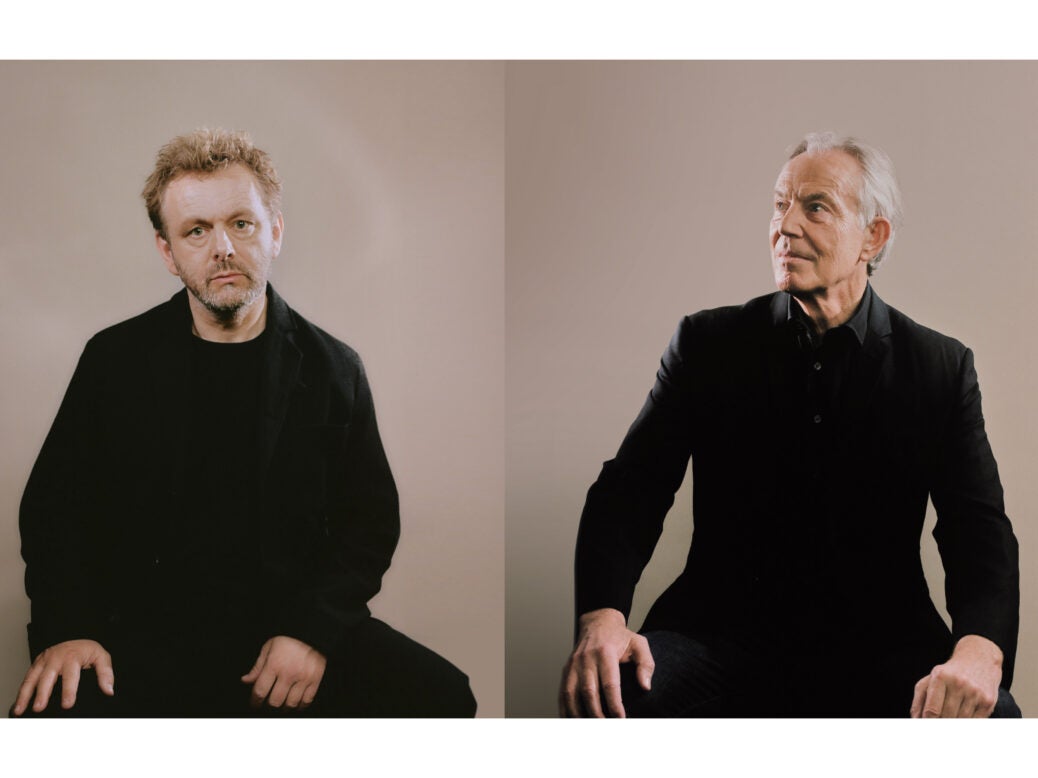
Michael Sheen and Tony Blair

My use of the word role there may suggest part of the reason: Even if actors are generally not especially intelligent, or insightful, or capable of repairing a leaky faucet, and their life experience is less relevant to the concerns of average people than pretty much anyone else’s — academics such as myself excepted — actors are used to playing the part of people who are intelligent or insightful or capable of fixing a leaky faucet, and perhaps they convey the superficial image of holding an intelligent conversation, even when they are utterly banal. (Just to be clear, I’m not saying that actors are unusually stupid: I have met some reasonably intelligent and interesting actors, and heard interviews with an occasional few who seemed genuinely fascinating. Only that their professional accomplishments give me no more expectation of their competence in any other area — or of them having anything interesting to say on any subject other than theatre and film — than members of any other profession or none.

It occurred to me, that there is an analogy to the perverse role of the finance industry. Money is sticky. That is, a significant fraction of the money running through the banks sticks to the people who handle it. It’s not at all obvious that the people who are responsible for investing and manipulating rich people’s money should themselves become rich. There is a German expression about the opposite expectation, “Pfarrers Kind und Müllers Vieh/ Gedeihen selten oder nie”: The preacher’s child and the miller’s livestock/ Will as good as never thrive. But we accept that there’s no way to prevent the people who are close to the money day in and day out from siphoning much of it into their own pockets. According to some estimates financial services in the US absorb a full 20% of all corporate income in the US.

Actors have a similar position in the attention economy. Attention is sticky. Their main job is to attract attention. And once they have the attention of a large public, the attention sticks to them, personally, even when they transition to activities that no sensible person would want to pay attention to.
The alternative to NATO

Apologists for Putin’s Ukraine atrocity point to NATO’s eastward expansion as the original sin that provoked Russian aggression. Proponents of Western innocence argue that this is a matter of autonomy of independent states whose need for the protection of the NATO alliance has been confirmed by Russian aggression not only against Ukraine, but also against Georgia and Moldova. Realism wouldn’t allow expansion to include former Soviet republics (except the Baltic states), they argue, but Western Europe had an obligation to go as far as it could to defend newly aspiring democracies.

In this telling, NATO has done as much as it could, taking on the burden of defending Poland, Hungary, etc. It explicitly decided not to make a commitment to Ukraine, and so has no moral obligation there — though it has gratuitously chosen to go beyond any obligation in assisting in the current crisis. But I’ve just been wondering… I haven’t heard any discussion of the alternative to NATO expansion. I don’t know what was realistic at the time, but I could imagine that following a rejection for inclusion in Western defense arrangements, the non-Russia former Warsaw Pact might have formed some kind of defensive alliance of their own, aimed at deterring Russian aggression, but sufficiently separate from NATO as to be recognised as a neutral buffer. These countries collectively have comparable population to Russia, and significantly higher GDP.

In this telling, NATO would bear significant responsibility for the current plight of Ukraine, not because it provoked Russia, but precisely because it couldn’t afford to provoke Russia too much. This led it to absorb Ukraine’s natural allies into an alliance that could never plausibly include Ukraine. It is then plausibly the fault of NATO expansion that Ukraine seemed to Putin a tempting target, defenceless and alone.

Riley in Odessa

While looking up something else in Uriel Weinreich’s Yiddish-English dictionary I came across the expression לעבן ווי גאָט אין אדעס — to live like God in Odessa — translated as “to live the life of Riley”.

I was familiar with the German expression Leben wie Gott in Frankreich — to live like God in France — with the same meaning, and I’d always assumed it was a reference to the large number of opulent houses that God has in France. But Odessa? It’s not a city I associate with cathedrals — though I’ve never been there. And would a Yiddish expression locate God’s dwelling in cathedrals? Is it originally a Russian expression? Presumably it’s connected to the German expression, but which came first? Maybe they both have nothing to do with cathedrals, but with a general opulence of lifestyle, in which God figures only as a kind of ironic hyperbole.

So many questions…

(Including about Riley. According to some sources the phrase goes back to a Sligo landowner Willy Reilly who found his way through to a contented and prosperous life after some ballad-worthy marital complications. There are no records of him ever having visited Odessa.)

“Unfair to other rich people”

The UK government is making a big show of considering, though they ultimately probably won’t follow through, scrapping the so-called “golden visa” programme, which allows wealthy people to bypass immigration constraints to move to the UK, in exchange for investing at least £2 million. This scheme is generally considered to have grossly abetted the growth of London as a world centre for money laundering.

Now, The Guardian reports, “London lawyers who help the global super-rich apply for “golden visas” to enter the UK have called on the government to reconsider its decision to abolish the Tier 1 investor visa scheme, warning that it would be “enormously damaging” to the economy.”

Kyra Motley, a partner at the law firm Boodle Hatfield, said the UK was jeopardising billions of pounds in overseas investment “because of a popular myth that foreign money is dirty money”…

Chetal Patel, a partner at law firm Bates Wells, said scrapping the investor visa because of increased tensions over Russia’s threat to Ukraine would be “unfair” to other rich people wishing to come to the UK.

“Since the introduction of golden visas in 2008, the UK has benefited from billions of pounds of investment. It would be enormously damaging to the UK economy if this was to be cut off.”

Weirdly, despite the fact that this is a purely economic argument the only people quoted are lawyers, not economists. I wonder whether The Guardian would be equally open to splashing on their home page claims by a group of economists that a new tax law would damage the integrity of the UK legal code? Particularly if those economists admitted — indeed, if their sole claim for expertise in this matter — was their personal pecuniary interest in having the law changed.

Honestly, is there any reason to think that the UK is suffering a shortage of foreign investment — as opposed to, say, a shortage of farm workers, which is well documented, and has been driven by intentional government action to exclude foreigners. And this despite the fact that — “popular myth” or no — the incidence of criminality among billionaires (domestic or foreign) is clearly higher than among farm workers.

Is science fiction the first draft of history?

I’ve just been reading a science fiction novel from 1998, Das Jesus-Video, by the German author Andreas Eschbach. It concerns a group of archaeologists in Israel who stumble upon what appear to be the remains of a time traveller from the near future who travelled back 2000 years with a video camera in order to film the crucifixion of Jesus. The dig is funded by an American mogul who is hoping that this discovery can be monetised to save his business empire, that has never been on sound financial footing. And in contemplating this he is obsessed with the example of another failed businessman from recent history:

Das mahnende Beispiel, das ihm immer vor Augen stand – so sehr, dass er sich allen Ernstes schon überlegt hatte, ein Bild des Mannes auf seinem Schreibtisch aufzustellen –, war das Schicksal eines längst vergessenen Immobilientycoons der achtziger Jahre, ein Mann namens Donald Trump, der jahrelang von den Medien als Wirtschaftswunderknabe und Erfolgsmensch hochgejubelt worden war, so lange, bis er es selber geglaubt hatte und leichtsinnig geworden war. Manche sagten später auch »größenwahnsinnig« dazu, und viele von denen, die das sagten, hatten zu denen gehört, die ihn beklatscht hatten, als er noch ganz oben zu stehen schien. Sein Sturz war schnell und grausam gewesen – Banken hatten ihre Kreditzusagen zurückgenommen, Investoren waren ausgestiegen, Projekte gescheitert – und er war sehr, sehr tief gefallen, war fast völlig von der Bildfläche verschwunden.

[The cautionary tale that always hovered before his eyes – so much so that he had seriously considered keeping a picture of the man on his desk – was the fate of a long forgotten property tycoon of the 1980s, a man called Donald Trump, who had been wildly celebrated in the media as a brilliant success and Enfant terrible of business for so many years that he came to believe it himself, and became reckless. Some even called him “megalomaniac”, even when these were some of the same people who had applauded when he seemed to be on top. His crash was abrupt and grisly – banks revoked his lines of credit, investors pulled their money, projects collapsed – and he had fallen very, very far, indeed had almost completely disappeared from the scene.

“Long forgotten” \_(ツ)_/

Booster — the final report

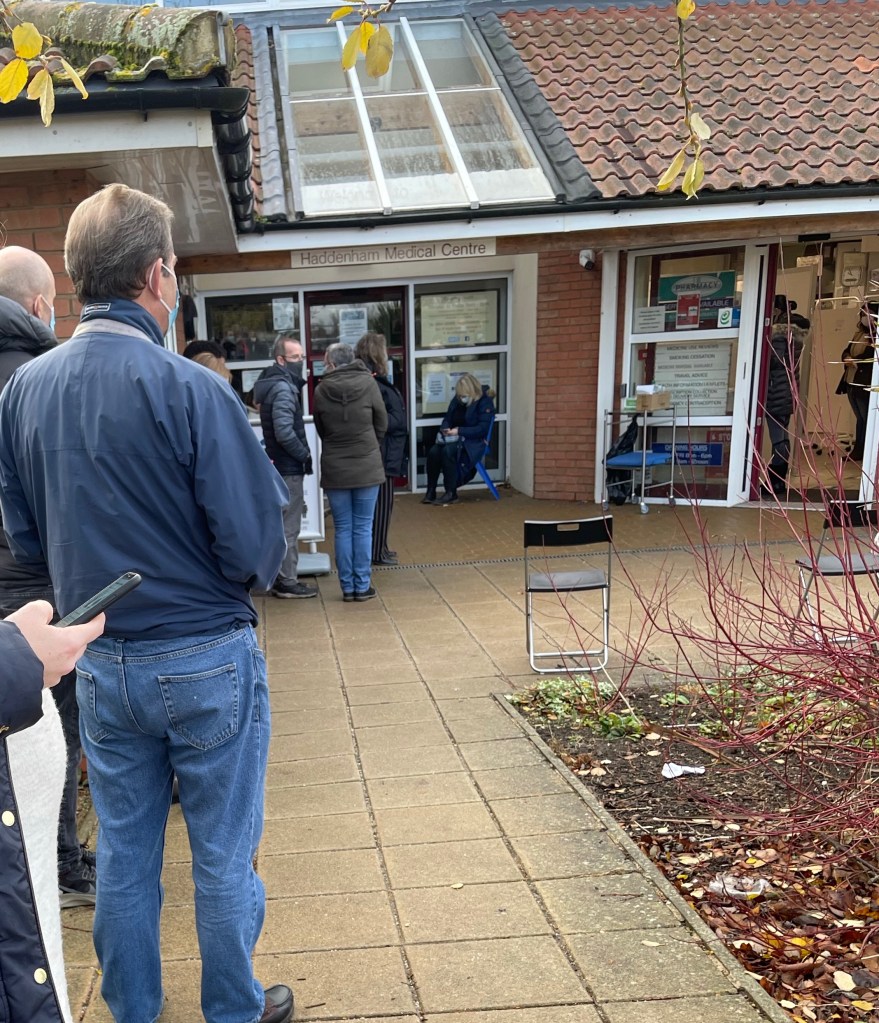
Another update of my Covid booster saga. After the only walk-in vaccination centre in Oxford decided to stop accepting walk-ins I looked about for other options. I was now eligible for a booster, but couldn’t sign up for an appointment, because only NHS-delivered vaccines count. I considered getting an appointment for a nominal first vaccine, but worried that that might just get me into trouble. I heard that the NHS had suddenly decided to start registering vaccinations performed abroad, and that would allow me to get a booster. (The website even suggested that you may be given a booster vaccine at the appointment, but you may not, and the appointment is really only to register your information.) But, bizarrely, the registration has to be done in person, and the nearest place is Reading, 25 miles away. So I could take the train, possibly get infected on the way, in order to get a booster.

Instead, I saw that there was a pharmacy offering drop-in vaccinations in Aylesbury, about 17 miles from Oxford, and connected by a reasonable route for cycling. And they were open Sunday. The weather was good, so I set out a bit after 8 on my bicycle, arriving around 9:45, shortly after they opened at 9:30.

“Do you have an appointment?”
“No. I’m here for a walk-in.”
Funny look.
“This is listed on the NHS website as a walk-in site.”
“It was, until yesterday, when we ran out of vaccine.”
“I just cycled two hours from Oxford.”
“If you want you can wait in that queue over there and try your luck.”
There were about a dozen people waiting already. I ended up being the last walk-in they let in, and I got the booster.

A student of mine waited 6 hours in the rain yesterday for a booster. I remember a German colleague commenting many years ago that he liked American university libraries because the librarians consider it their job to serve the readers with books. Unlike German librarians who consider it their job to protect the books from the readers.

The NHS — meaning, the larger dysfunctional system of the NHS and its many private subcontractors — seems to have a similar attitude toward vaccines. Better that ten should go unvaccinated than that one ineligible person should be vaccinated.

Self-deconstructing clichés: Polymeter edition

For earlier editions of this occasional series, see Weight-loss edition, Supreme Court edition, Europe edition, Bill of Rights edition, open door.

I remember very clearly when the figure of speech “the mother of all X” came into English. It was during the first Gulf War, and Saddam Hussein gave a speech threatening the US-led alliance with “the mother of all battles” should they have the temerity to attack. I recall how the phrase was so strange that an area expert spoke on television, explaining that this was the literal translation of a somewhat flowery Arabic expression, used to evoke an exceptionally strong superlative.

Because, the thing about mothers is that they are a) important, and b) unique. Which makes it surpassingly odd that Trump propagandist and still-congressman Devin Nunes some time ago, in the context of Trump’s first impeachment trial, referred to the allegations against the president as

“one of the mothers of all conspiracy theories” to imagine that “somehow the president of the United States would want a country he doesn’t even like … to start an investigation into Biden.”

To paraphrase an old saying, “a victory has a hundred fathers, but a conspiracy theory has a hundred mothers”, apparently.

No booster [update 10-12-2021]

The UK government is apparently desperately eager to get the whole population fully protected with three doses of Covid vaccine, to try and head off the mounting omicron wave. In a particularly awkward mixed pharmaceutical metaphor they promised to put the programme “on steroids”. But not so eager that they’re willing to resort to extreme measures like… just letting people get vaccinated.

The NHS website says people will be contacted for appointments six months after their second dose. But the government announced more than a week ago, following new advice from the Joint Committee on Vaccinations and Immunisations (JCVI), that “the booster will now be given no sooner than 3 months after the primary course.”

Having been initially vaccinated in Germany I can’t get on the list for an appointment anyway, so I decided to cycle down to Kassam Stadium, south of Oxford, the only nearby vaccination centre offering walk-in service. The fellow managing the queue was friendly and helpful, but told me that the current regulation — until they get new rules from the government — is actually a completely arbitrary seeming five months gap for people over 50 years of age (which I haven’t seen reported anywhere) — and six months for people over 40. (And no boosters for younger people.

So, no booster yet for me…

Update (8/12/2021): The NHS has now opened up boosters to people who had their second dose more than 3 months ago. Except, the bad people who had their first doses in foreign lands — including, if I understand correctly, Scotland — are still excluded.

[update 10-12-2021]: Yesterday mid-afternoon the official NHS website for vaccination information reported that anyone over 40 could get a booster at a walk-in site 3 months after their second dose. So I cycled down to Kassam Stadium again this morning. And again I was turned away. This time they agreed that I was eligible according to the NHS rules, but they have their own rules at this centre, and they’re not changing until Monday.

Not that it matters, because they also — my partner found this out when she went in the afternoon — decided spontaneously as of 2pm today to stop accepting walk-ins at all.

The de-wormer turns

Apparently, a conference in Florida to promote the use of anti-parasite treatment Ivermectin for Covid, turned into a super-spreader event.

“I have been on ivermectin for 16 months, my wife and I,” Dr Bruce Boros told the audience at the event held at the World Equestrian Center in Ocala, adding: “I have never felt healthier in my life.”

Boros is now reported to be gravely ill with Covid, and at least six other physicians who attended were also infected. It seems to me, if you don’t want people to dismiss your miracle treatment as “horse de-wormer”, you might choose to hold your national gathering somewhere that is not an equestrian center.

Conversion ratio

The attempted terrorist bombing of a Liverpool hospital a couple of days ago was apparently carried out by a Christian convert. As far as I can tell from reports in the press, Christian leaders — including the Pope and the Archbishop of Canterbury — have declined to condemn the attack, or engage in any soul-searching about violence in their communities. The bishop who confirmed the bombing suspect has professed to be “shocked and saddened” by the act, while denying having any specific recollection of the man, and dismissing any possibility of a connection between the conversion and the terror attack:

I know that he would have been thoroughly prepared with an understanding of the Christian faith. It seems that, sadly, despite this grounding, the bomber chose a different path for his life.

Where are the headlines about the “terror bishop”? Speculation about the Liverpool Cathedral terror cell?

In all earnestness, I doubt that this man was specifically motivated by Anglicanism to bomb a hospital, but at the same time, I come from a country (the US) where a significant fraction of terror attacks are committed by people adhering to Christian churches, and often claiming inspiration by their Christian faith. If the would-be terrorist has had been a Muslim convert would the press have devoted nearly so much space to the religious leader responsible for his conversion, lamenting that he had not taken the promised religious path? Instead, we get reports suggesting that there are many fake conversions, of Syrians hoping to strengthen their case for asylum.