
16th century rape culture

I was reading Montaigne’s essay “De l’inconstance de nos actions” (On the inconsistency of our actions). As a particularly piquant example of inconsistent behaviour Montaigne tells this tale:

Pendant les débauches de nostre pauvre estat, on me rapporta, qu’une fille de bien pres de là où j’estoy, s’estoit precipitée du haut d’une fenestre, pour éviter la force d’un belitre de soldat son hoste : elle ne s’estoit pas tuée à la cheute, et pour redoubler son entreprise, s’estoit voulu donner d’un cousteau par la gorge, mais on l’en avoit empeschée : toutefois apres s’y estre bien fort blessée, elle mesme confessoit que le soldat ne l’avoit encore pressée que de requestes, sollicitations, et presens, mais qu’elle avoit eu peur, qu’en fin il en vinst à la contrainte : et là dessus les parolles, la contenance, et ce sang tesmoing de sa vertu, à la vraye façon d’une autre Lucrece. Or j’ay sçeu à la verité, qu’avant et depuis ell’ avoit esté garse de non si difficile composition.

During the disorders of our poor country I heard of a young woman very close to where I was staying, who had thrown herself out a window to escape the advances of a piggish soldier who was quartered in her home. Not being killed by the fall, and to complete her task, she tried to cut her own throat with a knife, but was restrained, succeeding only in wounding herself grievously. She admitted that the soldier had imposed himself only by pleas, attentions, and presents, but said she feared he would force her by violence. We see here the words, the demeanour, and the blood all bearing witness to her virtue, a veritable modern-day Lucretia. And yet, I have it on good authority that before and after this event she was a slut who was by no means so difficult.

He goes on to warn his (male) readers not to take any evidence in one circumstance for proof of their mistress’s fidelity in general.

Here we see in pure form the mindset that still exists — perhaps is even still prevalent — and still even pokes out occasionally from judges in rape cases: Chastity is acceptable, even commendable, but it is the only plausible reason for a woman to refuse sex. Once she has given up the claim to refuse all sexual contact, to refuse any particular partner seems like pure tergiversation. Even if it looks like violence it’s not really, since to this way of thinking what looks like violence is really just helping her to overcome an atavistic need to make a public show of chastity. (One is reminded of American officials who claimed that they tortured Muslim prisoners to “help them” fulfill their need to make a show of resistance before they could square talking to the enemy with their religious obligation.)

One hears this often from feminists who lived through the sexual revolution of the 1960s and 1970s: While men experienced the relaxation of public sexual mores as a liberation, women had a much more ambivalent experience. The first step, eliminating the respect for chastity, was experienced by many as a loss of autonomy. Seen from the perspective of the 21st century it looks like a necessary step toward reclaiming women’s right to physical integrity and self-determination, but partly because eliminating hypocritical shield of chastity has forced men and women both to come to terms with what has now come to be called “rape culture”.

Electric guillotines

Just reading The Vanquished, Robert Gerwarth’s history of the violence that followed the ostensible end of the First World War. He has this to say about the atrocity rumours that circulated about the Bolsheviks:

Although the reality of the civil war was so terrible that it hardly needed any embellishment, fantastical stories about Lenin’s regime flourished and drifted westwards: of a social order turned upside down, of a never-ending cycle of atrocities and retribution amid moral collapse in what had previously been one of the Great Powers of Europe. Several American newspapers reported that the Bolsheviks had introduced an electrically operated guillotine in Petrograd designed to decapitate 500 prisoners an hour… The Bolsheviks, or so it was suggested [in the British press], had ‘nationalized middle- and upper-class women, who might now be raped at will by any member of the proletariat. Orthodox churches had been turned into brothels in which aristocratic women were forced to offer sexual services to ordinary workers. Chinese executioners had been recruited by the Bolsheviks for their knowledge of ancient oriental torture techniques, while inmates in the infamous Cheka prisons had their heads stuck into cages filled with hungry rats in order to extort information.

It seems that there are three things that escalate the ordinary horror of despotic violence into extraordinary horror, all of which are touched upon here:

  1. Violation of the natural order, particularly of a sexual nature.
  2. Upwelling of arcane, precivilised, non-European presumptively diabolic culture.
  3. Abuse of modern technological means toward barbaric ends.

I’m particularly fascinated by the last, represented by the “electrically operated guillotines”, which prefigure the genuine industrialised slaughter of the Holocaust. More than the scale of the killing — which could be achieved by other means — it is the industrial precision that unsettles people, and makes the Holocaust unique. Or, perhaps better said, makes us want to see it as unique.

It’s hard to disentangle these feelings about the Holocaust, which is what makes the electric guillotines so useful: It’s not that this would have been all that exceptional, to kill 500 prisoners in an hour, and you wouldn’t need anything as unusual as an electrically operated guillotine. (It’s not even clear to me how electricity would accelerate a guillotine significantly.) But the combination of electricity, then the prime symbol of modernisation, with mass execution, was shocking.

“The blood of our youth”

So, here’s racist US president Donald Trump, presenting his notorious racist new attorney general Jeff Sessions, with infamous genocidal racist president Andrew Jackson glowering in the background.


And Trump announced that he was directing the departments of Justice and Homeland Security to

break the back of the criminal cartels that have spread across our nation and are destroying the blood of our youth and other people.

This rhetoric doesn’t sound like usual presidential terminology, but it does sound familiar. What could it be? Maybe it reminds me of this:

Gift der Jüdischen Presse […] das ungehindert in den Blutlauf seines Volkes eindringen und wirken konnte

The poison of the Jewish press that penetrates without resistance and attacks the blood of the people

Or this

Er vergiftet das Blut des anderen, wahrt aber sein eigenes.

He [the Jew] poisons the blood of the others, but preserves his own.

From Mein Kampf.

Who tricked whom into eating potatoes?

Reading Richard Evans’s The Pursuit of Power: Europe 1815–1914, I discovered this anecdote about Ioannis Kapodistrias, appointed by Russia as governor of Greece in the late 1820s:

He introduced the potato into Greece, in an effort to improve people’s diet. At first, this met with deep skepticism among the peasantry, who refused to take up his offer of free distribution of seed potatoes to anyone who would plant them. Trying a new tactic, Kapodistrias had the potatoes piled up on the waterfront at Nafplio and surrounded by armed guards. This convinced local people and visitors from the countryside that these new vegetables were precious objects, and thus worth stealing. Before long, as the guards turned a blind eye, virtually all the potatoes had been taken — and their future in Greece was assured.

This reminded me of something I read many years ago, in Fernand Braudel’s The Identity of France:

In France, despite its early success, it was not until the mid-eighteenth century that the potato was regarded as truly ‘worthy’ to be eaten, with partisans prepared to defend it on both dietary and culinary grounds… In the géneralité of Limoges, potatoes were originally banned because they were thought to cause leprosy…

The corner was not really turned until the severe famine of 1769-70. The following year, the Academy of Besançon set an essay competition on the subject: “Suggest food plants which might be used in times of famine to supplement those usually eaten.’ All the essays mentioned the potato — notably the winning entry, which came from Parmentier. He then embarked upon a massive propaganda campaign, deploring ‘the mocking humour of our scornful citizens’. He published widely, gave advice on the growing and storing of the potato, organized gourmet dinners in his own home at which nothing but dishes made from potatoes were served…, brought to Paris all the varieties then cultivated in France and had even more shipped from America to give a better selection. He finally obtained from Louis XVI, in 1786, permission to set up an experimental plantation on about 20 hectares just outside Paris in Neuilly, on the untended and infertile soil of the plain of Sablons. It was a complete success. In his efforts to attract consumers, Parmentier concluded that the best method would be to entice people to steal his potatoes. So he ostentatiously had his plantation guarded by the maréchaussée, the local police — but only by day. Similarly, he advised landowners not to force potatoes on their peasants, but to plant one fine field full themselves and ‘expressly forbid anyone to enter’ — a more subtle approach than that of Frederick II of Prussia who sent in the troops to make the peasants plant potatoes.

Is it possible that Kapodistrias knew of Parmentier’s example? I guess so. Was this actually a well-known method for tricking the childish peasants into trying something new? Maybe. Or are these anecdotes, rather, merely recrudescences of a universal myth about how to trick the childish peasants? I’m not interested enough to track down the references…

Meeting our Waterloo

From the Guardian:

Jacob Rees-Mogg, the Conservative, says the 23 June last year will be remembered as a great day in history. It is comparable with Agincourt and Waterloo, he suggests.

I guess that’s how people talk about it in Britain, but it seems to me everywhere else “Waterloo” is synonymous with a crushing defeat. I imagine the Brexit vote will be the same: Considered a victory in Britain, recognised as a crushing defeat everywhere else.

16th century Sokal hoax

Many of our readers will recall the celebrated hoax perpetrated by mathematical physicist Alan Sokal in 1996 against the humanities journal Social Text. Sokal submitted an article “Transgressing the Boundaries: Towards a Transformative Hermeneutics of Quantum Gravity” for an issue on “Science Wars”. The article strung together buzzwords helter-skelter to conclude with a flattering claim of the importance of social theory for natural science. The fact that it was published is cited even today by supercilious physicists and insecure journalists as conclusive proof that academic jargon in the humanities and social sciences is all fake.

Anyway, I was just reading Montaigne’s essay “Du pedantisme” (On pedantry), and found the following anecdote:

J’ay veu chez moy un mien amy, par maniere de passetemps, ayant affaire à un de ceux-cy, contrefaire un jargon de Galimatias, propos sans suitte, tissu de pieces rapportées, sauf qu’il estoit souvent entrelardé de mots propres à leur dispute, amuser ainsi tout un jour ce sot à debattre, pensant tousjours respondre aux objections qu’on luy faisoit. Et si estoit homme de lettres et de reputation, et qui avoit une belle robbe.

I observed at my home a friend of mine making sport of one of these [pedants] by making up a nonsense jargon, propositions with no succession, a patchwork of pieces that had nothing in common except for some buzzwords  that he stuck in that related to their topic, and he amused himself a whole day with this crazy debate, always managing to think of new answers to the man’s objections. And this was a greatly reputed man of letters.

Land of the frei

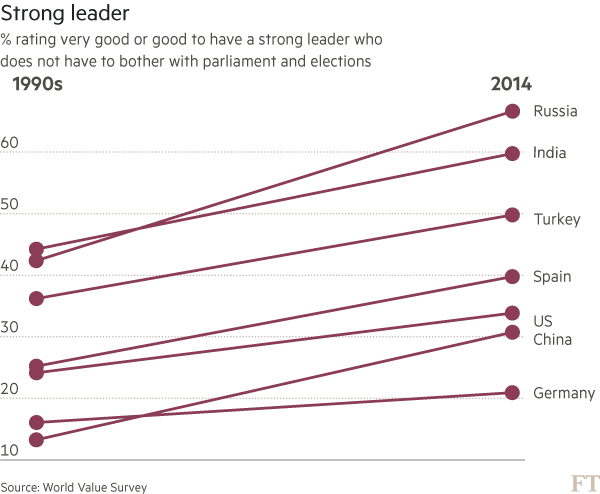
Trends in rejecting democracy

This plot from the Financial Times has been getting a lot of attention online. The data come from the World Values Survey (slightly incorrectly cited in the plot).

I don’t know what to make of it exactly, except to say that it supports my gut belief that Germany, more than any other country, understood after the Second World War, what it takes to cultivate a spirit of freedom and democracy. It was a long struggle, and they didn’t shy away from it. Education, the legal system, journalism: It’s the famous German thoroughness, applied to the problem of creating free citizens. The British, the Americans, and the French, each in their own way, considered democracy to be their inevitable birthright, and so have allowed relevant institutional arrangements and, even more importantly, the democratic spirit, to decay.

Maybe the Americans are just being more honest — in a Trumpian anti-PC way. Taboos are important. One important lessons that the Nazis understood was: Before you can commit unspeakable horrors, you need to find a way to make them speakable.

Good scandals

The US is just getting used to the idea of a president who will be running an international business marketing his name out of the Oval Office. Political journalists are fooling themselves in supposing that they’re going to have an easy time publicising scandals in the Trump administration. What’s a scandal, when the rulers are shameless? What could you find that would be worse than what has already come out during the campaign? And the mainstream will be pushing their carefully researched and reported evidence of malfeasance at the highest levels against social-network-distributed scandals on the other side, scandals about left-wing figures manufactured by Kremlin operatives or Macedonian teenagers. Of course, the made-up stories will be more piquant than the real ones. They are socially engineered to push every hot button, and so raise the public’s general shock threshold.

It seemed like a good time to repeat a post I wrote last year, about the importance for a healthy democracy to maintain its ability to be shocked: Continue reading “Good scandals”

Constraints

Maybe an opportune to repost something I wrote in June. Mitch McConnell had just remarked that Trump was no danger because “No matter how unusual a personality may be who gets elected to office, there are constraints in this country”. It reminded of the famous comment of Franz von Papen, leader of the Centre Party in the Weimar Republic, and the man who advised President Hindenburg to appoint Adolf Hitler as chancellor

Wir haben ihn uns engagiert. … Was wollen sie denn? Ich habe das Vertrauen Hindenburgs. In zwei Monaten haben wir Hitler in die Ecke gedrückt, dass es quietscht…

We hired him to work for us. … What’s the problem? I’m the one who has [President] Hindenburg’s confidence. In these two months we have completely backed Hitler into a corner.

He has such a wonderful way of connecting with the working class…

Being demographic

People have been saying for a long time that the Republican strategy of ethnic nationalism is running out of room, because of increasing proportions of ethnic minorities. I noted during the 2012 election how odd it was that some groups of people were considered to vote “demographically”, while others (white Protestant men) were assumed to vote on the basis of a broad array of concerns. According to the demographic fallacy, minority groups have special interests that are very important to them, but only of peripheral interest to the majority. Too much pandering can piss off the majority, but targeted appeals can motivate the minority, potentially to very high percentages, but there is no way to motivate the majority en bloc. After the 2012 election there were any number of comments of the sort “To win the presidency, Republicans need to make up their deficit among black and hispanic voters. They are losing them at such a level that (with changing povulation composition) a future Republican candidate would need to win the white vote at implausible levels to win a majority.” Now it appears that this argument is exactly wrong, for three reasons:

  1. As Trump correctly intuited, white people are also susceptible to ethnic appeals. And if you can motivate them as an ethnic group, they’re the biggest, baddest one of all. Meanwhile, the Democrats appeal to ethnic minorities was maxed out. The pervasive undercover racism of the Republican party gave Obama a huge edge among hispanics and blacks; naked racism, religious exclusion, and threats of deportation by Trump couldn’t move it any further, but could pull in vast numbers of white voters who share his racist world view and are relieved to hear it expressed openly. Those of us who move in educated circles should have taken more seriously the assertions early on that “Trump says what everyone really thinks”. Obviously, we didn’t know what people were thinking.
  2. Similarly for women. The model of what I called “demographic thinking” in politics is  I’m not the first to notice that women are not actually a minority. The power relations (yay intersectionality!) nonetheless seem to justify seeing the struggle for women’s rights as analogous to the struggle for rights of ethnic minorities.
    Feminists may have gotten suckered by a figure-ground second-sex fallacy with regard to women voters. If you think of males as the default, and women as the “minority”, then an openly misogynist candidate like Trump would seem to turn out the women to vote against him. But most of those women have been having to compromise with and make excuses for Trump-like figures in their lives — in their families — their whole lives. Some will recoil in horror, but most will continue to make excuses. And the women voters lost may be balanced by just as many men gained.
  3. It’s perfectly possible to maintain a semblance of democracy while entrenching the power of a minority to rule over the majority. Many countries have done this. With the single exception of 2004, the Republicans have not won a plurality in a presidential election since 1988. Democrats received a majority of the votes for representatives in 2012 and (probably) 2016. Nonetheless, the Republicans have attained unrestricted control over nearly the entire federal government, and very little stands in the way of further restricting voting rights to maintain their control and civil rights of minorities, expanding the political influence of the wealthy, to maintain their power indefinitely.

The electoral college was designed to leverage the 3/5 compromise to increase the power of southern slave-holding states in presidential election. Now, under very different circumstances, it is still serving this function.