
Social choice Brexit

The discussion over a possible second Brexit referendum has foundered on the shoals of complexity: If the public were only offered May’s deal or no deal, that wouldn’t be any kind of meaningful choice (and it’s absurd to imagine that a Parliament that wouldn’t approve May’s deal on its own would be willing to vote for the fate of Brexit to be decided by the public on those terms. So you’re left with needing an unconventional referendum with at least three options: No deal, May’s deal, No Brexit (plus possible additional alternatives, like, request more time to negotiate the Better Deal™).

A three-choice (or more) referendum strikes many people as crazy. There are reasonable concerns. Some members of the public will inevitably find it confusing, however it is formulated and adjudicated. And the impossibility of aggregating opinions consistent with basic principles of fairness, not even to say in a canonical way, is a foundational theorem of social-choice theory (due to Kenneth Arrow).

Suppose we followed the popular transferable vote procedure: People rank the options, and we look only at the first choices. Whichever option gets the smallest number of first-choice votes is dropped, and we proceed with the remaining options, until one option has a first-choice majority. The classic paradoxical situation is all too likely in this setting. Suppose the population consists of

  1. 25% hardened brexiteers. They prefer a no-deal Brexit, but the last thing they want is to be blamed for May’s deal, which leaves the UK taking orders from Brussels with no say in them. If they can’t have their clean break from Brussels, they’d rather go back to the status quo ante and moan about how their beautiful Brexit was betrayed.
  2. 35% principled democrats. They’re nervous about the consequences of Brexit, so they’d prefer May’s soft deal, whatever it’s problems. But if they can’t have that, they think the original referendum needs to be respected, so their second choice is no deal Brexit.
  3. 40% squishy europhiles. They want no Brexit, barring that they’d prefer the May deal. No-deal Brexit for them is the worst.

The result will be that no deal drops out, and we’re left with 65% favouring no Brexit. But if the PDs anticipated this, they could have ranked no deal first, producing a result that they would have preferred.

So, that seems like a problem with a three-choice referendum. But here’s a proposal that would be even worse: We combine choices 2 and 3 into a single choice, which we simply call “Leave”. Then those who wants to abandon the European project entirely will be voting for the same option as those who are concerned about the EU being dominated by moneyed interests, and they’ll jointly win the referendum and then have to fight among themselves after the fact, leaving them with the outcome — no-deal Brexit — that the smallest minority preferred.

Unfortunately, that’s the referendum we actually had.
Brexit deal still halfway concluded!

I cited this joke in the context of Brexit before:

A rabbi announces in synagogue, at the end of Yom Kippur, that he despairs at the burning need for wealth to be shared more equally. He will depart for the next year to travel through the world, speaking to all manner of people, ultimately to persuade the rich to share with the poor. On the following Yom Kippur he returns, takes his place at the head of the congregation without a word, and leads the service. At the end of the day congregants gather around him. “Rabbi, have you accomplished your goal? Will the rich now share with the poor?” And he says, “Halfway. The poor are willing to accept.”

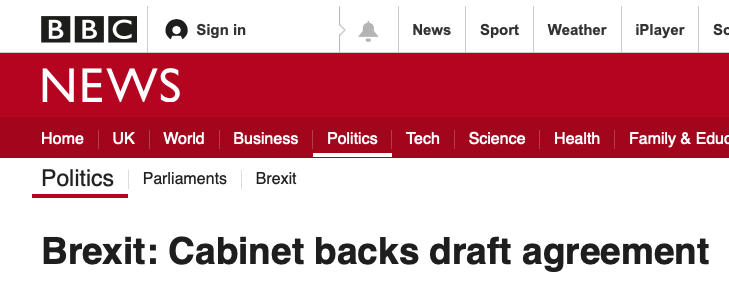
And it’s returned, because we again have these headlines:

Except the backing of the “cabinet” means the backing of those who didn’t resign because they wouldn’t back the agreement. Including the Northern Ireland Secretary (!) and the Brexit Secretary (!!) who was tasked with negotiating the thing. So, except for all the members most relevant to the deal (oh, yes, the Foreign Secretary already resigned over Brexit a few months ago), Theresa May has managed to get her handpicked cabinet to accept the negotiated agreement. All that remains is the other half of the task, which is to get it through Parliament, which only requires that she corral votes from her coalition partner, who see the backstop on Northern Ireland as a fundamental betrayal, and sufficient members of the opposition parties, because why wouldn’t they sign up to take responsibility for an agreement that everyone will blame for everything that goes wrong, even if nothing goes wrong, rather than forcing new elections?

How to do it Canada-style

A continuing series (previous entries here, here, and here) about the kind of table-thumping simple-minded blather that you sometimes hear about public policy. It depends on drawing out very superficial aspects of the problem, and waving away the core difficulties with some appeal to optimism or courage or something. With reference to a Monty Python sketch, I call this approach How to Do It (HTDI).

Chancellor of the Exchequer Phillip Hammond has described Boris Johnson’s policy-analysis process, which is pure HTDI:

When the pair discussed a ‘Canada’ style trade deal, ‘Boris sits there and at the end of it he says ‘yeah but, er, there must be a way, I mean, if you just, if you, erm, come on, we can do it Phil, we can do it. I know we can get there.’ ‘And that’s it!’ exclaimed the Chancellor, mimicking the Old Etonian.

Ambush!

The big story in all. the UK press is about the humiliation experienced by Theresa May –and by extension the entire British nation — from being ambushed by unanimous criticism of her “Chequers plan”.

Guardian on Salzburg "humiliation"

It’s unusual to have an ambush that has been so comprehensively announced in advance. Fortunately, to help unravel it we happen to have a transcript of the top secret radio communications that preceded this ambush:

UK: Maybot here. We’re coming through the Chequers Pass.

EU: Don’t come this way. We have a big force, 27 strong, blocking the way. We can’t let you pass through here.

UK: No, we have to go through here. If we turn back our own rearguard will shoot us.

EU: We don’t want to attack you, but the Chequers Pass leads into dangerous territory. We can’t let anyone through.

UK: Maybot, approaching Chequers Pass.

EU: There are multiple other passes. Please take one of them.

Warning shots are fired.

UK: Ambush! Treachery!

Onus: on us

When the onus is on some party in a negotiation, the point is to say which of several possible parties really needs to make a move. People have been pushing the onus back and forth in the Brexit negotiation:

EU Says Onus Is on U.K. for Brexit Progress

The onus is on Parliament now to protect our post-Brexit rights

Philip Hammond sees Brexit onus on Europe

But now Theresa May has announced at an EU summit that

the onus is now on all of us to get this deal done.

While I grant that her claim seems orthographically undeniable — onus = on us — I wonder what the prime minister could possibly be talking about. There literally are only two parties to the Brexit negotiation, the UK and the EU, so who else could the onus be on? Or is “us” her fellow heads of government in Salzburg, who have the responsibility to take the decision out of the hands of the bumbling bureaucrats of Brussels?

Written wordplay

Isaac Asimov, in a side-remark in his Treasury of Humor, mentioned a conversation in which a participant expressed outrage at a politician blathering about “American goals”. “His specialty is jails, not goals,” and then seeming to expect some laughter. It was only on reflection that Asimov realised that the speaker, who was British, had spelled it gaols in his mind.

I was reminded of this by this Guardian headline:

Labour has shifted focus from bingo to quinoa, say swing voters

The words bingo and quinoa look vaguely similar on the page, but they’re not pronounced anything alike. Unlike Asimov’s example, this wordplay is in writing, so spelling is important. My feeling is that wordplay has to be fundamentally sound-based, so this just doesn’t work for me. Maybe the Guardian editors believe in visual wordplay.

Alternatively, maybe they don’t know how quinoa is pronounced.

Squatting on the truth

Is the phrase diddly-squat obscene? I’m wondering because the word appears in Boris Johnson’s latest newspaper column:

the reality is that in this negotiation the EU has so far taken every important trick. The UK has agreed to hand over £40 billion of taxpayers’ money for two thirds of diddly squat.

It’s not that I find the word personally offensive — I’d rank it as low- to mid-grade obscenity — but surprising and out-of-place. Even for the desperate-for-attention Johnson this seemed like a surprisingly inappropriate word choice, simultaneously childish and scatological, rather like an eight-year-old trying to impress with his newly acquired potty vocabulary.

But maybe the word has different connotations in the UK than in the US — or maybe even within the US opinions differ. To my ear, the “squat” here is a more graphic substitution for “shit”, and “diddle” has the slang meaning of illicit groping or intercourse. The OED tells me that the original form — apparently American — was doodly-squat, with “doodle” a now rare slang term for excrement.

Anyway, I certainly hear the word as scatological, but I wonder how others perceive it.

Buy now! One-time exclusive Brexit offer!

Official Britain is all in a tizzy. They are going to get an exclusive Brexit deal from the EU! Different from what international hoi polloi gets!

The pound has managed to stay above the $1.30 mark, after comments from Michel Barnier boosted hopes that a Brexit deal will be struck.

The EU’s chief negotiator said “we are prepared to offer Britain a partnership such as there never has been with any other third country”.

Is Barnier a used-car salesman? Is he mocking the UK? It’s like he read pop sociology about the British, and realised, they don’t care what you offer them, as long as it’s exclusive. They’ll eat shit, as long as you tell them they’re getting special access to rare hand-selected microturds.

The sunny uplands of Brexit

Two years ago Brexit proponents were promising an easy negotiation, followed by ponies for all. Now this:

The government has demanded that companies and industry groups involved in Brexit planning sign non-disclosure agreements in an attempt to prevent alarming details leaking out.

I think it’s a characteristic of most really auspicious, well-considered government policies that everyone involved in the planning needs to be bound to secrecy to prevent panic. It’s a lot like a national surprise party. Really, nothing says “strong, stable leadership” like nondisclosure agreements to prevent alarming details leaking out. The Times article continues:

That explains why the plan to publicise no-deal preparations throughout the summer has been canned. The original plan was scrapped after a meeting last week chaired by Philip Rycroft, the senior mandarin in the Brexit department. A source said: “People will shit themselves and think they want a new referendum or an election or think the Tory party shouldn’t govern again.

Boris Johnson has an attack of the sads

Haunted Boris Johnson

Now that Theresa May has forced her cabinet to acknowledge a tiny portion of the reality of Brexit, Boris Johnson has apparently taken to moping around Whitehall to make certain that no one will think that he’s happy to now be conspiring with reality to betray his cause.

The best line is this:

Those close to the foreign secretary say that he feels he has been “bounced” into agreeing to a deal that is a world away from the hard Brexit he campaigned for. “He thinks that what’s on the table is so flawed we might even be better off staying in,” one said.

Continue reading “Boris Johnson has an attack of the sads”