The Guardian reports on UK government posturing to back out of its financial commitments to the EU, ahead of next week’s formal collapse start of the Brexit negotiations:
The EU scrutiny committee chairman, the Conservative MP Sir Bill Cash, urged the UK negotiators to point out during the talks that the UK wrote off half of Germany debts after the second world war, and as a result did not owe the Germans anything politically or legally.
Cash said the UK had been “net contributors for many decades” and the “massive contributions” paid to Brussels would offset any divorce fee demanded by officials. He urged the government to remind Europe’s leaders of the 1953 London debt agreement, “where Germany, for all its malfeasance during the second world war” and unprovoked aggression, had half its debt cancelled.
Cash said that given Germany’s dominant role in the EU, it might be worth “tactfully” reminding people “that there is a realistic position here that we really don’t owe anything to the EU, whether it’s legal or political”.
Well, that already sounds pretty tactful to me, backing out on financial commitments to all of Europe because of Germany’s “malfeasance” in the first half of the 20th century. It’s funny that the British didn’t mention how strongly they felt about this back when they were applying for membership in the EU. You would have thought their memories would have been fresher.
The news from Westminster and Holyrood inspires me to adapt a cartoon that I recall from a German newspaper from the days shortly after the opening of the Berlin wall:
Theresa May: We are one nation!
Nicola Sturgeon: We are too!
Maybe this doesn’t completely work in translation. In the original, of course, it was the East German demonstrators who really did shout “Wir sind ein Volk!”, and then the West Germans reply, “Wir auch!” That plays on the ambiguity in the German: “ein Volk” can mean “one people” or “one nation” or “a nation”.
Apparently the government is preparing to trigger Article 50 next week. Having trounced the House of Lords, the EU negotiatiors will be a cakewalk.
Commons: Give us the precious!
Lords: It is too much power. You must consent to some minor restrictions.
Commons: Give us the precious!
Lords: Okay.
Why do the Lords even bother to go on existing?
One of the more bizarre claims made by the government was to explain its opposition to the House of Lords amendment that mandates a final vote in Parliament on the Brexit deal in two years.
Downing Street has warned Lords that an attempt to give Parliament the final say over Brexit will “incentivise” the EU to give Britain a bad deal.
The Prime Minister’s spokesman argued that guaranteeing Parliament the power to reject Theresa May’s deal would “give strength” to EU negotiators during talks.
What is bizarre is that the usual argument is exactly the opposite: The negotiators are strengthened by being able to argue that their hands are tied by needing to convince skeptical legislators back home. Don’t bother offering us a crappy deal, because even if you dazzle us, it will never get through Parliament.
I understand the difference here — the EU doesn’t actually have much motivation to make any deal at all, and would be happy to have it rejected — but that just underlines how fatally weak the British position is. Supposing the EU negotiators would offer a deal that they are sure Parliament would reject. There are two possibilities:
1) The government would reject it too. In that case, it would never go to Parliament anyway, so Parliament’s right to a final vote is moot.
2) The government would accept it. In that case, what would motivate them to offer a better deal?
My prediction for quite a while has been that the xenophobia is going to heat up here pretty soon, when the UK activates Article 50 and is immediately confronted with immovable demands of the EU that do not comport with the due status of the Snowflake Kingdom — particularly the expected €60bn bill for outstanding financial obligations — and the negotiations stall. The tabloids will go nuclear, and turn their wrath on the European foreigners who are still enjoying her majesty’s hospitality.
But now Britain has just discovered a trick long known to deadbeats everywhere for escaping financial obligations: You flee the country, and so evade the jurisdiction of the courts. Such a simple idea, they wonder why they didn’t think of it sooner:
The EU cannot enforce a penny of a possible €60bn divorce bill if Britain crashes out of the bloc without an agreement, according to a report by a Lords committee…
“We conclude that if agreement is not reached, all EU law — including provisions concerning ongoing financial contributions . . . will cease to apply and the UK would be subject to no enforceable obligation to make any financial contribution at all.”
As part of the scheme, Great Britain will move to the Caribbean in the middle of the night, leaving no forwarding address. Seriously, is this intended to frighten the Europeans into offering better terms? It seems more likely to convince them that there is no use to making any reasonable offer to a UK that can’t be counted on to honour the spirit of any agreement, or even basic norms of decent behaviour. (Recall that before there was Brexit there was Grexit, threatened by the failure of Greece to meet its international financial obligations.)
If there is anybody in the European Union who thinks that if we don’t do a deal with the European Union, if we don’t continue to work closely together, Britain will simply slink off as a wounded animal, that is not going to happen.
I can reassure the chancellor that no one else in Europe thinks of Britain with such bathos. In any case,
British people have a great fighting spirit and we will fight back. We will forge new trade deals around the world. We will build our business globally. We will go on from strength to strength and we will do whatever we need to do to make the British economy competitive and to make sure that this country has a great and successful future.
Apparently they’re going to threaten to cut off exports to the continent of tough platitudes, which seems to be the only industry in which this country is still world-leading. (Though if France asserts appellation d’origine controlée to restrict use of the cliché, it could doom the whole British diplomatic effort.)
The government’s negotiating posture reminds me of the famous scene in the film The Usual Suspects, where the gangster Kaiser Sose is confronted with opponents who have taken his family hostage, and he responds by shooting them himself, just to prove that he can’t be pressured.
If I were a philosophy student with a looming deadline for an essay on casuistry, I know I’d turn to BuyEssay for expert help. The Guardian has reported on government moves to crack down on essay mills, that sell individually crafted essays for students who need “extra help” –anything from a 2-page essay to a PhD dissertation (for just £6750!) The article reprints some of the advertising text that these websites offer to soothe tender consciences.
“Is Buying Essays Online Cheating?” it asks, in bold type. You’d think this would be an easy question, hardly something you could spin a 300-word essay out of. But they start with a counterintuitive answer: “We can assure you it is NOT cheating”. The core of the argument is this:
What is essential when you are in college or university is to focus on scoring high grades and to get ready for your career ahead. In the long run, your success will be all that matters. Trivial things like ordering an essay will seem too distant to even be considered cheating.
Given that high grades are so essential, it seems almost perverse that universities make it so difficult to obtain them. Why do they put all these essays and other hurdles in the way — “unreasonable demands from unrelenting tutors in expecting extensive research in a short time”, as the essay puts it? It’s shitty customer service, that’s what it is.
The only critique I might make is that the essay is a bit generic. I’d worry that when I submitted it for the assignment “Is Buying Essays Online Cheating”, that the marker might notice that someone else bought almost the same essay for the assignment “Is Murder Wrong?” In the long run, your success will be all that matters. Wasn’t this the plot of Woody Allen’s Crimes and Misdemeanors?
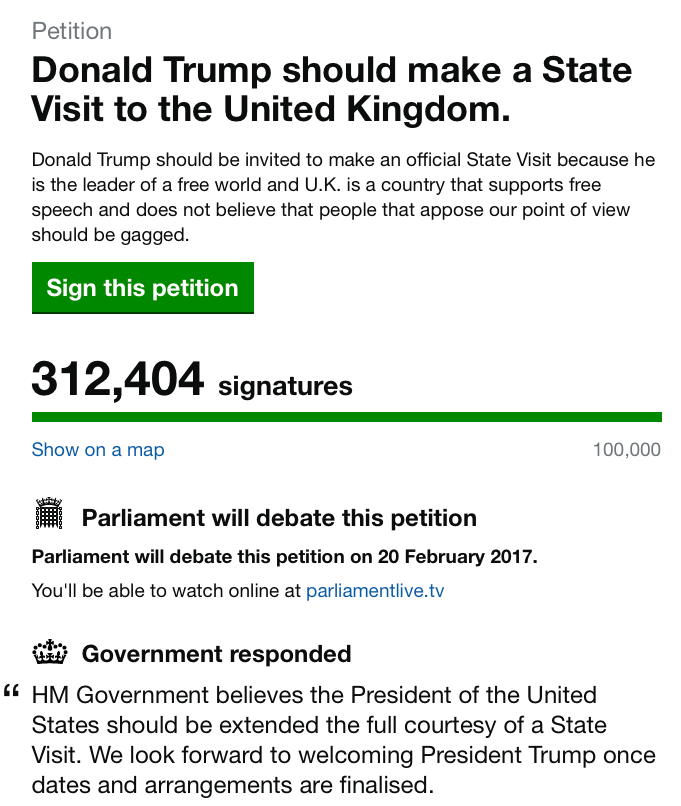
The House of Commons is now debating two petitions that both received more than the required 100,000 signatures to force a debate in parliament. One opposing a Donald Trump state visit (1.8 million signatures) and one supporting it (312 thousand). I couldn’t believe that the text given in favour of Trump’s visit in the newspaper so I checked on the official government website. The text was accurate. It’s just one (admittedly convoluted) sentence! Couldn’t they find someone to proofread it? Or was the text actually written by anti-Trump trolls eager to make the Trumpistas look like illiterate dunces?
(I’m not sure whether “leader of a free world” counts as an error… Of course, “leader of the free world” is the traditional phrase. But maybe they want to leave open exactly which “free world” he is leading.)
The Guardian reports on a new research study that finds the overstretching of the NHS — particularly in the winter — has caused about 30,000 excess deaths in 2015. The government’s response is practically Trumpian:
A DH spokesman described the study as “a triumph of personal bias over research”. He added: “Every year there is significant variation in reported excess deaths, and in the year following this study they fell by nearly 20,000, undermining any link between pressure on the NHS and the number of deaths. Moreover, to blame an increase in a single year on ‘cuts’ to the NHS budget is arithmetically impossible given that budget rose by almost £15bn between 2009-10 and 2014-15.”
Jacob Rees-Mogg, the Conservative, says the 23 June last year will be remembered as a great day in history. It is comparable with Agincourt and Waterloo, he suggests.
I guess that’s how people talk about it in Britain, but it seems to me everywhere else “Waterloo” is synonymous with a crushing defeat. I imagine the Brexit vote will be the same: Considered a victory in Britain, recognised as a crushing defeat everywhere else.
So now we know what was going on while Theresa May was off on her autocrat-ass-kissing tour, and refusing to join the civilised world in condemning the racist US immigration policy: Boris Johnson was negotiating a shameful special exemption for UK citizens. I think this is what they like to call “punching above our weight”.
Slopes and stairs, contradiction, and protests, according to one article in today’s Sunday Times, about government concerns related to the planned visit in June for the official handover of British sovereignty:
Members of Trump’s inner circle have warned officials and ministers that it would be counterproductive for Charles to ‘lecture’ Trump on green issues and that he will ‘erupt’ if pushed. They want the younger princes, William and Harry, to greet the president instead. Royal aides insist that he should meet Trump.
Senior government officials now believe Charles is one of the most serious ‘risk factors’ for the visit.
Trump’s team is also concerned that he will face a wave of protests, with thousands of people taking to the streets to denounce him…
Downing Street officials claimed the president’s phobia of stairs and slopes led him to grab the prime minister’s hand as they walked down a ramp at the White House.
UPDATE (30/1/2017): I was mentioning this story to someone recently, pointing out that “phobia” is clearly a really bad euphemism for “too old and weak”, which the strongman obviously could not admit to. He replied, “Apparently it IS a phobia – he also has a phobia of slopes, apparently.” I asked what the source was. It came from one of May’s aides, he said. And how would they know? People really have to stop defaulting to the assumption that claims coming from Trump’s circle is more likely to be true than false. On the contrary, information from anyone that has been near Trump is likely tainted.

 Common Infirmities