
Tender-hearted racists

The only place I run into Americans here is in the synagogue. There is one loud-and-proud right-winger who gets treated to a lot of good-humoured deference. This past Sunday, naturally, he was feeling his oats. I mostly stay out of these political discussions, but after listening to him go on and on about the “elitists” in their “bubbles” who had failed to appreciate the world-historical significance of Donald Trump, I remarked that these were very large bubbles that contained more than half of the US population. He suddenly switched gears and accused me of accusing all Trump voters of being racists, a remarkable feat of projection, given that no one up to this point had mentioned race. No, I said, I’m sure some of their best friends are black.

But I was thinking of this when I recently read this passage in John Ferling’s Jefferson and Hamilton: The rivalry that forged a nation. (Overall, a pretty interesting book, if not especially elegantly or engagingly written) about Hamilton’s attacks on Jefferson in the context of the election of 1796:

Hamilton raised questions about Jefferson and race. He drew on passages from Notes on the State of Virginia to demonstrate Jefferson’s racism.

The context is a society that accepts enslavement of African-Americans, Jefferson owned dozens of slaves, yet evidence of “racism” was seen as a black mark on his character. And Hamilton needed to delve into Jefferson’s writings to find “evidence” that the slave-owner Jefferson was racist. For that matter, Hamilton himself had owned slaves in the past, and probably did even as he was polemicising against Jefferson’s racism.

Anti-racism is self-limiting. As soon as we accept that racism is a terrible thing, there is a natural tendency to absolve pretty much anyone with a name and a face of this evil. Racism exists in the past, or on the fringes of society. People like Trump are just clumsily saying some racist things or appealing to non-PC white voters. (And if he’ll just stop saying racist things for a week or two, problem solved!) Similarly, the NY Times has just today seemed to express sympathy for famous racist and likely Trump cabinet pick, Alabama senator Jeff Sessions:
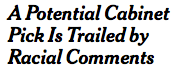
screenshot-2016-11-17-12-01-28

The poor guy is being trailed by those nasty racial comments. Maybe he can get a restraining order against them!

If you’re not actually burning crosses you’re not a real racist, just as anyone who isn’t Hitler can’t really be an antisemite. (And anyone who recalls the fake-Hitler-diary furore may also recall the breathless coverage that noted the absence of any reference to the holocaust, eager to absolve the Führer of the worst crimes.)

I think often of this exchange from the second presidential debate in 2000:

GORE: …The governor opposed a measure put forward by Democrats in the legislature to expand the number of children that would be covered. And instead directed the money toward a tax cut, a significant part of which went to wealthy interests. He declared the need for a new tax cut for the oil companies in Texas an emergency need, and so the money was taken away from the CHIP program… I believe there are 1.4 million children in Texas who do not have health insurance. 600,000 of whom, and maybe some of those have since gotten it, but as of a year ago 600,000 of them were actually eligible for it but they couldn’t sign up for it because of the barriers that they had set up.

MODERATOR: Let’s let the governor respond to that. Are those numbers correct? Are his charges correct?

BUSH: If he’s trying to allege that I’m a hard-hearted person and I don’t care about children, he’s absolutely wrong.

The words don’t adequately communicate the smarmy expression of offence that Bush displayed. Gore accused him of taking insurance away from 600,000 children. Bush didn’t respond or explain, but simply contended that to mention this fact was to insult him, to call him a “hard-hearted person”.

Advance warning

One of the things that seems to have gotten anti-Clinton forces into the highest dudgeon is the report that one or more questions at a Democratic primary debate were leaked to the Clinton camp. My very own right-wing troll — the only one I’ve had on this generally uncommented-upon blog — expresses (in response to this post) this sentiment to support his contention that polls are all made up.

This was commented upon in tones of offended sense of fairness by Donald “System-is-Rigged” Trump, whose grave concern for Bernie Sanders’s treatment by the Democratic establishment surely presages a cooperative working relationship between the two of them.

Which makes this passage particularly interesting from the NY Times review of Megyn Kelly’s new book:

The day before the first presidential debate, Mr. Trump was in a lather again, Ms. Kelly writes. He called Fox executives, saying he’d heard that her first question “was a very pointed question directed at him.” This disconcerted her, because it was true: It was about his history of using disparaging language about women.

Tempering our expectations

Following up on my comment about feeling like I’ve stumbled into a dystopian timebreak, I just got a missive from the alternate timeline that we should have been in. It’s an article by Jeff Stein and Sarah Frostenson on Vox, published at 8:47pm on the night of the election. He is reporting that the early results show that the Democrats will almost certainly fail to attain a majority in the House of Representatives, and commenting on the consequences:

The Republican Party will keep control of the House of Representatives, extinguishing Democrats’ hopes of a new progressive era in Washington.

Failing to retake the House is a sign that liberals will have to somewhat temper their expectations after Election Day. With both branches of Congress and the White House, Democrats could have passed a cap-and-trade bill to combat climate change. They may have tried thrusting through immigration reform. There could have been a real chance at implementing a nationwide paid family leave program or universal pre-K. Perhaps there were enough congressional Democrats to dramatically raise the minimum wage, or pass campaign finance reform, or tackle any of the rest of the party’s key agenda items.

All of that is now probably off the table. At the very least, the odds of any of those things happening are massively diminished.

Still tempering…

Likely probabilities

The BBC comments on Trump’s latest outrage:

The day after a video tape emerged in which he suggested he could have any woman he wants because he’s a star and so could just “grab them by the pussy”, Mr Trump is in a whole ocean of hot political water.

Enough, quite possibly, to sink any chance he had of winning the White House.

What does it mean to have “quite possibly” no chance? How does it differ from having quite likely a small chance? Or definitely a modest chance?

I suppose this could be describing a combination of an unknown state of facts that determine the probabilities for a random outcome. Imagine a bag of red and blue marbles, from which the election will be determined by picking a random one. (Red for Trump.) She is saying, “Quite possibly there are no red marbles left in the bag.” I’m don’t think that’s a good description of the situation, though. To the extent that Trump has a better chance of winning than you might think by looking at the polls or the near universal opprobrium he is exposed to, it doesn’t seem to me it’s on the basis of facts that are already determined but unknown.

Expectations

Commenting on tonight’s Republican presidential debate, RNC chair Reince Priebus

declined to go into the “details” on Trump’s preparation, but emphasized that Clinton would be held to higher standards because she’s spent over 30 years in the political sphere.

Is that how it works? Do people show up for a job interview and say, “I realise I wasn’t as good as the other candidate in the interview, but I really think you should hire me, because I have a lot less experience in this field”?

Pollster infallibility

I was reading this article by John Cassidy of the New Yorker about the current state of the US presidential election campaign, according to the polls, and was surprised by this sentence:

Of course, polls aren’t infallible—we relearned that lesson in the recent Brexit referendum.

It hardly requires any major evidence to argue against the straw man that the polls are infallible, but I didn’t recall any notable poll failure related to Brexit; on the contrary, I was following this pretty closely, and it seemed that political commentators were desperately trying to discount the polls in the weeks leading up to the referendum, arguing that the public would ultimately break for the status quo, no matter what they were telling the pollsters. I looked it up on Wikipedia:

UK referendum polls

So it looks like the consensus of the polls was that Leave and Remain were about equal, with a short-term trend toward leave, and about 10% still undecided. Hardly a major case against the polls being infallible when Leave won by a few percent…

Health choices

From the Guardian:

In February Prof Dame Sally Davies, the chief medical officer for England,… told a parliamentary hearing: “Do as I do when I reach for my glass of wine. Think: do I want the glass of wine or do I want to raise my own risk of breast cancer? I take a decision each time I have a glass.”

Umm… Wine or cancer? Are those really the options? Seems like an easy choice to make…

The rot goes deep

There’s a certain kind of insane genius to the Donald Trump performance. So we have this interview, where Trump was asked by a right-wing journalist,

There are still some black Americans who believe that the system is biased against them… What do you say to them?

He answered

Well, I’ve been saying, even against me the system is rigged. When I ran for president, I could see what is going on with the system, and the system is rigged… I can really relate it very much to myself.

Has our democracy really sunk so far, that even white billionaires can’t get a fair shake anymore?


Political typecasting

It is a well-known phenomenon, that some well-known actors find themselves too prominently identified as themselves to be appreciated as the character they are playing. So it is, I think, with Boris Johnson in his new role as foreign secretary. The BBC and other news outlets ran headlines yesterday saying

Boris Johnson to meet with EU counterparts.

For an instant I was genuinely puzzled. You’re supposed to understand this as

UK foreign secretary to meet with foreign ministers of other EU countries.

But I could only read it as “Boris Johnson is to meet with pompous upper-class clowns who are somehow similar to him in other EU countries”, which somewhat stymied me in trying to think of an example.

Taking the lead

The BBC has a surprising headline:

Screenshot 2016-04-15 11.30.25

Leading financial institutions welcomed a crackdown on tax dodging? That’s a surprise. Which institutions are these? Goldman Sachs? Deutsche Bank? Maybe UBS? Well, no. What they mean are International Financial Institutions (capitalised), which is a different thing from financial institutions (such as banks) that happen to act internationally and have the world economy by the throat. Government institutions. Somewhat less surprising.

Even the reference to “financial institutions” (plural) is misleading, since the only institution that is mentioned by name in the article is the IMF. Maybe the World Bank requested anonymity.