
The Emancipation Haggadah

A couple of years ago, in anticipation of the 150th anniversary of the Emancipation Proclamation, and because I was blown away by reading a couple of Frederick Douglass’s autobiographies, I had the inspiration to try to integrate the American slave experience with the traditional haggadah. In particular, I put in lots of quotes from Douglass about the nature of slavery and freedom — the amazing physicality and emotional presence — to supplement the traditional text of “hard labour, clay and bricks, and all the work of the fields”. I’ve always thought the main purpose of the seder is to remind children (and adults) to think again about the difference between freedom and slavery, and for that we need text that makes it fresh and real. Douglass does that.

I combined this with other favourite passages and the portions of the traditional haggadah that I like to include in my seders. Of course, for those of us who are not keen on stories of wandering Arameans and such, it’s very convenient to have your own haggadah with your own selection of material, to spare the annoyance of announcing page numbers.

The result is here, for anyone who wants to have a look.
Vice and virtue

From a NY Times article on the crazy low success rates of applicants to prestigious (and even not-so-prestigious) US universities:

Bruce Poch, a former admissions dean at Pomona College in Claremont, Calif., said he saw “the opposite of a virtuous cycle at work” in admissions.

The “opposite of a virtuous cycle”. There ought to be a name for that. Maybe, I don’t know, a “vicious cycle”?

(“Virtuous circle” is obviously a back-formation from “vicious circle”. It reminds me of the phrase “random act of kindness”, which seems to have almost superseded the “random act of violence” that it is obviously modelled on. Not that that’s a bad thing…)

Quoting clichés

There’s an interesting article in the NY Times on hackers’ use of remotely controlled devices like thermostats and vending machines to penetrate otherwise well-secured corporate networks. The subject matter is interesting, but I was also interested in the way experts were quoted. In particular, one network security expert

 compared the process of finding the source of a breach to “finding a needle in a haystack.”

I’m sure she really did use those words, but it seems peculiar to be putting a standard phrase like that in quotation marks, which are usually reserved for individual turns of phrase, or for emphasising the particular choice of words. In particular, it’s strange that only the cliché was quoted. It’s as though a national security reporter wrote “An administration source said the decision would have to be made by “the president”. Another source agreed that the decision would be made by “Barack Obama”.” Or “the engineer in charge of developing the product reduced the size of the design team, arguing that “too many cooks spoil the broth”.”

The political opinions of corporations

I’ve been intrigued by the forced resignation of Brendan Eich as CEO of Mozilla Corporation, on account of his donation of $1000 to the 2008 campaign to amend the California constitution to ban same-sex marriage. Some fascinating issues it brings up:
1. I’d forgotten that the last great political battle over same-sex marriage was fought in California. And the conservatives won it. How fascinating to be reminded that barely five years ago it was still possible to muster a majority for banning same-sex marriage in California of all places, and in the same year that Barack Obama was elected (also promising to oppose same-sex marriage). And after that Pyrrhic victory the conservatives basically fled the field, overwhelmed by an almost inexplicable tide of social change. Continue reading “The political opinions of corporations”

Killing the braces in order (technical)

I just noticed a funny tic that I have in programming (or writing LaTeX, which is sort of similar): When I remove brackets, I always look to remove the matched pair, even when they’re functionally equivalent, and even when it costs extra effort. For example, I have a text in LaTeX that goes something like

$\frac{1}{e^{x}}$.

I decide to change it to $e^{-x}$. So I remove the \frac{1}, and then the open brace, leaving me with $e^{-x}}$, and my cursor is right at the x. The simplest thing (measured in keystrokes) would be to shift over and remove the brace directly following the x. But there is mental resistance to removing the “wrong” brace, which I resolve by making the extra keystroke and removing the final brace. Not a big deal, but it occurs to me that there’s probably interesting work to be done (or already being done) in the psychology of programming, and the conflicts between the logical deep structure that programmers need to work with, and the surface structure that is all the computer gets to work with.

Why are the one percent only 1%?

Have the years of unremitting oppression cut short their lifespans and suppressed their fertility? Is it because they’ve been hunted nearly to extinction?

These are questions that naturally come to mind in reading the novel genre, pioneered by the Wall Street Journal editorial page, of billionaire lamentations, the most recent of which is this cri de coeur of trust fund Croesus and libertarian political manipulator Charles Koch, with the title “I’m Fighting to Restore a Free Society”. He accuses his opponents, the nameless beasts called “Collectivists”, of acting like “20th century despots” by engaging in “character assassination”, which, as we all know, is exactly the sort of thing that 20th century despots were famous for, except for the “character” part. But character assassination is almost exactly the same as assassination, except without the bombs and stuff, and except for the fact that it’s sometimes hard to distinguish from “criticism”, which people might think a natural part of a “Free Society”. But, in case you’re not sure of how perfidious are these Collectivists who “discredit and intimidate”, Koch informs us that this approach is one that “Arthur Schopenhauer described in the 19th century”, which pretty much settles the issue, as far as I’m concerned.

Sure, it seems natural to look at the increasing concentration of wealth in the US (and not just in the US) and see a tiny oligarchy enriching itself at the expense of the rest of us. But you could look at the same numbers and see an oppressed and shrinking minority of wealth producers, slowly evaporating like a brackish pool in the sun, with its salt (wealth) concentration rising as it shrinks.

Where some of us see an opulent gated community, the reality (Charles Koch tells us) is just a gilded concentration camp. Where his character gets assassinated EVERY DAY. (True story.)

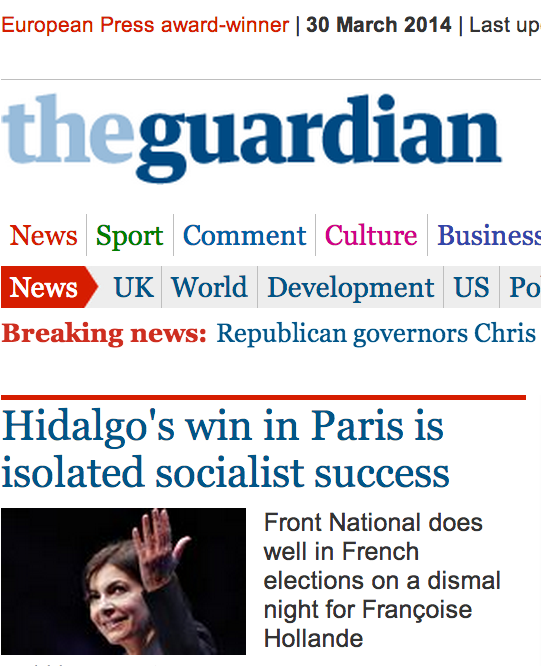
The Guardian got tired of waiting for France to elect a woman president

… so they decided to change the sex of the current one.

Guardian headline mentioning "Françoise Hollande"
Presumably Françoise is the one in the photo

I’m guessing that European Press Award they mention wasn’t for the excellence of their copyediting. I wonder if there’s some subliminally intentional slur in the way the Guardian made the French president a woman, while the NY Times made the German chancellor a man.

Four ways of paying the piper

I was thinking about four different expressions, interestingly different, for the platitude that people shape their consciences to their circumstances.

The most straightforward is the English classic

Who pays the piper calls the tune.

This is the most straightforwardly economical. The boss makes the decisions, and the opinions of the underlings are irrelevant. It says nothing about what those underling opinions might be.

A step more cynical is the old-German proverb

Wes Brot ich ess, des Lied ich Sing. [Whose bread I eat, that’s whose song I sing.]

It has the same general musical theme, suggesting the court jester performing for his master. But the singing, rather than piping, is more intimate, and to my mind suggests a more complete subordination of ones own beliefs to those of the master.

Perhaps the most pessimistic is the saying that Mark Twain claims to have learned as a boy, from a young slave:

You tell me whar a man gits his corn pone, en I’ll tell you what his ‘pinions is.

In other words, as Twain explains, no one can afford to have opinions that interfere with his livelihood. It’s not a matter of dissembling — which is what makes this more pessimistic (but maybe less cynical?) — but rather of naturally adopting the opinions that are a comfortable fit to his circumstances. (Twain’s more cynical version was “It is by the fortune of God that, in this country, we have three benefits: freedom of speech, freedom of thought, and the wisdom never to use either.”)

And then there was the perfection of the corn pone line, the famous dictum of Upton Sinclair,

It is difficult to get a man to understand something, when his salary depends upon his not understanding it.

Here we see the complete identification of master and slave. The slave not only gives voice to his master’s views, he not only comes to accept the master’s views, he has deformed his intellect to the point where any other opinion has become completely incomprehensible to him.


Those people

It seems like it’s a pretty solid PR principle that if your political party is bragging about what you’ve done for “them”, it’s going to seem more like pandering than like identifying with “their” core interests. Thus the Conservatives and “hardworking people” (as opposed to just “working people” who, we know, are hardly working, and usually on the dole). After presenting their hyper-pandering budget with tiny cuts to taxes on beer and Bingo, they went and boasted in a pretty crude advent that blew right across the narrow line between self-promotion and self-satire: Beer and Bingo“The things they enjoy”? It’s this sort of thing that puts hardworking political satirists out of work. Who can top this? Even if you support the goal of cutting taxes on lower earners without judging what they’re using the money for, this is a really odd framing. Could it really be a Conservative priority to encourage people to drink and gamble more? And, of course, this just confirms the way everyone just assumes the Conservatives talk about the sub-Etonian classes when they’re strategising in their country homes.

“Touched a nerve”

Wall Street Journal reporter Yukari Iwatani Kane has written a book about Apple, Inc. since the death of Steve Jobs. A highly critical book, apparently. In an email to reporters Jobs’s successor Tim Cook has basically called the book bullshit. In response, you might have expected the author to find a more or less deft way to say “No, it’s not bullshit.” Instead, he turns to psychobabble:

For Tim Cook to have such strong feelings about the book, it must have touched a nerve. Even I was surprised by my conclusions, so I understand the sentiment. I’m happy to speak with him or anyone at Apple in public or private. My hope in writing this book was to be thought-provoking and to start a conversation which I’m glad it has.

Not very encouraging. “Touched a nerve” is the sort of thing people say because it sounds good, but when you think about it, it really isn’t. Or rather, it could be good or bad, depending on the fundamental issue to which no response has been given. If the book’s account is accurate, then the fact that it touched a nerve among Apple’s leadership suggests that it’s also important. But if it’s bullshit, then “touching a nerve” means that it’s really offensive bullshit. The same with thought-provoking. If the book provokes interesting and well-grounded thoughts about the nature of modern capitalism, that’s a good thing. On the other hand, if it provokes utterly specious thoughts based on misconceptions, or provokes thoughts about the irresponsibility of modern publishers, that’s probably not a good thing.

It reminds me of an interview I once read with Bob Dylan from the 1970s, where he complained about the people who come up to him after a concert and say “Lotta energy, man!”