
Good words

There has been a lot of reporting on this recent poll, where people were asked what word first came to mind when they thought of President Trump. Here are the top 20 responses (from 1,079 American adults surveyed):

idiot         39
incompetent   31
liar          30
leader        25
unqualified   25
president     22
strong        21
businessman   18
ignorant      16
egotistical   15
asshole       13
stupid        13
arrogant      12
trying        12
bully         11
business      11
narcissist    11
successful    11
disgusting    10
great         10

The fact that idiot, incompetent, and liar head the list isn’t great for him. But Kevin Drum helpfully coded the words into “good” and “bad”:
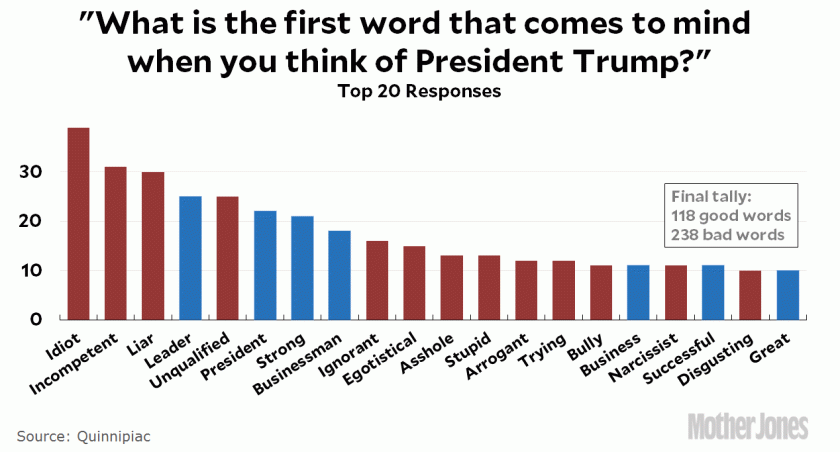
What strikes me is that even the “good” words aren’t really very good. If you’re asked what word first comes to mind when you think of President Trump and you answer president, that sounds to me more passive-aggressive than positive. Similarly, you need a particular ideological bent to consider businessman and business to be inherently positive qualities. Leader — I don’t know, I guess der Führer is a positive figure for those who admire that sort of thing. Myself, I prefer to know where we’re being led. If we include that one, there are 4 positive words, 4 neutral words, and 12 negative. (I’m including trying as neutral because I don’t know if people mean “working hard to do his job well”, which sounds like at least a back-handed compliment, or “trying my patience”.)

White House samsara

Is there some cosmic law of recurrence that decreed that as soon as Donald Trump had decided to go full-Nixon by firing the FBI director who was investigating his crimes, Henry Kissinger would pop up in the Oval Office?

Was he really there in the flesh, or were the photographers astonished to find his image appear on the film negatives? “Where two or three are gathered to subvert the Constitution, there am I among you.”

The serious point is, this shows how Trump’s impulsiveness (fortunately) gets in the way of his authoritarian showmanship. Presumably, a competent would-be strongman would have found a moment to subvert the rule of law for reasons that HAVE NOTHING TO DO WITH TREASONOUS CONTACTS WITH MOSCOW (which didn’t happen anyway), when he wasn’t scheduled to meet the next day with his handler the Russian ambassador and with Nixon’s Watergate henchman National Security Advisor.

Comey of errors

After the November US election I agreed with many commentators, who said that Comey really should resign for his failures of judgement or (depending on who you’re listening to) malfeasance with regard to the Clinton email server investigation, that it would provide partisan satisfaction for Democrats for him to be forced out, but that it was essential for the nation for him to stay in office as an independent check on the president’s authoritarian impulses. Some said he has the most secure job in Washington, since Republicans and Democrats both wanted to keep him, albeit for very different reasons.

Apparently not.

We’re used to thinking of scandals as something that will damage the politicians involved if and when they come out, possibly driving them from office. But that’s not always how it works. That isn’t even really the fundamental dynamic. Hidden criminality by people in power locks them in a death struggle with the rule of law and the system of honest democratic politics. Only one can survive. If the politician has weak support, or self-doubt, or respect for democratic norms then it’s like a moon in Jupiter’s gravitation — for all intents and purpose we can just say it’s the massive planet (the constitutional system) acting on the small body. But it can be more like a black hole interacting with a star: Both are perturbed, and until they get close you can’t judge how massive the black hole is. Continue reading “Comey of errors”

More honesty: Migrants and Expats

I was poking around Google for more tabloid reporting on Brexit, and found this headline from The Sun:

Brussels ‘plotted for weeks’ to scupper Theresa May’s deal to secure fate of Brit expats in Europe and EU migrants in the UK

The British in Europe are “expats”, while the Europeans in Britain are migrants. Opinions differ, but to me the word expat is redolent of colonialism. An expat, in British vernacular, resides only temporarily in the benighted country where he labours to construct a simulacrum of civilisation, even if measured by calendar time he has spent most of his life there and never actually returns “home”. A migrant — not even an immigrant, which has a certain nobility to it — is an ethnic and civilisational climber, probably swarthy and reeking of garlic, who can wish nothing more than to leave his degraded origins behind him.

Unusual honesty from the tabloid press

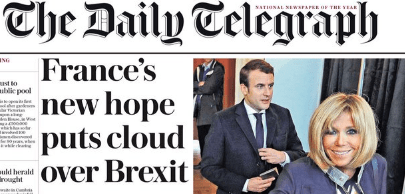
The response to the French election in the nationalist UK press is unusually revealing. The Daily Mail left it off the front page entirely, though it had touted Le Pen after the first round. The Daily Telegraph and the Daily Mirror published headlines that present Macron’s election as a setback for Britain’s Brexit plans. The Telegraph wrote “France’s new hope puts cloud over Brexit”, while the Mirror had “Why the new French leader could be bad for Brexit deal”. (The Daily Mirror, it should be noted, opposed Brexit.)

If the only thing that could be good for Brexit would be for France to elect a fascist president, doesn’t it kind of make you wonder about the wisdom of the whole project?

Rejecting Voltaire?

Emmanuel Macron’s election speech was reassuring. Intriguing that he took his long walk to the podium with the European anthem playing, rather than the French. One thing that disappointed me: He rejected fear, lies, division, fatalism, all good things to reject, but I just can’t get behind

Nous ne céderons rien à… l’ironie…

I don’t see how he can claim to be defending the values of the Enlightenment.

The word he used at the beginning interested me:

Je sais qu’il ne s’agit pas là d’un blanc-seing.

I’ve never heard the word blanc-seing before. It’s funny that we use a french phrase, carte blanche, for the same thing.

The secret of my success

A persistent obstacle to social reform is the common tendency to ignore the merely fortuitous in ones good fortune, and to attribute success to some self-flattering decision or essential virtue. I dropped out of school, taught myself computer programming, and became a wealthy entrepreneur. Or I became a world-famous surgeon despite growing as an impoverished black orphan. So don’t complain about being held back by poor schools and racial discrimination. It’s just hard work and faith that you need to get ahead.

This fallacy was already recognised, I have just noticed, by the Amoraim, the authors of the Babylonian Talmud. The tractate Yoma mentions Kimhith, a woman whose seven sons served, at some point*, as high priests:

The Sages said unto her: What hast thou done to merit such [glory]? She said: Throughout the days of my life the beams of my house have not seen the plaits of my hair. They said to her: There were many who did likewise and yet did not succeed.

In other words, she attributes her sons’ success to her exceptional modesty in always keeping her hair covered. The rabbis answer, many women have covered their hair without having such success.

* The story is pretty weird. If I understand correctly, two of the sons were called in to do the High Priest duties because on two different occasions their elder brother Ishmael ben Kimhith was defiled by having spat on himself during a heated discussion.

Fly me to the moon

In a democracy, what should be the relationship between leaders and the people? Last year Michael Gove famously offered a populist defense of Brexit against the dire warnings of economic experts: “people in this country have had enough of experts”. Donald Trump has obviously had great success with his idiosyncratic mix of doomsaying (“American carnage”) and pollyannaism (e.g. “You’re going to have such great health care, at a tiny fraction of the cost—and it’s going to be so easy”).* The vaguely conspiratorial premise — the spirit of “How to do it!” — is that our problems are all very simple, but elites are attempting to buttress their favoured position by making them seem complicated. Continue reading “Fly me to the moon”

Petard erection

A NY Times report on Trump’s first 100 days quotes senior Obama aide Ronald Klain

If Trump finds himself hoisted on the 100-day test, it is a petard that he erected for himself.

Does one erect a petard? I think not. Really, is it too much to ask, that a flack decorating his political bromides with Shakespeareana actually know what the words mean?