Givers and takers

There‘s a video clip going around showing ageing Australian edgelord Tim Gurner — who built a property empire on nothing but grit, moxie, and capital borrowed from his grandfather — speaking the capitalist quiet part out loud, arguing that we need higher unemployment to keep employees from getting uppity.

This reminded me of a thought I‘d had about the peculiar moral judgements built into our language of employment. Whereas a worker is an active agent, an employee is passive, shifting the active role to the heroic employer, that benevolent figure who grants them the opportunity to work.

This role-reversal is even more stark in German: The one who sweats and strains building or cleaning or making — that one is the Arbeitnehmer, the work-taker. The one who owns the business, maybe because they started it, maybe because they inherited it, or purchased it with inherited capital, is the Arbeitgeber, the work-giver.

Climate-change denial and the paradox of scrupulous science

I had a conversation recently with a relative who is generally quite intelligent, but also deep down the rabbit hole of climate-change denialism. And in talking to him, I realised something about a dilemma in science communication that is particularly acute for any topic where there is a vested interest willing to devote some significant effort to mystification. (So, climate science and vaccine immunology, but not, for instance, condensed-matter physics.)

Here’s the problem: The basic principle of the greenhouse effect — that the Earth’s temperature is regulated by the atmosphere, and that is scientifically almost trivial. It was first formulated by Fourier more than 200 years ago, in the course of making the first quantitative theory of heat transfer. Basically, it was unavoidable. Fourier didn’t know how the thermal insulation properties were specifically related to the composition of the atmosphere, but this was pretty comprehensively explained in 1898 by Svante Arrhenius, who recognised that carbon dioxide and water vapour were the main insulating gases, and then went on to calculate that doubling the CO2 content of the atmosphere would raise global temperatures by 5 to 6ºC.

That science is as certain as anything can be, and it’s not complicated. It’s accessible to anyone with high-school level chemistry and physics (and not any controversial theoretical components of the curriculum, nothing that anyone would challenge if they didn’t have uncomfortable implications for the profits of wealthy corporations). And we did the experiment: CO2 has been increased by about 50% since Arrhenius’s paper was published, and global temperatures have increased by almost 1.5ºC.

So, the quantity of carbon we’re burning globally is (by simple arithmetic) clearly the right amount to shift the CO2 content of the atmosphere by a substantial amount, and elementary physics tells us that this amount of extra CO2 should warm the globe by several degrees, and that several degrees of warming will be insanely destructive. We could stop there, and focus on thinking about how to clean up this mess. But again, there are vested interests whose profits and/or lifestyles depend on not understanding this.

As far as I can see, they mostly don’t challenge the first step (measuring CO2 seems like it should be pretty straightforward, and there’s no time lag or other complication) or the third (not sure why, since 2 or 3ºC doesn’t sound like so much — maybe I just haven’t explored the right dark corners of the interwebs), but focus on the middle step: Does CO2 really cause warming?

Now, the climate is a funny place, and all kinds of feedback effects could affect the result of the doubling CO2 experiment. Rationally, the core intuition should be to expect what elementary physics tells us: 5-6ºC increase. If you want to claim that something very different will happen, you should need a theory to explain the divergence, backed by rock-solid evidence. Instead, the challenges were of the sort, well, it’s all so complicated, anything could happen. Backed by the core intuition that the Earth is so big, and we are so small, that probably whatever we do is pretty harmless on a global scale. Or that said the Earth has homeostatic forces that will prevent any large changes — basically, the Gaia hypothesis.

In the 1980s climate scientists took on this challenge. And this is where things went off the rails. They studied all the feedback loops anyone could think of. They built up multiple lines of evidence about the palaeoclimate. They vastly expanded their theoretical understanding of and empirical measurements of deep ocean currents. They combined all of these into simulation models that can estimate the range of possible outcomes based on all the unknown and unknowable factors. And the outcome of all this effort and increased understanding is that smart (but scientifically naïve) laypeople have gotten the impression that anthropogenic warming is not a simple physics calculation, but the counterintuitive prediction of some complicated, abstruse modelling that no one understands very well… sort of the equivalent of asking ChatGPT for a weather forecast. And those precise measures of uncertainty, well, get back to us when you’re certain.

Tremendous effort has gone into trying to figure out whether these first-order effects might be overwhelmed (in either direction) by second-order feedbacks. And it turns out they might, to some extent, that it could happen in either direction, and there’s a fair amount of randomness, or at least, irreducible uncertainty, but we’ve acquired a much better understanding of how the climate system works. The result of all this, though, is to reduce the confidence among a segment of the public that looks at it and says, they sure seem to be working awfully hard to convince us of this totally counterintuitive claim that harmless CO2 is going to wreck the planet.

The depressing thing is, I can’t see how this could have been handled differently, or how it could be improved for the future. The work really did need to be done. The quibbles were right, in a sense, in that it’s all much more complicated than anyone even imagined, and there are huge feedback effects, positive and negative, increasing and decreasing the extent of warming. The final result, though, is that the central prediction for doubling of CO2 isn’t too far off what Arrhenius calculated, but we have more uncertainty on either side. And more ominously, rather than the gradual change that Arrhenius might have expected — with CO2 increase being directly translated into temperature increase — we have a system that responds with both time lags and in irreversible jumps, both of which make control extremely difficult — particularly in a situation where there is strong pressure not to take any action.

Christian pastry

The Guardian reported recently on a dispute between Ryanair and the cultural authorities of the Balearic Islands over a traditional pastry called ensaïmada. This spiral-formed pastry is apparently rather bulky, and the Irish surcharge-generating firm has been charging passengers £45 to take their ensaïmadas onboard as carry-on luggage.

Ensaïmada

According to the article, the pastry is

made from flour, sugar, eggs, water and pork fat. It takes its name from saïm, the Mallorcan word for pig fat.

Pig fat? Seems like a weird thing to put into pastry. And indeed, the article goes on to say that an identical pastry called a bulema was made by Mallorcan Arabs and Jews before the Spanish conquered the islands in 1229. Needless to say — but the Guardian does need to say it — neither the Arabs nor the Jews put pig fat in their pastry. But the weird thing was that apparently the pig fat was added explicitly to “Christianise” the pastry.

The Catalan poet and painter Santiago Rusiñol wrote in 1922 that with the addition of pig fat, “the Moorish ensaïmada became Christian, then it became Mallorcan and then was transformed into a food for all of humanity”.

I’ve long found it bizarre the extent to which, just as much as many Jews and Muslims see not eating pork as a crucial determinant of their identity, so many gentiles see themselves as a mirror image, with positively eating pork as decisive for their Christian identity. For example, there was this article about how some French schools were refusing to serve any alternative to pork for school lunches.

Bacon and sausage school dinners are being used by rightwing politicians to hammer home what it means to be French. Court battles and vicious political spats have erupted as protesters warn that controversial menu changes are sending a message to Muslim or Jewish children that to be truly French, they must eat roast pork.

And then there were the repeated attacks by the British press on the Jewish Labour leader Ed Milliband for “failing to look normal eating a bacon sandwich”.

God is high above, and the free speech tsar is far away

Apparently, the UK now has a “Free Speech Tsar”.

This is about as encouraging as the Conservatives’ decision a few years back to appoint an “Antisemitism Tsar”.

I guess it’s a way of signalling that the real point of these positions is to smash the socialists…

Bad intuitions about masking: Japan, 1933

Reading the gripping recent book by Uwe Wittstock on the activities of German writers and artists in the shock of February 1933, I just came across this passage from the little-known writer Hans Michaelis, published in the Berliner Morgenpost, reported from Japan on a medical innovation against the dangerous wave of flu then circling the globe:

„Die Bazillenmaske: Ein Oval-geschnittenes schwarzes Stück Tuch wird vor Mund und Nase gebunden, und hat die schwere Aufgabe den Bazillen den Eintritt zu verwehren.“ Allerdings wird die Mund-Nase-Maske, zur Überraschung von Michaelis, nur unter freiem Himmel getragen. In der Bahn und im Büro setzen die Japaner die Maske ab. “Sie sind der Überzeugung, dass sich die Grippeerreger vor allem auf der Strasse verbreiten, nicht in geschlossenen Räumen.”

“The bacteria-mask: An oval of black cloth is tied in front of the mouth and nose, and has the challenging task of denying entry to any and all bacteria.To be sure, these nose-and-mouth masks are only worn outdoors, much to Michaelis’s surprise. In the train and in the office the Japanese take the masks off. They are convinced that the flu germs spread mainly on the street, not in enclosed spaces.

Several things stand out about this report: First, how strange it is to see the hygienic mask as a new piece of technology. Particularly since we‘ve now all seen photographs from the US from the 1918-19 flu pandemic. It‘s not clear to me what was known when about the usefulness of medical masks.

Second, it‘s interesting to see innovations from Japan being taken so seriously, by an early 20th century European.

Third, when I visited Japan in 2005 I was interested to see so many people wearing masks on the street. I attributed this to the recent experience of SARS, but possibly the affinity for medical masks goes back much further.

Finally, there is this restriction of masks to outdoors, exactly the opposite of what we learned to do with COVID. I wonder if there was some misconceived medical theory behind this, or if it was simply the common intuition that one is safe indoors. Seeing public transport as “safe” in that way seems very strange, though.

The unbearable heaviness of buildings: Another episode in the series “Useless units”

Apparently, Manhattan is sinking by 1-2mm per year, due to the weight of its skyscrapers. The Guardian reports on the research led by Tom Parsons, of the US Geological Survey, saying that New York City’s buildings “weigh a total of 1.68tn lbs”.

What’s that, you say? You don’t have any intuition for how much 1.68 tn lbs is? The Guardian feels you. They’ve helpfully translated it into easy-to-grasp terms. This, they go on to say, “is roughly equivalent to the weight of 140 million elephants”.

The mythical pre-history of plant-based meat

In reading Matthew Cobb‘s fascinating new book on the history of ethics and genetic engineering I came across this quote from Martin Apple, president of the world’s first transgenic plant research institute, the International Plant Research Institute, in 1981:

We are going to make pork chops grow on trees!

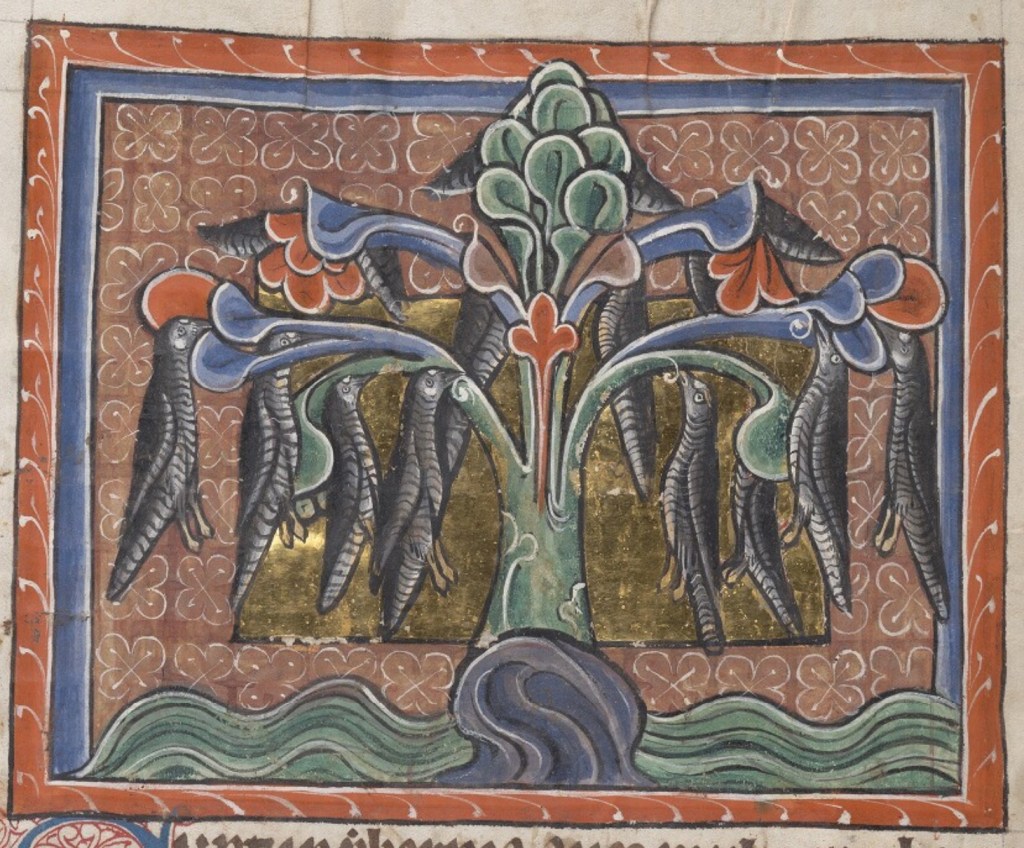
Of course, long before the first soy latte was even a twinkling in the woke barrista’s eye, people were concerned with plant-based substitutes for meat and dairy for religious reasons. And this reminded me obliquely of the myth of the barnacle goose.

In the Middle Ages it was widely believed that this bird grew from its snout from trees hanging over the water, or out of a barnacle attached to the bottoms of ships or loose pieces of wood. This raised a conundrum for medieval rabbis: For purposes of kashrut, should these geese be classed as fish, meat, or something else?

Some authorities said they were neither fish nor fowl, but rather like shellfish were impermissible no matter how they were slaughtered. But Rabbi Mordechai ben Hillel Ashkenazi of Regensburg said that, effectively, they are fruits:

Regarding birds that grow on trees, there are those that say that they do not require shechitah [ritual slaughter], because they do not reproduce sexually and are like any wood. (Quoted in Sacred Monsters: Mysterious and Mythical Creatures of Scripture, Talmud and Midrash, Nosson Slifkin, p. 319.)

Truly the world’s first plant-based meat!

More metric-imperial conversion hijinks

A while back I noted how an article on Ebola in the NY Times had apparently translated “one millilitre of blood” in a medical context into “one-fifth of a teaspoon of blood”. Hilarity ensued. Now I see that the fun doesn’t go in only one direction. I just got a letter from the NHS about an upcoming appointment, including these instructions:

Do not come to your appointment if you or anyone living with you has the symptoms of a new continuous cough (in the last week) or a temperature above 37.8 degrees or loss or change to your sense of smell or taste.

37.8 degrees? Why exactly this number? It sounds both arbitrary and absurdly precise. A bit of reflection revealed that 37.8 degrees Celsius is precisely 100 degrees Fahrenheit. They obviously copied some American guidelines, and instead of rounding appropriately — or reconsidering the chosen level — they just calculated the corresponding Celsius temperature. The funny thing is, Americans are used to having the very non-round guideline of 98.6 degrees as the supposed “normal” body temperature, because someone* in the 19th Century decided 37 degrees Celsius was roughly the right number, and that magic number got translated precisely into Fahrenheit.

* Carl Reinhold August Wunderlich, actually.

The World Comeuppance

There are few turnabouts more satisfying than when the cynic who thinks he’s calculated everything to his own benefit finds himself suddenly betrayed by the evil to which he’d accommodated himself. Extra points if he mocked the boring sincerity of those who moralised blah blah blah.

Which brings us to the World Cup. Anyone planning to attend or support the games has to be willing to ignore the corrupt process by which Qatar was selected; the thousands of labourers worked to death to build the facilities; and the foul mistreatment of women and sexual minorities by the Qatari authorities.

Eight years ago it was reported that the Qataris were already breaking the promises they had made to be allowed to host these games. They broke their promises to improve working conditions. They broke promises to allow LGBT+ visitors to attend the games safely. Most fans were happy that these promises were made, providing them cover to enjoy the World Cup, and were indifferent to whether the promises were kept.

But can they enjoy the World Cup without beer? Personally, I have zero appreciation of sport, but I have always accepted that other people really seem to dig football. But I do need to point out that the number of people who enjoy watching football completely sober seems to be rather small. Hence the dismay, that the theocratic dictators turned out to actually sincere in opposing alcohol, and are willing to take an economic hit to ban it from the tournament sites. Shocking!