Big notes

I remember reading, back in the late 1990s, an article in Spiegel, about the dubious decision of the Euro finance ministers to create a 500 euro banknote. Since the only people who use cash in significant quantities in this millennium tend to be shy people eager not to be singled out for their achievements by prosecutors, the question was raised, why would you want to create a unit of currency that enables law-abiding citizens (and others) to pack five times as much currency into a suitcase as the former favourite $100 bills?* The answer given by Edgar Meister, one of the directors of the Bundesbank, was that Germans had gotten used to having a 1000 Mark banknote, and that if the largest Euro banknote were worth less, people would think this new currency was a weakling.

Eine Währung, die es sich leisten kann, mit so hohen Noten herauszukommen muß wertbeständig sein.

A currency that can afford to produce such large banknotes must be solid.

As everyone knows, that’s why Germany produced this 50 million Mark note in 1923: Continue reading “Big notes”

Refer madness

Shortly after the EU referendum, someone asked me why the EU referendum was made to allow such an enormous change from a simple majority. After all, many countries have either supermajority threshold for referenda, or requirements that a majority be attained in a majority of regions or states. The answer, of course, is that

  1. The point of this referendum was to settle a conflict between two wings of the Conservative party. This was not an election, but a sporting contest — though sooner or later, in Britain, everything turns into a sporting contest — and it would have been completely unacceptable if both sides did not feel they had a reasonable chance of winning.
  2. There wasn’t any threshold at all. As many have pointed out, this wasn’t a referendum in the normal sense of the word. It was an opinion poll. The relevant law, the European Union Referendum Act 2015, orders only that the question be asked, and describes eligibility for voting. It says nothing about how the result is to be interpreted or enforced. (The most intricate part of the law seems to concern the question of which hereditary aristocrats are eligible to vote.)

There is nothing inevitable about concluding that the UK should withdraw from the EU because 52% voted that way in the referendum. Most democracies would not make it so easy for one group of citizens to deprive another group of citizens of cherished rights — particularly when the groups really are clearly defined social groups, whether age groups or semi-autonomous component nations (Scotland and Northern Ireland).

In principle, there’s a good argument that the government is constitutionally obliged to get clear authorisation from Parliament before pulling the Article 50 trigger. And if they do that, the MPs could reasonably point to the national divisions, or just the lack of an overwhelming majority, as justification for avoiding such wrenching change.

They won’t, though. Because it’s a sport, and nothing is more important to the British than appearing to be “good sports”. They call this “democracy”, and there have been any number of articles from left-wing Remain supporters, arguing that a commitment to democracy requires that they get behind the Brexit project now. The people have spoken, and any other response is an elitist insistence that you know better than the unwashed masses.

Where does that leave us, the foreigners? I am reminded of the work of David Blight and other historians on the “Lost Cause” historiography of the US Civil War. Americans of the North and the South decided to come together in a spirit of reconciliation, requiring that the Northerners agree to look past points of dispute, like the civil rights of African Americans. They — that is, the white people — pretty much all agreed that this was the charitable and democratic thing to do. Similarly, Britons are divided by economic and class differences, but they can all come together in agreement that the real problem is the foreigners. This is something I noticed when I first arrived here.

Things aren’t so bad in Oxford — though we all know people who have at least been menaced in public in the last couple of weeks for speaking a foreign language — and those of us with good professional jobs have a fairly easy out, if we want it, by acquiring UK citizenship. At least, that gets us to the other side of the rope line in terms of formal legal harassment. Elsewhere foreigners have to be thinking imminently about being driven out of places where they have resided for decades, and where they mistakenly thought they were at home.

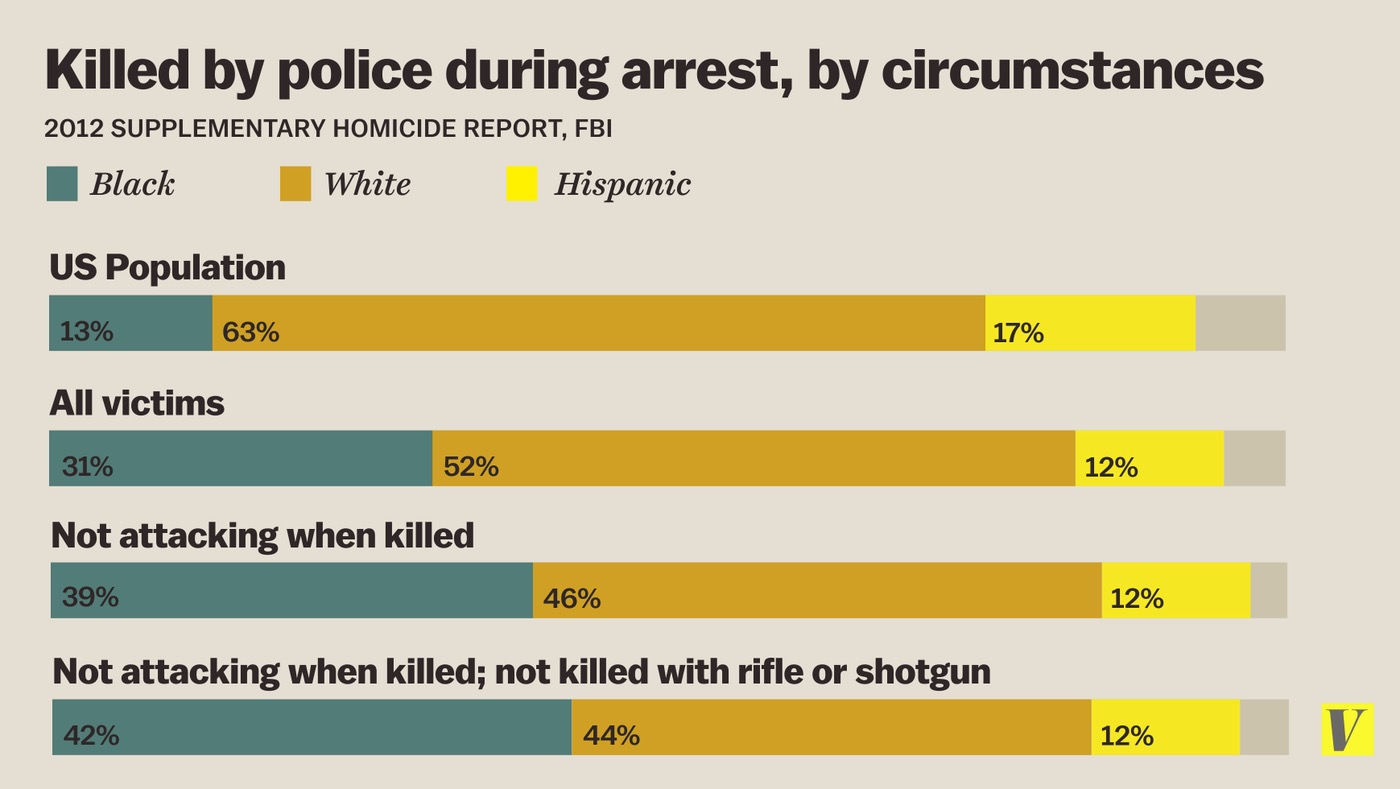
More damned statistics

The news website Vox published this chart last year, by Dara Lind, based on FBI data on people killed by police during arrest. The most chilling thing about it is that refined statistical analysis on people killed by police is possible, with all kinds of elaborate subgroup analyses. That’s because there were 426 cases in that year. In general I’m all in favour of more data, which makes it possible to study problems in a more refined way, but I’m happy that the statistics gathered by the Independent Police Complaints Commission don’t have much to work with: In the same year there were 15 deaths in or following police custody in England and Wales.

UPDATE:  I thought the US number seemed surprisingly small — only about 5 times the UK number on a per capita basis, despite the fact that British police don’t routinely carry firearms. In fact, The Guardian’s documentation of all police killings in the US lists 1146 people killed by police in 2015. I presume this has to do with the fact that the FBI statistic only counts people killed during arrest.

The worst form of government

One of the key points of indictment of the EU, favoured by those in the Leave campaign chary of venting raw xenophobia in public, was the “democracy deficit”. “Take back control” they said. Decisions about Britain need to be taken by the British parliament, rather than by unelected bureaucrats in Brussels. The British people need to show they are capable of governing their own fate.

Well, apparently we need to put Britain on the list of those countries whose culture is not yet ready for democracy:

Electoral services workers have reported calls from people asking if they could change their decision after Friday’s result became clear, while some publicly admitted they intended to use a “protest vote” in the belief the UK was certain to remain in the European Union.

Among those who “democratically” chose to take us out of the EU was

Mandy Suthi, a student who voted to leave, told ITV News she would tick the Remain box if she had a second chance and said her parents and siblings also regretted their choice.

“I would go back to the polling station and vote to stay, simply because this morning the reality is kicking in,” she said.

“I wish we had the opportunity to vote again,” she added, saying she was “very disappointed”.

My email inbox is full of solicitations from friends promoting a petition for a second referendum. That’s not how it works, I’m afraid, even if the petition has gathered close to 3 million signatures. It’s done.


The masks come off

I think a lot of people — a lot of foreigners living in Britain — are feeling like this character in Paul Murray’s wonderful satire of the financial crash, The Mark and the Void:

“But if you write the truth about our time? How can the truth ever be obsolete?”

“People don’t want the truth,” he says, waving a hand at the streets around us. “They want better-quality lies. High-definition lies on fifty-inch screens. I wrote the damn truth already, Claude. Maybe I didn’t write it well, but I wrote it. And not only did no one want to see it, they made me feel like a fool for even trying. They laughed out the window at me as they sped away on the gravy train.”

“That was during the boom. Now the gravy train has stopped.”

“Yeah, well, I can’t unsee what I saw. The money poured in, and it was like suddenly everyone in Ireland took off their masks, and they were these horrific, rapacious alien beings who if you fell down in the street would just leave you there to die.”

The day after 

Oxford is full of Europeans, and it seems like everyone is walking around in a daze since the referendum. It’s rare that you hear any other topic of conversation. If anyone has an opinion other than pro-EU they’re not saying, only citing some elderly relatives for possible insights into the psychology of Leave.

I hadn’t anticipated how hurt and angry people would be. Lots of people are talking about leaving. It’s not that anyone is expecting anti-European pogroms, but it makes it suddenly palpable how thoroughly unwelcome foreigners are in this country. I noticed this immediately when I arrived here, so maybe that’s why I’m not so shocked by this result.

Oxford is a xenophilic bubble, in this respect — 70% for Remain — so it’s easy to ignore, if you’re so inclined. Also, many Europeans didn’t really think of themselves as foreigners, which is why this rejection was such an emotional blow. It’s devastating for the university, of course.

I fear that this may turn a lot uglier. I think the British are going to be shocked to discover how much the rest of Europe resents them. It’s like a bad marriage: Europe has been making all kinds of compromises and telling Britain how much they love it to keep the union together. For the sake of the children let us say. The effect was only to heighten the British sense of their own importance. Now that they’ve announced, even though you’ve done everything I asked, I’m still leaving you, because I never loved you, and I never wanted to be married anyway, the British we’ll be surprised to discover how cold and businesslike the Europeans can be, in to just wanting be rid of them as quickly as possible. I fear that the unrealistic expectations will give way to fury and escalating rounds of retaliation against the hostages, who are the Europeans living in Britain and the Britons living in Europe.

Not the Day of Remain

It is accomplished. The UK is headed out of the EU. The generational coup of the pensioners against their children and grandchildren.

I’d hoped, but not expected, that it would turn out otherwise. Huge self-inflicted damage, and I doubt that the situation will develop to the advantage of those who supported Brexit. Scotland will likely secede. Northern Ireland may see the peace process unravel. I’m slightly worried that “Project Fear” actually underplayed the risk. It’s perhaps not the most likely scenario, but I see as perfectly conceivable that we face years of escalating frustration on both sides of the negotiating table, as the British are confronted with the reality of a Europe that has no interest in making the fantasies of the Conservative Party come true. The British public will become more bloody-minded, unwilling to be dictated to by a bunch of foreigners, leading to a feedback loop of retaliation against the hostages, the EU citizens living in Britain and the British living in the EU. It could get very ugly.

It’s a bit like climate-change denialism: You have one side saying, there’s a lot of uncertainty about the effects of our actions, so let’s be hopeful that it won’t be so bad. It might be substantially better than the median prediction. They conveniently ignore the downside risk, which could be pretty terrible.

Should I stay or should I go?

How will the referendum turn out? I’ve been saying, from the time when the referendum was just a twinkle in Nigel Farage’s eye, that I could hardly imagine the process, once Cameron had agreed to promise it as an election ploy, could end in anything but a UK withdrawal from the EU. Whatever the ostensible question, these sorts of referenda almost invariably turn into plebiscites on people’s general satisfaction with their government, and the answer is invariably NO. I can’t imagine the British people, given an opportunity to poke a finger in the eye of their leaders and those in Brussels, will turn it down. It just seems too exciting. On the other hand, people say that the undecideds will swing toward a status quo position, afraid of disruption. Could be. I suppose it depends on whether the public generally views their votes as political actions or as a form of self-expression.

Whatever happens, the next days and weeks will certainly be eventful.

Hope I leave the EU before I get old

I’m certainly not the only one to remark on the generational war being waged by the cohort of postwar babies, who discovered the power of age-based politics in the 1960s, against their children and grandchildren. Those now entering retirement have locked in promises of high pensions to themselves that no one before or after them will be able to receive.

That’s where the Brexit referendum comes in. The Guardian reported that Britons under 35 are almost 2:1 in favour of remaining in the EU, while those over 60 are almost as heavily biased in favour. A new article in the NY Times gives some anecdotal evidence in the same direction. This is usually explained as a matter of generational experience, those who experienced the Second World War smelling plans of German domination. But these are some of the same people who voted overwhelmingly to enter the EEC 40 years ago.

I can’t help but wonder whether, on some level, the over-60s see the situation they’ve manoeuvred the younger generations into — crumbling infrastructure, insufficient and overpriced housing, excessive pensions that will come at the expense of social spending for decades, and the only solution they can see — since a pension isn’t worth much if there aren’t enough working people to actually provide the services you depend on — is to block off their children’s potential escape routes.

Maybe it’s not about keeping THEM out. It’s about keeping the younger generation IN.

Whisper sweet non-racist nothings to me…

Continuing the theme of how Republicans see the problem with Trump as being his mode of expression, rather than his noxious world-view and beliefs, this new comment after everything from Ohio governor John Kasich:

Kasich told Scarborough that he was still open to supporting Trump if he moderated his anti-minority rhetoric and pivoted towards the general election.

It’s almost to Trump’s credit that he won’t camouflage himself, however much his copartisans bribe him so.