Post-existing climate conditions

According to the NY Times, insurers have been taking advantage of climate-change fears to raise prices for flood insurance. Now that the presidential election has conclusively proved that the greenhouse effect is a Chinese hoax to make Americans look stupid less productive, I think the Congress needs to move beyond minor defensive measures like abandoning the Paris accord, and move instead to aggressively defend Americans’ God-given right to build decadent structures in flood zones: Just as health insurers are now prohibited from inquiring about or taking account of “pre-existing conditions”, flood insurers need to be prohibited from taking account of (hoax) research about “post-existing” (future) climate conditions in determining flood insurance prices. Prices may be based only on past flood records.

This can be combined into a single consumer-rights bill with Mike Pence’s initiative to ban life insurance premiums that discriminate against tobacco users. As Pence wrote in 2000,

Time for a quick reality check. Despite the hysteria from the political class and the media, smoking doesn’t kill… Nine out of ten smokers do not contract lung cancer.

What’s all this hysteria for? Smoking is even safer than Russian Roulette. (Five out of six players don’t get shot!)

Paradoxical times

I remember in my childhood, maybe when I was ten or so, talking with my brother about the weird counterfactual possibility that someone could be elected president without winning a majority of votes. Of course, we imagined the most extreme possibility, a candidate winning by one vote in a minimum collection of states, and getting not a single vote in the rest, so that he could attain the presidency with (we worked out) only about one quarter of the votes.

This was discussed in the same kinds of spooky tones that we used to discuss uncanny notions like that someone could be his own grandfather or God could make a stone so heavy that he couldn’t lift it. When grownups on television tried to defend the Electoral College it was generally in terms of turning small vote majorities into decisive Electoral College majorities, thus enhancing the popular credibility of the vote. Now we’ve gotten used to the Electoral College being used to entrench Republican government against Democratic majorities. Given that it was originally designed to enhance the power of slave states, we can say it’s working as planned.

All the president’s businesses

Trump is behaving like a central Asian autocrat, blending his family business with national politics, alternatively threatening and pardoning the opposition according to his whim. One tends to think that it can’t go well for him, but then, we thought that a year ago. Who can call him to account?

My usual baseline emotional reaction to Republican presidents’ scandals and abuses is: Bring ’em on. The more the better, since in the long run they mainly serve to embarrass and distract the administration from carrying out policies that I generally oppose.

My reaction to Trump is very different, which just shows how genuinely different he is from a “normal” Republican. Part of this is his shamelessness and limited attention span. One typically reasons about a leader, “He can’t possibly do X, because the consequences would be Y, and that would be hugely unpopular.” That doesn’t work for Trump. Partly it’s his unshakeable bond to his core supporters — the I-could-shoot-someone-on-Fifth-Avenue phenomenon. But mainly it’s the impression that he is literally incapable of understanding or anticipating any consequences over a time horizon measured in minutes. Maybe this impression is inaccurate, maybe it’s just a bluff. If so, it’s effective, and he’s won this game of Chicken. No rational person would challenge him now under the assumption that he would be dissuaded by the prospect of long-term damage, to himself, to the country, or to the world. This gives him a madman’s freedom, whether or not he is actually mad.

I am existentially frightened of the effect of his administration, which means that I am hoping, not for his success, but for limits to his failure. I am hoping that someone will get his gritting under control before he comes into office, because I worry about him systemically corrupting the US federal government. I am hoping that some sensible people — even extreme right-wingers — will take control of his administration’s foreign policy because I worry that his impulsive leadership will lead to nuclear war or the collapse of peaceful order in Europe.

It’s been two weeks since the election, and the shock has worn off. The fear has, if anything, grown. Before the election, I eagerly awaited the puncturing of the vast Trump ego balloon. (I kind of assumed he was teetering on the edge of bankruptcy, being propped up by foreign banks and individuals who would lose interest after the election.) Now, I’d gladly accept him and his family looting hundreds of billions from the US treasury if he’ll leave us in peace.

Is global warming a hoax or not, Mr Sarkozy?

A few weeks ago former and possibly future French president Nicolas Sarkozy proclaimed his allegiance to international right-wing loonidom by ridiculing the scientific consensus on anthropogenic climate change:

Cela fait 4 milliards d’années que le climat change. Le Sahara est devenu un désert, ce n’est pas à cause de l’industrie. Il faut être arrogant comme l’Homme pour penser que c’est nous qui avons changé le climat…

[The climate has been changing for four billion years. The Sahara turned into a desert, and that wasn’t caused by industry. It takes a uniquely human arrogance to believe that we have changed the climate…]

But now, perhaps because Le Pen seems to have the loony right wing anti-science vote locked up, he is threatening to punish the US if it tries to scuttle the Paris accord:

Donald Trump has said – we’ll see if he keeps this promise – that he won’t respect the conclusions of the Paris climate agreement.

Well, I will demand that Europe put in place a carbon tax at its border, a tax of 1-3 per cent, for all products coming from the United States, if the United States doesn’t apply environmental rules that we are imposing on our companies.

The man who can’t stand to lose anything

After settling his Trump University fraud case for $25 million, the president elect reported on Twitter

I settled the Trump University lawsuit for a small fraction of the potential award because as President I have to focus on our country.

— Donald J. Trump (@realDonaldTrump) November 19, 2016

Not to seem ungrateful, but why would he say this? It would have been in keeping with the aggrieved self-sacrificing tone of the rest of the message for him to have written that he had settled the lawsuit for more than what he could have lost at trial, just because he loves America THAT MUCH that he couldn’t bare to be distracted from his transition duties.

Instead, since he can’t stand to suggest that he lost, even for a moment, even in the context of an unimaginably larger victory, he implies that he got off easy, that the real amount of the fraud was much larger than what they got out of him in the settlement.

Are we living in a David Mamet film?

I just had a frightening thought: Has the entire Trump campaign been scripted by conservative neozealot David Mamet? It’s House of Games, with politics and racism.

Before even being sworn in as president, Donald Trump has assured himself a place as probably the greatest con man of all times. And one of the most important skills of the really masterful con man (one learns from Mamet) is to know how to take advantage of people thinking they’ve seen through your con. A double con. There’s no one more gullible than someone who thinks he’s seen through you. Continue reading “Are we living in a David Mamet film?”

Tender-hearted racists

The only place I run into Americans here is in the synagogue. There is one loud-and-proud right-winger who gets treated to a lot of good-humoured deference. This past Sunday, naturally, he was feeling his oats. I mostly stay out of these political discussions, but after listening to him go on and on about the “elitists” in their “bubbles” who had failed to appreciate the world-historical significance of Donald Trump, I remarked that these were very large bubbles that contained more than half of the US population. He suddenly switched gears and accused me of accusing all Trump voters of being racists, a remarkable feat of projection, given that no one up to this point had mentioned race. No, I said, I’m sure some of their best friends are black.

But I was thinking of this when I recently read this passage in John Ferling’s Jefferson and Hamilton: The rivalry that forged a nation. (Overall, a pretty interesting book, if not especially elegantly or engagingly written) about Hamilton’s attacks on Jefferson in the context of the election of 1796:

Hamilton raised questions about Jefferson and race. He drew on passages from Notes on the State of Virginia to demonstrate Jefferson’s racism.

The context is a society that accepts enslavement of African-Americans, Jefferson owned dozens of slaves, yet evidence of “racism” was seen as a black mark on his character. And Hamilton needed to delve into Jefferson’s writings to find “evidence” that the slave-owner Jefferson was racist. For that matter, Hamilton himself had owned slaves in the past, and probably did even as he was polemicising against Jefferson’s racism.

Anti-racism is self-limiting. As soon as we accept that racism is a terrible thing, there is a natural tendency to absolve pretty much anyone with a name and a face of this evil. Racism exists in the past, or on the fringes of society. People like Trump are just clumsily saying some racist things or appealing to non-PC white voters. (And if he’ll just stop saying racist things for a week or two, problem solved!) Similarly, the NY Times has just today seemed to express sympathy for famous racist and likely Trump cabinet pick, Alabama senator Jeff Sessions:
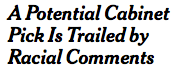
screenshot-2016-11-17-12-01-28

The poor guy is being trailed by those nasty racial comments. Maybe he can get a restraining order against them!

If you’re not actually burning crosses you’re not a real racist, just as anyone who isn’t Hitler can’t really be an antisemite. (And anyone who recalls the fake-Hitler-diary furore may also recall the breathless coverage that noted the absence of any reference to the holocaust, eager to absolve the Führer of the worst crimes.)

I think often of this exchange from the second presidential debate in 2000:

GORE: …The governor opposed a measure put forward by Democrats in the legislature to expand the number of children that would be covered. And instead directed the money toward a tax cut, a significant part of which went to wealthy interests. He declared the need for a new tax cut for the oil companies in Texas an emergency need, and so the money was taken away from the CHIP program… I believe there are 1.4 million children in Texas who do not have health insurance. 600,000 of whom, and maybe some of those have since gotten it, but as of a year ago 600,000 of them were actually eligible for it but they couldn’t sign up for it because of the barriers that they had set up.

MODERATOR: Let’s let the governor respond to that. Are those numbers correct? Are his charges correct?

BUSH: If he’s trying to allege that I’m a hard-hearted person and I don’t care about children, he’s absolutely wrong.

The words don’t adequately communicate the smarmy expression of offence that Bush displayed. Gore accused him of taking insurance away from 600,000 children. Bush didn’t respond or explain, but simply contended that to mention this fact was to insult him, to call him a “hard-hearted person”.

Opinion polling can’t stabilise democracy

Something I’ve been thinking about since the Brexit vote: There was a prevailing sentiment at the time that the British people are inherently conservative, and so would never vote to upend the international order. In fact, they did, by a small but decisive margin. But how was this “conservatism” imagined to act? The difference between 52-48 for Leave and 48-52 is happening in the minds of 4% of the population who might have decided the other way. Except that there’s nothing to tell them that they are on the margin. If you are negotiating over a policy, even if you start with some strategically maximum demand, you can look at where you are and step back if it appears you’ve crossed a dangerous line.

A referendum offers two alternatives, and one of them has to win. (Of course, a weird thing about the Brexit vote is that only one side — Remain — had a clear proposal. Every Leave voter was voting for the Leave in his mind. In retrospect, the Leave campaign is trying to stretch the mantle of democratic legitimation over their maximal demands.) There is no feedback mechanism that tells an individual “conservative” voter that the line is being crossed. Continue reading “Opinion polling can’t stabilise democracy”