I commented a while back on the NSA and GCHQ naming their most secret programs of spying on their fellow citizens after battles of their civil wars (American and English respectively). I didn’t remark at the time, but this clearly shows the dominance of the NSA, since it is striking how little memory there is of the English Civil War, in comparison to the omnipresent shadow cast by the American Civil War over US politics. It’s hard to imagine a British nerd making a playful reference to battles of the English Civil War, except in an attempt to anglicise a prior US nerd reference to the American Civil War.
A minor example of the latter is the comment by a Republican congressman, enthusiastic that his party was steering the country toward a government shutdown, and responding to a skeptical question about the (Democratic controlled) Senate’s response by saying
Ulysses S. Grant said, ‘Quit worrying about what Bobby Lee’s doing and let’s focus on what we are doing,’ ” Culberson added. “We are focusing on what we need to do and not worrying about what the other guy is going to do. . . . That’s how Ulysses S. Grant won the war.
It is a telling statement about the current state of US politics that one party is portraying the other as their opponents in a civil war. (And, in return, they are being compared to terrorists and hostage-takers.)
I see this as an improvement over Republicans invoking the spirit of the Confederacy. Oddly, Representative Culberson is from Texas. Even more oddly, he preceded this invocation of Civil War strategy by saying “We’re 100 percent united!” I guess that’s the effect of civil war, to make the residue seem more unified.
I was reading Ariel Levy’s New Yorkerprofile of Edith Windsor, the plaintiff in the recent Supreme Court case challenging the constitutionality of the Defense of Marriage Act (and, by extension, of bans on same-sex marriage). I was struck by this passage:
She applied for a job as a research assistant, programming an eight-ton UNIVAC computer for the U.S. Atomic Energy Commission.
Why “eight-ton”? She wasn’t carrying the UNIVAC around with her. If she’d been a maintenance engineer at the Empire State Building I doubt Levy would would have bothered to mention the weight of the building. If the story had happened today I doubt she would have said “she applied for a job programming Google’s 8-ton server cluster.” The complexity of programming the UNIVAC — if that is what is supposed to be brought out — would be brought out by mentioning the number of switches and vacuum tubes, for example, something that is only indirectly related to its weighing 8 tons.
Maybe it’s just a bit of meaningless historical colour, but I couldn’t help thinking that this fit in with the general tone of the article, which portrays Windsor as the classic type of the crusty old lesbian. (She is quoted complaining about the women she danced with at gay bars in the 1950s: “Lesbians can’t lead.”) The image of her doing data entry at a modern computer workstation would have seemed too dainty. There might be a huge server farm and the whole Internet at the other end of your Ethernet cable, but that doesn’t change the fact that sitting at a keyboard and typing still seems prissily similar to the stereotypical 1950s secretarial pool. Wrangling an 8-ton electronic behemoth, on the other hand, that’s work for a kick-ass lesbian.
This provokes me to wonder about whether there are two fundamentally different modes of stereotypes excluding girls by from male-dominated fields: Type 1, perhaps best typified by philosophy, but earlier by medicine (before women took over), and perhaps by computing, girls and young women are warned off — and women in the field may be undermined — by a supposition that women couldn’t be very good at this. But if they do it, it doesn’t call their identity as women into question. In other professions — the military and professional sports most prominently, but perhaps also engineering, construction, plumbing, finance, etc. — there might be even more dissuasion by the dual message, not only are you probably not going to be very good at it because of your lack of masculine endowments, but if you are good at it, it will prove that you’re not really a woman.
Just speculating here, because I’m too lazy to read the research by people who think for real about these things.
In many parts of the US the financial crisis has led to more houses being rented rather than bought by the people who want to live in them, according to an article in today’s NY Times, titled “As Renters Move In and Neighborhoods Change, Homeowners Grumble”.
Now, this might seem like a good thing, given how many families and overextended themselves financially to invest in real estate. But if you think that, you are forgetting renters are a bunch of thieves and drug dealers and all around no-goodniks. Why are they occupying single-family homes among nice Americans? Are there no prisons? Are there no workhouses?
The Times reporter Shaila Dawan visited a neighbourhood of Memphis, TN called Hillshire.
On a recent evening, parents pushed strollers and lawn mowers droned, children played on a tire swing and in one driveway, a longtime resident and his grandson tinkered with the fat tire of a slick red drag racer.
But there was a seedy underside. Jimmy Fumich, a homeowner and air-conditioner repairman, said he had been in court that day as a witness in an animal cruelty case against a neighbor, a renter, who had left a dog chained to a stop sign in the heat. She was already in trouble, he said, for breaking into an empty house on the block. Mr. Fumich… mentioned a couple of meth houses and one that had been used as a brothel. All were rentals.
A renter mistreated an animal. Others ran a brothel (in a rented house). Or did they just have too many visitors? Mr. Fumich complains further that the renters don’t join the neighbourhood watch.
It almost seems irrelevant when the article adds, parenthetically, that “Police department records show that major crime in the area, which does not include drug offenses, has actually gone down.”
But it’s not just the homeowners who hate the renters. The renters hate themselves:
In a small cul-de-sac near Hillshire… Rusby Amador cooked dinner for her three sons while waiting for her husband, a tile layer, to get home. One son was hosing off the walkway of their rented home. Two prodigious Boston ferns hung in the entry, and at the curb a colorful ceramic urn sat atop the mailbox.
“When the people buy a house, the people’s more nice,” Ms. Amador said. “Renters, they don’t care about neighbors. We don’t know who’s going to move in. We worry all the time because we don’t know. I have children.”
So, neighbours are good, but new neighbours are instruments of the devil. Unless you know who is going to move in which, in my experience, is not usual.
As though it need to defend its title as the world’s leading provider of smug, The New Republic has published a piece by NY Times religion reporter Mark Oppenheimer (MO hereafter) about how irrational everyone is. This disturbs him, because when he was growing up, when all was right with the world, “It was taken for granted in my house… that only right-wingers were mad enough to oppose scientifically tested public-health measures.” He describes what he calls “The New Puritanism”, starting from opposition to water fluoridation in Portland (which doesn’t look like an archetypically puritanical cause to the untrained eye), and moving on to Kids Today:
At a birthday party for a three-year-old, I was hit with the realization that most of the parents around me were in the grip of moral panic, the kind of fear of contamination dramatized so well in The Crucible. One mother was trying to keep her daughter from eating a cupcake, because of all the sugar in cupcakes. Another was trying to limit her son to one juice box, because of all the sugar in juice. A father was panicking because there was no place, in this outdoor barn-like space at some nature center or farm or wildlife preserve, where his daughter could wash her hands before eating. And while I did not hear any parent fretting about the organic status of the veggie dip, I became certain there were such whispers all around me.
Now, this could be dismissed as a dreary attempt to channel PJ O’Rourke, or some comparable swaggering humourist, with a cookie-cutter tall tale, but it’s stuffed with all kinds of weird. He hallucinates “whispers all around” about the organic status of the veggie dip, and yet he insists it is the others whose mental stability is in doubt. With that in mind, one might suspect that the father was not “panicking”, but was simply asking where his daughter could wash her hands before eating, which was certainly the custom when I was a child, though perhaps not in Oppenheimer’s antediluvian childhood.
He cites The Crucible, presumably both as a touchstone of left-wing right-thinking and as a marker of his own cultural sophistication, but has clearly never read or seen it. While “witchcraft” are often taken as a metonym for fear of moral contamination, Miller’s play dramatizes political manipulation of mob psychology.
But putting aside MO’s paranoid-pretentious MO, I am fascinated by his comments
When I was a child, birthday parties involved cake, ice cream, and Chuck E. Cheese pizza, or pizza-like substance; and trips to the grandparents’ house involved root-beer floats and late-night viewings of Benny Hill with my grandfather, who liked the T&A humor. I never washed my hands before I ate. And I turned out splendidly.
So, we started with fluoridation of water, which is a “scientifically tested public-health measure” that only a crazy person could oppose, but washing hands before eating — at a “barn-like space” where, presumably, it is not absurd to suppose the children may have been exposed to animal feces — is the kind of over-the-top fear of moral contamination (not just bacterial contamination) that invites mockery.
Now, MO’s aforementioned paranoid delusions may cause one to question his splendid self-appraisal, but he is certainly not alone in trumpeting the formulation “When I was a child we all did X, and we all turned out alright,” where X is some dangerous or unedifying activity that educated middle-class parents today try to limit or eliminate. An extreme version is this text that got forwarded to me a few years back:
To Those of Us Born 1930 – 1979
First, we survived being born to mothers who smoked and/or drank while they were pregnant. They took aspirin, ate blue cheese dressing, tuna from a can and didn’t get tested for diabetes. Then after that trauma, we were put to sleep on our tummies in baby cribs covered with bright colored lead-base paints. We had no childproof lids on medicine bottles, locks on doors or cabinets and when we rode our bikes, we had baseball caps not helmets on our heads. As infants & children, we would ride in cars with no car seats, no booster seats, no seat belts, no air bags, bald tires and sometimes no brakes. Riding in the back of a pick- up truck on a warm day was always a special treat. We drank water from the garden hose and not from a bottle. We shared one soft drink with four friends, from one bottle and no one actually died from this. We ate cupcakes made with Lard, white bread, real butter and bacon. We drank FLAV-OR- AID made with real white sugar…. We fell out of trees, got cut, broke bones and teeth and there were no lawsuits from these accidents. We would get spankings with wooden spoons, switches, ping pong paddles, or just a bare hand and no one would call child services to report abuse…
You might want to share this with others who have had the luck to grow up as kids, before the lawyers and the government regulated so much of our lives for our own good. While you are at it, forward it to your kids so they will know how brave and lucky their parents were. Kind of makes you want to run through the house with scissors, doesn’t it?
The implication is that the kids are all softies and the parents are anxious killjoys. I heard a stand-up comedian a few years back complaining about bicycle helmets: “When I was a kid we all fell off our bikes. We didn’t fall on our heads. If we did, no one died. Have kids’ heads gotten softer?”
Except, of course, that it’s not true that no one died. This is a good example of how people deal with small risks: Some are treated as zero, others are exaggerated. And part of the phenomenon (though I’ve never seen anyone analyse this process in detail) is that people fixate on whatever the current largest risks are, and often succeed in pushing them down. At that point, a new danger pops up that was always there, but masked by a larger risk, and so psychologically zeroed out. Thus, when I was growing up, in the 1970s, public health officials weren’t very concerned with children’s head injuries from bicycle accidents because there were far more of them from automobile accidents in the absence of seat belts, not to mention all the poisonings from medications without child-resistant packaging. If the risk of dying
To put some numbers on it: In the US, in 1998, about 6500 children under the age of 15 died in accidents. In 1981 (the earliest year whose statistics I have easily available at the moment) the number was 9000. In that time, the population under 15 increased from 49 to 60 million. In other words, if the society had held onto its habits of eschewing bicycle helmets, leaving the medications out, riding in the back of a pickup truck and all the rest, we’d have more than 4500 extra dead children a year. How awesome would that be?
That’s not to say that all concerns about health and nutrition and environment are reasonable — or that, even if they are reasonable, that the actions one would take to prevent or mitigate harm would not impose considerable costs, even such that they might be judged to outweigh the benefits. But instead of mockery and “I turned out alright” populism, we need to be clear on what the benefits are: 4500 fewer children being buried every year. And that’s ignoring the costs of nonlethal sickness and injury, the extra miscarriages and stillbirths, and the long-term damage to lungs and other organs that we now know were caused by all those smoking and drinking parents.
Update: The comedian I was thinking of was a woman, but here’s another comedian making fun of bicycle helmets for emasculating our children; in this version, he’s not asking why heads got softer, but why the pavement is harder. Same joke.
What’s the connection between Ben Franklin and Don Lockwood (Gene Kelly’s character in the 1952 film musical Singin’ in the Rain), aside from being the Americans most famous for felicitous activities during a rainstorm? I was watching the film recently, and was struck by the opening scene, which I had forgotten, where the hero, movie star Don Lockwood, narrates his biography, and we see Lockwood’s intimation of a sophisticated, upper-class upbringing — “[Mum and dad] sent me to the finest schools, including dancing school. . . We rounded out our apprenticeship at an exclusive dramatics academy… We played the finest symphonic halls in the country.” — humorously intercut with images on the screen of low-class reality — tap-dancing in a pool hall and fiddling in burlesque theatres, piano in honky tonks and whorehouses, being slapped by parents, etc.
It occurred to me that in one paradigm old-world fairy tale, a seemingly riffraff protagonist is revealed to be a person of consequence when his hitherto concealed high birth is recognised. In the American transformation, a seemingly foppish aristocrat is revealed to be a person of consequence when his hitherto concealed low birth and plucky struggle to the top are revealed. And as in so much else, this feature of American character and culture was first limned by Benjamin Franklin, in his famous “Information to those who would remove to America“:
According to these opinions of the Americans, one of them would think himself more obliged to a genealogist, who could prove for him that his ancestors and relations for ten generations had been ploughmen, smiths, carpenters, turners, weavers, tanners, or even shoemakers, and consequently that they were useful members of society; than if he could only prove that they were gentlemen, doing nothing of value, but living idly on the labor of others.
An even more pithy statement of a similar world view, that I have seen attributed to Franklin though without being able to find the reference (so that I suspect the source is in fact someone else):
I care not who my ancestors were. I care who my descendants will be.
Death rates at Bay Area hospitals vary widely, new report reveals
While some hospitals excelled at keeping patients alive, more than half of institutions around the Bay Area had worse-than-average death rates for at least one medical procedure or patient condition in 2010 and 2011, a new state report reveals.
Via Rachel Larimore is this NY Post article about the struggle by headmasters of exclusive NY private schools to get wealthy parents to perform menial duties in person. Instead, many are sending nannies to
fund-raisers, designing sets for school plays and taking seats at graduations and public performances.
“Now the schools are getting angry — and other parents are getting angry. They don’t want to work the school bake sale with someone’s paid employee,” Uhry said.
Now, it certainly makes sense that the parents should be present in person to see the performances, and designing sets is at least a reasonable parent-child joint activity, though, as Larimore points out, it’s not clear why the schools aren’t hiring professionals to help children with these tasks. This seems to reflect, more than anything the schools’ lack of respect for crafts as educational activity: Presumably they don’t expect the parents to come in the afternoon to grade the math homework.
But bake sales? Why are schools with $40,000 a year tuition holding bake sales? What is the economic rationale for parents to pay a nanny $15 an hour (just guessing…) to sell cookies at 3 for $1 to raise money for the school? Surely the fundraising purpose would be better served by eliminating the middleman.
I appreciate that working together on a fundraising activity may be a bonding experience for parents (or children), but then again, it may not. Presumably for most non-impoverished parents — and that describes, I’m guessing, pretty much all parents at the schools in question here — the hours that the bake sale costs would be more valuable than the pittance that the activity brings in. If the parents wanted to devote that time to the school, there are probably more constructive contributions they could make.
Unless, that is, the bake sales of these schools are more lavish (and lucrative) than I can imagine…
So, you’ve just been hit by a bus, and you’re lying bleeding in the gutter. Naturally, what you’re thinking about is, what would be the most convenient place to get a couple of pints of blood, and maybe have a ruptured spleen removed. Sure, the ambulance drivers might know the closest one, but I’m going to insist on being taken to the best, and what better recommendation could there be, when your life is at stake, than a placard on the side of a bus. (Anyway, the EMTs probably have a remunerative arrangement with some other hospital that will pad their incomes, regardless of whether you survive the trip.) And while I’m paying thousands of dollars a day just for being in the bed, I can think about how my money is being put to good use subsidising mass transit.
Seriously, isn’t this beyond bad taste? I’m used to a medical system that advertises to, you know, inform the public about medical matters. Not to drum up business for the ER.
In discussions of market forces in health care, someone always points out that we don’t allow people to just die in the streets. Anyone who shows up in an emergency room must be treated (in the US this has been true since the Emergency Medical Treatment and Active Labor Act of 1986, I believe). Among the many other reasons why medical care does not respond to free market incentives, then, is the fact that the providers are not able to turn away customers who are unwilling or unable to pay.
But here’s what I’m wondering: This is always presented as an issue of basic humanity, or altruism. We can’t let the poor die of treatable injuries or illnesses because that seems too brutal. But is that the whole story, or even most of the story? My suspicion — and I’d have to go back to the debates on EMTALA to develop any clarity on this — is that the real reason we have a no-exceptions requirement that hospitals provide urgent care to the poor is that there’s a significant danger that the non-poor might be confused with the poor, particularly in times of medical emergency. Someone who has been hit by a car or has suffered a stroke and is disoriented is likely incapable of quickly identifying herself as an upstanding creditworthy citizen with health insurance. So the hospital is required to try to keep them alive long enough to allow them (or their relatives) to demonstrate that they are worth saving.
Which leads to a question: Supposing biometric databases become universal, and the hospitals are able to immediately ID anyone who comes through the door. Will we then relax the rules, and allow them to turn away the indigent, perhaps sending them off to some primitive alternative hospital for the poor?
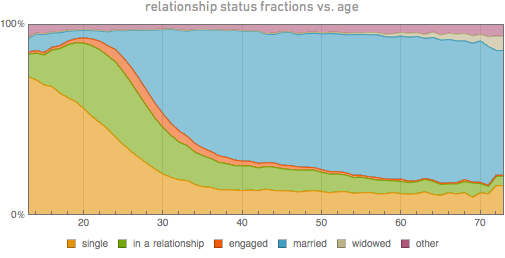
There’s lots of interesting plots on Stephen Wolfram’s analysis of Facebook data, but what jumps out to me is the way he feels compelled to turn his cross-sectional data — information about people’s interests, structure of friendship networks, relationship status, etc. as a function of age — into a longitudinal story. For example, he describes this plot
by saying “The rate of getting married starts going up in the early 20s[…] and decreases again in the late 30s, with about 70% of people by then being married.” Now, this is more or less a true statement, but it’s not really what is being illustrated here. (And it’s not just the weird anomaly, which he comments on but doesn’t try to explain, of the 10% or so of Facebook 13 year olds who describe themselves as married.) What we see is a snapshot in time — a temporal cross section, in the jargon — rather than a description of how the same people (a cohort, as demographers would put it) moves through life. To see how misleading this cross-sectional picture can be if you try to see it as a longitudinal story of individuals moving through life, think first about the right-hand side of the graph. It is broadly true, according to census data, that about 80% of this age group are married or widowed. But it is also true that 95% were once married. In fact, if they had had Facebook when they were 25 years old, their Stephen Wolfram would have found that most of them (about 75%) were already married by that age. (In fact, about 5% of the women and 3% of the men were already in a second marriage by age 25.)
So, the expansion of the “married” segment of the population as we go from left to right reflects in part the typical development of a human life, but it reflects as well the fact that we are moving back in time, to when people were simply more likely to marry. And the absence of a “divorced” category masks the fact that while the ranks of the married expand with age, individuals move in and out of that category as they progress through their lives.
Of course, the same caveat applies to the stories that Wolfram tells about his (quite fascinating) analyses of structure of friend networks by age, and of the topics that people of different ages refer to in Facebook posts. While it is surely true that the surge in discussion of school and university centred at age 18 reflects life-phase-determined variation in interests, the extreme drop in interest in salience of social media as a topic is likely to reflect a generational difference, and the steep increase in prominence of politics with age may be generational as well. (I wonder, too, whether the remarkably unchanging salience of “books” might reflect a balance between a tendency to become less involved with books with age, cancelling out a generational shift away from interest in books.)


 Common Infirmities