Brexit negotiations halfway concluded!

A classic joke:

A rabbi announces in synagogue, at the end of Yom Kippur, that he despairs at the burning need for wealth to be shared more equally. He will depart for the next year to travel through the world, speaking to all manner of people, ultimately to persuade the rich to share with the poor. On the following Yom Kippur he returns, takes his place at the head of the congregation without a word, and leads the service. At the end of the day congregants gather around him. “Rabbi, have you accomplished your goal? Will the rich now share with the poor?” And he says, “Halfway. The poor are willing to accept.”

I thought of that on seeing this headline:

Theresa May secures approval from cabinet

A mere 15 months after formally triggering the formal two-year process for exiting the EU, Conservative politicians have negotiated an (uneasy) agreement among themselves about what they hope to achieve from the process. Now, all that remains to wrap up in the next nine months is to get the approval of EU negotiators, the European Parliament and 27 national governments.

Update (7pm, 7/7/18): The Guardian website now posts this article with a different headline:

Theresa May faces Tory anger over soft Brexit proposal

Tory Brexiters voice concerns over ‘common rulebook’ plan for UK-EU free trade area

So, my suggestion that the first half of the Brexit negotiations had been successfully concluded was perhaps premature.

Divided illoyalties

A few years back I commented on the British government’s attempts to bully David Miranda — partner of Edward Snowden’s favourite journalist, Glenn Greenwald — during a stopover at Heathrow Airport, accusing him of transporting secrets that were damaging to UK interests. There is literally no sense in which a foreign national acting on foreign soil to dig out UK state secrets is violating UK laws, whether or not they collaborate with Britons and/or foreign governments. I felt similarly about the bizarre sotto voce threats of American authorities to charge Julian Assange with espionage.

First time tragedy, second time (or third time) farce. From the dwindling arsenal of Brexit rhetoric health secretary Jeremy Hunt has pulled out the rustiest blunderbuss yet:

Jeremy Hunt has called warnings from Airbus about the UK’s Brexit strategy “completely inappropriate”, saying the government should ignore “siren voices”.

In the most bullish comments from a cabinet minister since the intervention by the aerospace company’s chief executive, Hunt said businesses sounding the alarm about job losses risked undermining the government at a key moment in the negotiations.

“It was completely inappropriate for businesses to be making these kinds of threats, for one simple reason,” the health secretary told the BBC’s The Andrew Marr Show on Sunday. “We are in a critical moment in the Brexit discussions. We need to get behind Theresa May to deliver the best possible Brexit, a clean Brexit.”

Airbus, perhaps Mr Hunt needs to be reminded, is not a British company. They care about a “good” Brexit deal for their own narrow interests, but have no obligation not to “undermine” the chieftain of the strange folk among whom they are temporarily working. They are issuing a warning — a threat if you will — not an expression of patriotic support. Their obligations to the British nation begin and end with maximising long-term shareholder value. According to the ideology that his party has been promoting for the past 40 years, that would be the case even if it were a centuries-old British company. Fiat lucrum, pereat mundus.

To put it differently, if the plan to leave the EU depended for its success on the loyal support of businesses based in the UK, then it wasn’t a very smart plan. (I’m pretending, for rhetorical purposes, that I believe there was a plan.) To paraphrase an earlier Tory PM, a politician complaining about the disloyalty of business is like a sailor complaining about the sea.

My “industry” — education — is immovably British, and isn’t going to move away, even as its status will diminish post-Brexit. Many other leading British companies — concentrated, as far as I can tell, in gambling, manufacture of liquor, and money laundering — will do splendidly.

Volkswillen and Parliament

Brexit started with rhetoric about unelected Eurocrats thwarting holy parliamentary sovereignty. Now, faced with opposition to her Brexit plans in Parliament, Theresa May

insisted “the government’s hand in the negotiations cannot be tied by parliament”, adding that she would not countenance any amendment that would allow parliament to “overturn the will of the British people”.

I am reminded of this comment by German political scientist Jan-Werner Müller, shortly after the Brexit vote:

Dazu gehört in gewisser Weise ein Taschenspielertrick: Zunächst sagen sie, es gebe einen einzig wahren Volkswillen, der sich gar nicht irren könne. Dann behaupten sie, dass dieser Wille bisher von den Eliten unterdrückt und nicht gehört worden sei. Und schließlich, dass sie selbst nichts weiter täten, als diesen Willen zur Geltung zu bringen. Sie setzten nur um, wozu ihnen das Volk den Auftrag gebe.

Underlying it is a sort of sleight of hand: They start by saying, there is only a single popular will, that can never be wrong. Then they say, this will has been repressed and silenced by elites. And then, finally, that they themselves are doing nothing but to give effect to that will. They are just fulfilling the task assigned to them by the People.

The theosophy of Trump’s valets

“Il existe quelqu’un de pire que le bourreau, c’est son valet.”
— Mirabeau
There is someone more horrible than the hangman, and that is his servant.

For all the epic pathology of the Trump character spewing itself onto the stage of world affairs, one of his undoubted successes has been the ability to find lieutenants who are more depraved than the mad king himself, or are willing to learn to mimic and then exceed his madness. (It was almost amusing, in this regard, to read that White House staff mimic his lapses of grammar, spelling, and logical coherence in writing tweets in his name.
Now we have, after Trump tweeted a gratuitous insult of the Canadian prime minister, this comment by Trump’s trade adviser Peter Navarro:

There’s a special place in hell for any foreign leader that engages in bad faith diplomacy with President Donald J. Trump and then tries to stab him in the back on the way out the door.

The thing is, of all the insane boasts coming out of the White House, this is probably one of the more credible. I believe that there is a special place in Hell expressly for enemies of Donald Trump. At least, he surely has the right connections to get it set up. It probably looks just like any other Trump property, except that… Actually, probably no difference. The Trump Tartarus. Has a nice ring to it.

You can’t fight in here! This is the war cabinet.

After the unfortunate decision of the UK press to call Theresa May’s European Union Exit and Trade (Strategy and Negotiations) sub-Committee the Brexit war cabinet, we now have this:

Theresa May to hold Brexit peace summit for feuding cabinet

Maybe it should be called the civil war cabinet.

May-December

People shouldn’t be mocked or discriminated against because of their names. But I really wonder whether the Tories sufficiently considered the practical drawbacks of putting time-sensitive negotiations under the command of a prime minister whose name is also a month. I was disturbed by this report from the Guardian on a press conference of EU negotiator Michel Barnier:

Barnier says he has never spoken about the need for “sufficient progress” by June, as he did before the December summit.

He says May agreed to the backstop in March. She cannot go back on that, he says.

I fear worse may come…

From the archives: Charitable giving to universities

With The Guardian portraying the magnitude of Oxford and Cambridge college endowments on the front page as a major scandal — though taken all together they don’t reach even half of the endowment of Harvard — it seems like a good time to repost this comment I made five years ago, when the government was being attacked by Oxford’s chancellor for considering limiting the tax deduction for charitable donations to educational institutions. The post begins:

Let’s think this through:

  1. The government wants philanthropic funding of universities to replace public funding.
  2. Under current law, contributions to universities (and other charities) are matched by a 40% tax rebate for higher-earning taxpayers, so 2/5 of the costs of nominally “private” contributions are actually paid by the taxpayers. The government proposes to cap this subsidy at 15% of income or  £20,000.

Do you see the contradiction? Neither do I. In a time when the government is cutting funding for all manner of worthy projects, it seems pretty undemocratic to effectively allow wealthy citizens nearly unlimited access to the treasury to support their own favourite causes. The £560 million in charitable gifts last year presumably included more than £200 million in “gift” from the government. Whether or not this is a good thing, it seems troubling, as a point of democratic principle, that control over these £200 million has been passed from the citizenry at large (in the person of their elected representatives) to the infamous “one percent”.

For the rest, see here.

I think everyone would agree that if the wealthy elite want to spend their money on providing luxury education in medieval buildings to particularly talented young people, many but not all of whom come from privileged backgrounds, that’s probably not the most useless or antisocial thing that they’re free to do with their money. (And I can confirm, from personal experience, that Oxford colleges spend insane sums of money on maintenance for their buildings.) But as long as they’re leveraging public funds, which the current government has decided to withhold from educational institutions that serve a broader public far more efficiently, it’s no longer a simple matter of private choice.

Willfully misleading

A Home Office spokesman says

It is wilfully misleading to conflate the situation experienced by people from the Windrush generation with measures in place to tackle illegal immigration and protect the UK taxpayer.

Not just misleading, but willfully. There’s no possible way anyone could honestly see a connection between a policy of “hostile environment” (their words) for undocumented immigrants — effectively deputising the health service and every landlord to act as amateur immigration sleuths — and the mistreatment of members of a minority ethnic group whose immigration status has been kept deliberately ambiguous.

One of the celebrated cases reported in The Guardian was that of a man whose radiotherapy for prostate cancer was cancelled because he couldn’t prove his legal residency, despite having lived in the UK for 45 years. It’s hard to imagine that his skin colour and accent played no role in the hospital’s decision to question his status. It reminded me of a question I’ve considered several times: How can a native-born British citizen prove his or her right to be here? Everyone born since birthright citizenship was eliminated has been subject to jus sanguinis, with citizenship conditional on their bloodline. If you’re 30 years old and your landlord is asking you to prove your right to reside in the country, what do you do? Call your parents and ask for their birth certificates? If your parents are John and Mary Smith, how do you prove that they’re your parents? We’re gradually coming to a generation that will need to prove their grandparents were citizens. Registration of citizens and ID cards would resolve the problem, but the Tories got rid of those, suggesting they would infringe on personal liberty. As I commented before, the Conservatives have a stereotype of Nazis demanding people’s “papers”, and decided that the evil was not that disfavoured individuals were punished for not having correct papers, the offense was to provide them with papers in the first place.

I wanna hold your (geopolitical) hand

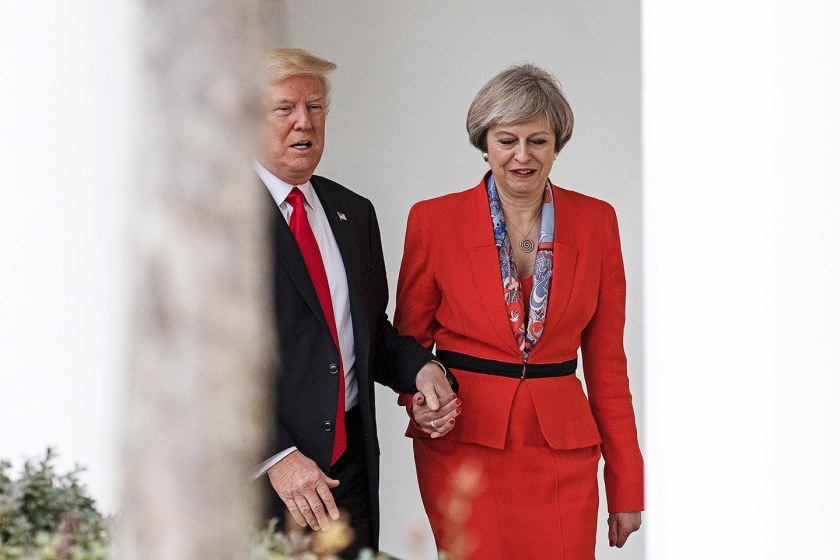
The trans-Atlantic romcom goes into its next season. We recall the highlight of last season, when Theresa and Donald were sharing a personal moment in their “special relationship”.

donald-trump-theresa-may

At the start of the new season, Melania confirms that she really would rather hold almost anything than Donald’s hand:

https://youtu.be/oAWMneAce0Q

Theresa was dancing around Number 10, like, “I can have him all to myself.” But then this French dude came into the picture.

5568

They look so happy together. Macron is even boasting about their “very special relationship”. And Theresa is saying, but Donald, I thought our relationship was the special one. I left Europa for you…

Do loony leftists use the right-hand rule?

So Leave.EU is still active, and apparently last year they were soliciting a graphic to ridicule journalist Carole Cadwalladr:

As a mathematical scientist it strikes me as significant that she is considered to be discredited by association with three images: Flat Earth, Illuminati (though it looks to me like the Masonic eye from the US dollar bill), and what looks like a cheat sheet for an introductory electromagnetism course. Down in the corner we see that she’s been learning the right-hand rule for multiplying vectors. Right above it she has the formula for calculating power, which seems problematic.