Donald Trump has somewhat spontaneously announced restrictions on importation of steel (and aluminum) into the US.
What is the chance that he actually thought he was prohibiting Chris Steele from entering the country?

Donald Trump has somewhat spontaneously announced restrictions on importation of steel (and aluminum) into the US.
What is the chance that he actually thought he was prohibiting Chris Steele from entering the country?
Carl Hempel famously crystallised an obstruction to the formalisation of inductive reasoning as the “Raven paradox”: Suppose I am an ornithologist, concerned to prove my world-shaking hypothesis, “All ravens are black”. I could go out into the field with binoculars and observe ravens. Suppose that over the course of the week I see 198 black ravens, 0 white ravens, 0 green ravens, and so on. These are strong data in favour of my hypothesis, and my publication in the Journal of Chromo-ornithology is assured. (And if they turn it down, I’ve heard there are numerous black studies journals…) But it gets cold out in the field, and sometimes damp, so I could reason as follows: “‘All ravens are black’ is equivalent to ‘all non-black objects are not ravens’.” And in my warm and dry study there may be no ravens, but there are many non-black objects. So I catalogue all the pink erasers and yellow textbooks and white mugs, and list them all as evidence for my hypothesis.
The status of this charming story as a paradox depends on the belief that no one would actually make such an inference. Behold, the president of the United States: Last week the special prosecutor for matters related to Russian interference with the 2016 US election released an indictment of 13 Russians. None of them had worked with the Trump campaign. Trump’s response:
In other words, while it is proving too difficult to collect proof of the contention “No anti-American voter fraud was performed by Trump,” he is collecting evidence that “There were actions not performed by Trump that were anti-American voter fraud.”
I’ve just been reading Ron Chernow’s new biography of U.S. Grant, struck by some of the parallels to current events. As interim Secretary of War Grant was at the center of the struggle over the Tenure of Office Act that served as the pretext for Johnson’s impeachment. Johnson’s supporters charged Grant with lying and drunkenness. The New York Tribune retorted
In a question of veracity between U.S. Grant and Andrew Johnson, between a soldier whose honor is as untarnished as the sun, and a President who has betrayed every friend, and broken every promise, the country will not hesitate.
And Grant’s opponent in the 1868 presidential election, New York governor Horatio Seymour, had
Denounced the Emancipation Proclamation as “a proposal for the butchery of women and children, for scenes … of arson and murder.” During the 1863 draft riots in New York, Seymour had praised the responsible hooligans as “my friends”.
Shades of Charlottesville.
On the one hand, it might be comforting to know that the US has come through worse. On the other hand, to say that current affairs have their parallels in the extreme crisis of civil war, and in a state of division that could only be “resolved” by policies that imposed essentially a century of apartheid in the southern states, is hardly comforting.
I just read Chris Hedges’s book The Wages of Rebellion, about the small sprouts of revolt against the omnipotent corporate state that are still popping up. I was struck by this quote from Jeremy Hammond, who was sentenced to 10 years in federal prison for hacking into government computers to steal and release evidence of government crimes:
He said he did not support what he called a “dogmatic nonviolence doctrine” held by many in the Occupy movement, describing it as “needlessly limited and divisive.” He rejected the idea of protesters carrying out acts of civil disobedience that they know will lead to arrest. “The point,” he said, “is to carry out acts of resistance and not get caught.”
In this he has a soul-brother in the White House, famous for having mocked John McCain for his years in Vietnamese captivity:
He’s not a war hero. He was a war hero because he was captured. I like people who weren’t captured.
Some people are accusing Donald Trump of inconsistency. Today in China he praised his hosts and attacked his own country:
“I don’t blame China – after all, who can blame a country for taking advantage of another country for the benefit of its citizens… I give China great credit,” said Mr Trump while addressing a room of business leaders.
They contrast it with the tone he struck during the campaign last year:
“We can’t continue to allow China to rape our country, and that’s what we’re doing,” he told the campaign rally on Sunday.
But why would anyone assume Donald Trump thinks badly of rapists?
Several years ago I wrote a post about the strikingly different place of the US Civil War and the English Civil War in the collective memories of their respective countries. The other day I alluded in a post title to William Faulkner’s famous dictum “The past is never dead. It’s not even past.” This things come together in the way the news from Washington was dominated for a few days by an argument over the causes of the Civil War. Donald Trump’s Chief of Staff decided to take up the white supremacist’s burden by claiming that the war was an unfortunate consequence of well-intentioned men on both sides being unwilling to compromise. (Rather in the same way that Polish intransigence over the border issue started the Second World War. Not to mention the SS guards’ well-documented failure to maintain proper air-quality standards in Auschwitz…) Continue reading “The compromise candidate”
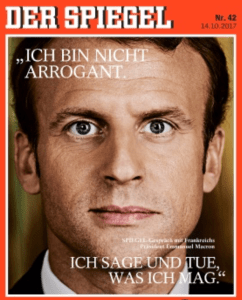
This week’s Spiegel has a headline quote from Emmanuel Macron:
Ich bin nicht arrogant… Ich sage und tue was ich mag.
I don’t know whether everyone does this, but whenever I read a line translated from a language that I know well, I subliminally translate it back. Often you find, particularly in news reports, that lazy translators have used false — or at least dubious -cognates. For example, I vaguely remember a quote from an English source referring to a leader being irritated by protests getting translated into irritiert, which actually means confused.
In this case, my own subliminal process stumbled over the cognate tue, meaning “I do” in German — so Macron said “I say and do what I want”, but “I kill” in French. Which immediately mapped onto another language giving me a momentary flash of Oscar Wilde’s famous line from The Ballad of Reading Gaol:
Yet each man kills the things he loves
It would have been pretty interesting if Macron had actually quoted Wilde to say “Je tue ce que j’aime”.
As for the other part, it’s probably a pretty good bet that if you find yourself insisting “I’m not arrogant”, you’re probably pretty arrogant. Speaking of which, I recently came across these videos of Donald Trump actually (and apparently unironically) acting out the classic punchline of the guy who boasts about his exceptional humility:
In the second one he manages to innovate beyond the obvious comedy of boasting about humility, by going one step farther and ridiculing the interviewer for being too stupid to be able to appreciate his humility.
I’m fascinated by how The Godfather has become the touchstone for all attempts to understand the Trump administration. And by a line of thinking that has hardened into conventional wisdom, clearly stated in today’s op-ed by the NY Times’s token theo-conservative Ross Douthat:
As the hapless Don Jr. — the Gob Bluth or Fredo Corleone of a family conspicuously short on Michaels — protested in his own defense, the Russian rendezvous we know about came before (though only slightly before) the WikiLeaks haul was announced.
We’ve given up on any pretense that the president of the United States isn’t a gangster. Conservative thought leaders are well into lamenting that he isn’t even a competent gangster.
Donald Trump after his discussion with Theresa May at the G20 summit:
We have been working on a trade deal which will be a very, very big deal a very powerful deal, great for both countries and I think we will have that done very, very quickly.
According to the Daily Telegraph,
The President’s comments are a huge boost for Mrs May…
I think it’s hilarious — emblematic of the desperate brexified incompetence of the UK in international trade negotiation. Does anyone think Donald Trump knows what goes into making a trade deal? Don’t they notice that this is just one of the many things that Trump has declared would be “easy” and “fast”. Building a wall on the southern border. Healthcare reform:
“Together we’re going to deliver real change that once again puts Americans first,” Trump said at an October rally in Florida. “That begins with immediately repealing and replacing the disaster known as Obamacare…You’re going to have such great health care, at a tiny fraction of the cost—and it’s going to be so easy.”
Did anyone bother to inform the PM that treaties need to be ratified by a 2/3 majority in the US Senate? That’s not a hurdle you surmount just by holding hands with DT and whispering sweet racial blandishments in his ear. (“Did anyone tell you you have the most Anglo-Saxon eyes?”) A £1 billion bribe isn’t going to cut it either.
It might be worth recalling who Trump said he was getting foreign policy advice from during the election campaign:
I’m speaking with myself, number one, because I have a very good brain and I’ve said a lot of things.
This graphic from the US Department of Health and Human Services has been getting a lot of attention.

Mainly, people have commented on the egregious deceptiveness of the content. The government’s plan is to increase the number of uninsured by 22 million. It’s like Hitler fulminating against Soviet barbarity (which he did — and was probably sincere). But I am fascinated instead by the Trumpification of official US government communications. Leaving aside the sheer novelty of government agencies putting out propaganda against current laws, the first “informational” slogan ends with an exclamation point! Is that normal? And am I merely fantasising the phallic-impotence imagery of the second one? (I mean, it’s hard to imagine why that image is there. Who thinks of mercury thermometers as a symbol for medical care these days? How many people have even seen one? And if that is a thermometer, did Obamacare fail by not getting the fever high enough?)
 Common Infirmities