Mutually reinforcing headlines in Munich

I’m spending a couple of weeks in Munich, and I had to burst out laughing when I saw this tabloid on sale from a stand. The headlines seem to be unintentionally commenting upon one another:

New war in Iraq

followed by

This is your true legacy!

TZ headline

(I have to admit that my translation above, while literally more or less correct, and corresponds to the way I first read it due to the juxtaposition, is not really idiomatic. In the context of large tabloid headlines it’s clear that an appropriate translation would be “This is the right way to leave an inheritance”, and the article is all about how to write your will and avoid paying inheritance tax.)

The death of irony: Snowden edition

I have commented before on the self-contradictions in the attempts by the US to portray Edward Snowden as a common criminal, while themselves taking an “everybody does it” approach to flouting other countries’ laws, and, indeed, its own Constitution.

Now comes a report in Der Spiegel, on a legal opinion presented by the US to a German parliamentary investigatory committee that is considering inviting testimony from Snowden:

Es sei bereits eine “strafbare Handlung”, so der US-Jurist, wenn der “Haupttäter” (gemeint ist Snowden, Anm. Redaktion) etwa durch deutsche Parlamentarier veranlasst werde, geheime Informationen preiszugeben. Gegebenenfalls könne das als “Diebstahl staatlichen Eigentums” gewertet werden. Je nach Faktenlagen könnten Strafverfolger gar von einer “Verschwörung” (conspiracy) ausgehen.

It would be in itself a “criminal offence”, according to the US lawyer, if the “offender” (meaning Snowden) were induced by, for example, German members of Parliament, to reveal secret information. This could be considered “theft of state property”. Depending on the exact circumstances, it could even be prosecuted as a “conspiracy”.

Are US intelligence services really advocating the principle that acquiring secret information from other governments is a criminal offence, one for which individual legislators or indeed an entire parliamentary committee (and why not the whole German Bundestag, and the government to boot?) could be prosecuted? I think it shows the extent to which the US government is, in the Age of Obama, sees international law as a set of rhetorical tricks for expressing the hopelessness of any resistance to US government interests, rather than any set of rules and principles to which all might be subject.

But maybe they really mean to establish the principle that asking for information is illegal. The only valid way to obtain information is theft or torture.

Who is allowed to spy?

A common response to the revelations of unbridled electronic surveillance by the NSA and its anglophone Five Eyes compadres (don’t they have two each? Is this some Graeae thing, where Obama keeps all the eyes locked up in the Oval Office and shares them out as needed? He certainly keeps charge of the tooth…) has been that those who are shocked were simply naïve, and those who weren’t naïve are only pretending to be shocked, for political show, to fool the rubes who are shocked. After all, they say, everyone knows that it’s just the job of spy agencies to suck up all the information they can. Political leaders like Angela Merkel know perfectly well the extent of electronic surveillance, even if some details — like the fact that they themselves were targets — escaped their notice.

So, what are the ethics of espionage?

I understand that appeals to naked power and self-interest are perfectly conventional in international relations*; if Obama and Cameron want to say, we’re big and tough, we have nuclear bombs and world-shaking economies (except for Cameron), so we get to listen in on your phone calls just because we want to, and you should return our runaway spy who revealed what we were doing because you don’t want to face our wrath, we could consider that argument on its own terms.

But Obama and Cameron and their lickspittles claim to be making a moral case: NSA and GCHQ are law-bound agencies, protecting decent people from the forces of darkness, and Edward Snowden is an outlaw, and a dirty traitor to boot.

But imagine a different Edward Snowden. This one was born to Ivan Snowdinsky, who changed his name to John Snowden when he came to the US in the 1970s as a KGB spy. Young Edward pretended to be an ordinary American, but secretly he burned with love for Mother Russia. He directed his career to develop the skills that he could use to infiltrate the dastardly American espionage services. Finally, at age 29, he got the job he wanted. He took all the files he could find and fled for Russia, turning all of  his thumb drives over to Vladimir Putin personally in a secret GRU award ceremony. All of them. Not just the public-interest stuff that our pusillanimous journalists have published. Operations. Methods. Technical data. Everything.

Do we suppose that David Cameron would have said, “Good on you. That’s great espionage you did there.” And would have mocked anyone who said it was unethical to lie to putative allies, violate their laws, and steal their confidential information, all for the purpose of attaining a military or commercial advantage? “Everyone does it,” our alternative-world David Cameron would say, in a joint press conference with the US president. At which Obama would add. “The good ones don’t get caught. Those Russians are the best. We need to learn from their methods.”

Just as the moral case for free access of medical personal to troubled regions is undermined when the CIA smuggles in agents disguised as doctors dispensing vaccines, so the moral case for international cooperation in law enforcement — incredibly important as it is for our security — is powerfully undermined when international power politics masquerades as law enforcement.

* Lewis Thomas’s essay ‘The Iks”, in his book The Lives of a Cell, is an intriguing meditation on the differences between conceptions of morality in the interpersonal and international contexts.

With friends like this, Israel doesn’t need enemies

After reading Goliath, Max Blumenthal’s damning and highly disturbing account of racism and human rights abuses in Israel, I was eager to see what the other side was saying. Israel has many passionate defenders, and Blumenthal is a blatantly partisan writer (not that that’s necessarily a bad thing), and not a Middle East expert — except in that he spent years in Israel researching this book — and doesn’t even seem to speak either of the major languages of the region, so I assumed there would at least be plausible basis for charging Blumenthal with major distortions, errors of fact, or concealing important context.

What I found was this article in The Nation by Eric Alterman. (Followed by this response from Blumenthal, and this counter-response from Alterman.) Alterman is obviously a strong supporter of Israel, obviously smart and competent, and those very facts make his article effectively a defence of Blumenthal’s book. You have to think, if this is all an enraged and intelligent opponent can come up with, the book must be pretty solid.

Because what he comes up with is, essentially, nothing. There’s plenty of invective and playground insults. It’s a “dreadful book” that could have been published by the “Hamas Book-of-the-Month Club” (not just that — Alterman insists that this is “no exaggeration”). Again and again he ridicules the insignificance of the book: “I’m the only person in a print outlet anywhere in the world, as far as I can tell, who has even noticed the existence of Blumenthal’s book.” He rightly derides Blumenthal’s annoying Chomsky-esque tic of larding his descriptions with judgemental adjectives.

And yet, when he hauls out against the book’s substance, his attacks range from the trivial to the bizarrely false. He takes issue with Blumenthal introducing a quote from Burl Katznelson by describing him as Labour Zionism’s “chief ideologue”, saying that this characterisation exists “exclusively in the author’s imagination”. When Blumenthal cites several Labour party leaders using this term, Alterman replies that he’s sure this is a bad translation of whatever it is they said in Hebrew. Well, maybe, but that hardly sounds like a hanging offence. Similarly, they get into a tussle over whether Yeshayahu Leibowitz’s theological and philosophical writings are appropriately described as “talmudic exegesis”. On the other hand, Blumenthal accuses Israel in great detail of systematic harassment of activists, ongoing dispossession of non-Jews, failure to enforce the rule of law with regard to the murder of Arabs and migrants (not even to mention the theft of their property), and official winking at eliminationist racist propaganda. Again, amid all that, if the sharpest criticism he can think of is that some of the chapter titles are overly harsh… The only charge of Alterman’s that is both modestly serious and true is his criticism of Blumenthal’s comment that Mossad agents pose as El Al airline employees to collect information about passengers, which turns out to be based on accusations of a single fired employee. This is pretty thin stuff to do the work that Alterman wants it to, of discrediting the entire book.

Instead, Alterman manufactures quotes or rips them out of context to try to portray Blumenthal as foolish or deceptive. (When caught manipulating a quote, Alterman apologises, saying he “misread it”. Fair enough, if slightly hard to explain. But the fact that Alterman has managed to botch one quote in a 1000-word blog post should give him pause in bashing Blumenthal for his translation of the Hebrew word for “ideologue”.)

Above all, Alterman clearly doesn’t like the fact that Blumenthal isn’t showing proper deference to his elders — he describes Blumenthal as ‘lecturing’ both Ha’Aretz editor Aluf Benn and novelist David Grossman, exactly the kind of tiresome rhetoric that he chided Blumenthal for. He never engages with any of Blumenthal’s arguments, accounts, and accusations, and instead simply spews contempt for Blumenthal and all of his readers, as when he writes “If Blumenthal wishes to categorize Hamas as a group of “terrorists,” as his letter implies, this would be a shock to the readers of his book.” I’m not at all sure what Alterman means to say with this — something like that the only people who would read Goliath are Hamas sympathisers. Of course, Alterman himself has read the book (apparently) but he’s not one of his READERS. Presumably this is some leftist trope that outsiders can’t quite grok. Maybe if I’d been to Woodstock…

The secret government

According to Spiegel, Obama has told Angela Merkel that he knew nothing of “possible eavesdropping” by the NSA on her cell phone — which has been going on for over 10 years — and that he would have stopped it immediately had he known. So we have to assume one of three possibilities:

  1. Obama has decided to double down on the diplomatic affront by baldly lying to the leader of Germany.
  2. Cynics are right: Everyone spies on everyone, and everyone in the higher echelons of government knows about it, so Angela Merkel has felt obliged to collude with Obama to deceive the media and the public.
  3. Obama owes Edward Snowden an apology. The NSA was not working for the US government. It was out of control, slipping the leash of democratic control. Obama was himself naïve to think that he could simply order an investigation. Think back to what Obama said in August about the NSA and Snowden:

And if you look at the reports — even the disclosures that Mr. Snowden has put forward — all the stories that have been written, what you’re not reading about is the government actually abusing these programs and listening in on people’s phone calls or inappropriately reading people’s emails. What you’re hearing about is the prospect that these could be abused… If you are outside of the intelligence community, if you are the ordinary person and you start seeing a bunch of headlines saying, U.S.-Big Brother looking down on you, collecting telephone records, et cetera, well, understandably, people would be concerned. I would be, too, if I wasn’t inside the government…

But people may have better ideas and people may want to jigger slightly sort of the balance between the information that we can get versus the incremental encroachments on privacy that if haven’t already taken place might take place in a future administration, or as technologies develop further…. And so those are the kinds of things that I’m looking forward to having a conversation about.

It’s a typical insider fallacy. He has access to secret information, so he assumes he understands everything that’s going on, far better than the deluded privacy obsessives who have the misfortune of being “outside of the intelligence community”.

So, maybe the president should consider whether it might not have been important after all for a concerned citizen to take matters into his own hands, if even he needed the German news media to let him know what his spooks were up to.

Vintage paranoia

The NYTimes has just published one of its brilliant series of debates, this time on the question of whether it is appropriate to spy on allies. The writers line up more or less two for, two against. Within the for camp there is a split between the world-weary cynical academic Rhodri Jeffreys-Jones, and Bush-era senior Homeland Security official Stewart Baker’s raving paranoia. His headline is “Allies aren’t always friends”, but what he really means is, there are no friends, only enemies we’re not at war with yet. The world is divided up into current enemies and future enemies. He writes

Even the countries we usually see as friends sometimes take actions that quite deliberately harm the United States and its interests. Ten years ago, when the U.S. went to war with Iraq, France and Germany were not our allies. They were not even neutral. They actively worked with Russia and China to thwart the U.S. military’s mission. Could they act against U.S. interests again in the future – in trade or climate change negotiations, in Syria, Libya or Iran?

This is, to put it briefly, insane. It’s like saying, “You’re not my friend. You actively worked to take away my car keys and thwart my plan to drive home from the party yesterday,” after you managed to get the keys back and then ran the car into a tree. Anyone who followed the discussion in France in Germany at the time of the Iraq war would have to acknowledge that “harming the United States and its interests” was nowhere part of the justification for opposing the war. It wasn’t even a matter of seeing the US and Europe as having opposing interests that demand a compromise, that of course can happen between friends. The general belief was that the US and Europe had one common interest, and the US was screwing it up with its obsession with the “military mission”.

Now, the public debate may have been a charade. Perhaps Mr Baker has seen NSA-procured films of clandestine meetings between Schröder and Chirac, with Chirac twirling the thin moustache that he had specially attached by state cosmeticians for such meetings, and saying, “Of course, you are right, cher Ger’art, my plan to deploy the Force de Frappe to obliterate Washington and that freedom-loving Bush and the ‘orrible MacDo, lacks sufficient, how you say, finesse. Far better to allow our good friend Saddam ‘ussein do our dirty work.” And then they pinned the European Star, first class, to Osama bin Laden’s robe, and apologised that his great service could not yet be publicly acknowledged, but that he would be shining beacon to enemies of freedom down through the ages.

It’s a shame that they can’t publish that. Everyone would understand then why spying on our not-yet-enemies is so important. Until then, our spies will have to remain sadly misunderstood.

Spying on the UN: The majestic equality of the law

One of the superficial arguments made against Edward Snowden is, He signed a contract, for crying out loud! He agreed not to reveal this information. And he broke the law. So, of course, he belongs in prison.

Let’s talk about some of the other people who violated the contracts they signed and broke the law. People like Barack Obama. Just to pick an example at random, we have today in Der Spiegel (odd that it hasn’t appeared yet in the English-language press, so far as I have seen):

The US clandestine service NSA has been spying not just on the European Union, but also on the United Nations Headquarters. That has been revealed by secret NSA documents that Spiegel has examined.

According to these, the NSA succeeded in the summer of 2012 in penetrating the videoconference system of the community of nations, and to break the encryption. This “dramatically improved the data received from video-teleconferences and the capacity to decrypt these data,” according to one secret NSA document. “These data transmissions deliver to us the internal video-teleconferences of the United Nations (yay!)”. Within three weeks the number of decrypted communications rose from 12 to 458.

The US is committed by treaty not to conduct clandestine operations against the UN or the national representations there. “yay!” indeed. It’s good to see that violations of international treaties are considered with an appropriate level of seriousness within the agency.

So Barack Obama — and his security agents — have violated solemn treaties, ratified by Congress, hence part of the “supreme law of the land”. So do those who break the law definitely belong in prison? What about those who have revealed information that they have pledged to keep secret? Or is there some wiggle room to consider justifications and rationales for breaking the law?

Why should David Miranda keep David Cameron’s secrets?

One more thought on l’affaire Miranda that hasn’t, I think, been sufficiently represented in the public discussion: What is stolen information? If David Miranda had picked up the British crown jewels in Berlin, and was flying them to Brazil, and was foolish enough to change planes in Heathrow, of course the police would have every right to stop him there and confiscate the jewels.

In fact, though, Miranda was carrying information. If his memory was good enough — if he had a photographic memory — he could have carried it in his head. He is a Brazilian citizen who has, so far as I know, no connection to the UK. What possible justification could there be for expecting him to keep British secrets? If we consider the implications of countries stopping travellers in transit, to examine and confiscate the information they are carrying, it is chilling. And again, what if the traveller is carrying the forbidden information in his head rather than on a hard drive? I’m sure I know many things which whose distribution could benefit enemies of, say, the Iranian state, or the Chinese.

Can Russia stab us in the back?

Who knew that things had gotten so intimate between the erstwhile Cold War adversaries? Senator Charles Schumer (of New York) says

Russia has stabbed us in the back, and each day that Mr. Snowden is allowed to roam free is another twist of the knife.

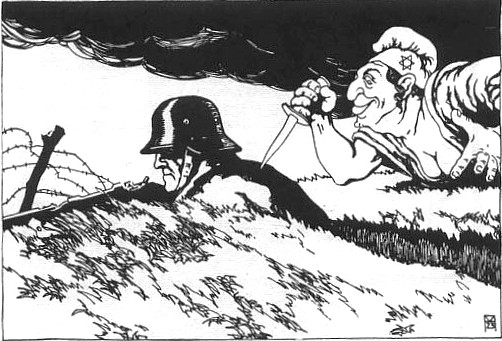
As Mr Schumer surely knows, the “stab in the back” is a favourite antisemitic trope, or more generally a reference to treacherous fellow citizens who are “behind us” because we think we can trust them, while our eyes are focused on the enemy across the border. They are the internal enemy, taking advantage of our attention focused on the external enemy.

1919 Austrian postcard.
In Schumer’s telling, Russia is the one on the right.

Now, Russia is a powerful nation, and I hope that the US has a reasonably cooperative diplomatic relationship to it, but I would never have thought it was a US ally.

So, what I want to know is, who screwed up and let the Russians have our backs?

Of course, we wouldn’t have this problem if Snowden (like Bradley Manning) was gay. Maybe we should stop giving security clearances to heterosexuals. It’s too easy for them to get asylum…

Extradition for thee but not for me

CIA agent Robert Lady, convicted of kidnapping and sentenced to 7 1/2 to 9 years in prison in Italy, has been arrested in Panama under an international arrest warrant. For some reason, though, the Panamanians have not held him, but have allowed him to board a plane bound for the US.

He probably think he has cleverly eluded justice. The joke is on him, though, because as we all know, the US is now a passionate advocate of international cooperation in arresting international fugitives, and of the rigorous enforcement of extradition treaties. So we can be sure that Mr Bob (as the Italian press has apparently taken to calling him) will be on his way back to Italy in handcuffs soon. Unless… But it can’t be that kidnapping (and abetting torture) is seen as a less weighty crime than publishing embarrassing political secrets. Can it?