Condorcet method for choosing a religion

Making choices is hard! Particularly when there are multiple possibilities, differing in multiple dimensions. Like choosing the best religion.

There are many possible methods, leading to a variety of outcomes. The 18th century French mathematician Marie Jean Antoine Nicolas Caritat, the Marquis de Condorcet, advocated privileging methods of deciding elections that will always grant victory to a candidate who would win one-on-one against each other candidate individually. (Of course, there need not be such a candidate.) Such methods are referred to as “Condorcet methods”.

I’ve just been reading The Jews of Khazaria, about the seventh to tenth-century kingdom in central Asia that converted to Judaism around the middle of the ninth century.

According to the Reply of King Joseph to Hasdai ibn Shaprut, one of the few surviving contemporaneous texts to describe the internal workings of the Khazar kingdom,

Each of the three theological leaders tried to explain the benefits of his own system of belief to King Bulan. There were significant disagreements between the debaters, so Bulan went a step farther by asking the Christian and Muslim representatives which of the other two religions they believed to be superior. The Christian priest preferred Judaism over Islam, and likewise the Muslim mullah preferred Judaism over Christianity. Bulan therefore saw that Judaism was the root of the other two major monotheistic religions and adopted it for himself and his people.

How to rid the world of genocide

One of my favourite Monty Python sketches is “How to do it“. It parodies a children’s show, teaching children how to do interesting and cool new things — in this case, “How to be a gynecologist… how to construct a box-girder bridge, … how to irrigate the Sahara Desert and make vast new areas of land cultivatable, and… how to rid the world of all known diseases.” The method described for the last is

First of all, become a doctor, and discover a marvelous cure for something. And then, when the medical profession starts to take notice of you, you can jolly well tell them what to do and make sure they get everything right, so there will never be any diseases ever again.

I think of this sketch often, when I hear a certain kind of blustering politician, most commonly (but not exclusively) of the US Republican variety. The classic sort of “How to do it” (HTDI) solution is the completely generic “I’d get the both sides into the room and tell them, c’mon guys, let’s roll up our sleeves and just get it done. We’re not leaving here until we’ve come up with a solution.” (That’s for a conflict; if it’s a technical challenge, like cancer, or drought, replace “both sides” with “all the experts”. Depending on the politician’s demeanor and gender this may also include “knocking heads together”.) The point is, they see solving complicated problems the way they might appear in a montage in a Hollywood film: Lots of furrowed brows, sleeves being rolled up, maybe a fist pounds on a table. It’s a manager’s perspective. Not a very intelligent manager. Of course, it sounds ridiculous to anyone who has ever been involved in the details solving real problems, whether political, technical, or scientific, but it sounds good to other people who have only seen the same films that the politician has seen. Continue reading “How to rid the world of genocide”

The Times racebaits

I mentioned before the peculiarly awkward and unfunny humour that bursts out in the Times when establishment interests are challenged (standing out particularly sharply in contrast to the usually professional and intelligent demeanour of that particular rag). Yesterday one of their columnists, Patrick Kidd, commented on Jeremy Corbyn’s first Labour Party conference speech. He noticed that two illustrious authors quoted in the speech were BLACK, and decided, giving him an appropriately racially charged metaphor for mocking the Reds:

It certainly felt as if he had taken us deep into the night with a series of unconnected riffs on a general jazz theme of “let’s be kinder to each other.” This was Jeremy Corbyn playing Miles Davis in the uncut version of Kind of Red, with contributions from Ben Okri on drums and Maya Angelou spanking the double bass.

One other point: I’ve noticed that lazy newspaper columnists have this trick of taking a stupid cliché that anyone would recognise as such — a disjointed speech is like jazz, ho hum, what is this, 1958? I think that’s when the Times was spreading fear of contamination by jazz-inflected, negro-influenced leftists, and youth contaminated by contact with racial inferiors — and inflates it to a shaggy-dog story with all kinds of extra detail and verbiage. Unless you’re SJ Perelman, it doesn’t become original this way, only more embarrassingly hackneyed.

“I wish that I was a film comedian”

I’ve just been reading David C. Cassidy’s updated version of his Heisenberg biography, titled Beyond Uncertainty. He reports that in May 1925 Wolfgang Pauli, who was struggling together with Heisenberg to apply the new quantum theory to calculate the spectral lines of hydrogen, wrote in a letter

Physics is at the moment once again very wrong. For me, in any case, it is much too difficult, and I wish that I was a film comedian or something similar and had never heard of physics.

Here is a challenge for a young postmodernist film-maker: Produce the silent-film comedies that Wolfgang Pauli would have made, had he never heard of physics (or abandoned physics? Presumably they would have been different…)

Alternatively, a science fiction author could write about a universe governed by Charlie Chaplin’s quantum mechanics.

International queueing theory

queue2
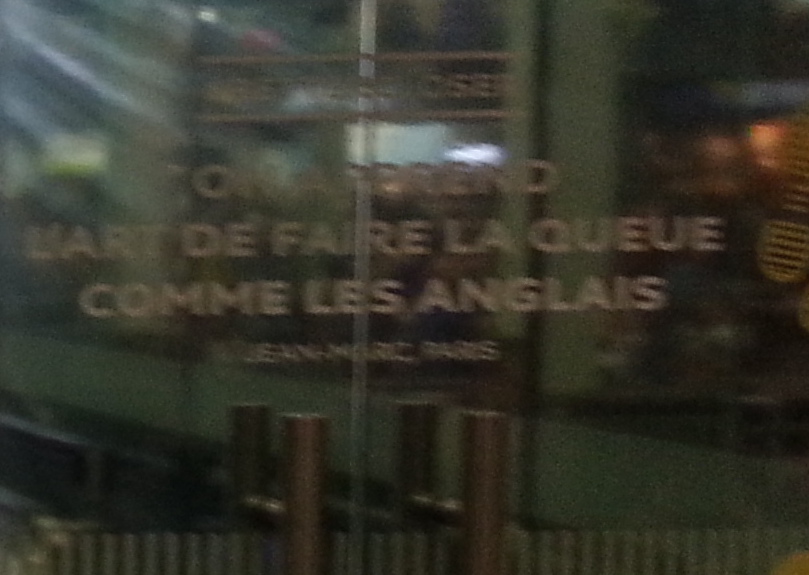
Queueing up to board the Eurostar in London recently, I saw these very conspicuous signs engraved in the doors leading to the platforms

On apprend l’art de faire la queue comme les anglais.

Attributed to “Jean-Marc, Paris”. There was also a translation, something like “We are learning the art of queueing up like the English”. Is this intended to shame the French passengers into behaving well in the queue? To flatter the English? To mock them?

Of course, while the English are very proud of their queueing habits, there are greater superlatives imaginable. Historical context is crucial, though. If the French develop their skills further (and if the Germans make more progress in dismantling the European economy), perhaps one day they will be able to say they have learned “the art of queueing up like the Poles (Communist era)”. Or even the Russians. If they get really advanced, they might learn the art of queueing up like Depression-era Americans.

And that’s the pinnacle. Presumably they’ll never have to learn to queue up like these people…

holocaust victims queueing for train

Greece and the lessons of Versailles

After commenting on the fake “assistance” that the Euro countries have bestowed on Greece for the past five years — stabilising Greece just far enough to get international banks clear of the falling debris, and then pushing it off the cliff — it occurred to me that this ties in usefully with the discussion that has been bubbling up — from Thomas Piketty among others — of how chief scold Germany had its debts written off after both world wars. Or, rather, it defaulted on its WWI debts as preparation for initiating WWII; the world then decided to cancel most of its debts after WWII — including debts to Greece — at the London conference of 1953. It would be hard to say that Germany in 1953 was more deserving of international assistance or forgiveness than Greece today. In part, this reflects the predilection for strong villains: Germany was seen as inherently strong, if currently weakened; Greece is viewed with contempt, for its weak and corrupt political system. Having reduced much of Europe to rubble and murdered millions is just one of those misadventures that befall those with big plans. At least you knew, if you bailed out Germany, the money wouldn’t just be wasted…

Plus ça change: Partition of Poland edition

If you wanted to refer to a paradigmatic example of wanton brutality in international affairs, the invasion and division of Poland by Nazi Germany and the Soviet Union in 1939 would likely spring to mind. That’s why I was struck by the 1903 remark on the Boer War cited by Richard Toye in his book on Churchill’s imperialism:

Bourke Cockran, Churchill’s Irish-born politician friend, thought the war to be “the greatest violation of justice attempted by any civilized nation since the partition of Poland.”

I suppose now you could say, “the partition of Poland was the greatest violation of justice since the last partition of Poland.” You’d leave out the “civilized nation” bit, not exactly because Nazi Germany and the Soviet Union wouldn’t qualify, but because the concept no longer seems to have much explanatory power.

More Zionist anti-semitism

I commented recently on the good fit between classical antisemitism and Zionism, despite the efforts of some to associate necessarily antisemitism with anti-Zionism, perhaps on the basis of both having the prefix “anti”. I just came across another forceful testimony to this alignment, from a figure less notorious than Adolf Eichmann. In the book Churchill’s Empire (about the development of Winston Churchill’s attitudes toward the British Empire), Churchill is quoted on the subject of Zionism from a 1920 newspaper article:

He distinguished between praiseworthy “National Jews”, loyal to the countries in which they lived, and the “sinister confederacy” of “International Jews” whom he claimed were largely responsible for the Bolshevik revolution. In this analysis Zionism offered a “third sphere to the political conceptions of the Jewish race”, and Churchill predicted that, “if, as may well happen, there should be created in our own lifetime by the banks of the Jordan a Jewish State under the protection of the British Crown […] an event would have occurred in the history of the world which would, from every point of view, be beneficial, and would be especially in harmony with the truest interests of the British Empire.”

Plaque assay

I was just in Paris for a few days. Walking past the Lycée Simone Weil, in the 3rd arrondissement, I noticed a plaque, such as one sees quite commonly on public institutions:

À la mémoire des jeunes filles, élèves de cet établissement, autrefois école de couture die la ville de Paris, déportées et assassinées de 1942 à 1944 parce qu’elles étaient nées juives, victimes innocentes de la barbarie nazie avec la complicité active du gouvernement de Vichy.

Plus de 11400 enfants furent déportés de France dont plus de 500 vivaient dans le 3ème art de Paris.

Ils furent exterminés dans les camps de la mort.

Les élèves du Lycée Simone Weil ne les oublieront jamais.

[To the memory of the girls, pupils of this establishment, which was then the Paris School of Dressmaking, deported and murdered from 1942 to 1944 because they were born Jewish, innocent victims of the Nazi barbarism with the active complicity of the Vichy government.

More than 11400 children were deported from France, of whom more than 500 lived in the 3rd arrondissement of Paris.

They were exterminated in the death camps.

The pupils of the Lycée Simone Weil will never forget them.]

As I read it, the formulation seemed to me strikingly perfect. The text avoids all the pitfalls that similar texts have been criticised for, whereby they seemed to either be minimising the horror, or pushing away blame, or somehow alienating the victims. The victims were “jeunes filles”, “innocent victims”, “murdered because they were born Jewish” (thus emphasising that it was a purely racist crime. They were “exterminated”, they lived right here, and then this somewhat wishful phrase at the end, usually attached to heroic martyrs, “The pupils will never forget them.” Most striking was the attribution of responsibility to “Nazi barbarism with the active complicity of the Vichy government.” They clearly were concerned to make absolutely unambiguous that they were not minimising French responsibility. Not just “complicity”, but “active complicity”. (Though it wasn’t the “French government”, but only the “Vichy government”.)

I was impressed first, then irritated. Precisely because they managed to tick every box and engrave such a perfect text on the plaque, it made it clear what a formulaic activity it is. (Perhaps the final sentence, unassailably high-minded just as it is clearly not true in any meaningful sense, also drove that point home.) It’s not that they did anything wrong, and I’m glad that they put all these plaques up. There’s just a limit to what you can achieve with a plaque, and perfecting the art of the memorial plaque in some ways undermines the spirit that it is meant to express.

A bomb in mathematics

I’ve just been reading Joseph Conrad’s The Secret Agent. It’s more than a century old, and I was surprised to find it such an acute analysis of the psychology of terrorism. It follows the planning and aftermath of a ridiculous and botched scheme to blow up the Greenwich Observatory. The ringleader Mr Verloc, the “secret agent” of the title, who spends his time infiltrating anarchist organisations, is put up to it by his employer, the embassy of an unnamed Central Asian nation. The crime seems almost entirely unmotivated. The new First Secretary of the embassy is irked by Verloc’s indolence and apparent uselessness, and seeks to prod him into making some exertions for his salary. The inane goal of the attack is to show up the ineptitude of the English police, and so stimulate an autocratic turn in its inconveniently soft and democratic government. Plus ça change… The target must be such as to seem senseless (hence not a tiresomely conventional target, like a crown prince or a government building), important (hence not the National Gallery — “There would be some screaming, of course, but from whom? Artists — art critics and such like — people of no account. No one minds what they say.”) and sufficiently menacing. He announces

The demonstration must be against learning—science.  But not every science will do.  The attack must have all the shocking senselessness of gratuitous blasphemy.  Since bombs are your means of expression, it would be really telling if one could throw a bomb into pure mathematics.  But that is impossible…  What do you think of having a go at astronomy?

I was also amused by the comment of the bomb engineer:

The system’s worked perfectly.  And yet you would think that a common fool in a hurry would be much more likely to forget to make the contact altogether.  I was worrying myself about that sort of failure mostly.  But there are more kinds of fools than one can guard against.  You can’t expect a detonator to be absolutely fool-proof.