Can Russia stab us in the back?

Who knew that things had gotten so intimate between the erstwhile Cold War adversaries? Senator Charles Schumer (of New York) says

Russia has stabbed us in the back, and each day that Mr. Snowden is allowed to roam free is another twist of the knife.

As Mr Schumer surely knows, the “stab in the back” is a favourite antisemitic trope, or more generally a reference to treacherous fellow citizens who are “behind us” because we think we can trust them, while our eyes are focused on the enemy across the border. They are the internal enemy, taking advantage of our attention focused on the external enemy.
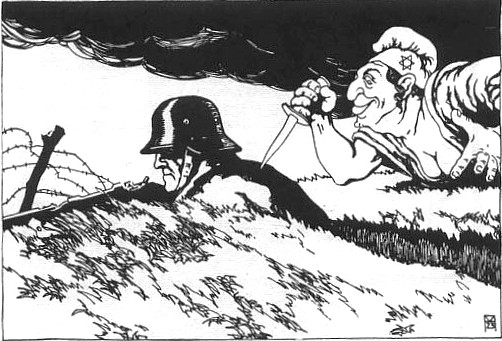
1919 Austrian postcard.
In Schumer’s telling, Russia is the one on the right.

Now, Russia is a powerful nation, and I hope that the US has a reasonably cooperative diplomatic relationship to it, but I would never have thought it was a US ally.

So, what I want to know is, who screwed up and let the Russians have our backs?

Of course, we wouldn’t have this problem if Snowden (like Bradley Manning) was gay. Maybe we should stop giving security clearances to heterosexuals. It’s too easy for them to get asylum…

Insider trading and the birth of America

In Walter Isaacson’s biography of Benjamin Franklin I’ve just encountered the following anecdote. Edward Bancroft was secretary to the American commissioners — Franklin, Silas Deane, and Arthur Lee — who were in Paris negotiating the crucial military alliance with France. The British were desperate to forestall this alliance with their own peace overtures:

The British sent to Paris the most trusted envoy they could muster, Paul Wentworth, their able spymaster. At the time, Wentworth was angry with his secret agent Bancroft for sending inside information to his stock-speculating partner before sending it to Wentworth, who was also a speculator. King George III, upset by the bad news that his spies were giving him, denounced them all as “untrustworthy stock manipulators”, but he reluctantly approved Wentworth’s secret mission.

And indeed,

years later, when he was haggling with the British over back pay, Bancroft wrote a secret memo, telling the foreign secretary that this was “information for which many individuals here would, for purposes of speculation, have given me more than all that I have received from the government.” In fact, Bancroft had indeed used this information to make money speculating on the markets. He had sent 420  pounds to his stock partner in England… and provided him word of the impending treaties, so that it could be used to short stocks… Bancroft ended up making 1000 pounds in the transaction.

I find it delicious to think that American independence was made possible, or was, at least, expedited by British agents’ clumsy insider trading.

(Anyone who is interested in the culture of speculation and market-manipulation driven by political information, and also enjoys a good philosophical yarn, should read Neal Stephenson’s Baroque Cycle.)

Gambling and finance: The 17th century view

I’ve commented on the peculiar dissipation in recent times of the moral stench of gambling, particularly as practiced by the quant elite, who seem at times to revel in their role as gamblers. But I discover now that I was preceded by more than 3 centuries by Daniel Defoe, in his brilliant Essay on Projects:

Wagering, as now practised by politics and contracts, is become a branch of assurances; it was before more properly a part of gaming, and as it deserved, had but a very low esteem; but shifting sides, and the war providing proper subjects, as the contingencies of sieges, battles, treaties, and campaigns, it increased to an extraordinary reputation, and offices were erected on purpose which managed it to a strange degree and with great advantage, especially to the office-keepers; so that, as has been computed, there was not less gaged on one side and other, upon the second siege of Limerick, than two hundred thousand pounds.

This last extraordinary remark, that people were wagering vast sums on the outcomes of sieges. (£200 thousand in the 1690s is probably like £20 million today, or $30 million.) And he goes on to use gambling on the outcomes of siege warfare to present a fascinating example of a sort of arbitrage called a “dutch book”: Combining different wagers with different parties so as to obtain a cumulative certain profit. (De Finetti’s “Dutch Book Theorem”, stating that you need to calculate with something indistinguishable from the standard rules of probability if you don’t want to fall victim to someone else’s dutch book, is the basis of certain approaches to the foundations of probability.) Continue reading “Gambling and finance: The 17th century view”

Computer culture and gun culture, ctd.

Since I’ve been interested in the history and political significance of cryptography (I discussed the connection between computers and the 2nd amendment here) I read the book This Machine Kills Secrets by journalist Andy Greenberg, a fascinating, if somewhat brief and barely technical history of underground cryptography in the internet age. Among other things I learned there is that, whereas I had thought of gun culture and computer culture as analogous but non-intersecting, in fact there was considerable overlap:

One adjunct group, called the Cypherpunks Shooting Club, even organized trips to rifle ranges to teach each other to shoot .22s and semiautomatic weapons, the final resort should the government ever come after their electronic and physical freedoms. (Tim May, an avid gun enthusiast himself, didn’t attend. “I Don’t give free lessons, especially not to clueless software people,” he says.)

Jim Bell, a cypherpunk insider, proposed in the mid-1990s “Assassination Politics”, basically a scheme for combining strong cryptography with a sort of stock market for murder contracts. The goal was anarchy:

If only one person in a thousand was willing to pay $1 to see some government slimeball dead, that would be, in effect, a $250,000 bounty on his head[…] Chances are good that nobody above the level of county commissioner would even risk staying in office.

Just how would this change politics in America? It would take far less time to answer, “What would remain the same?” No longer would we be electing people who will turn around and tax us to death, regulate us to death, or for that matter send hired thugs to kill us when we oppose their wishes.

This all sounds like the sorts of rant you hear these days from the extreme gun nuts. So maybe the analogy is not that far-fetched.

And, come to think of it, now that concrete schemes are afoot to turn weapons manufacture into a software problem with 3d printing, even the technical differences between guns and codes are dissipating.

Benjamin Franklin’s advice on vaccination

I’ve never seen Franklin brought into the discussion of parents’ refusal to vaccinate their children. This passage from his autobiography made a deep impression on me:

In 1736 I lost one of my sons, a fine boy of four years old, by the small-pox, taken in the common way. I long regretted bitterly, and still regret that I had not given it to him by inoculation. This I mention for the sake of parents who omit that operation, on the supposition that they should never forgive themselves if a child died under it; my example showing that the regret may be the same either way, and that, therefore, the safer should be chosen.

More comments on Andrew Wakefield and the MMR-autism hoax here.

I once was at a parents’ meeting in Oxford where a homeopath had been invited to speak. I was genuinely nonplussed that she was raving against vaccines. Aren’t vaccines the one great success of the homeopathic world-view? Giving a tiny dose of the disease-causing agent to cure (or prevent) the disease. Her answer was incomprehensible to me, but seemed to suggest that the very fact that there was a measurable physiologic effect showed that they weren’t any good (from a homeopathic perspective). And the fact that pharmaceutical firms made the vaccines was all you needed to know about their chthonic nature.

I fled the meeting in revulsion when the homeopath started prating about homeopathic cures for tetanus.

Paradoxes of belief: Holocaust denial edition

(or, Vonnegut’s Mother Night reversed)

I’ve long thought it amazing how many odd, nearly unbelievable, individual stories are hidden in the corners of the grand ghastly narrative of the Holocaust; and no matter how many stories I read — Peter Wyden’s account of Stella Goldschlag, for instance, his Jewish schoolmate in 1930s Berlin who specialised in sniffing out undercover Jews for the Gestapo — there’s always another even stranger, such as the jewish graphic designer Cioma Schönhaus who survived the war, and saved many other lives, by learning to forge identity papers.

Holocaust denial seems to have its own bizarre corners. To wit, this new revelation:

[David Stein] a cerebral, fun-loving gadfly who hosted boozy gatherings for Hollywood’s political conservatives […] brought right-wing congressmen, celebrities, writers and entertainment industry figures together for shindigs, closed to outsiders, where they could scorn liberals and proclaim their true beliefs. That he made respected documentaries on the Holocaust added intellectual cachet and Jewish support to Stein’s cocktail of politics, irreverence and rock and roll.

[Under his original name David Cole he] was once a reviled Holocaust revisionist who questioned the existence of Nazi gas chambers. He changed identities in January 1998.

This reads like an April Fool’s prank, or a high-concept film plot from the fevered leftist imagination. The right-wing Jewish Holocaust documentary maker and fanatical Israel supporter is actually a secret neo-Nazi. Ha ha. Who would believe that? It’s not so easy to change your identity, particularly if you’ve just made yourself notorious on TV chat shows. And how would a man with no past be able to start a new career and become a political insider?

But what intrigues me most of all is when the Guardian article touches on the question of Stein/Cole’s true beliefs. One of the important lessons of modern cognitive psychology and philosophy of mind is that it is very difficult — perhaps impossible — to develop a coherent theory of beliefs, under which statements like “X believes Y” are statements of fact. (See, for example, the seminal book by Stephen Stich, that relegates beliefs — and other many other concepts — to the realm of “folk psychology”.)

Continue reading “Paradoxes of belief: Holocaust denial edition”

Statisticians of the World, Unite!

You have nothing to lose but your Markov chains!

From “A Brief History of Britain 1066-1485”, by Nicholas Vincent:

Finally, as in all modern debates from which statistics and the spirit of Karl Marx are never far distant, it has been argued that, by 1200, Philip of France was far richer than the King of England and therefore ideally placed to seize the Plantagenet lands.

Statisticians or Stakhanovites? You decide…

Fascism in America

Today we have conquered the health-care insurance exclusion for pre-existing conditions. Tomorrow, Poland!
Nuremberg rally
Die NRA sind unser Unglück!

I remember many years ago when I first saw a car bumper sticker saying “First round up the guns, then round up the Jews!”, which I assumed to be suggesting that the owner disapproved of both confiscations. Just now, the “Nazi gun control” trope is all over the place: for instance, here and here and even here.
It’s weird, because this story seems to have literally zero basis in fact. I’ve read quite a few books about the Weimar Republic, the rise of Nazism, and the Third Reich, and I’ve never come across any reference to a Nazi interest on the question of private gun ownership. Sure, Jews were forbidden to have guns, but they were also forbidden from owning cats. It’s not that the Nazis feared the wrath of the Hebrew feline defenders.

The only reference I’ve come across to a nexus between Nazi ideology and private guns (as opposed to military armaments, in which they obviously had an abiding interest) is a passage in Ian Kershaw’s masterful biography of Hitler. Discussing the extraordinary thoroughness of the campaign of “Gleichschaltung” — the “coordination” of all institutions, whether large or petty, with Nazi goals and ideology — in 1933, he quotes an “activity report” from the small town of Theisenort (population about 750) in Upper Franconia:

The Veterans’ association was coordinated on 6.8.33, on 7.8.33 the Singing Association in Theisenort. With the Shooting Club in Theisenort this was not necessary, since the board and committee are up to 80 per cent party members.

So there would have been no need to round up the weapons of regime opponents, because the shooting enthusiasts were all Nazis to begin with. That doesn’t really support the whole bulwark against fascism idea. Continue reading “Fascism in America”

British riots

rioting-carousel-007

The well-known history of enclosure riots in 16th and 17th century England fascinates above all for their orderliness. Describing one riot in early Jacobean Bedfordshire, V. Magagna writes “The assembly that plotted the riot met in the church[…] The leader of the riot was the village constable.”

I thought of this when I read the following on the BBC web site, on the third day of riots and looting throughout London:

“Full scale looting going on at Clarence convenience store right by the burning car on clarence road. “One by one” shouts one man as people crowd round to get into the shop, whose entrance has been smashed in. Women calling: can you get me a magazine? Other people asking for alcohol.”

One by one. That’s British looting for you. They’ll pillage, and they’ll rampage, and they’ll kill, but they’ll queue up in an orderly fashion to do it… particularly if they have hopes of being rewarded with alcohol.

“Petitioning implies a belief in a natural order of society protecting the interests of rich and poor alike, which the authorities can be expected to enforce once the misdeeds of individuals are brought to their notice. Even riot can be seen in this light, for the intention was usually to compell authority to maintain a traditional order, rather than to overturn it.” Underdown, 1985, p. 118

london looting