Big notes

I remember reading, back in the late 1990s, an article in Spiegel, about the dubious decision of the Euro finance ministers to create a 500 euro banknote. Since the only people who use cash in significant quantities in this millennium tend to be shy people eager not to be singled out for their achievements by prosecutors, the question was raised, why would you want to create a unit of currency that enables law-abiding citizens (and others) to pack five times as much currency into a suitcase as the former favourite $100 bills?* The answer given by Edgar Meister, one of the directors of the Bundesbank, was that Germans had gotten used to having a 1000 Mark banknote, and that if the largest Euro banknote were worth less, people would think this new currency was a weakling.

Eine Währung, die es sich leisten kann, mit so hohen Noten herauszukommen muß wertbeständig sein.

A currency that can afford to produce such large banknotes must be solid.

As everyone knows, that’s why Germany produced this 50 million Mark note in 1923: Continue reading “Big notes”

Utility of the Devil

I very much enjoyed reading Richard Thaler’s book Misbehaving, on behavioural economics and his own role in its development. It occurred to me that the basic lessons of that soi disante science may be summarised by a variant on a famous Rolling Stones song:

You can’t always know what you want…

But if you don’t try, most of the time

You just might find you want what you know.

Shut it down!

From John Holbo I got this link to weird libertarian rantings by a financial journalist I never heard of. I was particularly struck by this Randian comment

Maybe we should shut Wall Street down for 24 hours, see how everybody who blames Wall Street for everything likes that.

Well, what would happen? I think I know a fair amount about the role of financial markets in the economy, and while I don’t consider them useless, I really can’t see what the problem would be if they were shut down for 24 hours. Not only that, I’m not even sure what their staunchest defenders might claim the problem would be.

In fact, didn’t we try this experiment already? The NYSE, and pretty much all the New York financial industry got shut down for several days or a week after the 9/11 attacks. Did anyone mind? I’ve heard a lot of commentary about the impact of 9/11, and I’ve never once heard anyone even suggest that there had been negative consequences to closing the financial markets for a week.

The magic of markets

I find The Times fascinating, as a peek into the id of the British establishment. Thus, it usually seems sort of objective and reasonable — and I find its science coverage excellent, for a daily newspaper — until some event hits the nerve of class interests and establishment ideology, such as on the day after Jeremy Corbyn’s election as Labour Party leader. Then the news and editorials fall into line with a kind of mirthless sarcasm that astonishes in its combination of vituperation and simplemindedness. I find myself then reading it, like the scripture of some weird sect — I’m not naming names here — wondering, does anyone really find this either amusing or insightful. With the extra frisson of remembering that those who find it both amusing and insightful are running the country.

Today there was an editorial bashing the NHS. After one of those it-was-probably-clever-the-first-time-someone-said-it quips about how at current growth rates, the NHS will exceed 100 percent of the British economy by 2100, the writer (Ross Clark) refers to one of today’s news items:

A new threat to NHS financial stability has emerged: thanks to the increasing complexity of drugs it will cost a lot more in future to produce generic versions.

At present, drugs typically fall in price by 95 per cent once their patents expire. But new drugs that rely on biological agents are expected to fall in price by only 25 per cent, drastically cutting the £13.5 billion  the NHS saves every year by using generic drugs.

The NHS should have cottoned on much faster to the fact that generic drugs cannot be relied on indefinitely. It should be using its power in the marketplace much more to push prices down.

I bet there are heaps of overpaid NHS managers slapping their foreheads, thinking “power of the marketplace, why didn’t I think of that?!” The whole point is that these new drugs are expensive to produce, so no pharmaceutical company is going to rush in to sell it for 5% of the original cost, regardless of whether it is protected by patent rights. We’re seeing a change in the relative cost of development and production. (It’s the reverse of the change in the music industry from the early days of CDs when the physical production of the CD cost several dollars to now when the marginal cost of an album is infinitesimal.)

No amount of “cottoning on” by the NHS is going to change this fundamental reality.

Singing the Swedish national anthem

When someone speaks incomprehensibly, an English speaker will be inclined to reference Shakespeare’s Julius Caesar, saying “it was Greek to me”. But what does a Greek finance minister say when no one understands him at Eurogroup negotiations? From an interview with Yanis Varoufakis in the New Statesman:

There was point blank refusal to engage in economic arguments. Point blank. You put forward an argument that you’ve really worked on, to make sure it’s logically coherent, and you’re just faced with blank stares. It is as if you haven’t spoken. What you say is independent of what they say. You might as well have sung the Swedish national anthem – you’d have got the same reply.

Unavoidable chaos in the NHS?

A BBC headline announces that

Migration rules ‘may cause NHS chaos’

The problem is, a rule introduced in 2011 requires that foreign workers must return home after 6 years if they are not earning over £35,000. This is presented a disaster that can only be averted by the government granting an exemption to the rules.

The union says that by 2017 more than 3,300 NHS nurses could be affected. And by the end of the decade the numbers could be double that – a potential waste of nearly £40m when all the costs of recruitment are taken into account, the RCN says.

RCN general secretary Peter Carter said: “The immigration rules will cause chaos for the NHS and other care services.

“At a time when demand is increasing, the UK is perversely making it harder to employ staff from overseas.”

He told BBC Radio 4’s Today programme the move was “totally illogical” as there is currently a “major shortage of nurses”, leading to many NHS trusts spending “tens of millions” to recruit from overseas.

Dr Carter also stressed that most nurses earn “nowhere near” £35,000, with most on salaries of between £21,000 and £28,000 a year.

I don’t mean to defend the Tory policies, which combine the Conservative view that the non-rich are inherently undesirable with the usual British political one-upmanship on bashing foreigners, but this doesn’t look to me like an inherently unsolvable problem. There is a method known for increasing the supply of labour: raise wages. If there is a “major shortage” of nurses when you pay between £21,000 and £28,000 a year, I’m willing to guess that there would be less of a shortage if they were paid between £25,000 and £32,000 a year. It probably wouldn’t solve the problem completely, in the short term, but it would bring in marginal resources — some part-time workers would work more hours, some would delay retirement, and so on — and it would pull more young people into the profession. And if they raised salaries to £35,000, that would solve their international recruitment problem. Continue reading “Unavoidable chaos in the NHS?”

The annuity puzzle

Stanford biodemographer Shripad Tuljapurkar has written a very thoughtful post about the “annuity puzzle”: Why do people generally not choose to purchase annuities that would seem to protect them from a major risk: Being feeble and impoverished 30 or 40 years after retirement? His explanation, which is surely right as far as it goes, is that the shunning of annuities is a rational response to the compensating default risk from the insurance company. You have to live quite a long time to make your nut on an annuity. The “risk” — the probability of living that long — is low, and (he argues, persuasively) one could reasonably conclude that it is outweighed by the likelihood of a financial crash in the interim.

From a behavioural economics perspective, this matches closely one of the standard explanations for discounting: Future returns are drastically uncertain, so we develop the habit of preferring immediate gratification. So this falls in the category of attempts to explain seemingly irrational economic behaviour by showing that it is in fact rational when you take into account limited information or costs of acquiring or analysing information. Of course, any economic theory inevitably struggles to deal with questions of insurance and annuities, where the risk involves the life of the economic agent. The celebrated analysis of this problem by Jack Benny is still relevant.

But while this is a cogent argument for why people shouldn’t buy annuities, I’m skeptical of it as an explanation for why they don’t buy annuities. First, the annuity puzzle is a phenomenon of average people, not savvy investors. I doubt that most people think much about the risk of established financial companies defaulting. One prominent study (based on surveys conducted in 2004) found that 59% of Americans would trade half of their Social Security annuity for an actuarially fair lump sum payment. I’m pretty sure that they are not thinking that they can find a safer investment, with less risk of default, than Social Security. Continue reading “The annuity puzzle”

Feeling good

According to the Guardian,

British taxpayers should expect to feel worse off under whichever party wins the general election next week, according to the Institute for Fiscal Studies.

What a weird circumlocution! We’re not saying that people will be worse off, only that they will feel that way. We’re not even really saying that that they will feel worse off, only that they should expect to feel worse off. And what will be the basis for that feeling? They will be paying higher taxes which, as taxpayers, is all those people care about. It may be that British residents will be feeling better if Labour is elected — their children will have more and better school places, they won’t have to queue at the hospital A&E, they’ll have access to better social services in times of need — but British taxpayers will be down in the dumps. Maybe there’s some way we could get them to meet up, even for the residents to share some of their good fortune with taxpayers.

The funny thing is, the report does not use the expression “worse off” (except in reference to a particular proposed tax change with a cliff-edge effect, leaving some people in a particular income band worse off than if they had lower incomes). It doesn’t include broad statements about people’s general subjective well being, or even their financial well-being. It simply suggests that all the parties are going to raise taxes somewhat, make minor changes to benefits, and overall make the system slightly more complicated and less coherent.

The Underground George Osborne

Paul Krugman has taken on the Conservatives’ new budget, which proposes tax cuts, spending increases (until the election) and reducing the budget deficit in some unspecified way.

Osborne produces a ludicrous budget, and even commentators who acknowledge that it’s ludicrous give him credit for showing

a keen understanding of the constraints facing the country

Think about that: someone says that 2+2=5, and gets credit, because it shows that he recognizes how hard it is to live within the constraint of 2+2 just equalling 4.

Admittedly, it looks like vote-grubbing flimflam, but maybe we’re misunderestimating (to use a phrase popular among conservative Georges) the Chancellor of the Exchequer. Maybe, when you look past the snazzy new haircut we would see a soul in existential crisis, who would cry out from the floor of the Commons like Dostoyevsky’s Underground Man:

“Upon my word, they will shout at you, it is no use protesting: it is a case of twice two makes four! Nature does not ask your permission, she has nothing to do with your wishes, and whether you like her laws or dislike them, you are bound to accept her as she is, and consequently all her conclusions. A wall, you see, is a wall … and so on, and so on.”

Merciful Heavens! but what do I care for the laws of nature and arithmetic, when, for some reason I dislike those laws and the fact
that twice two makes four? Of course I cannot break through the wall by battering my head against it if I really have not the strength to knock it down, but I am not going to be reconciled to it simply because it is a stone wall and I have not the strength.

As though such a stone wall really were a consolation, and really did contain some word of conciliation, simply because it is as true as twice two makes four. Oh, absurdity of absurdities! How much better it is to understand it all, to recognise it all, all the impossibilities and the stone wall; not to be reconciled to one of those impossibilities and stone walls if it disgusts you to be reconciled to it; by the way of the most inevitable, logical combinations to reach the most revolting conclusions on the everlasting theme, that even for the stone wall you are yourself somehow to blame, though again it is as clear as day you are not to blame in the least…

What people don’t know about the NHS

… is that it is incredibly cheap. I was speaking recently with a British colleague, who asked how I liked being back in the UK after a year on sabbatical. I mentioned that there are things I really appreciate about living in California, but one of the things I like best about the UK is the NHS. Even without any significant health problems in the family, the incomparable irrationality of the US healthcare system (though even calling it a “system” seems overly generous) is palpably unnerving, at the very least since you’re occasionally confronted with the question of whether this or that problem is significant enough to go to the hospital for, and then you have to consider whether it’s worth entering into a multiyear negotiation over fictional bills for thousands of dollars.

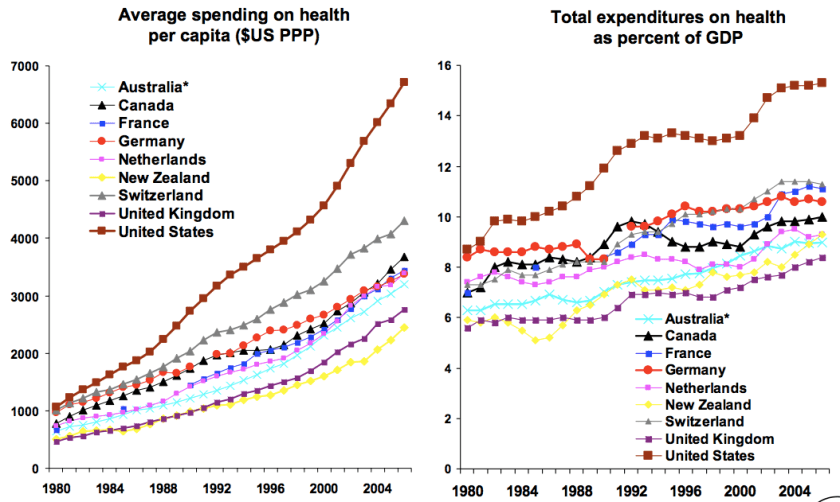
Anyway, I remarked that I wish the UK would just raise its health spending to the European average, that it would be far and away the best in the world, as opposed to limping along as it does now, being the best for equality, but clearly overstretched, and not quite matching the top national healthcare systems. I thought this was simply a platitude, but he seemed genuinely surprised by the claim. On further questioning, he said that he would have thought the NHS was relatively expensive compared with healthcare in western Europe generally.

In fact, UK health expenditures are low, not just compared with the wealthy countries of western and northern Europe, but with respect to the EU generally — including the relatively poor countries of eastern Europe. They would have to spend an additional 6 billion pounds — about a 5% increase — to match the EU average. In 2011 the UK was below average healthcare spending for the OECD, and was still only average after removing the exceptionally high spending USA. (The US, despite the notoriously expensive private healthcare system of which its right-thinking populace is so proud, has considerably more public healthcare expenditure per capita than the UK, on top of the private system. And life expectancy is still several years shorter.)

I wonder if the public would demand more spending on the NHS, rather than accepting the government line about necessary efficiencies and the magic of privatisation, if they knew how efficient the NHS already is, and how little they are spending on healthcare compared with their European neighbours, not to mention the profligate Americans and Canadians.

 

2012-07-17-03-31-04-pm1