
Papers, please!, ctd.

Apparently Immigration and Customs Enforcement (ICE) in the US has been conducting raids targetted enforcement in major US cities.

A DHS official confirmed that while immigration agents were targeting criminals, given the broader range defined by Trump’s executive order, they also were sweeping up noncriminals in the vicinity who were found to be lacking documentation.

For me, this raises again a question that has genuinely puzzled me for a long time: How many Americans typically carry with them documentation that would show their citizenship, or otherwise prove their right to be in the US? A birth certificate would do (unlike in the UK, where the government has been at pains to show that it won’t even recognise the right to citizenship of people of tainted foreign blood, even if they were born in the UK at a time when everyone thought the law automatically granted them citizenship), or a passport, but most people don’t carry these things around every day. Many Americans don’t have passports, and birth certificates may be hard to lay your hands on at short notice. (Besides which, what good does it really do to show a birth certificate if your name is John Smith — or, let us say, José Garcia?)
The random correspondence theory of truth

Republicans may not believe in scientific reasoning, but Republican administrations seem to be the best for generating innovations in epistemology. The Bush administration brought us the taxonomy of “known unknowns”, etc.

Now presidential advisor Kellyanne Conway continues to press forward her creative truth-value confections. After coining the term “alternative facts” for what were formerly called “lies”, she is now attacking what might be called the curatorial conception of truth.

“You can talk about somebody almost making a mistake and not doing it,” Tapper said. “I’m talking about the President of the United States saying things that are not true, demonstrably not true. That is important.”

“Are they more important than the many things that he says that are true that are making a difference in people’s lives?” Conway replied.

It is not important, in her conception, for true statements to be statistically more common than false, or, presumably, even more common than background randomness. Only that they are there, and that they “make a difference”. The lies presumably make a difference as well.

Abstractly, statements can be generated by a machine, or a Magic 8 Ball, and there are approximately equal numbers of potential statements that are true as false. (Think Library of Babel.) We count on humans having a preference for truth, even an abhorrence of falsehoods. From Conway’s point of view, though, Trump has no obligation to make overwhelmingly true statements, as long as the truths that do crop up “make a difference”.

“The blood of our youth”

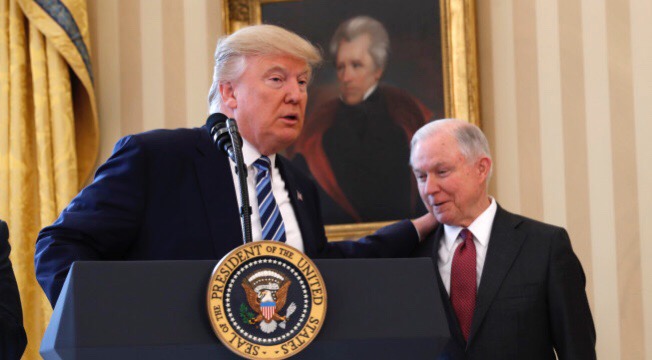
So, here’s racist US president Donald Trump, presenting his notorious racist new attorney general Jeff Sessions, with infamous genocidal racist president Andrew Jackson glowering in the background.


And Trump announced that he was directing the departments of Justice and Homeland Security to

break the back of the criminal cartels that have spread across our nation and are destroying the blood of our youth and other people.

This rhetoric doesn’t sound like usual presidential terminology, but it does sound familiar. What could it be? Maybe it reminds me of this:

Gift der Jüdischen Presse […] das ungehindert in den Blutlauf seines Volkes eindringen und wirken konnte

The poison of the Jewish press that penetrates without resistance and attacks the blood of the people

Or this

Er vergiftet das Blut des anderen, wahrt aber sein eigenes.

He [the Jew] poisons the blood of the others, but preserves his own.

From Mein Kampf.

No laughing matter

Trump today:

A lot of people say, oh, oh, Trump was only kidding with the wall. I wasn’t kidding. I don’t kid. I don’t kid. I watched this and they say I was kidding. No, I don’t kid. I don’t kid about things like that, I can tell you.

So what does he kid about?

Invading Mexico: “President Trump’s comments that he was ready to send US troops to Mexico to stop the “bad hombres down there” were “lighthearted” and not meant to be threatening, the White House said Thursday.”

Accusing President Obama of treason: “After repeatedly suggesting Thursday that President Barack Obama was the literal founder of ISIS, the terrorist group the U.S. is currently waging war against, Donald Trump called it “sarcasm” in a tweet Friday morning. The bizarre turn followed Trump’s assertion to a conservative radio host in an interview Thursday morning that he did not mean that Obama’s policies created the space for ISIS to flourish, rather that he was its actual founder.”

Destroying people who disagree with his policies: “President Donald Trump threatened to “destroy” the career of a Texas state senator after a Texas sheriff accused the lawmaker of getting in his way by promoting asset forfeiture reform.

“Want to give his name? We’ll destroy his career,” Trump told Sheriff Harold Eavenson of Rockwall County, Texas.

https://twitter.com/Acosta/status/829075389184081920

The sins of the fathers

I was just reading Kevin Drum’s article on the fallout from the hapless US military raid in Yemen last week. He lists the costs:

Our adventure in Yemen last week failed to kill its target; caused the death of numerous Yemeni civilians; resulted in one dead American sailor; and ended with the loss of a $70 million helicopter.

This is not unusual of the commentary, and I find it weird that it fails to mention that a US civilian was among those killed: the eight-year-old daughter of American renegade Anwar Al-Awlaki, given that the sanctity of American life is the bedrock of American antiterror policies. I suspect this reflects the atavistic sense that the child of an evildoer is tainted, and somehow deserves to be punished for his crimes. Of course, the new president famously vowed to “take out their families”.

Who’s on first?

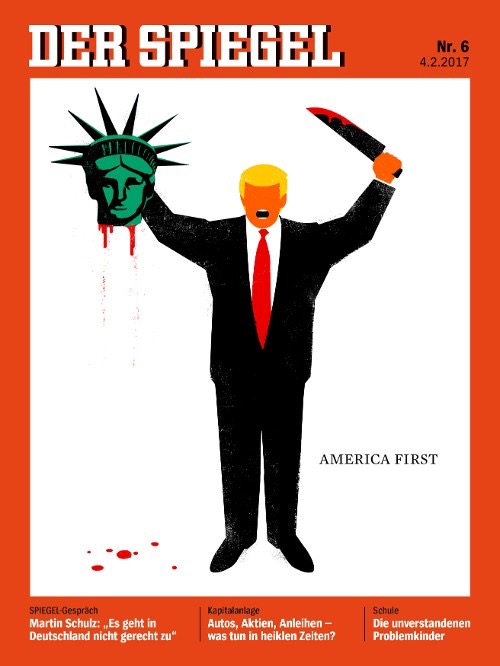
I love Der Spiegel, I consider it one of the best sources for international news, in addition to (of course) news about Germany, and it has to some extent maintained the idiosyncratic playful and sophisticated language style of its founder. I’m not usually wild about its graphics, though, and find it dull and obvious, as well as straining to find a reason to associate an image of naked breasts with any article. 

That said, I find this cover amazing. Obviously I’d feel differently about the image if I felt differently about Donald Trump, but it’s not simply a feeling of gratification at an enemy being publicly insulted. Like the best graphics — like the best scientific plots — this image combines familiar iconography and space to give substance to the horror that so many of us feel, crystalising an idea that was elusive. The Statue of Liberty and the iconography of terrorist self-promotion decapitation videos. Yes. It’s a good thing Germany just eliminated its lèse majesté law…

The association with Daesh puts the “America First” slogan in a different light as well. It’s a slogan that the murderers of the self-proclaimed caliphate could share, in the same spirit as the terrorist narrator of Leonard Cohen’s song, First we take Manhattan, Then we take Berlin.

It’s not even inappropriate, given that Stephen Bannon and his cronies have been fairly open about their intention to use Trump as the point of the spear to destroy liberal democracy in Europe, in favour of white ethnonationalism.

They really mean it (a continuing series)

Once again, I am forced to revise my impression of the Trump White House. I assumed that their failure to mention Jews in their statement for International Holocaust Remembrance Day was an oversight, sloppy drafting, which they then had to justify and insist was intentional because Trump. But no:

The State Department drafted its own statement last month marking International Holocaust Remembrance Day that explicitly included a mention of Jewish victims, according to people familiar with the matter, but President Donald Trump’s White House blocked its release.

Together with the Trump administration’s decision that they really don’t like Israeli settlements, I wonder if the right-wing orthodox Jews and Israelis who thought they had the measure of the man are beginning to feel like building contractors on a Trump hotel project.

The Emperor’s New Wall

Fox News reported Thursday morning that Department of Homeland Security Secretary Gen. John Kelly said that parts of President Donald Trump’s border wall would be transparent.

Built with special transparent concrete purchased at a premium from Trump, Inc.

Transparent to unqualified coastal elitists and cuckservatives, that is. Smart Real Americans will be able to see how beautiful it is.

Who tricked whom into eating potatoes?

Reading Richard Evans’s The Pursuit of Power: Europe 1815–1914, I discovered this anecdote about Ioannis Kapodistrias, appointed by Russia as governor of Greece in the late 1820s:

He introduced the potato into Greece, in an effort to improve people’s diet. At first, this met with deep skepticism among the peasantry, who refused to take up his offer of free distribution of seed potatoes to anyone who would plant them. Trying a new tactic, Kapodistrias had the potatoes piled up on the waterfront at Nafplio and surrounded by armed guards. This convinced local people and visitors from the countryside that these new vegetables were precious objects, and thus worth stealing. Before long, as the guards turned a blind eye, virtually all the potatoes had been taken — and their future in Greece was assured.

This reminded me of something I read many years ago, in Fernand Braudel’s The Identity of France:

In France, despite its early success, it was not until the mid-eighteenth century that the potato was regarded as truly ‘worthy’ to be eaten, with partisans prepared to defend it on both dietary and culinary grounds… In the géneralité of Limoges, potatoes were originally banned because they were thought to cause leprosy…

The corner was not really turned until the severe famine of 1769-70. The following year, the Academy of Besançon set an essay competition on the subject: “Suggest food plants which might be used in times of famine to supplement those usually eaten.’ All the essays mentioned the potato — notably the winning entry, which came from Parmentier. He then embarked upon a massive propaganda campaign, deploring ‘the mocking humour of our scornful citizens’. He published widely, gave advice on the growing and storing of the potato, organized gourmet dinners in his own home at which nothing but dishes made from potatoes were served…, brought to Paris all the varieties then cultivated in France and had even more shipped from America to give a better selection. He finally obtained from Louis XVI, in 1786, permission to set up an experimental plantation on about 20 hectares just outside Paris in Neuilly, on the untended and infertile soil of the plain of Sablons. It was a complete success. In his efforts to attract consumers, Parmentier concluded that the best method would be to entice people to steal his potatoes. So he ostentatiously had his plantation guarded by the maréchaussée, the local police — but only by day. Similarly, he advised landowners not to force potatoes on their peasants, but to plant one fine field full themselves and ‘expressly forbid anyone to enter’ — a more subtle approach than that of Frederick II of Prussia who sent in the troops to make the peasants plant potatoes.

Is it possible that Kapodistrias knew of Parmentier’s example? I guess so. Was this actually a well-known method for tricking the childish peasants into trying something new? Maybe. Or are these anecdotes, rather, merely recrudescences of a universal myth about how to trick the childish peasants? I’m not interested enough to track down the references…

Donald Trump gets into refugees

The Washington Post reports on Donald Trump’s objections to an agreement to take in 1250 mostly Middle Eastern refugees currently in Australian detention sites:

Trump was also skeptical because he did not see a specific advantage the United States would gain by honoring the deal, officials said.

He can’t conceive of a deal whose purpose is to benefit someone else. This reminds me of Monty Python’s Merchant Banker sketch. A humble fellow raising money for charity wanders into the office of a very wealthy and self-centred banker:

Mr Ford: Oh. I wondered whether you’d like to contribute to the orphan’s home. (he rattles the tin)

Banker: Well I don’t want to show my hand too early, but actually here at Slater Nazi we are quite keen to get into orphans, you know, developing market and all that…

Mr Ford: So er, how about a pound?

Banker: A pound. Yes, I see. Now this loan would be secured by the…

Mr Ford: It’s not a loan, sir.

Banker: What?

Mr Ford: It’s not a loan.

Banker: Ah… Look, I think I’d better run this over to our legal department. If you could possibly pop back on Friday…

Mr Ford: Well do you have to do that, couldn’t you just give me the pound?

Banker: Yes, but you see I don’t know what it’s for.

Mr Ford: It’s for the orphans.


Banker: Well, I’m awfully sorry I don’t understand. Can you just explain exactly what you want.

Mr Ford: Well, I want you to give me a pound, and then I go away and give it to the orphans.

Banker: Yes?

Mr Ford: Well, that’s it.

Banker: No, no, no, I don’t follow this at all, I mean, I don’t want to seem stupid but it looks to me as though I’m a pound down on the whole deal.