No daylight

In case there was any doubt that the Trump administration is stumbling about in the dark:

White House press secretary Sean Spicer on Wednesday denied reports that Attorney General Jeff Sessions and Secretary of Education Betsy DeVos clashed over an upcoming executive order expected to weaken protections for transgender students.

“There’s no daylight between anybody, between the President, between any of the secretaries,” Spicer told reporters at his daily press briefing.

As I have already made clear

I am fascinated by political rhetoric. And while I have been talking a lot about how Trump’s rhetoric breaks the bounds of normal US presidential rhetoric, I’m also interested in the ways in which he pushes the normal to its logical conclusion. To wit, the White House statement Monday on the wave of bomb threats against Jewish institutions:

Hatred and hate-motivated violence of any kind have no place in a country founded on the promise of individual freedom. The President has made it abundantly clear that these actions are unacceptable.

A typical reaction was that of CNN:

 The White House on Monday denounced a spate of threats made against Jewish Community Centers around the country.

For context, this comes after the president explicitly refused to comment last week, and instead attacked the reporter for raising the question. Given that pressure has been placed on the president precisely because he has not made the position of his administration clear, this statement seems less a forthright condemnation of the threats than an explicit refusal to make the president’s position any more “abundantly clear” than he already has.

This is a common political trope, and I’m never sure how to interpret it. I guess it’s supposed to put to rest accusations that one has not yet denounced whatever one was supposed to denounce, while not thereby accepting the accusation that one has failed to denounce it in the past.

But it can come off seeming like another refusal, still giving comfort to those who were supposed to be denounced. That’s especially true in this case, where the statement also fails to say anything about the particulars of these incidents: It condemns violence — in fairly anodyne terms, it must be said — but not threats, which are the particular issue here, and once again refuses to explicitly mention Jews.

“Getting a bit of extra assistance is never cheating”

If I were a philosophy student with a looming deadline for an essay on casuistry, I know I’d turn to BuyEssay for expert help. The Guardian has reported on government moves to crack down on essay mills, that sell individually crafted essays for students who need “extra help” –anything from a 2-page essay to a PhD dissertation (for just £6750!) The article reprints some of the advertising text that these websites offer to soothe tender consciences.

“Is Buying Essays Online Cheating?” it asks, in bold type. You’d think this would be an easy question, hardly something you could spin a 300-word essay out of. But they start with a counterintuitive answer: “We can assure you it is NOT cheating”. The core of the argument is this:

What is essential when you are in college or university is to focus on scoring high grades and to get ready for your career ahead. In the long run, your success will be all that matters. Trivial things like ordering an essay will seem too distant to even be considered cheating.

Given that high grades are so essential, it seems almost perverse that universities make it so difficult to obtain them. Why do they put all these essays and other hurdles in the way — “unreasonable demands from unrelenting tutors in expecting extensive research in a short time”, as the essay puts it? It’s shitty customer service, that’s what it is.

The only critique I might make is that the essay is a bit generic. I’d worry that when I submitted it for the assignment “Is Buying Essays Online Cheating”, that the marker might notice that someone else bought almost the same essay for the assignment “Is Murder Wrong?” In the long run, your success will be all that matters. Wasn’t this the plot of Woody Allen’s Crimes and Misdemeanors?

16th century rape culture

I was reading Montaigne’s essay “De l’inconstance de nos actions” (On the inconsistency of our actions). As a particularly piquant example of inconsistent behaviour Montaigne tells this tale:

Pendant les débauches de nostre pauvre estat, on me rapporta, qu’une fille de bien pres de là où j’estoy, s’estoit precipitée du haut d’une fenestre, pour éviter la force d’un belitre de soldat son hoste : elle ne s’estoit pas tuée à la cheute, et pour redoubler son entreprise, s’estoit voulu donner d’un cousteau par la gorge, mais on l’en avoit empeschée : toutefois apres s’y estre bien fort blessée, elle mesme confessoit que le soldat ne l’avoit encore pressée que de requestes, sollicitations, et presens, mais qu’elle avoit eu peur, qu’en fin il en vinst à la contrainte : et là dessus les parolles, la contenance, et ce sang tesmoing de sa vertu, à la vraye façon d’une autre Lucrece. Or j’ay sçeu à la verité, qu’avant et depuis ell’ avoit esté garse de non si difficile composition.

During the disorders of our poor country I heard of a young woman very close to where I was staying, who had thrown herself out a window to escape the advances of a piggish soldier who was quartered in her home. Not being killed by the fall, and to complete her task, she tried to cut her own throat with a knife, but was restrained, succeeding only in wounding herself grievously. She admitted that the soldier had imposed himself only by pleas, attentions, and presents, but said she feared he would force her by violence. We see here the words, the demeanour, and the blood all bearing witness to her virtue, a veritable modern-day Lucretia. And yet, I have it on good authority that before and after this event she was a slut who was by no means so difficult.

He goes on to warn his (male) readers not to take any evidence in one circumstance for proof of their mistress’s fidelity in general.

Here we see in pure form the mindset that still exists — perhaps is even still prevalent — and still even pokes out occasionally from judges in rape cases: Chastity is acceptable, even commendable, but it is the only plausible reason for a woman to refuse sex. Once she has given up the claim to refuse all sexual contact, to refuse any particular partner seems like pure tergiversation. Even if it looks like violence it’s not really, since to this way of thinking what looks like violence is really just helping her to overcome an atavistic need to make a public show of chastity. (One is reminded of American officials who claimed that they tortured Muslim prisoners to “help them” fulfill their need to make a show of resistance before they could square talking to the enemy with their religious obligation.)

One hears this often from feminists who lived through the sexual revolution of the 1960s and 1970s: While men experienced the relaxation of public sexual mores as a liberation, women had a much more ambivalent experience. The first step, eliminating the respect for chastity, was experienced by many as a loss of autonomy. Seen from the perspective of the 21st century it looks like a necessary step toward reclaiming women’s right to physical integrity and self-determination, but partly because eliminating hypocritical shield of chastity has forced men and women both to come to terms with what has now come to be called “rape culture”.

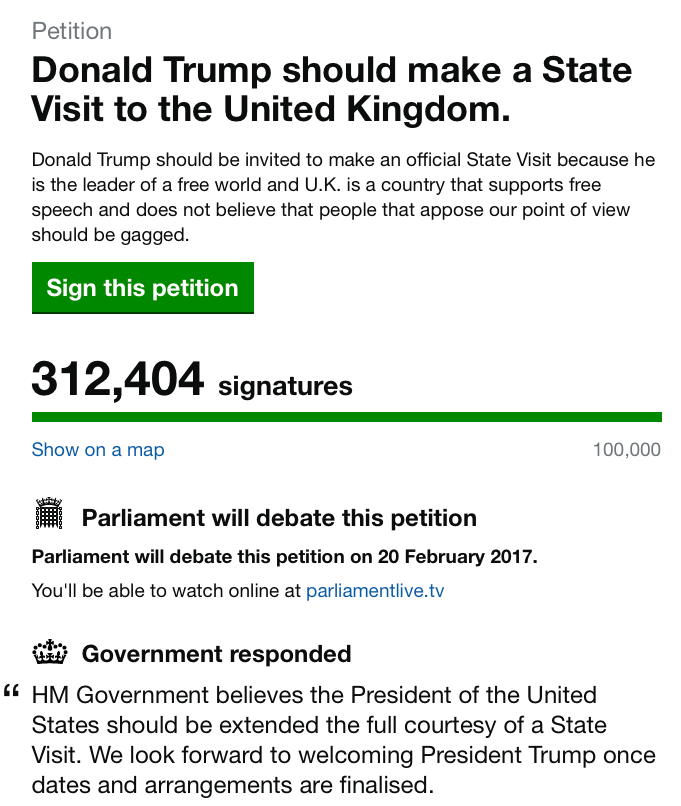
Debating Trump’s state visit

The House of Commons is now debating two petitions that both received more than the required 100,000 signatures to force a debate in parliament. One opposing a Donald Trump state visit (1.8 million signatures) and one supporting it (312 thousand). I couldn’t believe that the text given in favour of Trump’s visit in the newspaper so I checked on the official government website. The text was accurate. It’s just one (admittedly convoluted) sentence! Couldn’t they find someone to proofread it? Or was the text actually written by anti-Trump trolls eager to make the Trumpistas look like illiterate dunces?

petition question

(I’m not sure whether “leader of a free world” counts as an error… Of course, “leader of the free world” is the traditional phrase. But maybe they want to leave open exactly which “free world” he is leading.)

“Who would believe this?”

This comment from Trump’s rally to launch his 2020 reelection campaign has gotten a lot of attention:

You look at what’s happening in Germany, you look at what’s happening. Last night in Sweden. Sweden, who would believe this? Sweden. They took in large numbers. They’re having problems like they never thought possible.

(I’ve repunctuated from my source, since “You look at what’s happening last night in Sweden” doesn’t work grammatically.) Narrow-minded commenters have obsessed over the fact that nothing out of the ordinary happened in Sweden. (Not than anyone has presented proof that nothing happened…) But he didn’t say anything unusual happened. All he did was to ask “who would believe this?” They took in large numbers. TRUE! It’s a testimony of faith that “they’re having problems like they never thought possible”. Every day, including last night. Trump is inviting the elect to testify to their belief. “Belief” is considered a good thing in church, why not in politics? John McCain, at least, is on the same page:

“Can Americans be confident that a Republican-controlled Congress can investigate this President thoroughly if necessary?” Chuck Todd asked McCain on NBC News’ “Meet the Press.”

“I hope so and I have to believe so,” McCain said. “More hope than belief.”

We have to believe! We believe in congressional action unseen. Just because you’re in the Senate does not mean that you are responsible for causing the action to occur. It will happen. We just have to believe.

“A triumph of personal bias over research”

The Guardian reports on a new research study that finds the overstretching of the NHS — particularly in the winter — has caused about 30,000 excess deaths in 2015. The government’s response is practically Trumpian:

A DH spokesman described the study as “a triumph of personal bias over research”. He added: “Every year there is significant variation in reported excess deaths, and in the year following this study they fell by nearly 20,000, undermining any link between pressure on the NHS and the number of deaths. Moreover, to blame an increase in a single year on ‘cuts’ to the NHS budget is arithmetically impossible given that budget rose by almost £15bn between 2009-10 and 2014-15.”

Demeaning experts who bring unpleasant news is the primary tactic. Continue reading ““A triumph of personal bias over research””

Electric guillotines

Just reading The Vanquished, Robert Gerwarth’s history of the violence that followed the ostensible end of the First World War. He has this to say about the atrocity rumours that circulated about the Bolsheviks:

Although the reality of the civil war was so terrible that it hardly needed any embellishment, fantastical stories about Lenin’s regime flourished and drifted westwards: of a social order turned upside down, of a never-ending cycle of atrocities and retribution amid moral collapse in what had previously been one of the Great Powers of Europe. Several American newspapers reported that the Bolsheviks had introduced an electrically operated guillotine in Petrograd designed to decapitate 500 prisoners an hour… The Bolsheviks, or so it was suggested [in the British press], had ‘nationalized middle- and upper-class women, who might now be raped at will by any member of the proletariat. Orthodox churches had been turned into brothels in which aristocratic women were forced to offer sexual services to ordinary workers. Chinese executioners had been recruited by the Bolsheviks for their knowledge of ancient oriental torture techniques, while inmates in the infamous Cheka prisons had their heads stuck into cages filled with hungry rats in order to extort information.

It seems that there are three things that escalate the ordinary horror of despotic violence into extraordinary horror, all of which are touched upon here:

  1. Violation of the natural order, particularly of a sexual nature.
  2. Upwelling of arcane, precivilised, non-European presumptively diabolic culture.
  3. Abuse of modern technological means toward barbaric ends.

I’m particularly fascinated by the last, represented by the “electrically operated guillotines”, which prefigure the genuine industrialised slaughter of the Holocaust. More than the scale of the killing — which could be achieved by other means — it is the industrial precision that unsettles people, and makes the Holocaust unique. Or, perhaps better said, makes us want to see it as unique.

It’s hard to disentangle these feelings about the Holocaust, which is what makes the electric guillotines so useful: It’s not that this would have been all that exceptional, to kill 500 prisoners in an hour, and you wouldn’t need anything as unusual as an electrically operated guillotine. (It’s not even clear to me how electricity would accelerate a guillotine significantly.) But the combination of electricity, then the prime symbol of modernisation, with mass execution, was shocking.

Defending the fraud

From the perspective of normal human psychology, everything about the Trump-Putin interaction seems off. As I remarked before, if Trump were really a Russian agent, you would expect Putin to advise him to be less conspicuous in advocating Russian interests, simply to preserve his usefulness.

On the other hand, imagine Trump as a naive businessman with generally russophile leanings. (I don’t know, maybe he read The Gambler at an impressionable age, and modeled his life on it.) He’s had no significant contact with the Russian leadership, but he once met Vladimir Putin at a beauty pageant, thinks he praised him (mistakenly), and thinks he could do some good for the world by relaxing tensions with the world’s second-largest nuclear power. He is convinced that he deserves to be president, but privately unsure the world will acknowledge his greatness. Now he receives intelligence briefings giving strong evidence that the Russians are attempting to interfere with the election in his favour. What would he do? Before the election maybe he keeps quiet and tries to suppress or discredit the claims. But you would expect him to be seething with fury, that the Russians threaten to taint his election. The help they’re giving is marginal, but the blowback is potentially enormous. It’s like a referee intentionally calling an unwarranted penalty in a football match. It probably won’t change the result, but it makes the favoured side look terrible. To do that without consent is an act of aggression against those you’re ostensibly helping. Continue reading “Defending the fraud”