More damned statistics

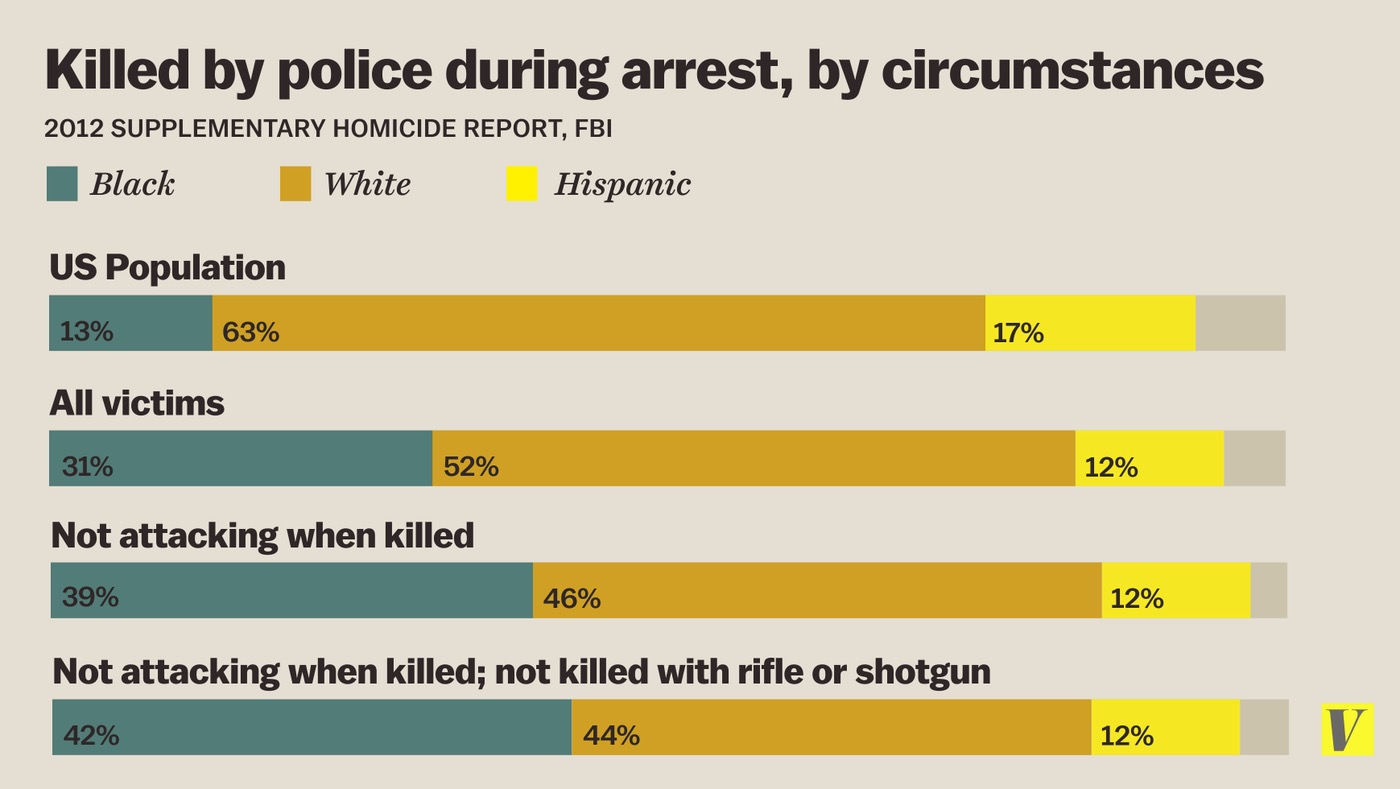
The news website Vox published this chart last year, by Dara Lind, based on FBI data on people killed by police during arrest. The most chilling thing about it is that refined statistical analysis on people killed by police is possible, with all kinds of elaborate subgroup analyses. That’s because there were 426 cases in that year. In general I’m all in favour of more data, which makes it possible to study problems in a more refined way, but I’m happy that the statistics gathered by the Independent Police Complaints Commission don’t have much to work with: In the same year there were 15 deaths in or following police custody in England and Wales.

UPDATE:  I thought the US number seemed surprisingly small — only about 5 times the UK number on a per capita basis, despite the fact that British police don’t routinely carry firearms. In fact, The Guardian’s documentation of all police killings in the US lists 1146 people killed by police in 2015. I presume this has to do with the fact that the FBI statistic only counts people killed during arrest.

Damned statistics

At a conference talk on the “reproducibility crisis” in psychology, the speaker quoted a relative issuing the commonplace anti-statistics apothegm “You can prove anything with statistics”. It’s a funny sort of claim, because it is self-undermining. Outside of a seminar on Popperian scientific philosophy no one would say “you can prove anything with numerology” or “you can prove anything with astrology”. Those who are not in thrall to these methods of divination find them either entertaining or ridiculous, but 

Is it because statistics is too abstruse for ordinary people to criticise? No one says, you can prove anything with quantum mechanics. Or, for that matter, mathematics.

Statistics is sufficiently precise and rigid and generally reliable to be authoritative, but leaves enough flexibility for experts to disagree and for manipulative misapplications to still hew close to standard procedure, and sufficiently abstruse that most people can’t figure out whether they’re being manipulated.

An interesting parallel is the Shakespearean dictum “The devil can cite scripture for his purpose.”

Cervantes on objectification of women

For those inclined to be too optimistic about the pace of progress in recognising the validity of female perspectives — the way an objectifying male perspective has been perniciously treated as a default and inherently valid — I note that Cervantes in Don Quixote made this point more than four centuries ago. In satirising the tradition of courtly pickup artists who stalk their fair damsels remorselessly, Cervantes allows a woman to speak at the funeral of a man whose friends furiously attribute his death to her “cruelty” in rejecting his advances:

Heaven has made me, so you say, beautiful, and so much so that in spite of yourselves my beauty leads you to love me; and for the love you show me you say, and even urge, that I am bound to love you. By that natural understanding which God has given me I know that everything beautiful attracts love, but I cannot see how, by reason of being loved, that which is loved for its beauty is bound to love that which loves it; besides, it may happen that the lover of that which is beautiful may be ugly, and ugliness being detestable, it is very absurd to say, “I love thee because thou art beautiful, thou must love me though I be ugly.” But supposing the beauty equal on both sides, it does not follow that the inclinations must be therefore alike, for it is not every beauty that excites love, some but pleasing the eye without winning the affection; and if every sort of beauty excited love and won the heart, the will would wander vaguely to and fro unable to make choice of any; for as there is an infinity of beautiful objects there must be an infinity of inclinations, and true love, I have heard it said, is indivisible, and must be voluntary and not compelled. If this be so, as I believe it to be, why do you desire me to bend my will by force, for no other reason but that you say you love me? Nay–tell me–had Heaven made me ugly, as it has made me beautiful, could I with justice complain of you for not loving me?

I am reminded of the joke about the holy warrior who is struck down at last after many grim battles. He arrives in the afterlife and is ushered into a room where waits a plain woman who proceeds to abuse him verbally and physically. “Lord,” he shouts out, “I expected, for all my service, that I would be rewarded with a beautiful virgin when I was carried off to heaven.” And the woman says, “Heaven? You’re not in Heaven. I’m in Hell.”

The masks come off

I think a lot of people — a lot of foreigners living in Britain — are feeling like this character in Paul Murray’s wonderful satire of the financial crash, The Mark and the Void:

“But if you write the truth about our time? How can the truth ever be obsolete?”

“People don’t want the truth,” he says, waving a hand at the streets around us. “They want better-quality lies. High-definition lies on fifty-inch screens. I wrote the damn truth already, Claude. Maybe I didn’t write it well, but I wrote it. And not only did no one want to see it, they made me feel like a fool for even trying. They laughed out the window at me as they sped away on the gravy train.”

“That was during the boom. Now the gravy train has stopped.”

“Yeah, well, I can’t unsee what I saw. The money poured in, and it was like suddenly everyone in Ireland took off their masks, and they were these horrific, rapacious alien beings who if you fell down in the street would just leave you there to die.”

The day after 

Oxford is full of Europeans, and it seems like everyone is walking around in a daze since the referendum. It’s rare that you hear any other topic of conversation. If anyone has an opinion other than pro-EU they’re not saying, only citing some elderly relatives for possible insights into the psychology of Leave.

I hadn’t anticipated how hurt and angry people would be. Lots of people are talking about leaving. It’s not that anyone is expecting anti-European pogroms, but it makes it suddenly palpable how thoroughly unwelcome foreigners are in this country. I noticed this immediately when I arrived here, so maybe that’s why I’m not so shocked by this result.

Oxford is a xenophilic bubble, in this respect — 70% for Remain — so it’s easy to ignore, if you’re so inclined. Also, many Europeans didn’t really think of themselves as foreigners, which is why this rejection was such an emotional blow. It’s devastating for the university, of course.

I fear that this may turn a lot uglier. I think the British are going to be shocked to discover how much the rest of Europe resents them. It’s like a bad marriage: Europe has been making all kinds of compromises and telling Britain how much they love it to keep the union together. For the sake of the children let us say. The effect was only to heighten the British sense of their own importance. Now that they’ve announced, even though you’ve done everything I asked, I’m still leaving you, because I never loved you, and I never wanted to be married anyway, the British we’ll be surprised to discover how cold and businesslike the Europeans can be, in to just wanting be rid of them as quickly as possible. I fear that the unrealistic expectations will give way to fury and escalating rounds of retaliation against the hostages, who are the Europeans living in Britain and the Britons living in Europe.

Not the Day of Remain

It is accomplished. The UK is headed out of the EU. The generational coup of the pensioners against their children and grandchildren.

I’d hoped, but not expected, that it would turn out otherwise. Huge self-inflicted damage, and I doubt that the situation will develop to the advantage of those who supported Brexit. Scotland will likely secede. Northern Ireland may see the peace process unravel. I’m slightly worried that “Project Fear” actually underplayed the risk. It’s perhaps not the most likely scenario, but I see as perfectly conceivable that we face years of escalating frustration on both sides of the negotiating table, as the British are confronted with the reality of a Europe that has no interest in making the fantasies of the Conservative Party come true. The British public will become more bloody-minded, unwilling to be dictated to by a bunch of foreigners, leading to a feedback loop of retaliation against the hostages, the EU citizens living in Britain and the British living in the EU. It could get very ugly.

It’s a bit like climate-change denialism: You have one side saying, there’s a lot of uncertainty about the effects of our actions, so let’s be hopeful that it won’t be so bad. It might be substantially better than the median prediction. They conveniently ignore the downside risk, which could be pretty terrible.

Utility of the Devil

I very much enjoyed reading Richard Thaler’s book Misbehaving, on behavioural economics and his own role in its development. It occurred to me that the basic lessons of that soi disante science may be summarised by a variant on a famous Rolling Stones song:

You can’t always know what you want…

But if you don’t try, most of the time

You just might find you want what you know.

Revolution as entertainment

I was just reading this article about how the UK farming minister told the Guardian that British withdrawal from the EU, would be a godsend to the environment:

If we had more flexibility, we could focus our scientists’ energies on coming up with new, interesting ways to protect the environment…

“New and interesting” sounds good, but these hardly seem like essential criteria for environmental protection laws. “Safe” and “effective” seem more appropriate. I’m happy to leave it to Hollywood to entertain me, if EU environmental policy will just, you know, protect the environment.

An even more extreme example of the craving for politics to fill the boring spaces in an empty existence is this Bernie Sanders supporter who was quoted in a recent NY Times article:

Victor Vizcarra, 48, of Los Angeles, said he would much prefer Mr. Trump to Mrs. Clinton. Though he said he disagreed with some of Mr. Trump’s policies, he added that he had watched “The Apprentice” and expected that a Trump presidency would be more exciting than a “boring” Clinton administration.
“A dark side of me wants to see what happens if Trump is in,” said Mr. Vizcarra, who works in information technology. “There is going to be some kind of change, and even if it’s like a Nazi-type change, people are so drama-filled. They want to see stuff like that happen. It’s like reality TV. You don’t want to just see everybody be happy with each other. You want to see someone fighting somebody.”

You can’t say he’s not going into it with his eyes open.

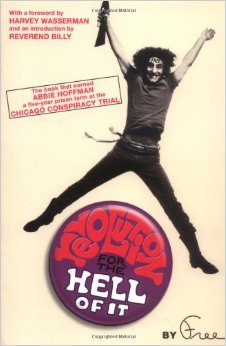
As usual, I blame Abbie Hoffman.Revolution for the Hell of It


Rapid growth

A lot of EU citizens who live in Britain are worried that they will be forced out if the UK voters decide next month to withdraw from the EU. The Leave campaign dismisses this, and all concerns that anyone might have about this radical step, as “Project Fear”:

Clearly any EU citizen that is legally here if we come out of the EU would absolutely have the right to remain here. Any other suggestion is just absurd.

Given that the main point of Brexit is to reduce immigration from the Continent, and given that tempers are likely to flare when the fate of said migrants (on both sides) are negotiated, and given that current UK law clearly would not give most of the EU citizens who are here the right to permanent residency, it’s clearly not absurd to worry. To adapt an old saw, even those whom political campaigners are trying to make paranoid, have real reasons to worry.

Well, from the NY Times, here’s some non-evidence:

Rose Carey, the head of immigration at Charles Russell Speechlys, a global law firm based in London, said she had seen an “unprecedented amount” of applications for British citizenship in the last few months.

“Historically, E.U. nationals didn’t really bother applying for a British passport,” she said. “It used to be a couple hundred a year to now five queries a week.”

From a couple of hundred a year to five a week — that’s pretty rapid growth!