Land of the frei

Trends in rejecting democracy

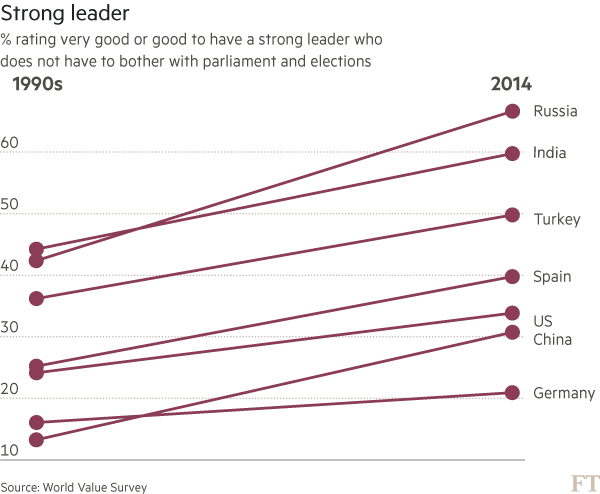
This plot from the Financial Times has been getting a lot of attention online. The data come from the World Values Survey (slightly incorrectly cited in the plot).

I don’t know what to make of it exactly, except to say that it supports my gut belief that Germany, more than any other country, understood after the Second World War, what it takes to cultivate a spirit of freedom and democracy. It was a long struggle, and they didn’t shy away from it. Education, the legal system, journalism: It’s the famous German thoroughness, applied to the problem of creating free citizens. The British, the Americans, and the French, each in their own way, considered democracy to be their inevitable birthright, and so have allowed relevant institutional arrangements and, even more importantly, the democratic spirit, to decay.

Maybe the Americans are just being more honest — in a Trumpian anti-PC way. Taboos are important. One important lessons that the Nazis understood was: Before you can commit unspeakable horrors, you need to find a way to make them speakable.

Tender-hearted racists

The only place I run into Americans here is in the synagogue. There is one loud-and-proud right-winger who gets treated to a lot of good-humoured deference. This past Sunday, naturally, he was feeling his oats. I mostly stay out of these political discussions, but after listening to him go on and on about the “elitists” in their “bubbles” who had failed to appreciate the world-historical significance of Donald Trump, I remarked that these were very large bubbles that contained more than half of the US population. He suddenly switched gears and accused me of accusing all Trump voters of being racists, a remarkable feat of projection, given that no one up to this point had mentioned race. No, I said, I’m sure some of their best friends are black.

But I was thinking of this when I recently read this passage in John Ferling’s Jefferson and Hamilton: The rivalry that forged a nation. (Overall, a pretty interesting book, if not especially elegantly or engagingly written) about Hamilton’s attacks on Jefferson in the context of the election of 1796:

Hamilton raised questions about Jefferson and race. He drew on passages from Notes on the State of Virginia to demonstrate Jefferson’s racism.

The context is a society that accepts enslavement of African-Americans, Jefferson owned dozens of slaves, yet evidence of “racism” was seen as a black mark on his character. And Hamilton needed to delve into Jefferson’s writings to find “evidence” that the slave-owner Jefferson was racist. For that matter, Hamilton himself had owned slaves in the past, and probably did even as he was polemicising against Jefferson’s racism.

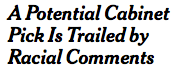
Anti-racism is self-limiting. As soon as we accept that racism is a terrible thing, there is a natural tendency to absolve pretty much anyone with a name and a face of this evil. Racism exists in the past, or on the fringes of society. People like Trump are just clumsily saying some racist things or appealing to non-PC white voters. (And if he’ll just stop saying racist things for a week or two, problem solved!) Similarly, the NY Times has just today seemed to express sympathy for famous racist and likely Trump cabinet pick, Alabama senator Jeff Sessions:
screenshot-2016-11-17-12-01-28

The poor guy is being trailed by those nasty racial comments. Maybe he can get a restraining order against them!

If you’re not actually burning crosses you’re not a real racist, just as anyone who isn’t Hitler can’t really be an antisemite. (And anyone who recalls the fake-Hitler-diary furore may also recall the breathless coverage that noted the absence of any reference to the holocaust, eager to absolve the Führer of the worst crimes.)

I think often of this exchange from the second presidential debate in 2000:

GORE: …The governor opposed a measure put forward by Democrats in the legislature to expand the number of children that would be covered. And instead directed the money toward a tax cut, a significant part of which went to wealthy interests. He declared the need for a new tax cut for the oil companies in Texas an emergency need, and so the money was taken away from the CHIP program… I believe there are 1.4 million children in Texas who do not have health insurance. 600,000 of whom, and maybe some of those have since gotten it, but as of a year ago 600,000 of them were actually eligible for it but they couldn’t sign up for it because of the barriers that they had set up.

MODERATOR: Let’s let the governor respond to that. Are those numbers correct? Are his charges correct?

BUSH: If he’s trying to allege that I’m a hard-hearted person and I don’t care about children, he’s absolutely wrong.

The words don’t adequately communicate the smarmy expression of offence that Bush displayed. Gore accused him of taking insurance away from 600,000 children. Bush didn’t respond or explain, but simply contended that to mention this fact was to insult him, to call him a “hard-hearted person”.

Being demographic

People have been saying for a long time that the Republican strategy of ethnic nationalism is running out of room, because of increasing proportions of ethnic minorities. I noted during the 2012 election how odd it was that some groups of people were considered to vote “demographically”, while others (white Protestant men) were assumed to vote on the basis of a broad array of concerns. According to the demographic fallacy, minority groups have special interests that are very important to them, but only of peripheral interest to the majority. Too much pandering can piss off the majority, but targeted appeals can motivate the minority, potentially to very high percentages, but there is no way to motivate the majority en bloc. After the 2012 election there were any number of comments of the sort “To win the presidency, Republicans need to make up their deficit among black and hispanic voters. They are losing them at such a level that (with changing povulation composition) a future Republican candidate would need to win the white vote at implausible levels to win a majority.” Now it appears that this argument is exactly wrong, for three reasons:

  1. As Trump correctly intuited, white people are also susceptible to ethnic appeals. And if you can motivate them as an ethnic group, they’re the biggest, baddest one of all. Meanwhile, the Democrats appeal to ethnic minorities was maxed out. The pervasive undercover racism of the Republican party gave Obama a huge edge among hispanics and blacks; naked racism, religious exclusion, and threats of deportation by Trump couldn’t move it any further, but could pull in vast numbers of white voters who share his racist world view and are relieved to hear it expressed openly. Those of us who move in educated circles should have taken more seriously the assertions early on that “Trump says what everyone really thinks”. Obviously, we didn’t know what people were thinking.
  2. Similarly for women. The model of what I called “demographic thinking” in politics is  I’m not the first to notice that women are not actually a minority. The power relations (yay intersectionality!) nonetheless seem to justify seeing the struggle for women’s rights as analogous to the struggle for rights of ethnic minorities.
    Feminists may have gotten suckered by a figure-ground second-sex fallacy with regard to women voters. If you think of males as the default, and women as the “minority”, then an openly misogynist candidate like Trump would seem to turn out the women to vote against him. But most of those women have been having to compromise with and make excuses for Trump-like figures in their lives — in their families — their whole lives. Some will recoil in horror, but most will continue to make excuses. And the women voters lost may be balanced by just as many men gained.
  3. It’s perfectly possible to maintain a semblance of democracy while entrenching the power of a minority to rule over the majority. Many countries have done this. With the single exception of 2004, the Republicans have not won a plurality in a presidential election since 1988. Democrats received a majority of the votes for representatives in 2012 and (probably) 2016. Nonetheless, the Republicans have attained unrestricted control over nearly the entire federal government, and very little stands in the way of further restricting voting rights to maintain their control and civil rights of minorities, expanding the political influence of the wealthy, to maintain their power indefinitely.

The electoral college was designed to leverage the 3/5 compromise to increase the power of southern slave-holding states in presidential election. Now, under very different circumstances, it is still serving this function.

Second season

When my daughter asked me recently, “What happens if Donald Trump wins?” I said I just couldn’t imagine it (even though, as I noted, I couldn’t see a good reason to think it extremely unlikely.) The mind recoils from such madness, though as I have also noted, Berlusconi is a good precedent, and it took nearly a decade to winkle him out of office. Berlusconi with nukes and the NSA.

But while I tried to find a reason for confidence, there was always a nagging voice telling me: People are going to want to see how this show ends. This was the voice of the Sanders supporter quoted in the NY Times back in June who said he would probably support Trump in the general election because Clinton would be boring:

A dark side of me wants to see what happens if Trump is in. There is going to be some kind of change, and even if it’s like a Nazi-type change, people are so drama-filled. They want to see stuff like that happen. It’s like reality TV. You don’t want to just see everybody be happy with each other. You want to see someone fighting somebody.

The showman Trump had set up an outrageous spectacle that ended on a cliffhanger. If you vote for Clinton, the Trump show gets cancelled, and you never get to see what would have happened.

That dark side won (though not a majority, apparently — now the Republicans will never agree to get rid of the electoral college). The Trump show has been renewed, and we’ll all be watching it — living it, really — for at least the next four years.

Democratic antinomianism

One thing that the US and UK have in common is a sort of democratic antinomianism — a pervading sense that to the holy all things are holy, and to the inherently democratic all things are democratic. Thus they can spy on their populace, torture prisoners held indefinitely without trial, hold embarrassingly badly organised elections, and still be offended at the notion that anyone might have anything to lecture them about democracy. They can elect, or come close to electing, a comically unfit would-be ethnic-nationalist authoritarian strongman and still celebrate their constitutional order.

This is a reason why I feel particularly comfortable in Germany. Germans can be arrogant, on a personal and national level, but they have learned deep in their bones distrust of colourful demagogues.

Trump and the bicycle-riders

We now have Donald Trump’s final argument for his election, which basically amounts to saying that manly man Donald Trump will beat down the foreigners and Jews — George Soros, Janet Yellen, Lloyd Blankenfein — who are secretly pulling the strings behind the political establishment. (Speaking of Janet Yellen, I have to confess that I hadn’t noticed that the Federal Reserve had been led by elders of Zion Jews — three of them Republicans — for all but nine years since 1970.)

I think often of a public lecture that Yale history professor John Boswell gave in the 1980s with the title “Jews and Bicycle-riders”. The title came from a celebrated anti-Nazi joke of the 1930s: A Jew is pushed off his bicycle by a Brownshirt, who looms over him and screams “Who is responsible for Germany’s misfortunes?” “The Jews,” replies the trembling Jew, “and the bicycle riders.” “Why the bicycle riders?” asks the Nazi. And he replies: “Why the Jews?”

Boswell’s lecture was mainly about homosexuality, pointing out that prejudice against gay people had risen and fallen over the past two millennia, and tended to parallel the ups and downs of antisemitism, and to be promoted by the same people. The joke suggests that antisemitism is irrational and arbitrary, and has nothing really to do with the Jews; Boswell extends this to say that antisemitism and homophobia are both targets of convenience for what is really an anti-urban, anti-cosmopolitan agenda.

(The bicycle-riders in the joke are supposed to be an obviously ridiculous target of discrimination. Boswell might have been amused to know that in the febrile politics of the 21st century, bicycle-riders have also become a frequent target of right-wing abuse — for example, Colorado Republican who called Denver cycling initiatives “part of a greater strategy to rein in American cities under a United Nations treaty” and Rob Ford in Toronto: “What I compare bike lanes to is swimming with the sharks. Sooner or later you’re going to get bitten… The cyclists are a pain in the ass to the motorists.”)

Obviously part of the point was that the credibility of antisemitism was at a low point in the mid-1980s, while discrimination against sexual minorities was decidedly respectable. From the perspective of 2016 things look decidedly different. Homophobia us barely tolerated in polite circles, while antisemitism is ascendant. I’m sure I thought in 1985 that the downward trajectory of antisemitism was inevitable — it was so obviously irrational — while the rights of gay and lesbian people seemed to need fighting for. In retrospect, I see that no matter how marginalised they may be, both of them are always capable of recolonising the body politic when the right conditions return. Somehow this seems to me more obvious and intuitive with regard to homosexuality than with regard to Judaism; Boswell’s link helps to clarify the danger.

The Brexit spiral begins

I’ve been warning since the Brexit vote that there could be a xenophobic feedback spiral:

We face years of escalating frustration on both sides of the negotiating table, as the British are confronted with the reality of a Europe that has no interest in making the fantasies of the Conservative Party come true. The British public will become more bloody-minded, unwilling to be dictated to by a bunch of foreigners, leading to a feedback loop of retaliation against the hostages, the EU citizens living in Britain and the British living in the EU. It could get very ugly.

According to the Guardian,

The chairman of JD Wetherspoon has fired a warning shot that the pub chain could stop selling drinks brands from other European countries if senior EU leaders maintain a “bullying” approach to Brexit negotiations.

For Britain to take a decision that harms its neighbours — with rhetoric that positively seems to relish the gratuitous harm to its neighbours — is a matter of high principle. Sovereignty! But when the neighbours respond in kind it is “bullying”.

I never heard of this chain, but then, the negotiations haven’t even started.

Stranger than fiction

Over the many decades when a female president had become conceivable but not yet real, fictional representations purveyed all kinds of notions — some silly, some serious, some sexist — of the first female president. (Jokes about the closet space in the White House were, as I recall, a staple.) But I can’t recall that anyone supposed that the first presidential campaign to feature a woman candidate would have her up against an opponent who bragged about grabbing women’s genitals, or that we would have the following exchange between her opponent and the sitting vice president:

Biden said of Trump on Saturday: “The press always asks me, don’t I wish I was debating him? No, I wish we were in high school and I could take him behind the gym. That’s what I wish.”

Casting scorn on Biden’s physical strength, Trump said, “Mr Tough Guy, you know he’s Mr Tough Guy, you know when he’s Mr Tough Guy? When he’s standing behind a microphone by himself.” Trump added: “He wants to bring me to the back of the barn? Oooooooooh. Some things in life you could really love doing.”

A fiction writer would hardly have dared to imagine the campaign to feature such a running parody of male pathology. It would have been ridiculed as insular feminist propaganda.

Maybe it will come out next that Trump has been scrawling Clinton’s telephone number on bathroom walls.