
Papers, please!, ctd.

Apparently Immigration and Customs Enforcement (ICE) in the US has been conducting raids targetted enforcement in major US cities.

A DHS official confirmed that while immigration agents were targeting criminals, given the broader range defined by Trump’s executive order, they also were sweeping up noncriminals in the vicinity who were found to be lacking documentation.

For me, this raises again a question that has genuinely puzzled me for a long time: How many Americans typically carry with them documentation that would show their citizenship, or otherwise prove their right to be in the US? A birth certificate would do (unlike in the UK, where the government has been at pains to show that it won’t even recognise the right to citizenship of people of tainted foreign blood, even if they were born in the UK at a time when everyone thought the law automatically granted them citizenship), or a passport, but most people don’t carry these things around every day. Many Americans don’t have passports, and birth certificates may be hard to lay your hands on at short notice. (Besides which, what good does it really do to show a birth certificate if your name is John Smith — or, let us say, José Garcia?)
The random correspondence theory of truth

Republicans may not believe in scientific reasoning, but Republican administrations seem to be the best for generating innovations in epistemology. The Bush administration brought us the taxonomy of “known unknowns”, etc.

Now presidential advisor Kellyanne Conway continues to press forward her creative truth-value confections. After coining the term “alternative facts” for what were formerly called “lies”, she is now attacking what might be called the curatorial conception of truth.

“You can talk about somebody almost making a mistake and not doing it,” Tapper said. “I’m talking about the President of the United States saying things that are not true, demonstrably not true. That is important.”

“Are they more important than the many things that he says that are true that are making a difference in people’s lives?” Conway replied.

It is not important, in her conception, for true statements to be statistically more common than false, or, presumably, even more common than background randomness. Only that they are there, and that they “make a difference”. The lies presumably make a difference as well.

Abstractly, statements can be generated by a machine, or a Magic 8 Ball, and there are approximately equal numbers of potential statements that are true as false. (Think Library of Babel.) We count on humans having a preference for truth, even an abhorrence of falsehoods. From Conway’s point of view, though, Trump has no obligation to make overwhelmingly true statements, as long as the truths that do crop up “make a difference”.

“The blood of our youth”

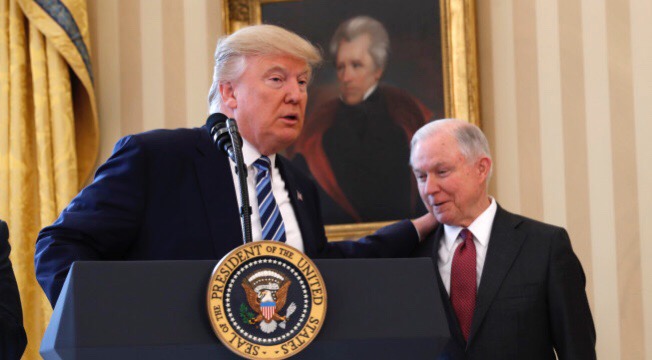
So, here’s racist US president Donald Trump, presenting his notorious racist new attorney general Jeff Sessions, with infamous genocidal racist president Andrew Jackson glowering in the background.


And Trump announced that he was directing the departments of Justice and Homeland Security to

break the back of the criminal cartels that have spread across our nation and are destroying the blood of our youth and other people.

This rhetoric doesn’t sound like usual presidential terminology, but it does sound familiar. What could it be? Maybe it reminds me of this:

Gift der Jüdischen Presse […] das ungehindert in den Blutlauf seines Volkes eindringen und wirken konnte

The poison of the Jewish press that penetrates without resistance and attacks the blood of the people

Or this

Er vergiftet das Blut des anderen, wahrt aber sein eigenes.

He [the Jew] poisons the blood of the others, but preserves his own.

From Mein Kampf.

The sins of the fathers

I was just reading Kevin Drum’s article on the fallout from the hapless US military raid in Yemen last week. He lists the costs:

Our adventure in Yemen last week failed to kill its target; caused the death of numerous Yemeni civilians; resulted in one dead American sailor; and ended with the loss of a $70 million helicopter.

This is not unusual of the commentary, and I find it weird that it fails to mention that a US civilian was among those killed: the eight-year-old daughter of American renegade Anwar Al-Awlaki, given that the sanctity of American life is the bedrock of American antiterror policies. I suspect this reflects the atavistic sense that the child of an evildoer is tainted, and somehow deserves to be punished for his crimes. Of course, the new president famously vowed to “take out their families”.

Who’s on first?

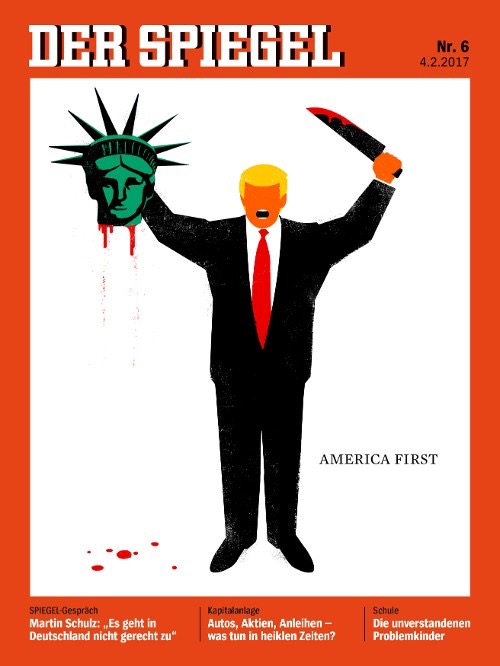
I love Der Spiegel, I consider it one of the best sources for international news, in addition to (of course) news about Germany, and it has to some extent maintained the idiosyncratic playful and sophisticated language style of its founder. I’m not usually wild about its graphics, though, and find it dull and obvious, as well as straining to find a reason to associate an image of naked breasts with any article. 

That said, I find this cover amazing. Obviously I’d feel differently about the image if I felt differently about Donald Trump, but it’s not simply a feeling of gratification at an enemy being publicly insulted. Like the best graphics — like the best scientific plots — this image combines familiar iconography and space to give substance to the horror that so many of us feel, crystalising an idea that was elusive. The Statue of Liberty and the iconography of terrorist self-promotion decapitation videos. Yes. It’s a good thing Germany just eliminated its lèse majesté law…

The association with Daesh puts the “America First” slogan in a different light as well. It’s a slogan that the murderers of the self-proclaimed caliphate could share, in the same spirit as the terrorist narrator of Leonard Cohen’s song, First we take Manhattan, Then we take Berlin.

It’s not even inappropriate, given that Stephen Bannon and his cronies have been fairly open about their intention to use Trump as the point of the spear to destroy liberal democracy in Europe, in favour of white ethnonationalism.

16th century Sokal hoax

Many of our readers will recall the celebrated hoax perpetrated by mathematical physicist Alan Sokal in 1996 against the humanities journal Social Text. Sokal submitted an article “Transgressing the Boundaries: Towards a Transformative Hermeneutics of Quantum Gravity” for an issue on “Science Wars”. The article strung together buzzwords helter-skelter to conclude with a flattering claim of the importance of social theory for natural science. The fact that it was published is cited even today by supercilious physicists and insecure journalists as conclusive proof that academic jargon in the humanities and social sciences is all fake.

Anyway, I was just reading Montaigne’s essay “Du pedantisme” (On pedantry), and found the following anecdote:

J’ay veu chez moy un mien amy, par maniere de passetemps, ayant affaire à un de ceux-cy, contrefaire un jargon de Galimatias, propos sans suitte, tissu de pieces rapportées, sauf qu’il estoit souvent entrelardé de mots propres à leur dispute, amuser ainsi tout un jour ce sot à debattre, pensant tousjours respondre aux objections qu’on luy faisoit. Et si estoit homme de lettres et de reputation, et qui avoit une belle robbe.

I observed at my home a friend of mine making sport of one of these [pedants] by making up a nonsense jargon, propositions with no succession, a patchwork of pieces that had nothing in common except for some buzzwords  that he stuck in that related to their topic, and he amused himself a whole day with this crazy debate, always managing to think of new answers to the man’s objections. And this was a greatly reputed man of letters.

CDC works toward the president

Dem Führer entgegenarbeiten — Working toward the Leader — was one of the most important neologisms of the early Third Reich. No one really knew what Hitler wanted to do — not even Hitler himself — and the organs of state were in turmoil, certainly incapable of providing rapid guidance at the local level to the government’s plans. So everyone’s obligation was to surmise what the Führer’s ultimate objectives were, and work toward accomplishing it, without needing specific instructions.

Compare that to these recent decisions of the completely apolitical Centers for Disease Control and Prevention:

CDC abruptly cancels long-planned conference on climate change and health

The Climate and Health Summit, which had been in the works for months, was intended as a chance for public health officials around the country to learn more about the mounting evidence of the risks to human health posed by the changing climate. But CDC officials abruptly canceled the conference before President Trump’s inauguration, sending a terse email on Jan. 9 to those who had been scheduled to speak at the event. The message did not explain the reason behind the decision.

CDC Indefinitely Postponed LGBT Youth Health Summit After Election

To be fair, the reason seems to be that they needed the resources to focus on their conference on disease transmission by refugees and illegal immigrants.


P.S.

My 8-year-old was telling me about a recent school lesson. The teacher was telling them (for some reason) about the use of the term P.S. Her explanation began “In the old times people didn’t have computers, so they had to write letters on paper…”

Of course, I know that my children have lived entirely in the age of personal computing, but it was still striking to hear it presented in such stark terms. I actually experienced the transformation exactly during my university studies. When I arrived at Yale in the fall of 1983 I had my Apple IIe, my roommate had a Compaq, and otherwise pretty much no one had a personal computer. Everyone else seemed to be writing their papers on a typewriter. (It was kind of unreasonable of me, actually, to expect the professors to read the low-resolution dot-matrix output that I turned in, but I wasn’t very considerate at the time.) The Macintosh appeared the next year, and by 1986-7 everyone was writing their senior essays on the Macintoshes in the college’s computer room.

Keeping out the riffraff

I was just interested in comparing the conditions for citizenship and annual number of new citizens between the UK and Germany. The UK numbers I found on this government website. Under “Key Facts” the first thing they have to say is

Applications for British citizenship fell by 29% in the year ending June 2015 to 137,406.
There were 112,407 decisions about British citizenship, 40% fewer than in the previous year (188,910). Correspondingly, there were 42% fewer people granted British citizenship (-75,908 to 105,043). This was the lowest annual figure since 2002 (120,121).

It seems like they’re really proud that British citizenship has become so unattractive. The number of people acquiring German citizenship in around the same timeframe was slightly higher — 107,181 according to the Statistisches Bundesamt — which also notes that this represents a slight decrease (1.1%) from the previous year.

The Berlin newspaper Der Tagesspiegel commented on these statistics with concern:

 Deutscher Pass verliert weiter an Attraktivität

Die Zahl der Einbürgerungen in Deutschland ist seit Jahren rückläufig. Das ist ein beschämender Trend.

German passport continues losing its lustre

The number of people acquiring citizenship in Germany has been going down for years. This is an embarrassing trend.

The Statistisches Bundesamt also compares these numbers to the “Einbürgerungspotenzial” — the “potential acquisitions of citizenship” — finding that only about 2% of the available citizen material has been “ausgeschöpft” (made use of).

I might note at this point that the Germans take only 255 euros as a citizenship fee, as opposed to the £1,236 that the British take. (One wonders if the whole Brexit thing is just a scam to get Europeans living here to apply for citizenship. If all 3 million apply, that will be worth nearly £4 billion.

5500-year history

An adviser to Donald Trump today gave a new argument against the scientific consensus on anthropogenic climate change:

There was an overwhelming science that the Earth was flat. And there was an overwhelming science that we were the center of the world.

In case there was any doubt about the source of his independent scientific perspective, he summarised his argument

I’m saying people have gotten things wrong throughout the 5,500-year history of our planet.

(5500 is a remarkably precise number by the way. My intuitive response was to think he was a young-Earth creationist, but their best researchers invariably give the Earth an age above 6000 years. Perhaps he’s a moderate Omphalist?)