Who built that?

Obama vs. Romney vs. Brecht smackdown

 

I’ve avoided writing comments on US politics, mostly, but here’s something that really needs another perspective. Mitt Romney has seized upon a comment of Barack Obama in a campaign speech:

If you are successful somebody along the line gave you some help. There was a great teacher somewhere in your life. Somebody helped to create this unbelievable American system we have that allowed you to thrive. Somebody invested in roads and bridges. If you’ve got a business, you didn’t build that. Somebody else made that happen. The Internet didn’t get invented on its own. Government research created the Internet, so then all the companies could make money off the Internet. The point is, is that, when we succeed, we succeed because of our individual initiative, but also because we do things together.

Romney mocks this statement as anti-capitalist, anti-entrepreneur, which to a certain extent it is; at least, it is opposed to the maximalist Führerprinzip of heroic capitalism. This is how Romney puts it:

To say that Steve Jobs didn’t build Apple, that Henry Ford didn’t build Ford Motor, that Papa John didn’t build Papa John pizza, that Ray Kroc didn’t build McDonald’s, that Bill Gates didn’t build Microsoft … to say something like that is not just foolishness, it’s insulting to every entrepreneur, every innovator in America, and it’s wrong.

Well, sorry if they’re insulted, but they seem to have a pretty thin skin. The left has been defending Obama by saying this is twisting his words out of context (which it is), and that Obama LOVES entrepreneurs, which is also probably true. But the fact that they are fighting on these terms just shows how low the left has sunk, both intellectually and spiritually. There was a time when the left could have said, the entrepreneurs and business leaders certainly have their roles to play, but they are not the only ones making a contribution to the country, or to building a business. (Well, there were also those on the left saying that the entrepreneurs and business leaders are thieves and scoundrels, who will be the first with their backs up against the wall when the revolution comes.)
As so often, the quintessential formulation of this apparently difficult political concept comes from Bertolt Brecht: “Who built the seven-gated Thebes/ In the books I find only the names of kings./Did the kings lug the massive stones?/…Caesar smashed the Gauls./ Didn’t he at least have a cook?” So the proper response to Romney would be, “Steve Jobs built Apple. By himself? Didn’t he at least have a cook?” Continue reading “Who built that?”


Pirates

500px-Flag_of_Edward_England.svg Piratenlogo

Outside of Germany, no one seems to have noticed the extraordinary efflorescence of a new party, Die Piraten, the Pirate Party. (Also, no one seems to have noticed that the German word PARTEI — political party — is an anagram of PIRATE.) It’s an international movement, of course, and I suppose it started in Sweden, with links to the Pirate Bay file-sharing site. As with many such political movements — fascism and the Green movement are just two examples — Germany has proved a particularly fertile ground, and the most recent state elections in Nordrhein-Westfalen found the Pirates winning 7.8% of the votes, nearly as many as the liberal FDP. Interestingly, that vote has drawn quite a bit of attention in the foreign press for its undermining the ruling coalition, but no one outside of Germany is talking about the Pirates.

There is a long tradition, going back to Cicero — and continuing through Gilbert and Sullivan — of invoking pirates as an ironic commentary on rapacious rulers, extended to rapacious capitalists by Bertolt Brecht and others. The association of piracy with illegal copying of artistic works goes back to the 17th century in England, as I learned from Adrian Johns’s magisterial book Piracy rights, where I also learned that the earliest designation of copying as piracy did not describe neglect of an author’s right to earn a living from his work (which right was nonexistent), but rather neglect of the king’s right to censor. A pirate was not someone who stole a poor scribbler’s hard-fought text, but rather one who arrogated to himself permission to publish without royal license. More recently, pirate radio expressed the opposition between piracy and censorship.

I find myself enormously encouraged by this movement. Their stated goals are ones I generally support: reform of intellectual property laws, data protection, civil rights and government transparency. But there’s not enough there to really make up a political program. I see it in generational terms. It may not be true that all property is theft, but it certainly seems that those who got into the world before us have gone out of their way to make sure that everything that exists has been carved up and allocated to owners, up to and including the land, the sea, their ideas, their music, and their genetic code.

German election poster
Greens: Every power needs something to drive it
Pirates: Strengthen education. Understand Physics.

Here’s an election campaign poster of the Piraten in NRW. The Greens on top with one of their solemn eco posters: Windmills and the slogan “Every source of power needs a driving force” (approximately), and then “Green makes the difference.” What does it mean? Damned if I know, but it sounds green!
Below it the Piraten put a graphically much cruder retort to this vaguely pious blather:
“Strengthen education. Understand physics.
You’d rather vote for the Pirates.”

Universities and charity


Here’s a weird, but hardly novel, controversy: Charity tax row: Oxbridge joins revolt.

The Oxford and Cambridge vice-chancellors wrote privately to Chancellor George Osborne saying his plans risked undermining the culture of university philanthropy. UK universities, which raised some £560m from charitable gifts last year, want him to rethink. Ministers want to stop tax avoidance. Mr Osborne says he is shocked by thescale of legal tax avoidance by multi-millionaires. Under current rules, higher-rate taxpayers can donate unlimited amounts of money to charity and offset it against their tax bill to effectively bring the amount of tax they pay down, sometimes to zero. But from 2013, uncapped tax reliefs – including those on charitable donations – are to be capped at £50,000 or 25% of a person’s income, whichever is higher… An Oxford University spokeswoman said that the government’s own policy emphasised the role of private and philanthropic investment, rather than the public purse. “A step that penalises the government’s own approach seems ill-considered.”

Hmmm. How about this alternative statement:

The university’s own justification depends on its promoting self-consistent argument, rather than specious self-serving sophistry. “An argument that contradicts the university’s own raison d’etre seems ill-considered.”

Continue reading “Universities and charity”

The revolution will not be televised devouring its own children


A perennial topic of public discussion ever since my childhood has been the sellout our not of the formerly revolutionary former youth of the Baby Boom. The false premise here is that they were the sellers rather than the buyers. While there are great acts of civil courage and genius (political, scientific, and artistic) revealed individually in that generation, as in every generation, when seen as a collective these people’s actions are indistinguishable from the script one would have expected if they had been forged into a steel-sinewed generational army equipped to plunder the past and the future. First, they sucked resources out of their parents while devising a cult of youth that absolved them of any need to respond with ordinary human gratitude. Then they determined to ensure that their own children would never do the same to them, by stitching up the tax system and the pensions to ensure that public resources would be bled dry by the time their successors tried to make a claim on them. Continue reading “The revolution will not be televised devouring its own children”

Greek contagion

Since yesterday, news reports are full of comments like this:
Many economists fear that if Greece exits the euro, it could lead to financial contagion, as investors and ordinary bank depositors in other eurozone countries may fear that their own government will follow suit.

What does this mean? Are the Spanish looking to the Greeks as a model? That would be really weird. Esos griegos tenían un gran éxito con su incumplimiento de las deudasHagámos lo mismo. Or is it a matter of queueing up? Greece has first dibs on default, and Spain just has to wait its turn. Or is this setting up a resonance in a Sheldrakian morphic field of default patterns? Perhaps we are witnessing the final consummation of the marriage of 21st century mathematics and 20th century pseudoscience that finance has been tending toward for the past three decades (at least).

Surely the impact on investors will depend in part on the effects seen from a Greek euro withdrawal. At the very least If we think back to recent history, presumably any reasonable person would have thought, after the Lehman Brothers shit-storm, that the US financial authorities would be less likely to allow another similar bankruptcy to proceed. So, if Greece leaves the euro in a ball of flames, Spain will be unlikely to see it as a model. And if Greece’s exit from the euro isn’t so terrible then… maybe it’s just not so terrible.

Consent of the governed

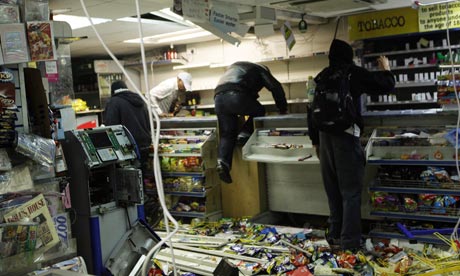
Speaking at the recent Conservative party conference, a government minister has said that the mass arrests and prison sentences for decent citizens who chose to rob shops and set buildings ablaze in London and other cities during a recent wave of looting, had brought the law into disrepute.

Our laws against arson were introduced centuries ago, when a typical London building was built of wood. There have been huge advances in fire-fighting technology since then. Our blanket ban on arson has been discredited, because it failed to keep up with these changes. And what about “vandalism”? Should the law really be fixated on the practices of wandering bands of hairy Germanic tribesmen? Can anyone genuinely say he thinks our laws against burglary are fit for a 21st century economy? By allowing a portion of the shops’ overpriced merchandise go up in flames, and another portion to the informal vending sector, where it is substantially marked down, we bring thousands of decent firebugs and thrifty shoppers back within the law, restoring the legitimacy of the penal system, improving productivity and delivering hundreds of millions of pounds of stimulus that the economy sorely needs.

No, sorry, I got that wrong. The correct quote is:

The 70mph motorway speed limit has become “discredited” and resulted in millions of motorists breaking the law, Transport Secretary Philip Hammond said today as he confirmed plans to consult on allowing it to rise to 80mph.

Mr Hammond told the Conservative Party conference the move would “restore the legitimacy” of the system and benefit the economy by “hundreds of millions of pounds”.

He said: “The limit that was introduced way back in 1965 – when the typical family car was a Ford Anglia.”

Mr Hammond said he owned an Anglia, as did Baroness Thatcher when she became an MP, but added: “Things have changed quite a bit since then. There have been huge advances in car technology, road deaths have been reduced by three-quarters.

“Meanwhile, the 70mph limit has been discredited because it failed to keep up with these changes – with almost half of all motorists exceeding it, bringing the law into disrepute.

“So I will consult on increasing the limit on motorways to 80 mph, bringing millions of decent motorists back within the law, restoring the legitimacy of the speed limit system, speeding up journey times, improving productivity and delivering hundreds of millions ofpounds of net economic benefits.”

We should start making a list. Laws that need to be ruthlessly enforced when they are disobeyed en masse: Arson, burglary, “theft by finding”, receiving stolen goods. Laws that need to be abolished when they are disobeyed en masse: Tax laws, speed limits. Hmmm. What’s the pattern? Prosperum ac felix scelus virtus vocatur. [Seneca. A successful and happy crime gets to be called virtue.]

Of course, Monty Python nailed it while I was still a toddler. In this case, the Mouse Sketch:

Make a thing illegal and it acquires a mystique. Look at arson – I mean, how many of us can honestly say that at one time or another he hasn’t set fire to some great public building? I know I have. The only way to bring the crime figures down is to reduce the number of offences.

British riots, further reflections

loottherich1

From the BBC web site:

Home Secretary Theresa May has asked the Metropolitan Police to check whether banning theft and arson is an effective strategy for preventing crime. Some criminologists have claimed that widespread looting and arson mean the laws are not having the desired effect. Speaking on BBC Radio 4’s Today programme, Mrs May hinted that the riot laws remained under review. She added: “There’s not much point in having laws that are inefficient.” She suggested that the funds currently spent on policing might be better spent on reconstruction.

No, sorry, I got that wrong. It wasn’t the Home Secretary, it was the Chancellor of the Exchequer. The correct quote is:

Chancellor George Osborne has asked the Inland Revenue to check whether the 50p top rate of income tax is actually making money for the government. Some economists have claimed that tax avoidance and evasion mean the rate is raising less income than expected. Speaking on BBC Radio 4’s Today programme, Mr Osborne hinted that the 50p rate remained under review. He added: “There’s not much point in having taxes that are very economically inefficient.”

Continue reading “British riots, further reflections”

On the downgrade

Further reflections on non-transitive folk probability

Continuing my thoughts about zero-one probability from here, I come to the recent decision of Standard & Poor’s to lower their rating of US treasury debt. There are plenty of reasons to doubt their judgement,  both because they’ve been absurdly wrong in the past (subprime mortgage backed securities were AAA, but treasury bills are risky?), because they can’t read budget estimates or can’t do basic arithmetic, because they are trying to project political trends, which they surely know even less about than about arithmetic, or because the people who work there are generally known to be pretty dim. But from a probabilist’s point of view what’s strange is the timing. Whatever you may think of the recent deal to avoid the US defaulting on its debt, it did avoid defaulting on its debt. Surely the likelihood of a default went down after the deal was passed. So why is the credit rating lower this week than it was last week? Now, this is all perfectly consistent with the view that S&P is not actually making a prediction of future default probability, but simply seeking the best opportunity to promote its wares. Certainly, the way they operate is not the like someone trying to give what will be perceived as neutral advice; they act more like central bankers, timing their announcements to try to move markets and (above all) seem relevant. They’re reminiscent of the folktale of the rooster who threatens to withhold his crowing, which inevitably will forestall the sun rise. The other animals plead with him to relent, but it’s a threat that only works as long as the rooster is modest enough to recognise that he can’t hold out forever. In the case of the US treasury bonds, S&P held out, and still the sun rose.

But there is something about their approach that seems to make sense to intelligent people, and not purely idiosyncratic. I’m reminded of Tversky’s famous conjunction fallacy, with studies seeming to show that people’s everyday probability intuitions don’t necessary satisfy the apparently inevitable law of conjunction: The probability of A or B must be bigger than the probability of A and the probability of B. Here we see intuitions of probability that don’t seem to satisfy the law of total expectation: If  are possible future states of the world, and is the probability of event A conditional on  happening, then the probability of event A now must be some kind of average of these conditional probabilities.

downgrade

British riots

rioting-carousel-007

The well-known history of enclosure riots in 16th and 17th century England fascinates above all for their orderliness. Describing one riot in early Jacobean Bedfordshire, V. Magagna writes “The assembly that plotted the riot met in the church[…] The leader of the riot was the village constable.”

I thought of this when I read the following on the BBC web site, on the third day of riots and looting throughout London:

“Full scale looting going on at Clarence convenience store right by the burning car on clarence road. “One by one” shouts one man as people crowd round to get into the shop, whose entrance has been smashed in. Women calling: can you get me a magazine? Other people asking for alcohol.”

One by one. That’s British looting for you. They’ll pillage, and they’ll rampage, and they’ll kill, but they’ll queue up in an orderly fashion to do it… particularly if they have hopes of being rewarded with alcohol.

“Petitioning implies a belief in a natural order of society protecting the interests of rich and poor alike, which the authorities can be expected to enforce once the misdeeds of individuals are brought to their notice. Even riot can be seen in this light, for the intention was usually to compell authority to maintain a traditional order, rather than to overturn it.” Underdown, 1985, p. 118

london looting

Playing Euro Survivor

It’s starting to look like we’re all going to be entertained this summer watching the monetary reality show, Euro Survivor: Who can be the last country left in the Euro? Greece has already been voted off the island, even if it hasn’t left yet. Ireland and the Iberians are looking decidedly unpopular, and Italy seems headed downhill as well. (I never understood why Italy was not on financial deathwatch. Is such a massive default just too horrible to contemplate? Or perhaps people just assumed Italy couldn’t possibly print lire until Berlusconi has arranged adequate shell companies to siphon the printing contracts discretely into his own syndicate.) My money is on Luxembourg. It seems fair that they should get to keep the Euro for themselves, since I can’t remember what their currency was called before the Euro. Belgium may end up with two new currencies. (But what’s the first prize? Maybe they get the rump European Central Bank, and a free set of dominoes.)
20eurofr_HR

Continue reading “Playing Euro Survivor”