
I wonder whether any Republican legislators, in a quiet moment alone, is troubled to realise that the path they’ve followed has led them to work to trash the reputation of a highly respected moderate Republican former deputy attorney general and (until very recently) director of the FBI. Does it ring any alarm bells for them? Do they think, this isn’t really what I expected to be doing with my life?
Category: Politics
Where are the simple joys of Maidenhead?
Theresa May’s gamble has gone badly wrong. There’s a danger of chaos overwhelming all of us now, but I want to take this moment, with the result still fresh, to exult.
There is a special joy at seeing a tactically shrewd and wholly cynical and unprincipled scheme fail. The Tories made a principled case back in 2010 for fixed-term parliaments, which they enshrined in law. May made a principled case for not calling a new election last year when she took over the leadership last year. And then she abandoned all those principles as soon as she saw a political advantage in the sky-high poll numbers for herself and her party. There was no other justification than that she thought she was sure to win, because all the press barons loved her, and Jeremy Corbyn dresses badly, and she couldn’t conceive of having to compromise. Just to make it particularly destructive, she lit the 2-year fuse on Brexit before calling the new election, so that time is running out even while they sort out their mess in Westminster.
A reasonable conclusion would be that it was a mistake to try to run the country off the hard Brexit cliff on the basis of a paper-thin referendum majority, and that she should instead seek a broad consensus, at least on the EU negotiations, with all the major parties. That wouldn’t be Theresa May’s conclusion, though. She may not have been in favour of Brexit, but she’s not going to lose the opportunity to knife the perfidious foreigners, even if the price is collaborating with the DUP to undermine abortion rights, climate policy, and peace in Northern Ireland.
By the way, if you don’t recognise the reference in the post title…
Exponential vernacular
Like most mathematicians, I think, I’m irritated by the way “grows exponentially” has come into common parlance as a synonym for “grows rapidly”; whereas exponential growth in mathematics may be fast or slow, depending on the current level of the quantity. This has even crossed into technical discussions, as when I heard a talk by a cancer expert who objected to standard claims that cancer mortality increases exponentially through adulthood — which it does — because the levels actually stay low through the 50s, and so only “increase exponentially” after that point.
Anyway, I was under the impression that the vernacular application of this mathematical concept was fairly recent. So I was intrigued to find the cognate concept of “growing geometric” popping up in Evan Thomas’s Nixon biography, on the Watergate tapes. In the context of cancer. Used correctly! It’s quite a famous part of Watergate lore, where John Dean refers to Watergate as a “cancer… close to the presidency”.
We have a cancer — within — close to the presidency, that’s growing. It’s growing daily. It’s compounding, it grows geometrically now, because it’s compounding.
Trump’s cheap shyster responds to the former FBI director
I know that Donald Trump is famously stingy, but I would have thought a man with his history of persistent involvement with the shady side of the law would appreciate the value of competent legal assistance. Instead, he has this guy:
President Donald Trump’s personal lawyer on Wednesday responded to fired FBI Director James Comey’s prepared testimony to the Senate Intelligence Committee by saying that Trump felt “completely and totally vindicated.”
“The president is pleased that Mr. Comey has finally publicly confirmed his private reports that the President was not under investigation in any Russia probe,” Marc Kasowitz wrote in a statement. “The president feels completely and totally vindicated.”
Seriously? The FBI director has presented what most people would consider overwhelming evidence of attempted obstruction of justice, attempting to block investigation of his close associates, strikingly similar but even more blatant than the actions for which Richard Nixon was forced to resign. The best his lawyer can come up with is to say that, in the course of the discussions in which he attempted to obstruct justice the president received assurances that he was not, at that point, two months ago, personally a target of investigation. That’s what he calls “totally vindicated”.
I suppose this is what you get when top law firms consider the president too skeezy to associate with.
Absence and present values: A thought on monuments
I’ve just been reading Eric Foner’s Reconstruction: America’s Unfinished Revolution, and came upon this passage, that is relevant to current debates about maintaining monuments to once-admired figures who have now fallen into disrepute:
[The Republican Party] did gain the support of General James Longstreet, whose example inspired some Confederate veterans to follow in his footsteps… General Longstreet’s decision to join the Republican Party made him an object of hatred among Southern Democrats for the remainder of his life. When he died, in 1903, the United Daughters of the Confederacy voted not to send flowers to his funeral, and unlike other Confederate generals, no statues of Longstreet graced the southern landscape.
It’s incredibly naïve to say, monuments should stay as they are because they are part of history. They’re not. History is history, but monuments are present expressions of an attitude toward history. Sure, the statue of Robert E. Lee that was recently taken down in New Orleans was itself a historical artifact, and part of (a certain period of) city history, but the curatorial choice of what to keep is a statement about our current values. To the untrained eye, the statue was not a monument to 1884, when it was put up, but to 1863.
If you really want it to be a monument to 1884, and the intervening time when it has stood, so that the public could appreciate the “history” represented by the erection of a statue of Robert E. Lee (or of Cecil Rhodes), you would need to be able to make them see not only the statue that is present, but also the statue that is absent (of General Longstreet, say, or Olive Schreiner). But an absence can never compete with a presence in its impact on the viewer. So Lee and Rhodes must fall.
The other statement is overridden
Nixon press secretary Ron Ziegler used to be the gold standard for political obfuscation, with his declaration (when he had to reverse previous insistence that no one in the White House was involved in the Watergate break-in “This is the operative statement. The others are inoperative.”
Trump, recognising that his Watergate reboot won’t pull in 21st-century viewers if they have to watch a “third-rate burglary” investigation playing out over 2 1/2 years, is ramping up the malfeasance (Russian espionage! billion-dollar bribes!) and the pace, while still hitting the classic Nixonian marks (asking the CIA to block an FBI investigation!) One place where they’ve been exceeding their originals is in the obfuscatory rhetoric. Following on Kellyanne Conway’s celebrated rechristening of lies as “alternative facts”, we have budget director Mike Mulvaney explaining why Trump’s explicit promise not to cut Medicaid was now being reversed. NY Times reporter John Harwood:
at briefing today, Mulvaney told me Trump promise not to touch Medicaid had been overridden by Trump promise to repeal/replace Obamacare https://t.co/WSafn6ighT
— John Harwood (@JohnJHarwood) 23 May 2017
“Overridden”! Like a good reboot, it’s reminiscent of the Zieglerian original, yet somehow punchier, with a novel twist. (Tens of millions of poor people losing access to healthcare. Great cliffhanger!) The critics, though, might carp at them reaching for effect this way on their policy statements, where Nixon himself was pretty solid, leaving perhaps less headroom for further amplification when we get to the corruption charges.
Some are saying the show might not even be renewed for another season.
By the way, I’ve just read Evan Thomas’s biography Being Nixon. I’ve never had much patience for those who claim that Nixon got a raw deal over Watergate — the burglary and cover-up were just the most salient aspect of the presidential malfeasance and abuse of power — but I understand better why many people would have seen his fall as tragic. Great talents that could have served the country well, sadly bonded to a flawed personality that dragged himself and the country into a mire of recriminations.
Comparing Trump to Nixon is deeply unfair to Nixon.
Republican humour
I’ve tended to think of republicans as a fairly humorless bunch. But with information coming out more about the pattern of top Republicans making “jokes” (Trump on stopping the Flynn investigation, House Majority Leader McCarthy on Trump being paid by the Russians) under conditions of absolute secrecy, I have to consider the possibility that there’s a whole underground world of Republican humour.
And they’re obviously sincere, since they also mistook President Obama’s secret private warning about Flynn for a joke.
Wake-up call
Microsoft responds to the worldwide ransomware attack on Windows XP:
The governments of the world should treat this attack as a wake-up call.
A wake-up call where they kill sick people in need of medical treatment. I’m not staying in that hotel again.
Fortunately, it turns out that no one was responsible: not Microsoft, not the NSA. Here in Britain, the government that skimped on funding vital infrastructure for the National Health Service so that their computers didn’t get urgent security patches looks likely to be re-elected in a landslide, because the important thing is not what a government does in office, but whether its plans for what it would do get leaked to the press several days early.
Strong and stubborn stable leadership.
Donald Trump’s Lawyer and the Monty Hall Shadow
Our distant descendants hunkering in their radiation-proof underwater bunkers will speak of “Donald Trump’s lawyer” proverbially, as an oxymoronic self-flagellating professions, the way we might speak of “Bernie Madoff’s accountant” or “Jeffrey Dahmer’s nutritionist” or “Water-safety officer on the Titanic”. Tom Lehrer spoke on one of his satirical LPs from the 1960s about people following the news with unease, feeling “like a Christian Scientist with appendicitis”. One might similarly say “I feel like Donald Trump’s lawyer”.
Our story to date: When last we saw Sheri Dillon it was a week before Donald Trump’s inauguration, and she spoke beside a table full of binders — none of which were ever seen by the public — which supposedly showed that Trump was taking some unspecified action that would resolve all legal and ethical conflicts arising from his business interests. They were the most prominent unseen-document-political-props since Joseph McCarthy’s infamous “list” of “known communists”. (Or perhaps Mitt Romney’s “binders full of women”.) Continue reading “Donald Trump’s Lawyer and the Monty Hall Shadow”
Good words
There has been a lot of reporting on this recent poll, where people were asked what word first came to mind when they thought of President Trump. Here are the top 20 responses (from 1,079 American adults surveyed):
idiot         39
incompetent   31
liar          30
leader        25
unqualified   25
president     22
strong        21
businessman   18
ignorant      16
egotistical   15
asshole       13
stupid        13
arrogant      12
trying        12
bully         11
business      11
narcissist    11
successful    11
disgusting    10
great         10
The fact that idiot, incompetent, and liar head the list isn’t great for him. But Kevin Drum helpfully coded the words into “good” and “bad”:
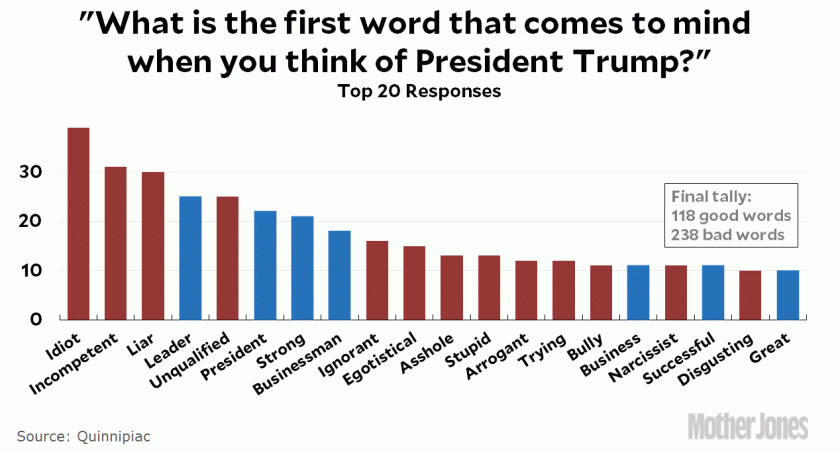
What strikes me is that even the “good” words aren’t really very good. If you’re asked what word first comes to mind when you think of President Trump and you answer president, that sounds to me more passive-aggressive than positive. Similarly, you need a particular ideological bent to consider businessman and business to be inherently positive qualities. Leader — I don’t know, I guess der Führer is a positive figure for those who admire that sort of thing. Myself, I prefer to know where we’re being led. If we include that one, there are 4 positive words, 4 neutral words, and 12 negative. (I’m including trying as neutral because I don’t know if people mean “working hard to do his job well”, which sounds like at least a back-handed compliment, or “trying my patience”.)
 Common Infirmities