Matthew Yglesias has given a pithy summary of the case against free on-street parking:
Obviously people who currently get to occupy valuable urban space with their private vehicles would like to keep that privilege. But by the same token, I’d love it for the city government to just give me a free car or stop charging me property tax. That doesn’t mean it would be a good idea. There may be an argument that 30 to 40 parking spaces for cars is a better use for a given piece of land than protected bicycle lanes, but “Waaaah, don’t affect my parking” is not a very persuasive argument. The streets are public spaces and they need to be used for public benefit, not just the benefit of whoever happens to own a car on the block.
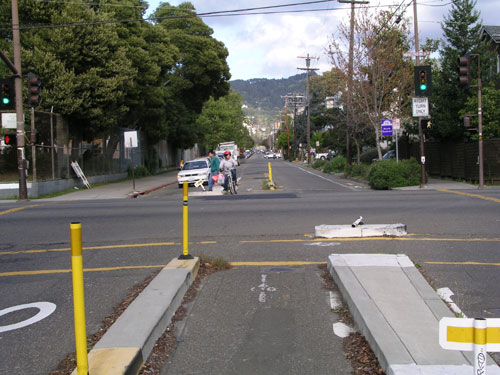
This is even more of an issue here in Oxford, where people with private cars get to take up not only the streets, but also substantial portions of the already quite narrow sidewalks. (Yglesias was discussing the debate over installing a new bicycle lane in Washington DC. I’m not sure if it would be quite so contentious here, since — as I discussed here — drivers don’t hesitate to park in bicycle lanes, and so far as I can tell the enforcement is zero. See, for example, the photograph below, of a typical local cycle lane.) [Update 5 Oct, 2013: Not quite zero. I actually saw a car in the cycle lane with a fixed-penalty notice on the windscreen. So there.]
People clearly have ideas about things that by right and nature ought to be free. Perhaps because I don’t drive a car myself, I cannot imagine why parking spaces should be one of them, particularly not residents’ parking. To be sure, residents’ parking is not free here. It’s £50 a car — just enough to create a sense of entitlement among those who have paid for it, not enough to come anywhere close to covering the real costs of providing
It’s not at all clear why people have any more right to 6 square metres of public road to semi-permanently store their automobiles than I have to store my surplus books. I would not be permitted to set out a storage shed by the side of the road. (I suppose I could use an automobile as a storage facility — some people clearly do, at least in Berkeley — but I would at least need a driver’s license and a car that was sufficiently functional to be registered.)
Having taken on the controversial question of the significance of ascribing shrillness (shrillity? shrillth?) to ones opponents, I feel obliged to wade in on the pressing issue of “bleating”.
The occasion is an open letter by a group of British education experts, pointing out the well-established fact that the UK obsession with getting children learning arithmetic and reading at ever earlier ages — formal schooling starts at age 3 1/2 — is counterproductive, and that children would be better off with age-appropriate education. The education ministry has responded with an extraordinarily unprofessional (shrill, or perhaps “spittle-flecked” would be the vernacular description) ejaculation of mostly generic insults, including the charge that
We need a system that aims to prepare pupils to solve hard problems in calculus or be a poet or engineer – a system freed from the grip of those who bleat bogus pop-psychology about ‘self image’, which is an excuse for not teaching poor children how to add up.
I can’t fault the alliteration of “those who bleat bogus pop-psychology”, but what does it mean? It sounds like an insult, but I’m not sure what is insulting about it. Presumably it’s supposed to make you think of a flock of sheep, dumbly repeating some meaningless sounds. And, bleating is sort of a shrill sound, so maybe it also is meant to have effeminate overtones.
The term “pop-psychology” is interesting in this context. Given that the letter is signed by professors and senior lecturers in psychology and education, I have to assume that, right or wrong, what they’re talking about is real psychology, not “pop”. So it’s interesting that the bureaucrats felt that they couldn’t take on the reputation of academic psychology directly, but only by insinuating that it is all just self-help pablum. (And is “bogus” a modifier of pop-psychology — to say, this isn’t even the top-drawer pop — or a redundant intensifier, as when one refers to “disingenuous government propaganda”?) Continue reading “Is bleating shrill?”
Regular readers of this blog are already aware that Richard Dawkins thinks that, among the crimes perpetrated upon children by Catholic priests, sexual molestation is less bad than teaching religion. (The quote is here.) Now he has given an interview to the Times magazine (reported by Katie McDonough here) in which he describes a schoolteacher who “pulled me on his knee and put his hand inside my shorts”, and says this “mild touching up” and “mild pedophilia” is something he “can’t find it in me to condemn… by the same standards as I or anyone would today.” Being an expert on something or other, Dawkins opines that “I don’t think he did any of us any harm.”
Some of those school masters presumably also taught religion, but it’s sadly too late (by several centuries) to bring them to justice for that crime.
I find myself wondering why this man keeps coming back to publicly trivialising child abuse. Maybe the Bible can provide some insight.
Another unusual juxtaposition. This one was inspired by a thought-provoking rant by Alison Benedikt at Slate, titled “If You Send Your Kid to Private School, You Are a Bad Person”. It’s a commendably forthright statement of an extreme position in an argument in which all sides usually beat wildly around every possible bush. (It’s not the most extreme possible position, which I take to be the position of the makers of this film. Benedikt specifically opposes even banning private schools.)
I have some sympathy for her argument, which can basically be summarised (I hope I’m doing it justice; the article is definitely worth reading in full) in two major points:
Wealthy and well-educated parents have an obligation to all children, not just to their own. Keeping their children in state schools will induce them to apply their power and learning to improve those schools for everyone.
As regards your own children, they’ll be all right even in a crappy school. You’ll make up for the deficits at home. And the crappy public school will teach them lessons about society and citizenship that they can’t get anywhere else.
I don’t think either of these statements are entirely wrong. But in arguing for point 2, Benedikt writes
I went K–12 to a terrible public school. My high school didn’t offer AP classes, and in four years, I only had to read one book. There wasn’t even soccer... I left home woefully unprepared for college, and without that preparation, I left college without having learned much there either. But guess what the horrible result is? I’m doing fine. I’m not saying it’s a good thing that I got a lame education. I’m saying that I survived it, and so will your child, who must endure having no AP calculus so that in 25 years there will be AP calculus for all…
Is the argument here that the economic game (or, at least, journalism) in America is so badly rigged, that a child of middle-class parents doesn’t actually need an education to get a decent job as a journalist. All she needs is a college degree, and there are plenty of institutions who will happy to hand her one, despite the fact that she arrived woefully unprepared, and left having learned almost nothing. Or is she exaggerating? Or is she an exceptional autodidact, whose experience doesn’t necessarily translate well to the vast majority of other children. Continue reading “Schools, socialisation, Socrates and circumcision”
I’ve just returned from my sabbatical in Berkeley, and while I’ve written some harshcriticism of life in the US when it unfortunately intersects with the medical system, as long as you can stay healthy there are some conspicuous advantages to life in Berkeley. Particularly if you walk or ride a bicycle.
Some of it is no one’s fault: There’s obviously more space in Berkeley for wide sidewalks, and the crush of tourists on a few major boulevards, particularly in summer, is peculiar to Oxford. On the other hand, Oxford city council chooses to allow merchants to block half of the narrow pavement with advertising signs. Still, with the narrow, often one-way streets, Oxford is no paradise for drivers either.
And maybe that’s part of the reason why Oxford drivers are, there’s no way to prettify this, hateful toward non-drivers. (Presumably toward other drivers as well, but I haven’t had that experience.) Not all of them, of course, and not all the time, but enough to make cycling something I avoid when I have time to walk, and makes me feel on edge much of the time even when I’m walking. Berkeley drivers are sometimes thoughtless, of course, but the threatening incidents of recklessness still seem less frequent in Berkeley than the incidents of active aggression and rage in Oxford.
Cycle lanes are occasional and intermittent, and the average Oxford driver considers “cycle lane” to be just a fancy word for “free parking”. We don’t have as much of a problem with restaurants or constructions sites parking their dumpsters on the cycle lanes as they apparently have in Belfast, but here’s a cheeky comment on their difficulties.
I suspect that the better conditions in Berkeley are a good example of the civilising influence of the law. California law requires that drivers stop for pedestrians in any crosswalk, whether or not it is marked. And they do. Nearly always, except on high-speed highway-like urban roads, and even there if you make yourself conspicuous you’ll usually get someone to stop pretty quickly. This gets people into the habit of paying attention to slower travellers using the road, and frequently they’ll stop even when they are not required to, for instance, for pedestrians crossing in the middle of a block, or for cyclists on a cross-street.
In Oxford, as in all of England (I have been informed), cars are required to stop only at elaborately constructed official zebra-striped crosswalks with huge flashing lights overhead. Because of the elaborate construction these are rare, and even so are often ignored. And I can certainly count on the fingers of one hand the number of times in five years that any driver has stopped to let me cross the street as a pedestrian when it was not strictly required by law. It didn’t matter if it was snowing or pouring rain and I was out walking with a small child. In Berkeley I was more likely to be embarrassed by a car stopping for me to cross when I was merely loitering near to the crosswalk.
Back in 2008 I remember being amused by the accusations of arrogance levelled at then-candidate Barack Obama. It seemed to me a mere expression of anti-intellectualism. Of course you don’t become a top politician, even within reach of the presidency, without being pathologically arrogant, but no one really wants a shrinking violet as president.
But the Republican He’s a smart, educated guy, and the Republicans think (I supposed) they can gain an advantage by playing to the common fear that any such person must hold the average citizen in contempt.
I must now admit to having experienced a failure of empathy. Only now, when I (and those like me) am the object of the great BO’s contempt, do I appreciate how peculiarly infuriating this man’s ego is. This idiosyncratic blend of openness and narrow-mindedness, his willingness to discuss anything with anyone, undertaken with the absolute self-assurance that his intellect already encompasses any argument we might make.
Basically, Obama tells the American people, “You’re beautiful when you’re angry”.
In his recent remarks on l’affaire Snowden, Barry said
And if you look at the reports — even the disclosures that Mr. Snowden has put forward — all the stories that have been written, what you’re not reading about is the government actually abusing these programs and listening in on people’s phone calls or inappropriately reading people’s emails. What you’re hearing about is the prospect that these could be abused. Now, part of the reason they’re not abused is because these checks are in place, and those abuses would be against the law and would be against the orders of the FISC.
Having said that, though, if you are outside of the intelligence community, if you are the ordinary person and you start seeing a bunch of headlines saying, U.S.-Big Brother looking down on you, collecting telephone records, et cetera, well, understandably, people would be concerned. I would be, too, if I wasn’t inside the government…
But people may have better ideas and people may want to jigger slightly sort of the balance between the information that we can get versus the incremental encroachments on privacy that if haven’t already taken place might take place in a future administration, or as technologies develop further….
And so those are the kinds of things that I’m looking forward to having a conversation about.
Speaking as one of those “ordinary persons”, I am disgusted by the president offering to start a “conversation” about what I and many others who have thought deeply about these matters consider to be already huge violations of our civil liberties, an injury to the rule of law, and laying the groundwork for the complete evacuation of democracy, with the caveat right up front that the only possible result could be “to jigger slightly sort of the balance”. Because Obama the Omniscient couldn’t possibly have gotten the whole policy wrong. He’s an (adjunct) constitutional scholar, ferchrissake!
He ridicules our concerns, because we’re not well informed like the people in the “intelligence community”, but he has been withholding the information, and taking extreme measures against anyone who tries to inform us.
But he loves having these heated conversations with us. We ordinary folks are so beautiful when we’re angry!
What is the attraction of monarchy? According to the BBC headline “Kate Middleton in labour as world waits”. Really? The world? What exactly are they holding off on? Doesn’t the world have important things to do? (On the other hand, I’ve just discovered that The Guardian now has an alternative “republican” versions of its web site, with a report on rock star Morrissey in place of the princess’s labour pains. Just click to toggle.)
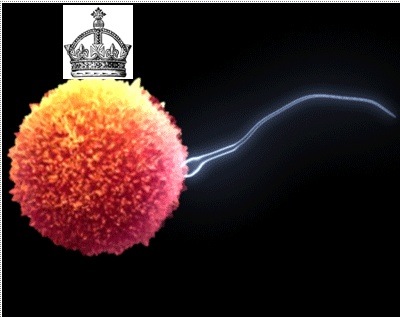
In honour of the newly announced maturation of the royal zygote into an air-breathing royal neonate — and its generous decision to head off a constitutional crisis by choosing to make do with only half its potential complement of X chromosomes — who is already predestined to rule over Britain, even while he is likely to be occupied less with affairs of state in the near future than with spitting up curdled royal milk from HRH the DoC’s royal mammary glands, I am reposting my proposal from two years ago, occasioned by the royal wedding. The proposal has been unaccountably ignored, despite its prospects for improving the democratic legitimacy of the monarchy. I can only infer that the neglect is due to a basic discomfort among the British elite with the innovations of modern science (unlike the innovations in, say, tax accounting, of which they tend to be avidly fond).
With the impending union of male and female royalty breeders, there has been increasing tendency to cite Thomas Paine’s evergreen mockery:
The idea of hereditary legislators is as inconsistent as that of hereditary judges or hereditary juries; and as absurd as an hereditary mathematician, or an hereditary wise man; and as ridiculous as an hereditary poet-laureate.
(Paine never got to see the number of statistician children filling posts in some of today’s leading statistics departments, but the point is, in principle, well taken.) Seen as the monarchical version of an election — the keystone of the procedure by which a legitimate head of state is created — a Royal wedding certainly feels a trifle arbitrary. But this opposition to monarchy, though it wears the finery of modernity, has failed to keep up with advancing technology. True, it might formerly have been the case that the hereditary principle made the choice of head of state no different from a lottery (for which, see this suggestion). It seems impossible to unite the hereditary principle with the increasingly popular superstition that rulers should be selected by some non-random process, and that hoi polloi should have something to say about it. But now the following arrangements have been announced by the Palace (a particularly sodden corner of the palace wine cellar, to be precise)*:
Following the wedding, a selection of at least 5 royal spermatozoa** will be extracted and fully sequenced by a specially selected team at the Royal Institution for Genetics Pedigree Studies. The secret method (which, in a nod to popular taste, does use beer as a reagent) has been designed to be maximally non-destructive.
The sequences will published on the website princesperm.gov.uk. The public will have 5 days to register and vote for the one that they prefer be invited to form their new ruler.
The elected sperm will be invited in the first instance to inseminate the royal egg. Should it fail in its attempt, the second-place sperm will be sent in. In the case of a repeat failure, a national referendum will be held to determine the correct voting procedure.
* It may be argued that this election proposal, being purely fictional and even farcical, has no bearing on the justification or not of the British monarchy. A dangerous argument indeed, for those who would dispense with fiction and farce would leave central pillars of the British constitutional order bereft of all foundation.
** Why are the future queen’s eggs not also sequenced? Choice of the ovum is a royal prerogative, cf. Blackstone, Commentaries on the Laws of England, v. 5, section 113 (Oxford 1765-1769).
As though it need to defend its title as the world’s leading provider of smug, The New Republic has published a piece by NY Times religion reporter Mark Oppenheimer (MO hereafter) about how irrational everyone is. This disturbs him, because when he was growing up, when all was right with the world, “It was taken for granted in my house… that only right-wingers were mad enough to oppose scientifically tested public-health measures.” He describes what he calls “The New Puritanism”, starting from opposition to water fluoridation in Portland (which doesn’t look like an archetypically puritanical cause to the untrained eye), and moving on to Kids Today:
At a birthday party for a three-year-old, I was hit with the realization that most of the parents around me were in the grip of moral panic, the kind of fear of contamination dramatized so well in The Crucible. One mother was trying to keep her daughter from eating a cupcake, because of all the sugar in cupcakes. Another was trying to limit her son to one juice box, because of all the sugar in juice. A father was panicking because there was no place, in this outdoor barn-like space at some nature center or farm or wildlife preserve, where his daughter could wash her hands before eating. And while I did not hear any parent fretting about the organic status of the veggie dip, I became certain there were such whispers all around me.
Now, this could be dismissed as a dreary attempt to channel PJ O’Rourke, or some comparable swaggering humourist, with a cookie-cutter tall tale, but it’s stuffed with all kinds of weird. He hallucinates “whispers all around” about the organic status of the veggie dip, and yet he insists it is the others whose mental stability is in doubt. With that in mind, one might suspect that the father was not “panicking”, but was simply asking where his daughter could wash her hands before eating, which was certainly the custom when I was a child, though perhaps not in Oppenheimer’s antediluvian childhood.
He cites The Crucible, presumably both as a touchstone of left-wing right-thinking and as a marker of his own cultural sophistication, but has clearly never read or seen it. While “witchcraft” are often taken as a metonym for fear of moral contamination, Miller’s play dramatizes political manipulation of mob psychology.
But putting aside MO’s paranoid-pretentious MO, I am fascinated by his comments
When I was a child, birthday parties involved cake, ice cream, and Chuck E. Cheese pizza, or pizza-like substance; and trips to the grandparents’ house involved root-beer floats and late-night viewings of Benny Hill with my grandfather, who liked the T&A humor. I never washed my hands before I ate. And I turned out splendidly.
So, we started with fluoridation of water, which is a “scientifically tested public-health measure” that only a crazy person could oppose, but washing hands before eating — at a “barn-like space” where, presumably, it is not absurd to suppose the children may have been exposed to animal feces — is the kind of over-the-top fear of moral contamination (not just bacterial contamination) that invites mockery.
Now, MO’s aforementioned paranoid delusions may cause one to question his splendid self-appraisal, but he is certainly not alone in trumpeting the formulation “When I was a child we all did X, and we all turned out alright,” where X is some dangerous or unedifying activity that educated middle-class parents today try to limit or eliminate. An extreme version is this text that got forwarded to me a few years back:
To Those of Us Born 1930 – 1979
First, we survived being born to mothers who smoked and/or drank while they were pregnant. They took aspirin, ate blue cheese dressing, tuna from a can and didn’t get tested for diabetes. Then after that trauma, we were put to sleep on our tummies in baby cribs covered with bright colored lead-base paints. We had no childproof lids on medicine bottles, locks on doors or cabinets and when we rode our bikes, we had baseball caps not helmets on our heads. As infants & children, we would ride in cars with no car seats, no booster seats, no seat belts, no air bags, bald tires and sometimes no brakes. Riding in the back of a pick- up truck on a warm day was always a special treat. We drank water from the garden hose and not from a bottle. We shared one soft drink with four friends, from one bottle and no one actually died from this. We ate cupcakes made with Lard, white bread, real butter and bacon. We drank FLAV-OR- AID made with real white sugar…. We fell out of trees, got cut, broke bones and teeth and there were no lawsuits from these accidents. We would get spankings with wooden spoons, switches, ping pong paddles, or just a bare hand and no one would call child services to report abuse…
You might want to share this with others who have had the luck to grow up as kids, before the lawyers and the government regulated so much of our lives for our own good. While you are at it, forward it to your kids so they will know how brave and lucky their parents were. Kind of makes you want to run through the house with scissors, doesn’t it?
The implication is that the kids are all softies and the parents are anxious killjoys. I heard a stand-up comedian a few years back complaining about bicycle helmets: “When I was a kid we all fell off our bikes. We didn’t fall on our heads. If we did, no one died. Have kids’ heads gotten softer?”
Except, of course, that it’s not true that no one died. This is a good example of how people deal with small risks: Some are treated as zero, others are exaggerated. And part of the phenomenon (though I’ve never seen anyone analyse this process in detail) is that people fixate on whatever the current largest risks are, and often succeed in pushing them down. At that point, a new danger pops up that was always there, but masked by a larger risk, and so psychologically zeroed out. Thus, when I was growing up, in the 1970s, public health officials weren’t very concerned with children’s head injuries from bicycle accidents because there were far more of them from automobile accidents in the absence of seat belts, not to mention all the poisonings from medications without child-resistant packaging. If the risk of dying
To put some numbers on it: In the US, in 1998, about 6500 children under the age of 15 died in accidents. In 1981 (the earliest year whose statistics I have easily available at the moment) the number was 9000. In that time, the population under 15 increased from 49 to 60 million. In other words, if the society had held onto its habits of eschewing bicycle helmets, leaving the medications out, riding in the back of a pickup truck and all the rest, we’d have more than 4500 extra dead children a year. How awesome would that be?
That’s not to say that all concerns about health and nutrition and environment are reasonable — or that, even if they are reasonable, that the actions one would take to prevent or mitigate harm would not impose considerable costs, even such that they might be judged to outweigh the benefits. But instead of mockery and “I turned out alright” populism, we need to be clear on what the benefits are: 4500 fewer children being buried every year. And that’s ignoring the costs of nonlethal sickness and injury, the extra miscarriages and stillbirths, and the long-term damage to lungs and other organs that we now know were caused by all those smoking and drinking parents.
Update: The comedian I was thinking of was a woman, but here’s another comedian making fun of bicycle helmets for emasculating our children; in this version, he’s not asking why heads got softer, but why the pavement is harder. Same joke.
I downloaded and listened to the audiobook This is Our Music: Free Jazz, the Sixties, and American Culture. The author is Iain Anderson, and the language and structure seem like those of a slightly rewritten doctoral dissertation. It’s pretty interesting as a source for the politics — particularly racial politics — of jazz in the late 50s and early 60s, and it held my interest for the 5 hours I needed to listen to it at double speed. But what really fascinated me was the reader’s voice. The reader is listed as Paul Steven Forrest, but I can hardly believe that this is a human voice. (Indeed, this is the only book that this name has been assigned to as reader.) The sentence intonations are much too regular, and seem to ignore any cues related to the meanings of words. Some reasonably common English words — at least, common enough in academic jargon — such as “diaspora” are systematically mispronounced, but without any hesitation such as you might expect from a human reader stumbling over an unfamiliar word. Similarly, non-English words were completely botched, but without apparent self-consciousness.
On the other hand, if Paul Steven Forrest is in truth the pseudonym for a computer-generated voice, it’s remarkably good, at least to someone who has not been following progress in speech generation over the past decade. It took me an hour of listening before it struck me that something was off about the voice, and while it started to bug me, it never became unbearable.
Back when I was a graduate student, in the late 1980s and early 90s, there was a lot of discussion, among those interested in cryptography and computing (which I was, only peripherally) of the status of cryptographic algorithms as “weapons”, subject to export controls. The idea seemed bizarre to those of us who thought of algorithms as things you prove theorems about, and computer code as something you write. It seemed as absurd as declaring a book to be a weapon. Sure, you might metaphorically call Das Kapital a weapon, or the Declaration of Independence, but it’s not really a weapon, and a country was much more likely to think about banning imports than banning exports. The author of PGP was then being threatened with prosecution, and had the code published as a book to mate the analogy more explicit.
So, I used to defend free access to cryptography because I thought it was ridiculous to consider codes to be weapons. I now think that was naïve. But if codes are weapons, does that provide a justification for a right of free access (in the US)? Maybe it’s not freedom of speech or the press — 1st amendment — but if cryptography is a weapon, is the use and manufacture of cryptographic algorithms and software protected in the US by the 2nd amendment? Certainly the main arguments made for a right to firearms — sport, self-defence, and bulwark against tyranny — are all applicable to cryptography as well. Are there current US laws or government practices that restrict the people’s free access to cryptography that would be called into question if cryptography were “arms” in the sense of the 2nd amendment?
This is connected to the question I have wondered about occasionally: Why didn’t strong cryptography happen? That is, back then I (and many others) assumed that essentially unbreakable cryptography would become easy and default, causing trouble for snoops and law enforcement. But in fact, most of our data and communications are pretty insecure still. Is this because of legal constraints, or general disinterest, or something else? The software is available, but it’s sufficiently inconvenient that most people don’t use it. And while it wouldn’t actually be difficult to encode all my email (say) with PGP, I’d feel awkward asking people to do it, since no one else is doing it.
It seems as though the philosophy of the Clipper chip has prevailed: Some people really need some sort of cryptography for legitimate purposes. If you make a barely adequate tool for the purpose conveniently available, you’ll prevent people from making the small extra effort to obtain really strong cryptography.




 Common Infirmities