“No race problem”

Another interesting episode from Götz Aly’s book on 2/3 of a century of European antisemitism (1880-1945): At the conference convened in Évian, France in 1938, where representatives of the world’s democracies met to try to create a common policy on Jewish refugees, the Australian trade minister Thomas W. White explained Australia’s refusal to accept any Jewish refugees thus:

As Australia at present has no race problem at present, I think everyone will understand that we are in no hurry to import one.

From the perspective of modern race consciousness it is fascinating to see the Australia of 1938, with its marginalised and near-genocidally oppressed aboriginal population, seen as self evidently lacking a “race problem”, whereas the immigration of some thousands of Jewish refugees would self-evidently create one.

The Canadian prime minister Mackenzie King similarly believed that no good could come of tainting the pure Canadian race:

My own feeling is that nothing is to be gained by creating an internal problem in an effort to meet an international one… We must… seek to keep this part of the Continent free from unrest and from too great an intermixture of foreign strains of blood, as much the same thing as lies at the basis of the Oriental problem. I fear we would have riots if we agreed to a policy that admitted numbers of Jews.

(The exact quote comes from this paper.)

Nothing new in anti-Semitism: Jews as colonizers

Western leftists are committed to the ideological identification of Israeli Jews with European colonizers, which transforms the bitter conflict between Arabs and Jews into a noble chapter in the ongoing anti-imperialist struggle.* Thus I was interested when I discovered (in German author Götz Aly’s book on the history of anti-Jewish violence in Europe between 1880 and 1945) that this trope also has its conceptual antecedents.

It concerns the reaction of Romanian anti-Semites to the murder of Jewish student David Fallik in 1926. No less a figure than the Interior minister (and briefly later prime minister) Octavian Goga called the murder “a defense of the trampled honour of the Romanian people”, and went on to say that the Jews treated the Romanians no differently than “the English treat their colonised peoples.”

* I am referring here less to the discussion of the Israeli occupation of the West Bank, which does have colonialist traits, though I’d say more analogous to the English in Scotland and Ireland — including, dare I say it, Northern Ireland — than the military occupation of distant lands. I am thinking more of the general framing that the entire Israeli nation is a colonial project that should be overthrown, and that the Jews should go back where they came from.

Christian pastry

The Guardian reported recently on a dispute between Ryanair and the cultural authorities of the Balearic Islands over a traditional pastry called ensaïmada. This spiral-formed pastry is apparently rather bulky, and the Irish surcharge-generating firm has been charging passengers £45 to take their ensaïmadas onboard as carry-on luggage.

Ensaïmada

According to the article, the pastry is

made from flour, sugar, eggs, water and pork fat. It takes its name from saïm, the Mallorcan word for pig fat.

Pig fat? Seems like a weird thing to put into pastry. And indeed, the article goes on to say that an identical pastry called a bulema was made by Mallorcan Arabs and Jews before the Spanish conquered the islands in 1229. Needless to say — but the Guardian does need to say it — neither the Arabs nor the Jews put pig fat in their pastry. But the weird thing was that apparently the pig fat was added explicitly to “Christianise” the pastry.

The Catalan poet and painter Santiago Rusiñol wrote in 1922 that with the addition of pig fat, “the Moorish ensaïmada became Christian, then it became Mallorcan and then was transformed into a food for all of humanity”.

I’ve long found it bizarre the extent to which, just as much as many Jews and Muslims see not eating pork as a crucial determinant of their identity, so many gentiles see themselves as a mirror image, with positively eating pork as decisive for their Christian identity. For example, there was this article about how some French schools were refusing to serve any alternative to pork for school lunches.

Bacon and sausage school dinners are being used by rightwing politicians to hammer home what it means to be French. Court battles and vicious political spats have erupted as protesters warn that controversial menu changes are sending a message to Muslim or Jewish children that to be truly French, they must eat roast pork.

And then there were the repeated attacks by the British press on the Jewish Labour leader Ed Milliband for “failing to look normal eating a bacon sandwich”.

Mathematics and Meditation

Womb Realm Mandala

Sure, they’re both four-syllable words starting with M*, but do they have anything else in common?

Actually, quite a lot. They’re both ancient mental technologies for refining the mind’s ability to focus and grasp what is fundamentally ineffable: for mathematics this is space, motion, and quantity (or number); for meditation (I’m thinking here of Buddhist jhana meditation) it is the nature of mind and thought itself. Both require many years of intensive training and apprenticeship, often focusing on learning to solve a set of standard problems and carry out fixed exercises and incantations (QED, induction on n, proof by contradiction; buddham saranam gacchami). The practitioners of both are generally viewed as weird and otherworldly, and advanced practitioners demonstrate their mastery with bizarrely abstruse feats such as proving that all integers can be represented as a sum of a finite number of primes, or spending long periods of time in trance states, or levitating.

There is some direct overlap as well. Meditative practices often draw on geometric motifs — as in the mandala above — and arithmetic relations. Many chants are built on combinatorial principles. More specifically, the last of the five jhana factors is ekagatta, often translated as ‘one-pointedness’. This is typically interpretted as identification of mind and object, but the Pali word is purely geometric: eka (one) agga (point) ta (state). Viewed from a mathematical perspective you can see that the focusing of consciousness to a point can happen continuously, through contraction, or discretely, through reduction of dimension. It is possible to experience the mind as a geometric space, whose dimension can be reduced through concentration.

Presumably it’s just a coincidence, but I find it fascinating that the modern systematic approach to numbers is often attributed to the work of Euclid, in the early 3rd century BCE, shortly after Indian influences started to filter into Greek philosophy, particularly through the thought of skeptics such as Pyrrho of Ellis.

* Reminding me obliquely of the report I heard on the radio in Germany about 20 years ago about the efforts in Germany to establish mediation as an alternative path for dispute resolution. The expert bemoaned the lack of understanding that the general public had of mediation, claiming that many people thought it was some sort of esoteric process, because they confused the word with meditation. (The German words are the same as the corresponding English words.) That is, at least, a problem I’ve never had with the word mathematics.

Bad intuitions about masking: Japan, 1933

Reading the gripping recent book by Uwe Wittstock on the activities of German writers and artists in the shock of February 1933, I just came across this passage from the little-known writer Hans Michaelis, published in the Berliner Morgenpost, reported from Japan on a medical innovation against the dangerous wave of flu then circling the globe:

„Die Bazillenmaske: Ein Oval-geschnittenes schwarzes Stück Tuch wird vor Mund und Nase gebunden, und hat die schwere Aufgabe den Bazillen den Eintritt zu verwehren.“ Allerdings wird die Mund-Nase-Maske, zur Überraschung von Michaelis, nur unter freiem Himmel getragen. In der Bahn und im Büro setzen die Japaner die Maske ab. “Sie sind der Überzeugung, dass sich die Grippeerreger vor allem auf der Strasse verbreiten, nicht in geschlossenen Räumen.”

“The bacteria-mask: An oval of black cloth is tied in front of the mouth and nose, and has the challenging task of denying entry to any and all bacteria.To be sure, these nose-and-mouth masks are only worn outdoors, much to Michaelis’s surprise. In the train and in the office the Japanese take the masks off. They are convinced that the flu germs spread mainly on the street, not in enclosed spaces.

Several things stand out about this report: First, how strange it is to see the hygienic mask as a new piece of technology. Particularly since we‘ve now all seen photographs from the US from the 1918-19 flu pandemic. It‘s not clear to me what was known when about the usefulness of medical masks.

Second, it‘s interesting to see innovations from Japan being taken so seriously, by an early 20th century European.

Third, when I visited Japan in 2005 I was interested to see so many people wearing masks on the street. I attributed this to the recent experience of SARS, but possibly the affinity for medical masks goes back much further.

Finally, there is this restriction of masks to outdoors, exactly the opposite of what we learned to do with COVID. I wonder if there was some misconceived medical theory behind this, or if it was simply the common intuition that one is safe indoors. Seeing public transport as “safe” in that way seems very strange, though.

The mythical pre-history of plant-based meat

In reading Matthew Cobb‘s fascinating new book on the history of ethics and genetic engineering I came across this quote from Martin Apple, president of the world’s first transgenic plant research institute, the International Plant Research Institute, in 1981:

We are going to make pork chops grow on trees!

Of course, long before the first soy latte was even a twinkling in the woke barrista’s eye, people were concerned with plant-based substitutes for meat and dairy for religious reasons. And this reminded me obliquely of the myth of the barnacle goose.

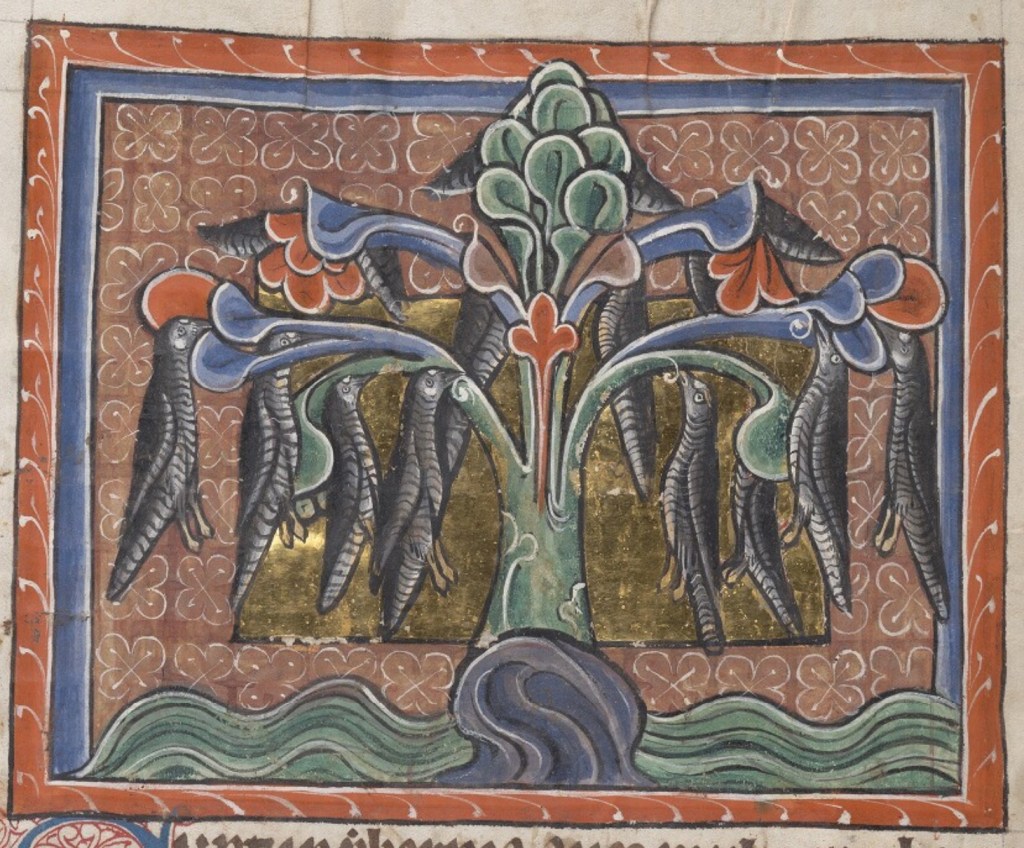
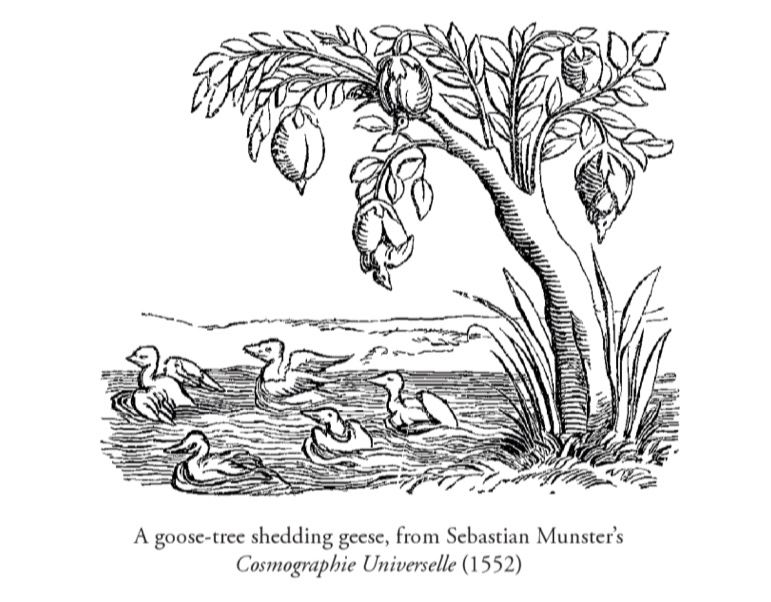
In the Middle Ages it was widely believed that this bird grew from its snout from trees hanging over the water, or out of a barnacle attached to the bottoms of ships or loose pieces of wood. This raised a conundrum for medieval rabbis: For purposes of kashrut, should these geese be classed as fish, meat, or something else?

Some authorities said they were neither fish nor fowl, but rather like shellfish were impermissible no matter how they were slaughtered. But Rabbi Mordechai ben Hillel Ashkenazi of Regensburg said that, effectively, they are fruits:

Regarding birds that grow on trees, there are those that say that they do not require shechitah [ritual slaughter], because they do not reproduce sexually and are like any wood. (Quoted in Sacred Monsters: Mysterious and Mythical Creatures of Scripture, Talmud and Midrash, Nosson Slifkin, p. 319.)

Truly the world’s first plant-based meat!

More metric-imperial conversion hijinks

A while back I noted how an article on Ebola in the NY Times had apparently translated “one millilitre of blood” in a medical context into “one-fifth of a teaspoon of blood”. Hilarity ensued. Now I see that the fun doesn’t go in only one direction. I just got a letter from the NHS about an upcoming appointment, including these instructions:

Do not come to your appointment if you or anyone living with you has the symptoms of a new continuous cough (in the last week) or a temperature above 37.8 degrees or loss or change to your sense of smell or taste.

37.8 degrees? Why exactly this number? It sounds both arbitrary and absurdly precise. A bit of reflection revealed that 37.8 degrees Celsius is precisely 100 degrees Fahrenheit. They obviously copied some American guidelines, and instead of rounding appropriately — or reconsidering the chosen level — they just calculated the corresponding Celsius temperature. The funny thing is, Americans are used to having the very non-round guideline of 98.6 degrees as the supposed “normal” body temperature, because someone* in the 19th Century decided 37 degrees Celsius was roughly the right number, and that magic number got translated precisely into Fahrenheit.

* Carl Reinhold August Wunderlich, actually.

Strained historical comparisons: Holodomor edition

EU Commission president Ursula von der Leyen today condemned Russia, comparing its actions to Stalin’s brutal engineered famine in Ukraine in the 1930s, and promising to take action to… export thousands of tons of Ukrainian grain.

Stalin was all in favour of exporting Ukrainian grain!

This is clearly a positive development, but the analogy needs some work…

Scant progress

In the middle of an economic slowdown and a huge expansion in spending to reduce households’ winter fuel costs, the new UK government has just announced, in its new “mini-budget” its intention to drastically cut taxes on wealthy individuals and corporations. Not surprisingly, the price of UK bonds has plummeted, and interest rates have risen to their highest level since the 2008 financial crisis.

The Guardian quotes international market experts from ING saying this was a “perfect storm” for the UK, as “global markets shun sterling and gilts.” They continue

Price action in UK gilts is going from bad to worse. A daunting list of challenges has arisen for sterling-denominated bond investors, and the Treasury’s mini-budget has done little to shore up confidence.

“Little to shore up confidence” is such an elegant bit of English understatement, so extreme as to amount almost to deception. Like “the expanded hours for flight departures at Heathrow have done little to improve the noise pollution problem for residents near the airport” or “Herr Hitler’s new ‘Nuremberg Laws’ have done little to shore up confidence in fair treatment among Germany’s half million Jewish citizens.”

The Queen’s two bodies

There’s something that baffles me about the public discussion of ERII’s legacy: Why do so many people feel comfortable lauding the late monarch as the (no longer) living embodiment of the nation when she’s waving to the crowd and dispensing Christmas bromides, but just a befuddled girl when her imperial government is committing crimes against humanity?

The cognitive dissonance is extreme: What kind of monsters would we be were we to be charmed by a person responsible for the murder and torture of thousands? Therefore she was not responsible. Therefore, implicitly — since she was responsible for everything — these crimes did not occur.

And just to be extra clear, I am not doubting the expert claim that Harold Macmillan lied like a rug to keep Her Majesty in the dark on the sordid details of the Empire, or lied to the public to pretend that he did. The living embodiment of the nation embodies its crimes as well as its virtues. She can’t embody the spirit of Paddington Bear, but be free of any taint of Hola. The victims of Her Majesty’s government are her royal victims, whether or not her mortal body participated, whether or not it was indeed aware.

The alternative is, monarchy is just bullshit, just celebrity culture with extra-fancy headgear. That seems to be the genuine belief revealed by the public’s response.