Longitudinal fables, ctd.: Is Julia shrinking?

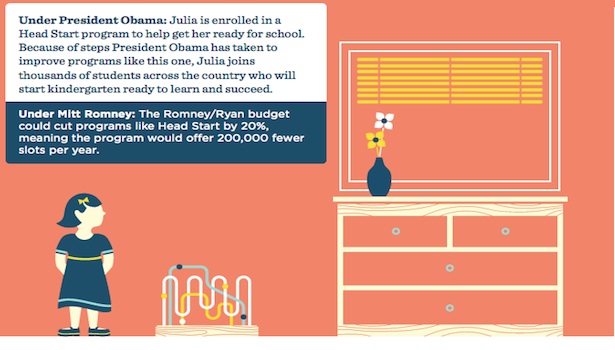
I was commenting on how people like to turn age-structured information into longitudinal stories: If 80-year-olds buy more big-band recordings, and 20-year-olds more rap, we describe how people’s tastes shift as they age, from the hard rhythms of rap to the gentle lilt of swing. And I noted that the Obama campaign got itself into trouble last year trying to turn its age-specific policies into a longitudinal fable, called “The Life of Julia”. Looking at the pictures of Julia at different agesobama-julia-infographic

I had the impression that Julia is shrinking as she moves into her forties.

More careful inspection of the pictures revealed that she is not shrinking (or not much); the main height change came when she stopped wearing high heels at age 37. But  that got me wondering: should she have been shrinking? Or would that again have been confusing the cross section with the individual life course — the period with the cohort effect, in demographer jargon?

It’s certainly true that cohorts in America (and in many other prosperous countries) have been getting taller. US Civil war soldiers in 1863-4 averaged 5′ 7 1/2″. 50 years later the average height of young men had not changed significantly, but by 1955 the average height of young men was up to 5′ 9 1/2″ (and they were attaining their maximum height several years earlier). It’s not clear to what extent the trend has continued in the US — according to recent data, the average height of young male adults in the US is still about 5′ 9 1/2″ — though it clearly has in other countries that have seen a substantial improvement in children’s average nutritional welfare, such as Portugal, or the Netherlands, Italy, and Japan.

There is also a tendency for individuals to shrink as they age, from compression of the spine, particularly pronounced after age 60, and more extreme in women than in men. A sketch from this paper is included below. So, in fact, the hypothetical Julia should probably have been drawn about 2 inches shorter at age 67 than when she was 20. That’s about 3% — hard to tell from the silhouettes, with the changing hairstyle and all…

It’s funny, because I have seen height used as a paradigm example of where cross-sectional measures are misleading if you interpret them as cohort effects — narrating the changes within individual lives — but at least for the latter half of the 20th century in the US, the cross sectional data seem to give the right picture.
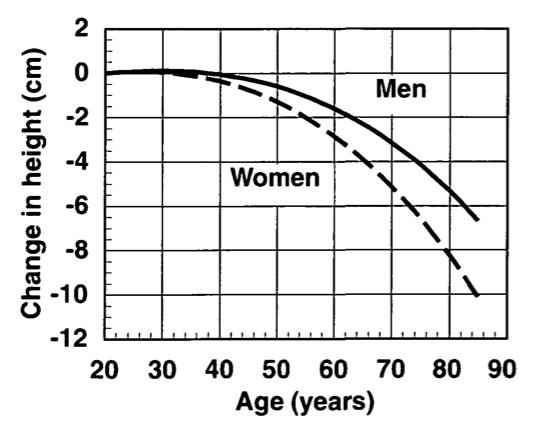
Longitudinal change of height with age

Conspiratorial resurrection

By way of Andrew Sullivan, there’s this report from Scientific American about the psychology of conspiracy theorists. Key lines:

while it has been known for some time that people who believe in one conspiracy theory are also likely to believe in other conspiracy theories, we would expect contradictory conspiracy theories to be negatively correlated. Yet, this is not what psychologists Micheal Wood, Karen Douglas and Robbie Suton found in a recent study. Instead, the research team, based at the University of Kent in England, found that many participants believed in contradictory conspiracy theories. For example, the conspiracy-belief that Osama Bin Laden is still alive was positively correlated with the conspiracy-belief that he was already dead before the military raid took place. This makes little sense, logically: Bin Laden cannot be both dead and alive at the same time

Contradiction is in the mind of the beholder. They are ignoring the possibility that President Obama, dissatisfied with the poor progress of the minions he had been able to hire to destroy America (he’s a stickler for benchmarks) sent a Kenyan voodoo strike team into Pakistan to resurrect Osama bin Laden, who had already been garroted personally by George W. Bush (in one of the many top secret missions he carried out while his body double cleared brush on the ranch).

The next president will not only have a $20 trillion debt to cope with, he’ll also have to take out an undead al Qaeda leader. Continue reading “Conspiratorial resurrection”

The Life of Julia: Another longitudinal fable

Picking up from my earlier discussion of the way cross-sectional data  get turned into (sometimes misleading) longitudinal stories, it’s been about a year since the Obama campaign unveiled The Life of Julia, a slide show that contrasted Obama’s and Romney’s policies with regard to their effects on women at different ages. Stated that way it would be pretty standard and uncontroversial, but in fact it turned into a flashpoint for the early part of the campaign. Why? Precisely because it was not a list of cross-sectional promises — What President Obama will do for children; What President Obama will do for seniors; etc. would be standard campaign web site headings — but was turned into a longitudinal story. These were not 12 different women, of different ages, who would putatively be helped by the president’s policies, but a single woman “Julia” who seems to be spending her whole life looking for government programs to scrounge from. Of course, it only seems this way because of the way this infographic interacts with our expectations of a biographical narrative, where we expect to be seeing the high points of her life, and every one of them involves government services. Creepy! It’s no wonder some critics were reminded of cradle-to-grave socialism.

Of course, the real story is cross-sectional. If Julia is 3 years old now, Obama is not really promising to provide a small business loan to her in the year 2040. And by the time she reaches retirement, she’ll probably be living on a Mars colony or hiding out from roving mutant bandits in subterranean bunkers after the nuclear climate catastrophe.

obama-julia-infographic julia full

Stephen Wolfram’s longitudinal fables

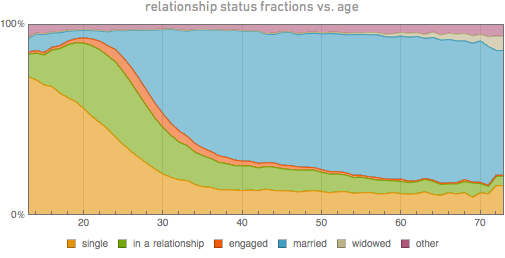
There’s lots of interesting plots on Stephen Wolfram’s analysis of Facebook data, but what jumps out to me is the way he feels compelled to turn his cross-sectional data — information about people’s interests, structure of friendship networks, relationship status, etc. as a function of age — into a longitudinal story. For example, he describes this plotrelationship-status-vs-age2

by saying “The rate of getting married starts going up in the early 20s[…] and decreases again in the late 30s, with about 70% of people by then being married.” Now, this is more or less a true statement, but it’s not really what is being illustrated here. (And it’s not just the weird anomaly, which he comments on but doesn’t try to explain, of the 10% or so of Facebook 13 year olds who describe themselves as married.) What we see is a snapshot in time — a temporal cross section, in the jargon — rather than a description of how the same people (a cohort, as demographers would put it) moves through life. To see how misleading this cross-sectional picture can be if you try to see it as a longitudinal story of individuals moving through life, think first about the right-hand side of the graph. It is broadly true, according to census data, that about 80% of this age group are married or widowed. But it is also true that 95% were once married. In fact, if they had had Facebook when they were 25 years old, their Stephen Wolfram would have found that most of them (about 75%) were already married by that age. (In fact, about 5% of the women and 3% of the men were already in a second marriage by age 25.)

So, the expansion of the “married” segment of the population as we go from left to right reflects in part the typical development of a human life, but it reflects as well the fact that we are moving back in time, to when people were simply more likely to marry. And the absence of a “divorced” category masks the fact that while the ranks of the married expand with age, individuals move in and out of that category as they progress through their lives.

Of course, the same caveat applies to the stories that Wolfram tells about his (quite fascinating) analyses of structure of friend networks by age, and of the topics that people of different ages refer to in Facebook posts. While it is surely true that the surge in discussion of school and university centred at age 18 reflects life-phase-determined variation in interests, the extreme drop in interest in salience of social media as a topic is likely to reflect a generational difference, and the steep increase in prominence of politics with age may be generational as well. (I wonder, too, whether the remarkably unchanging salience of “books” might reflect a balance between a tendency to become less involved with books with age, cancelling out a generational shift away from interest in books.)

More scary maths

I was just working through the sheet music for “As Time Goes By”. I don’t remember ever having heard the intro — it was left out when the song appeared in Casablanca, and seems never to have been performed since. It begins with the lines

This day and age we’re living in gives cause for apprehension,

With speed and new invention, and things like the third dimension.

Yet, we grow a trifle weary with Mister Einstein’s theory,

So we must get down to earth, at times relax, relieve the tension.

“Third dimension” — pretty scary! (Those interested in the influence of geometric ideas on early 20th century literature, in particular the work of Franz Kafka, could look at this paper. Though typically the anxiety about dimensions started at four.)

http://www.youtube.com/watch?v=8EsTZiXYJJY

I’ve commented earlier on suggestions that math education should be confined to the rudiments to spare children from math anxiety, and the use of math anxiety by unscrupulous politicians to distract attention from their policies.

Who needs math?

According to a study by sociologist Michael Handel, summarised here by Jordan Weissman, 75% of American workers never use any mathematics more complicated than fractions in their work. (It goes without saying that most partake of recreational calculus, at least on weekends…) Writing in the NY Times last year, Andrew Hacker argued that most schoolchildren are wasting their time learning mathematics: They’ll never understand it, and they won’t be any the worse off for it. As for scientists, the great entomologist E. O. Wilson has recently taken to the pages of the Wall Street Journal to argue that

 exceptional mathematical fluency is required in only a few disciplines, such as particle physics, astrophysics and information theory.

For that matter, even Albert Einstein famously remarked to a schoolgirl correspondent

Do not worry about your difficulties in Mathematics. I can assure you mine are still greater.

But that was after he’d mostly decamped from physics for sagecraft.

Wilson goes on to portray mathematical biologists as technicians, armed with useful tools and useless ideas. And if you need them, you just hire them. (It’s not like they have anything important to do with their time.) So what’s going on? Are mathematicians scamming the public, teaching algebra and other unnecessaries to justify their existence? I would suggest that there are several important issues that these wise men are ignoring or underplaying:

  • It may be true (as Hacker argues) that only a tiny techno-elite actually needs to know how a computer works, or how to compute the trajectory of a spacecraft, or how to program a Bayesian network. But when they’re 11 years old you don’t know who will have the interest or aptitude to join that elite. If you start sieving the children out early because they don’t seem like a likely candidate for that track — and let’s be honest, a lot of the tracking is going to be based on parental status and educational attainment — most of them will have no way to change tracks later on, because of the cumulative nature of mathematical understanding. Worth noting, in this context, is Handel’s observation (cited above) that skilled blue collar jobs are actually slightly more likely to require “advanced maths” (algebra and beyond) than skilled white collar jobs. So you can’t decide who needs the advanced maths based on the kinds of work they’re going into. Those without the education are simply more likely to be stuck at the lower rungs of whatever trade or profession they go into. (On the other hand, a larger fraction of white collar workers are in Handel’s “upper” (skilled) category, so an average blue collar worker probably needs less maths than an average white collar worker.)
  • Mathematics is a language. And what is discussed in that language is, as Hacker recognises, crucial to the fate of everyone in the world. Those who have not learned at least the rudiments of the language are excluded from the conversation. I am reminded of a friend who dismissed the value of learning to speak French, with the argument that “Everyone in France speaks English.” Now, France might have been a bad choice for his claim, but even if it were true, it puts you at a significant disadvantage to be surrounded by people who speak your language, while you can’t decipher their language to understand what it is they’re saying to each other.
  • Think about that Einstein quote: Everyone finds mathematics difficult when they’re pushing beyond their current knowledge. If we’re going to drop mathematics training when it becomes challenging, we might as well stop counting when we run out of fingers and toesies.
  • I would suggest that Wilson may be using more sophisticated mathematics in his work than he is aware. To paraphrase J M Keynes, practical biologists who believe their work to be quite exempt from any need for mathematics, are usually the slaves of some defunct mathematician. Modern biologists of bench and field are often quite attached to some mathematical and statistical machinery that happens to be some years old, and seemed impossibly abstruse when it first seeped in from the pure mathematics or theoretical statistics world. Many of the attempts to apply mathematical techniques in biology (or sociology or economics or whatever) will prove more clever than enlightening, but some will stick, and become part of the basic toolkit that the biologists who think they don’t need any sophisticated math do use. Wilson’s arrogant posture really reflects the fact that there are far more trained mathematicians who are intellectually flexible enough to try and figure out what the biologists are doing, and what the connections might be to their own field, than trained biologists willing to work in the other direction.

Third most popular

Being a fan of the Dvorak keyboard layout, I was intrigued to learn that there is another QWERTY competitor, called Colemak. On the official Colemak web site one learns that

Colemak is now the 3rd most popular keyboard layout for touch typing in English, after QWERTY and Dvorak.

That formulation could be effective in other contexts. For example,

Standing up is now the 3rd most popular posture for sleeping, after lying down and sitting.

Or a political version:

Congress is now the 3rd most respected branch of the US government, after the executive and the judiciary.

Not going anywhere

Is it a good thing to be “not going anywhere”? I thought about this when I read President Obama’s comment that “Planned Parenthood is not going anywhere”. As with many things in life, it depends on what the alternative is. It could mean “not going someplace good”. In Obama’s phrase, where it’s not going is presumably “away”, or into the dustbin of history. Or going downhill.

It’s another example of a self-negation, an expression that can mean two exact opposites. If Planned Parenthood is “going downhill”, we mean the future looks bleak. If it’s “all downhill from here for PP”, the future looks pretty good. The difference in metaphorical emphasis between these two is subtle. In “going downhill” we emphasise that up is good and down is bad, and don’t explicitly mention the relative difficulty of going up and down. In “all downhill from here” we think about the difficulty of going up relative to down, and ignore the question of whether it’s better to be up or down. The attention is focused on some sort of forward motion that presumably has been impeded by the uphill slog. So if PP isn’t going anywhere, it’s not going downhill. If it is going somewhere, it’s because it’s all downhill from here.

Unterwegs mit Mum

According to the NY Times, “The Guilt Trip” is a “mild-mannered dud” of a comedy, in which Seth Rogen and Barbra Streisand play son and mother on a road trip together for some not very interesting reason. But I’m amused by the German version of the title, above, which translates to “Travelling with Mum”. It has many of the classic qualities of German film titles that I catalogued in “What’s German for G.I. Joe?“: The modest wordplay of the original title has been stripped out, replaced by a straight three-word description of the plot. But then, you wouldn’t want the audience to fail to notice that the film is a foreign import, so the English “Mum” has to be in there. Except, the film American, so it really should have been “Mom”, but who knows the difference?

Of course, a really classic German film title would have played the description out longer, something like “A Totally Crazy Week in the Car Travelling Across America with Mum” (on the model of “The Unbelievable Trip in a Wacky Airplane” — “Airplane” in the original — since it helps to be sure the audience knows it’s a comedy).

Bad apples

I remember being mystified back when President Bush defended his administrations stewardship of the Iraqi penal system by saying that the torture enhanced interrogation torture (I guess it was officially, since people got prosecuted for it) at Abu Ghraib was the work of “a few bad apples”. I guess that phrase had been going around for a while, and now it’s certainly common. (For example, here is the assertion that “a few bad apples” are responsible for most complaints about doctors.)

But back in 2003 I was confused by this expression. Bush seemed to be using it to mean that the US occupation of Iraq, and the US military and antiterror policies more generally, were sound, and that the crimes were the isolated work of individuals with no broader implications. But why apples? Why not “a few bad people”? The reference is clearly to the phrase “one rotten apple spoils the barrel”. But that expression has exactly the opposite implication: Rottenness is not isolated. If you’ve found “a few bad apples”, you must expect that the rot is widespread. Now, there’s nothing compulsory about that metaphor — you may not think that one bad individual casts suspicion on the rest — but why are apples being gratuitously referred to when the desired implication is exactly the opposite? How did this adage get turned into its converse? Or is the referent actually something else?