Metathreats

Even in America it is illegal to attain political ends by threats of violence. But what about threats of threats of violence? From Florida:

“We began receiving complaints from voters,” she said Wednesday in an email to the Post’s editorial board. “Some felt uncomfortable voting at the Islamic Center. When we received a call that indicated individuals planned to impede voting and maybe even call in a bomb threat to have the location evacuated on Election Day…

I suppose this is familiar as a kind of protection-racket negotiating stance. “We’re just having a friendly chat here. Nobody is making threats. If you want to make threats, we can also make threats, but there’s no need for any of that.”

Big notes

I remember reading, back in the late 1990s, an article in Spiegel, about the dubious decision of the Euro finance ministers to create a 500 euro banknote. Since the only people who use cash in significant quantities in this millennium tend to be shy people eager not to be singled out for their achievements by prosecutors, the question was raised, why would you want to create a unit of currency that enables law-abiding citizens (and others) to pack five times as much currency into a suitcase as the former favourite $100 bills?* The answer given by Edgar Meister, one of the directors of the Bundesbank, was that Germans had gotten used to having a 1000 Mark banknote, and that if the largest Euro banknote were worth less, people would think this new currency was a weakling.

Eine Währung, die es sich leisten kann, mit so hohen Noten herauszukommen muß wertbeständig sein.

A currency that can afford to produce such large banknotes must be solid.

As everyone knows, that’s why Germany produced this 50 million Mark note in 1923: Continue reading “Big notes”

Refer madness

Shortly after the EU referendum, someone asked me why the EU referendum was made to allow such an enormous change from a simple majority. After all, many countries have either supermajority threshold for referenda, or requirements that a majority be attained in a majority of regions or states. The answer, of course, is that

  1. The point of this referendum was to settle a conflict between two wings of the Conservative party. This was not an election, but a sporting contest — though sooner or later, in Britain, everything turns into a sporting contest — and it would have been completely unacceptable if both sides did not feel they had a reasonable chance of winning.
  2. There wasn’t any threshold at all. As many have pointed out, this wasn’t a referendum in the normal sense of the word. It was an opinion poll. The relevant law, the European Union Referendum Act 2015, orders only that the question be asked, and describes eligibility for voting. It says nothing about how the result is to be interpreted or enforced. (The most intricate part of the law seems to concern the question of which hereditary aristocrats are eligible to vote.)

There is nothing inevitable about concluding that the UK should withdraw from the EU because 52% voted that way in the referendum. Most democracies would not make it so easy for one group of citizens to deprive another group of citizens of cherished rights — particularly when the groups really are clearly defined social groups, whether age groups or semi-autonomous component nations (Scotland and Northern Ireland).

In principle, there’s a good argument that the government is constitutionally obliged to get clear authorisation from Parliament before pulling the Article 50 trigger. And if they do that, the MPs could reasonably point to the national divisions, or just the lack of an overwhelming majority, as justification for avoiding such wrenching change.

They won’t, though. Because it’s a sport, and nothing is more important to the British than appearing to be “good sports”. They call this “democracy”, and there have been any number of articles from left-wing Remain supporters, arguing that a commitment to democracy requires that they get behind the Brexit project now. The people have spoken, and any other response is an elitist insistence that you know better than the unwashed masses.

Where does that leave us, the foreigners? I am reminded of the work of David Blight and other historians on the “Lost Cause” historiography of the US Civil War. Americans of the North and the South decided to come together in a spirit of reconciliation, requiring that the Northerners agree to look past points of dispute, like the civil rights of African Americans. They — that is, the white people — pretty much all agreed that this was the charitable and democratic thing to do. Similarly, Britons are divided by economic and class differences, but they can all come together in agreement that the real problem is the foreigners. This is something I noticed when I first arrived here.

Things aren’t so bad in Oxford — though we all know people who have at least been menaced in public in the last couple of weeks for speaking a foreign language — and those of us with good professional jobs have a fairly easy out, if we want it, by acquiring UK citizenship. At least, that gets us to the other side of the rope line in terms of formal legal harassment. Elsewhere foreigners have to be thinking imminently about being driven out of places where they have resided for decades, and where they mistakenly thought they were at home.

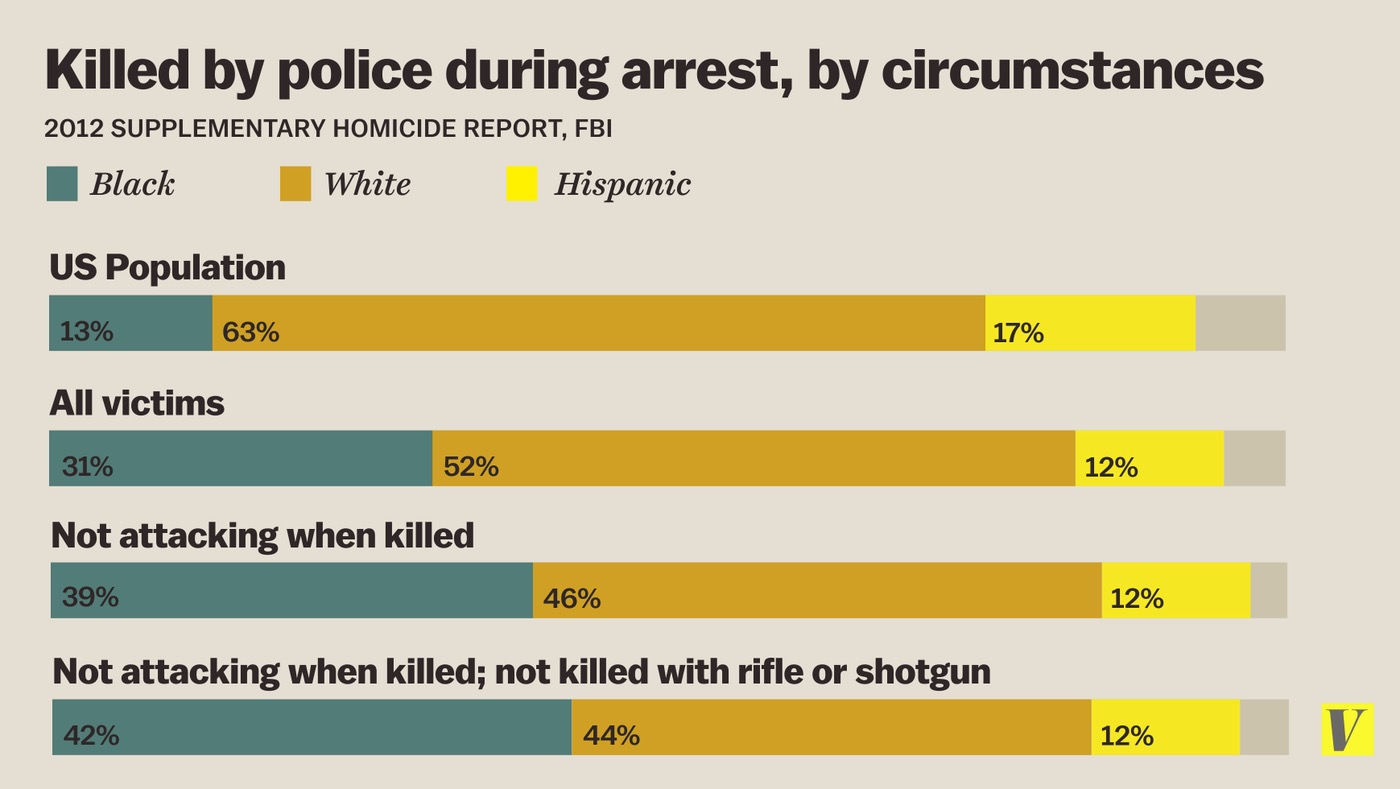
More damned statistics

The news website Vox published this chart last year, by Dara Lind, based on FBI data on people killed by police during arrest. The most chilling thing about it is that refined statistical analysis on people killed by police is possible, with all kinds of elaborate subgroup analyses. That’s because there were 426 cases in that year. In general I’m all in favour of more data, which makes it possible to study problems in a more refined way, but I’m happy that the statistics gathered by the Independent Police Complaints Commission don’t have much to work with: In the same year there were 15 deaths in or following police custody in England and Wales.

UPDATE:  I thought the US number seemed surprisingly small — only about 5 times the UK number on a per capita basis, despite the fact that British police don’t routinely carry firearms. In fact, The Guardian’s documentation of all police killings in the US lists 1146 people killed by police in 2015. I presume this has to do with the fact that the FBI statistic only counts people killed during arrest.

Damned statistics

At a conference talk on the “reproducibility crisis” in psychology, the speaker quoted a relative issuing the commonplace anti-statistics apothegm “You can prove anything with statistics”. It’s a funny sort of claim, because it is self-undermining. Outside of a seminar on Popperian scientific philosophy no one would say “you can prove anything with numerology” or “you can prove anything with astrology”. Those who are not in thrall to these methods of divination find them either entertaining or ridiculous, but 

Is it because statistics is too abstruse for ordinary people to criticise? No one says, you can prove anything with quantum mechanics. Or, for that matter, mathematics.

Statistics is sufficiently precise and rigid and generally reliable to be authoritative, but leaves enough flexibility for experts to disagree and for manipulative misapplications to still hew close to standard procedure, and sufficiently abstruse that most people can’t figure out whether they’re being manipulated.

An interesting parallel is the Shakespearean dictum “The devil can cite scripture for his purpose.”