Soft bones

From political journalist Simon Maloy in Salon

People often note that public opinion of Hillary tends to be ossified after more than two decades spent continuously in the national political spotlight, but Trump’s unique and unrelenting awfulness as a candidate represents a timely opportunity to get voters to start thinking more positively about Hillary Clinton.

It amazes me that people can make claims like this, in light of the fact that her net favourability in Gallup polls has shifted by almost 50 points in three years. (She was at +31 in April 2015.)

The debate debate

We’re still waiting for the Democratic convention, but ofter that, the general election campaign gets off to a particularly early start, with no defining events until the debates. Debates? Will there actually be US presidential debates in the fall?

I haven’t seen any discussion of this. Of course there will be debates. There are always debates. But then, candidates always release their tax returns. I can’t really imagine Trump being willing to share a stage with a woman, one on one. A woman whom he has been saying should be imprisoned. (Will she need to flee the country if she loses the election?) Surely there will be a fund-raiser for veterans that he can’t possibly miss on the same night as the debate, or his people will just find themselves unable to consent to extremely unfair conditions that the rigged system is trying to impose on him.

An opportunistic political infection

Donald Trump is likely to lose the US presidential election. But maybe not. And we need to recognise that a healthy body politic would not have a dangerous figure like him in striking distance of the most powerful office in the land — and in the world.

Trump is almost comically incompetent, and still has more than 40% of the public willing to vote for him. (According to the most recent estimates of fivethirtyeight.com he has nearly a 40% chance of winning the election.) Even if he doesn’t win, it is purely coincidental that his frightening demagoguy, autocratic impulses, and willingness to trample on democratic traditions and norms was not coupled with even an average competence in running a campaign, or even ability to let professionals take over managing the thing for long enough to get him elected.

A more competent demagogue will almost surely follow where he has led.

Donald Trump and the polygamy of virtue

The expression “marry X to Y” is used conventionally to represent the possibility of combining two unrelated qualities to make a harmonious new quality. Two. But in Donald Trump’s America virtues are polygamous:

[Ivanka Trump] told London’s Sunday Times “And it’s a big reason I am the woman I am today. He always told me and showed me that I could do anything I set my mind to if I married vision and passion with work ethic.”

Does Mike Pence know about this?

Statistics and causal truth: Police edition

As usual, Andrew Sullivan — who has now returned temporarily to blogging, attracted like a moth to the Trump conflagration — manages to take a common, superficially convincing argument, and express it with moral fervour and personal conviction that makes the tenuous logic really conspicuous. In this case, it’s the argument based on the much-discussed study by Roland G. Fryer, Jr. of the rate of various violent outcomes of police stops, finding that black people are more likely than white to be physically abused by police, but not more likely to be shot.

(Here’s an excellent NY Times report, and  the original study.)

…the Black Lives Matter activists, whose core and central argument is that black men are disproportionately killed by cops. The best data shows this is false…  I find [the study] conclusive. Feelings do not, er, trump data in a deliberative democracy. A reader writes:

I understand that there has been the recent study suggesting that given an interaction with a police officer occurs, then the police officer is no more likely to use a gun with a black person than with a white person. However, given that many black men have a much higher rate of interaction with police (such as, anecdotally, Philando Castile, with 52 traffic stops), then is it not fair to say that black men are disproportionately killed by cops?
The point is that there is no evidence of individual racism in these police encounters, despite the impression from many chilling phone videos. The structural bias still exists as a whole, as I said, but the narrative about cops being more likely to kill a black member of the public when encountering him is false.

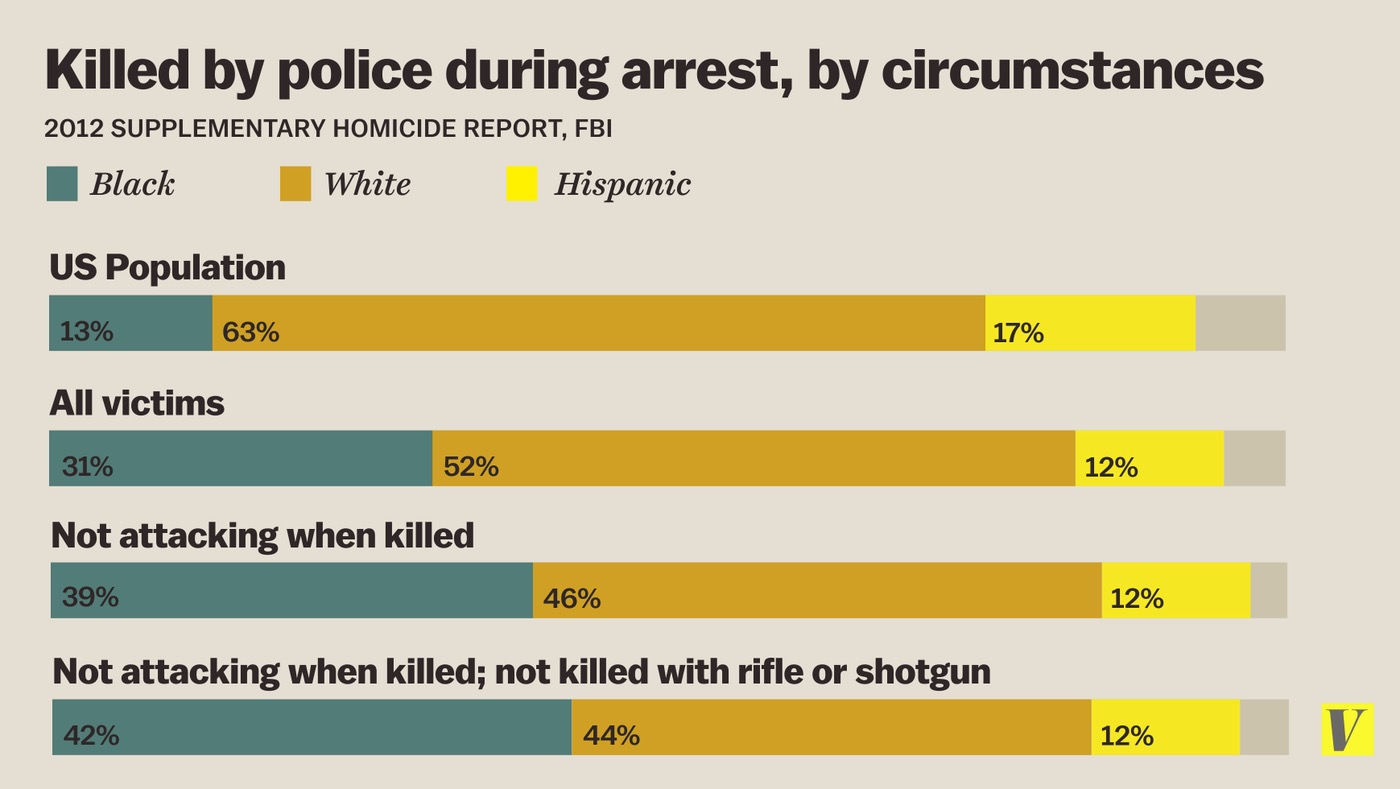
I have no criticism to make of the study — I have not analysed it in any depth, but it seems credibly and even impressively done — even if I find the premise absurd, that a single study of such a complex phenomenon could be “conclusive”. But they do not “trump” the data that black people make up 13% of the US population, but 31% of those killed during an arrest, and 42% of those killed during an arrest when unarmed. The point is, what these facts (and many others, including the others) mean jointly depends on what we think is the reason for black people being so much more likely to be arrested.

Continue reading “Statistics and causal truth: Police edition”

The rot goes deep

There’s a certain kind of insane genius to the Donald Trump performance. So we have this interview, where Trump was asked by a right-wing journalist,

There are still some black Americans who believe that the system is biased against them… What do you say to them?

He answered

Well, I’ve been saying, even against me the system is rigged. When I ran for president, I could see what is going on with the system, and the system is rigged… I can really relate it very much to myself.

Has our democracy really sunk so far, that even white billionaires can’t get a fair shake anymore?


Metathreats

Even in America it is illegal to attain political ends by threats of violence. But what about threats of threats of violence? From Florida:

“We began receiving complaints from voters,” she said Wednesday in an email to the Post’s editorial board. “Some felt uncomfortable voting at the Islamic Center. When we received a call that indicated individuals planned to impede voting and maybe even call in a bomb threat to have the location evacuated on Election Day…

I suppose this is familiar as a kind of protection-racket negotiating stance. “We’re just having a friendly chat here. Nobody is making threats. If you want to make threats, we can also make threats, but there’s no need for any of that.”

More damned statistics

The news website Vox published this chart last year, by Dara Lind, based on FBI data on people killed by police during arrest. The most chilling thing about it is that refined statistical analysis on people killed by police is possible, with all kinds of elaborate subgroup analyses. That’s because there were 426 cases in that year. In general I’m all in favour of more data, which makes it possible to study problems in a more refined way, but I’m happy that the statistics gathered by the Independent Police Complaints Commission don’t have much to work with: In the same year there were 15 deaths in or following police custody in England and Wales.

UPDATE:  I thought the US number seemed surprisingly small — only about 5 times the UK number on a per capita basis, despite the fact that British police don’t routinely carry firearms. In fact, The Guardian’s documentation of all police killings in the US lists 1146 people killed by police in 2015. I presume this has to do with the fact that the FBI statistic only counts people killed during arrest.

Whisper sweet non-racist nothings to me…

Continuing the theme of how Republicans see the problem with Trump as being his mode of expression, rather than his noxious world-view and beliefs, this new comment after everything from Ohio governor John Kasich:

Kasich told Scarborough that he was still open to supporting Trump if he moderated his anti-minority rhetoric and pivoted towards the general election.

It’s almost to Trump’s credit that he won’t camouflage himself, however much his copartisans bribe him so.

How to do racist things with words

In contemplating the state of political discussion on the right wing of US politics, I found myself thinking about the celebrated work How To Do Things with Words, by the linguistic philosopher J. L. Austin.

I’ve been trying to understand the way Republicans talk about Donald Trump. For months mainstream Republicans have been predicting that Trump would “pivot” toward the general election and adopt a more “presidential” tone.  “Pivot”, a term that usually describes a turn away from the interests of ideological allies in ones own party toward emphasising more centrist positions, but in the special context of this presidential election means ceasing to make racist attacks and boasting about penis size.

Republicans don’t like Trump’s open racism. You might think they would then not support him. Or (and I’m not so naive as to miss their inescapable self-interest in continuing to support him) if they find his racism just embarrassing but not inherently a problem they might publicly condemn it, while privately encouraging him to tone it down, and hope that people will forget. Instead, though, they are publicly encouraging him to stop making racist comments. For example, Senate Majority Leader Mitch McConnell said “He needs to quit these gratuitous attacks on other Americans”, and said “Donald Trump has got a lot of good qualities, but he needs to put them forward and suppress some of these other actions.” Senator Bob Corker said Trump has “two or three weeks” to “pivot to a place where he becomes a true general election candidate.” Continue reading “How to do racist things with words”