
Aposematism and toy guns

Another person has been shot in the US because he was brandishing a toy gun.

Police hit the 32-year-old man three times Sunday evening after he pulled from his waistband what was later determined to be an air gun, which fire metallic projectiles such as pellets or BBs, police spokesman Albie Esparza said.[…]

The air gun did not have a colored tip on it, which is a standard identifier of a toy gun, Officer Gordon Shyy said Monday.

Actually, this wasn’t even exactly a “toy”. More, a sublethal weapon. I’m generally not the most sympathetic to police officers who kill the citizens they are supposed to be protecting. (In Utah last year police were the leading category of homicide perpetrators.) And the case of the boy who was shot on a playground because he had a toy gun clearly seems tinged with racism. But I can’t blame the problem on a lack of coloured tips on the gun.

Surely a brief thought about warning colours and mimicry in nature suggests that a strategy that says “a red tip means the police don’t need to worry about this otherwise very dangerous-looking weapon” can’t be viable. It’s too easy to mimic the signal and gain the advantage (lessened police response to your weapon). This is not quite the same as aposematism — advertising ones inedibility to predators through defensive colouration — but the general problem of cheap signals undermined by mimicry is the same. Continue reading “Aposematism and toy guns”

People who wore top hats

In thinking about the response of many Americans to the revelations of torture of prisoners by the CIA (not that it was a huge secret before, but I think most people still found something to be surprised and appalled by in the Senate report, such as the 26 people whom even the CIA acknowledges were held in error, or “rectal feeding”), but also the response of many American and British Jews to atrocities and human rights abuses by Israel, I often find myself coming back to the remarks of Aldous Huxley, in his 1958 Brave New World Revisited. In discussing the distinction between the old-fashioned totalitarianism of 1984 — innovative propaganda and mental manipulation, to be sure, but backed up by hard power and torture — and the purely medical and psychological manipulation of Brave New World, he admits that he was too hasty in consigning the crude atrocities to the ashheap of history:

Fifty years ago, when I was a boy, it seemed completely self-evident that the bad old days were over, that torture and massacre, slavery, and the persecution of heretics, were things of the past. Among people who wore top hats, traveled in trains, and took a bath every morning such horrors were simply out of the question. After all, we were living in the twentieth century. A few years later these people who took daily baths and went to church in top hats were committing atrocities on a scale undreamed of by the benighted Africans and Asi­atics. In the light of recent history it would be foolish to suppose that this sort of thing cannot happen again. It can and, no doubt, it will. But in the immedi­ate future there is some reason to believe that the punitive methods of 1984 will give place to the rein­forcements and manipulations of Brave New World.

This phrasing is perfect. (I’m willing to give Huxley the benefit of the doubt by reading ironic scare quotes into “benighted Africans and Asiatics”.) Compare “people who took daily baths and went to church in top hats” with this excerpt from an interview with torturer-in-chief Dick Cheney:

CHUCK TODD:

Well, let me start with quoting you. You said earlier this week, “Torture was something that was very carefully avoided.” It implies that you have a definition of what torture is. What is it?

DICK CHENEY:

Well, torture, to me, Chuck, is an American citizen on a cell phone making a last call to his four young daughters shortly before he burns to death in the upper levels of the Trade Center in New York City on 9/11. There’s this notion that somehow there’s moral equivalence between what the terrorists and what we do. And that’s absolutely not true. We were very careful to stop short of torture. The Senate has seen fit to label their report torture. But we worked hard to stay short of that definition.

CHUCK TODD:

Well, what is that definition?

DICK CHENEY:

Definitions, and one that was provided by the Office of Legal Counsel, we went specifically to them because we did not want to cross that line into where we violating some international agreement that we’d signed up to. They specifically authorized and okayed, for example, exactly what we did. All of the techniques that were authorized by the president were, in effect, blessed by the Justice Department opinion that we could go forward with those without, in fact, committing torture.

Instead of going to church in top hats to have their crimes blessed by God, they went to the Office of Legal Council in slick suits to have their crimes blessed by the Justice department. But the idea is, people like us don’t commit atrocities, because they’re people like us.

CHUCK TODD:

Let me go through some of those techniques that were used, Majid Khan, was subjected to involuntary rectal feeding and rectal hydration. It included two bottles of Ensure, later in the same day Majid Khan’s lunch tray consisting of hummus, pasta, sauce, nuts and raisins was pureed and rectally infused.[…]  Does that meet the definition of torture in your mind?

DICK CHENEY:

–in my mind, I’ve told you what meets the definition of torture. It’s what 19 guys armed with airline tickets and box cutters did to 3,000 Americans on 9/11. What was done here apparently certainly was not one of the techniques that was approved. I believe it was done for medical reasons.

When did you stop sexually assaulting women other than your wife?

It is a cliché of the legal trade: “Have you stopped beating your wife?” The paradigmatic damned-if-you-do-damned-if-you-don’t trick yes-or-no question. Everyone knows it. Thus it is with a sense of awe that I read of this comment by US Representative Steve Cohen:

“I don’t keep up with football, except college football, except Eli Manning or Peyton Manning. And Eli and Peyton don’t do sexual assaults against people other than their wives,” Cohen said during his rather perplexing response.

Amazingly, it appears that no sarcasm was intended:

“Congressman Cohen misspoke, abhors sexual violence of any kind, is a fan of both Manning brothers, and deeply regrets any confusion,” spokesman Ben Garmisa told The Tennessean. “His intention was simply to indicate that Eli and Peyton are committed to monogamous marriages.”

It seems like such a simple intention could have been realised more simply.

Muted outrage

Psychologists say that children under 4 or so are generally incapable of understanding that other people’s minds are distinct from their own, that to understand other people they need a distinct representation of the knowledge and beliefs of others. But some people take longer:

Brian Williams asked former NSA Director Michael Hayden how he would have felt had a member of his own family been tortured. Hayden’s flippant response: “I actually think that my concern or my outrage, if that were ever done to any of my family members, would be somewhat muted if my family member had just killed 3,000 of my citizens.”

What about a family member who had been piloting drones in attacks that killed hundreds of civilians in Pakistan, Afghanistan, and Yemen? I’m sure he believes that he can put himself in the place of a man whose entire extended family were wiped out because the CIA decided to bomb their wedding party. Simple herder that he is, he would nonetheless be aware that Americans only act with the best of intentions, and this unfortunate accident is only one more reason to support them in in their noble struggle to rid the world of those who are truly responsible for this mass slaughter, the terrorists. And anyone who does attribute evil intentions to Americans must be in the grip of a fanatical ideology, and so belongs on the target list anyway.

Wer es glaubt wird selig, is the German expression for such an exuberance of presumed naïveté. Only a saintly fool could believe that.

The origin of “tool” use

I always thought that the word “tool”, used to mean a fool easily manipulated, particularly by advertising or consumer marketing (though more recent usages have veered closer to “unfashionable” for those who don’t believe they follow fashions) was a recent neologism, derived from the 1960s phrase “capitalist tool”. The capitalist tool was the pendant to the “commie symp”, and there’s a nice parallelism in the way “tool” rhymes with “fool” (which rhymes with “pool”) and “symp” is like “simp”.

I just happened across a piece of 1760s political doggerel in Robert Middlekauf’s history of the American Revolution, an attack on Massachusetts state representative James Otis, Jr., called Jemmibullero:

And Jemmy is a silly dog, and Jemmy is a tool,

And Jemmy is a stupid curr, and Jemmy is a fool.

And Jemmy is a madman, and Jemmy is an ass,

And Jemmy has a leaden head and forehead spread with brass.

Absence of correlation does not imply absence of causation

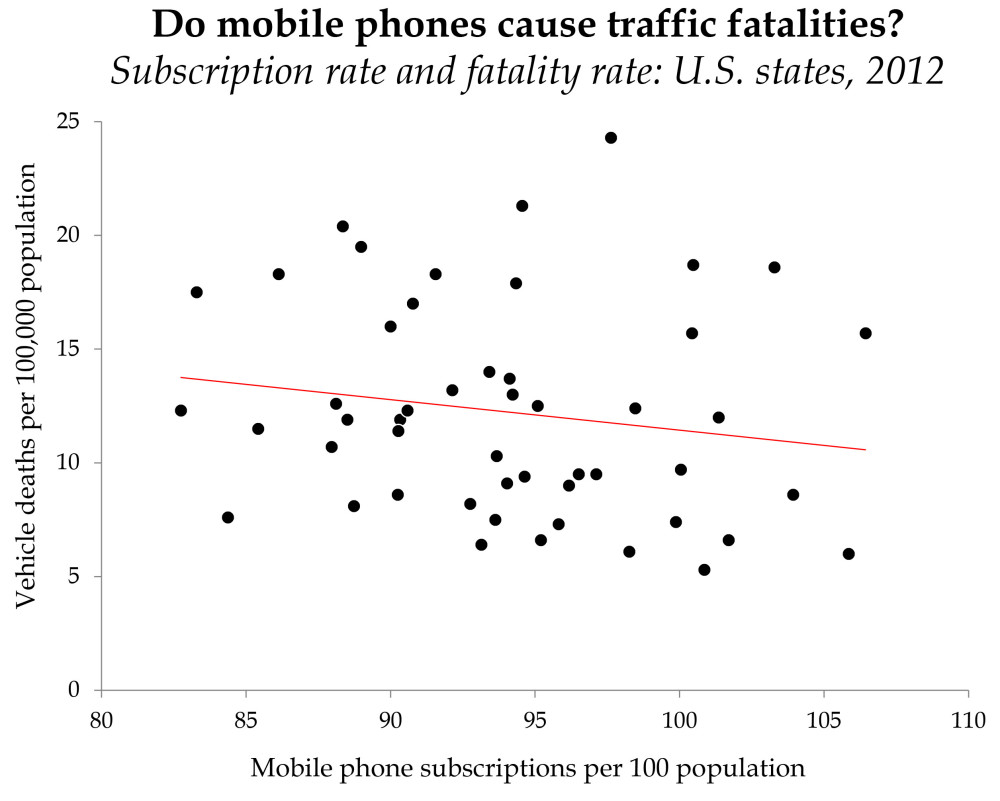
By way of Andrew Sullivan we have this attempt by Philip N. Cohen to apply statistics to answer the question: does texting while driving cause accidents? Or rather, he marshals data to ridicule the new book by Matt Richtel on a supposed epidemic of traffic fatalities, particularly among teens, caused by texting while driving. He has some good points about the complexity of the evidence, and a good general point that people like to fixate on some supposed problem with current cars or driving practices, to distract their attention from the fact that automobiles are inherently dangerous, so that the main thing that causes more fatalities is more driving. But then he has this weird scatterplot, that is supposed to be a visual knock-down argument:

We need about two phones per person to eliminate traffic fatalities...
We need about two phones per person to eliminate traffic fatalities…

So, basically no correlation between the number of of phone subscriptions in a state and the number of traffic fatalities. So, what does that prove? Pretty much nothing, I would say. It’s notable that there is really very little variation in the number of mobile phones among the states, and at the lowest level there’s still almost one per person. (Furthermore, I would guess that most of the adults with no mobile phone are poor, and likely don’t have an automobile either.) Once you have one mobile phone, there’s no reason to think that a second one will substantially

Whether X causes Y is a separate question from whether variation in X is linked to variation in Y. You’d like to think that a sociologist like Cohen would know this. A well-known example: No one would doubt that human intelligence is a product of the human brain (most directly). But variations in intelligence are uncorrelated with variations in brain size. (Which doesn’t rule out the possibility that more subtle measurements could find a physical correlate.) This is particularly true with causes that are saturated, as with the one phone per person level.

You might imagine a Cohen-like war-crimes investigator deciding that the victims were not killed by bullets, because we find no correlation between the number of bullets in a gun and the fate of the corresponding victim.

Just to be clear: I’m not claiming that evidence like this could never be relevant. But when you’re clearly in the saturation region, with a covariate that is only loosely connected to the factor in question, it’s obviously just misleading.

Cornpone opinions in academia

I was commenting recently on the attempt by University of Illinois (Urbana-Champaign) Chancellor Phyllis Wise to explain to all of us addleheaded profs that her ability (and that of US employers more generally) to fire people for expressing their opinions really has nothing at all to do with freedom of speech or academic freedom:

People are mixing up this individual personnel issue with the whole question of freedom of speech and academic freedom.

Political scientist Corey Robin has taken up the same quote, and explained how pervasive it is, and how fundamental it is to the machinery of repression in the US. It seems like one of those dogmas that is patently absurd to the uninitiated, but for those inside the machine (and by “the machine”, I mean simply mainstream American thinking about politics) it is self-evident.

Robin has nothing on Mark Twain, who wrote more than a century ago:

It is by the goodness of God that in our country we have those three unspeakably precious things: freedom of speech, freedom of conscience, and the prudence never to practice either of them.

He explained at greater length in his great essay “Corn-pone Opinions”, telling of a young slave whom he knew in his boyhood, who told him

“You tell me whar a man gits his corn pone, en I’ll tell you what his ‘pinions is.”

I can never forget it. It was deeply impressed upon me. By my mother. Not upon my memory, but elsewhere. She had slipped in upon me while I was absorbed and not watching. The black philosopher’s idea was that a man is not independent, and cannot afford views which might interfere with his bread and butter. If he would prosper, he must train with the majority; in matters of large moment, like politics and religion, he must think and feel with the bulk of his neighbors, or suffer damage in his social standing and in his business prosperities. He must restrict himself to corn-pone opinions — at least on the surface. He must get his opinions from other people; he must reason out none for himself; he must have no first-hand views.


Metric overlap

big ben faceI was just reading this article about the failure of the US to convert to the metric system in the 1970s — a review of the book Whatever Happened to the Metric System? by John Bemelmans Marciano. (About whose title I wonder, whatever happened to the phrase “what ever”? Isn’t “whatever” a completely different word? Whatever.)

It reminded me of my school days, when the units unit — the unit on converting between English and SI units — was a regular feature of every year’s math lessons. We were told that this would be important for the future, since everything was going to be converted to metric. Something to justify a lifetime of skepticism toward those

At the time, I thought it strange that so much time was being spent on converting between the old and the new units. Once you start using new units, you rarely need to convert to the old ones; and most of the conversion can be done with double-marked measuring utensils, like the measuring tapes that were then and still are ubiquitous. (I was fascinated when I first saw the 18th century clock faces that have the hours subdivided simultaneously into fours and into fives, the latter to accommodate the new-fangled minute hands, the former for the old one-handed system, where a single hand showed the time on a 12-hour or 24-hour scale (or 10-hour, if it was late 18th century Paris), with each hour subdivided into quarter hours. An example, from a much later date (mid-19th century, pictured above) is the face of Big Ben in London.

Emphasising conversions made it seem like metric requires hard math, as well as remembering things like 3.28 feet in a metre, or 454 grams in a pound, whereas it actually means you can stop remembering things like 5280 feet in a mile, or 4840 square feet in an acre, or 4 pecks in a bushel. But I remember being particularly struck at the time (the time being about 1980) by an argument I read, claiming that metric conversion would impose untold costs on the US economy, requiring the replacement of everything from shot glasses to wrenches. I found this claim very odd. Surely, I thought, the fact that we measure the size of drinks in millilitres rather than ounces doesn’t forbid us from making a drink have an odd number of millilitres, at least until the old glasses break.

It reminds me of when Deutsche Telekom, in the pre-competition days, proposed changing the basic unit of charging for local calls from three minutes to half a minute, or maybe it was even less. I remember listening to a call-in show on the radio where this was being discussed, and an elderly woman called to express her outrage. “Who would make a half-minute call? What can you discuss in so little time?”

Anyway, metric didn’t happen in the US, except for the 2-litre pop bottles, and gram bags of cocaine. But even where it did happen there remains an overlap of older units. In Britain, which has been metricated by law since EEC accession in the 1970s, house sizes are in square metres, petrol sold by the litre, and fruits are priced in pence per kilo, but beer is sold by the pint and distances between cities are generally measured in miles. People’s weights seem to be given equally in pounds, kilos, or stones (14 pounds). Commonly imperial units are given as alternatives to officially required metric units, suggesting that at least some portion of the public has a better intuitive grasp of the imperial units. But even in Germany, which had the metric system imposed by Napoleon more than 2 centuries ago, people still talk of “Ein Pfund Butter”, even if this “pound” of butter is a metricated pound, rounded to 500 grams.

Creative destruction (Updated)

Headline on the NY Times website:

TV Chief Takes 2-by-4 to a Proposed Cable Merger

I was at first confused by the reference. Having grown up around my father’s lumberyard, I naturally think of a 2-by-4 as a basic element of house construction. For those whose experience of lumber is shaped by Mafia films, it’s an implement of destruction. (It’s interesting how the pop-culture image of organised crime has been shaped by the somewhat coincidental situation of the New York-New Jersey crime families who largely laundered their money through construction firms. Think “cement overshoes”.) I am reminded of the period in the early 1990s when skinhead mobs in Eastern Germany and Berlin suddenly started attacking foreigners, particularly but not exclusively asylum-seekers. The favoured weapons were baseball bats. I remember an article from around 1993, where a police expert was interviewed about why it was that baseball bats were ideally suited to be used as weapons, in addition to their advantage of having a legal use that endows carrying them with a superficial legitimacy, despite the fact that, as the German association of baseball enthusiasts admitted, the total number of baseball players in Germany was estimated at just a few hundred, substantially smaller than the number of baseball bats that had been sold in the past year. In any case, baseball bats (“Baseballschläger”) have become routine emblems of violence in German newspaper headlines, with no further explanation required, specifically xenophobic neo-Nazi violence. For example, when Der Spiegel reported on a government-sponsored youth music initiative with a CD of songs opposing neo-Nazi violence, the article was titled

Tonträger gegen Baseballschläger     (Recordings vs. Baseball Bats)

Interestingly, when Bill Gates handed over control of Microsoft to Steve Ballmer, Der Spiegel covered press reports with a headline “Baseball bat in his hand”, referring to an LA Times report that said

Ballmer, der dafür bekannt ist, dass er bei internen Besprechungen herumbrüllt und manchmal Anordnungen gibt, während er einen Baseballschläger in der Hand hält… (Ballmer, who is known for screaming during internal conferences, and sometimes holds a baseball bat in his hand while giving orders…)

It sounds much more menacing in German.

Update: Somehow I forgot the famous lyric from the gospel song Oh Mary Don’t you Weep (what I take to be Pete Seeger’s revised lyrics; at least, it’s clearly not part of the original spiritual, and does appear on Pete Seeger’s recordings, and later versions):

Moses stood on the Red Sea shore

Smotin’ the water with a two-by-four.

Pharaoh’s army got drowned.

Oh, Mary, don’t you weep!

The tragic contradiction of rooting for the underdog

Everyone loves stories of plucky individuals, beaten down by circumstances but working hard to get ahead. Dickens made a career out of them. It’s a noble sentiment, but it’s a terrible basis for public policy, which is unfortunate for the US, which has persistently put that heart-warming story at the centre of its social welfare policies. I was reminded of this recently when reading an article in the German newsweekly Der Spiegel about the push in some American cities — Seattle, in particular — to raise the minimum wage substantially. (The article doesn’t seem to be available online, but a related interview with activist-entrepreneur Nick Hanauer is here.) I am all in favour of these proposals — there’s no better way to help poor people stop being poor than to give them more money — but it’s clearly not going to solve all of society’s problems. In particular, the Spiegel reporter talks to a single mother of two children, working 32 hours a week for Domino’s Pizza, whose apartment is too small for both children, only manages to get enough to eat by taking home leftover pizza, and has to admit shamefacedly that she never can afford to buy her children any sort of gift. It’s wonderful that she will be earning 60 percent more in a few years (unless she loses her job), but the reporter adds in the sort of detail that German reporters inevitably include in reports on US urban misery:

She lives in a suburb of Seattle. Not a good neighbourhood, she says, lots of drugs and crime. Once someone was shot to death in front of her house.

So, maybe the increase in the minimum wage is going to help her and her sons move to a better neighbourhood. But it’s not going to make the neighbourhood better! The only way to reduce the number of people who have someone shot in front of their house is to reduce the number of people who are shot. If all the people earning minimum wage decide to use their raises to move to a better neighbourhood, the rent in the better neighbourhoods will just go up. Their negotiating position for housing will be improved relative to retirees, nonworking poor, students, etc. But the number of sad stories of people who can’t afford to move out of their run-down crime-infested neighbourhood will not change, though possibly the people suffering will be less sympathetic, which might seem like an improvement.

Continue reading “The tragic contradiction of rooting for the underdog”