November’s top deportation stories

I don’t mean to make light of the plight of the ordinary immigrants caught in the slow-grinding mills of the UKBA, but faced with a political climate where parties are competing to outflank each other to the right on immigration — If you want to join our government, you’d have to REALLY hate foreigners — they’ve managed to produce a year’s worth of absurd deportation stories in just a few days.

It’s hard to pick a favourite. First there was the American head teacher of a school in rural Scotland, married to a UK citizen, who was issued with a 28-day deportation order when he tried to replace his temporary visa with an application for permanent residency. (That one got resolved in his favour when the case provoked a crisis in relations between Westminster and the Scottish government, owing to the enormous difficulty of finding any qualified people who want to be head teachers in rural Scotland.)

Then there was another valuable worker, an Australian NHS therapist for children and adolescents who has been living and working in the UK for 9 years, also issued with a 28-day deportation order. And to round off a great week’s work undermining children’s education and welfare, the UKBA went right for the children themselves, sending a letter to a 7-year-old boy (whose mother is a British citizen), informing him that “you should now make arrangements to leave [the UK]. If you fail to do so voluntarily your departure may be enforced.”

Just yesterday, there was news that an asylum seeker who was nearly dead, after three months on hunger strike, had been summarily deported back to Nigeria on a private plane at great expense in order to make the point that the Home Office won’t be pushed around. Maybe they won’t, but they could at least have taken advice from the Foreign Office. Today, the news is that the plane and its passenger are back in Britain after 20 hours, having been denied entry to Nigerian airspace.

Well, at least they don’t assign their immigration agents with quotas to find sufficient numbers of harmless long-term legal residents who they can deport on a technicality, the way some countries do.

What is it about pirates?

The Daily Telegraph quotes our mild-mannered PM, speaking at the Lord Mayor’s Banquet in the City, saying he wants Britain to show an “entrepreneurial buccaneering spirit”. Why are comparisons to pirates seen as favourable*? Indeed, if he had commented on the City’s “piratical spirit” they would have evicted him from the square mile. Even if you think that 17th century pirates set a remarkable example of untrammelled human spirit of liberty, or something, suppose you asked, what sectors of our society suffer from too much respect for propriety, social norms, and the law? Is there anyone (Mr Cameron excepted) who would spontaneously reply, “You must be talking about the finance industry”?
Do you want to know who showed an entrepreneurial buccaneering spirit that Blackbeard would have been proud of? The young people who plundered London shops in 2011 and set several of them ablaze. I don’t recall any expressions of admiration from Mr Cameron then.

* There are multiple traditions of the use of the word “piracy”. As I discussed here, Internet piracy, pirate radio, and European political pirate parties, all draw on an old tradition of  “pirate” as an opposition to overreaching restraints on free exchange of ideas. But “buccaneering” is clearly meant to refer to the real guys with ships and guns.

Adversaries “rubbing hands with glee”

… can’t they use moisturiser like everyone else? I’m sure I’ve seen this movie:

Sir John Sawers, head of MI6, said: “The leaks from Snowden have been very damaging… It is clear our adversaries are rubbing their hands with glee.”

In other reports, enemies of Britain are said by security experts to be “cackling maniacally”. And intelligence sources have reported that leading terrorist operatives have been heard gloating over our failure to stop their brilliantly contrived schemes for world domination.

“Give me the appearance of liberty or give me death…”

Patrick Henry

… if David Cameron were Patrick Henry, that would have been his impassioned cry.

Here’s what he did say to parliament:

We have a free press, it’s very important the press feels it is not pre-censored from what it writes and all the rest of it.

I don’t want to have to use injunctions or D notices or the other tougher measures. I think it’s much better to appeal to newspapers’ sense of social responsibility. But if they don’t demonstrate some social responsibility it would be very difficult for government to stand back and not to act.

We would like the press to feel it is not pre-censored. But they must be in fact pre-censored, otherwise the government will have to resort to “the other measures”. But not to worry. The only people who might be subject to these other measures are in thrall to ‘a “lah-di-dah, airy-fairy view” (that was really Cameron’s expression) about the dangers of leaks.

Why am I not reassured in this government’s willingness to carefully weigh the different interests in the secrecy debate? Nothing speaks “careful analysis” like presenting your opponents’ view as”lah-di-dah, airy-fairy”.

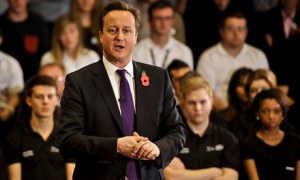
Cameron tours the Mini car plant in Oxford.

A thoughtful politician

I was at the concluding conference today for the New Dynamics of Ageing research programme in London, and one of the talks was by David Willetts, the Minister of State for Universities and Science.

I won’t speak for his general politics — even if I knew how much of the policy of his ministry he is responsible for — but I was impressed with his thoughtfulness. He wasn’t academic, but he showed a nimble ability to deploy concepts from science and philosophy in response to questions, and a willingness to think on his feet that is far from the stereotype of the cautious time-serving politician.

One thing that impressed me was his answer to a somewhat vague and mundane question about ageism, and what we can do about it. It would have been easy to answer to give a conventionally pious answer, saying that we all need to recognise the contributions of blah blah blah. Instead, he spoke about the problem of increasing segregation by age in British society, related it to nurseries being more inclined to separate 2-year-olds from 3-year-olds, and concluded by saying that teenagers are at least as likely to be stereotyped and discriminated against as the elderly. I think this is true, and hardly a politically safe position to take.

In response to a question about adult learning he drew a contrast between “Calvinist education” (not quite predestination or reprobationism, but he seemed to mean more that everything is determined in the first few years) and neural plasticity. He said, “The large hippocampus of a London taxi driver isn’t because people with large hippocampus become taxi drivers.” Not a highly original point, one that I’m sure is made in any number of popular science books, but he clearly had mastered the outlines of this science, and was able to weave it in with policy considerations on the fly.

Migrants are the root of all evil…

… or something. Having commented before on the xenophobia that pervades the British political establishment — with politicians of all parties falling all over themselves to profit from public anti-immigrant sentiment — I am hardly surprised by home secretary Theresa May preening herself with the macho boast that her government will intensify the “hostile environment” for foreigners — sorry, she boasts that she will initiate the not-yet-existing hostile environment, and only for “illegal migrants”. One of the most striking provisions of the soon-to-be-law is a requirement that landlords check the immigration status of prospective tenants. This leads me to wonder, again, how exactly a British citizen can prove to a prospective landlord that he or she is British, now that the government has abolished Labour’s identity-card program as being too intrusive and really the antechamber to tyranny. Of course, many people have passports, but many don’t, and they are, of course, generally the poorer and more vulnerable citizens. Passports cost £72.50.

I asked a British colleague how he would prove his citizenship if he didn’t have a passport. He said he has a birth certificate, apparently unaware that the UK abolished birthright citizenship 30 years ago. Anyone born after 1983 would need not only his own birth certificate, but that of one of his parents.

Of course, I am being somewhat disingenuous here. We all know that the real British will demonstrate their citizenship by having the right skin colour and the right accent. That’s what this is really about.

Free meals from the nanny state

One of the first things the Cameron-Clegg government did when it came into power in 2010 was to announce the revocation of child benefit from families where one earner earned above £42,000 p.a. (the threshold for the 40% marginal tax bracket). They’ve held to this — and the implicit penalty for single-income families — though they have sensibly replaced the sharp cutoff, which would have caused some people to actually lose money if they got a salary raise, by a more gradual cutoff between £50,000 and £60,000. This was superficially sensible — in times of austerity, why should wealthy parents be getting a government handout? — although most developed countries have some sort of tax credit for children, reflecting a sense that some of the cost of taking care of children should be seen as public costs. In the US this comes in the form of an income deduction, so that high-income parents who pay more tax also get a larger subsidy, so the old UK system was less biased toward subsidising wealthy parents. For that matter, the same is true of the credit for childcare expenses in the UK, which comes in the form of paying expenses with pretax income, effectively giving a larger subsidy to wealthier parents. This has been slightly modified, but it still favours the wealthy.

Anyway, so far so consistent. But now the government has announced that they want to spend more money on children, to provide free school lunches to all children up to age 7. (Poor children already get free lunches, and there is also free fruit for children up to age 7.) The rhetoric around it is the government claim that parents don’t know how to pack appropriately nutritious lunches for their children. So the government has taken away a subsidy that parents could have spent in any way the choose — including nutritious lunches — and replaced it with a subsidy to the companies that have not been very successful at convincing children to eat their lunches voluntarily. And this from the party that attacks Labour as the party of the “nanny state”. If I had a nanny who insisted they had better ideas than I of what my children should eat, I would fire them.

It’s not entirely the Conservatives’ fault. This seems to have been some sort of coalition bargain to gain Liberal Democrat support for their even more pointless priority of a tax subsidy for married couples (whether or not they have children).

Is “open for business” fit for purpose?

One peculiarity of British political culture that I find most striking, coming to it from the outside, is the occasional coining of technocratically flavoured verbal taunts, and the incessant efforts to shoehorn as many of the old chestnuts as possible into whatever attack is currently being made.

Witness the reaction of energy companies to Ed Miliband’s proposal to freeze energy prices for 20 months (which, on the merits, sounds like a pretty awful idea, managing to be offensive both to oil tycoons and environmentalists):

The companies have reacted with fury to his plans, saying he is risking power blackouts and sending a message that Britain is not open for business.

(More quotes used the same slogan to attack proposals to fund the reduction in business energy rates by raising corporate income tax.) The phrase gets associated with Margaret Thatcher, though it’s been used intensively both by the current government, and by Tony Blair, who has been well paid to travel around the world attesting to other countries being “open for business”: Palestine, Sierra Leone, Thailand.

Public relations advice for GCHQ (from Wolf Biermann)

If you don’t speak German you probably have never heard of Wolf Biermann, who many people (I am one of them) would consider to be the greatest, or at least one of the greatest, political songwriters of the 20th century. Unfortunately, text-heavy songwriting doesn’t cross borders well, so he is almost unknown outside the German-speaking world. But he is an extraordinary poet and musician, and I’m not sure who could compare to his blend of wit, righteous anger and political sophistication.

At the moment, I’m particularly thinking of his 1974 Stasi Ballade, a sarcastic paean to the internal security service (Staatssicherheit, or Stasi) that had kept him constantly under surveillance since the early 1960s, when his communist idealism had been pegged as politically deviant. I’ve included the whole German text below (certainly a copyright sin, but perhaps a venial one). A crude translation of parts of it give a sense of Biermann’s text:

I feel myself somehow entwined
with the poignant Stasi swine
who watch my house, who come and go
in pouring rain and sleet and snow.
Who installed a microphone
to listen in on all my moaning,
songs and jokes and mild bitching
on the toilet, in the kitchen:
Brothers from Security —
You alone know all my grief!

…..

Words that would have disappeared
are stored by you on eight-inch reels,
and I know how, now and then,
you sing my songs at night in bed!
For years I’ve been depending on
the Stasi as my Eckermann.

When I come home late at night
from the pub tired, maybe tight,
And some crude peasants were to lurk
in the darkness by my door,
and they attacked most vulgarly
to do, I don’t know what, to me –
But that’s impossible today.
The comrades in their battle grey
from the Stasi would — I’d bet you! —
Prohibit an assault or battery

Because the papers in the West
Would try to blame the crime — I’d bet you! —
on the Communists …
The Stasi is — I must regard it
as my loyal bodyguard!

Or we could reflect a while
upon my foolish carnal freestyle –
My habit, such a source of strife,
that always discomposed my wife –
This monstrous, mad, and reckless tempt-lure
pulling me toward new adventure.
Since I know how Argus-eyed
the comrades watch, I haven’t tried
to pick my cherries anymore
from the trees on other shores.

I know I’d risk that such events
would be recorded, and soon be sent
to my wife with clear intent –
Such a huge embarrassment!
And so I skip these sideways swerves
so save my strength, my time, my nerves –
And there’s no question that this spark
I save redounds to fire my work!
I say, in short: the Security
Secures my immortality!

So, let’s summarise: Biermann thanks the Stasi surveillance for three services:

  1. Recording his words. Assuring that they will never be forgotten, and that someone is paying attention. Of course, it’s not clear how much attention GCHQ is allowed to pay, according to current law, but they could do a lot more to win over the hearts and minds of the public on the other score. Imagine GCHQ Backup. Never lose another file. If you have a disagreement about what was said in a telephone conversation, just use the webform to contact GCHQ’s round-the-clock service representatives, who will be happy to provide you with the recording. Maybe they’ll even get people to agree to leave their webcams on at all times, in return for cataloguing and backing up their non-telephonic conversations.
  2. Protection from crime. They’ve emphasised this so far. I’m not sure that there is more to be gotten plausibly, at current funding levels.
  3. Preserving morals. This one is delicate, but may have the greatest potential for development. Of course, it’s implicit in the argument that people make, that those who have not committed crimes have nothing to fear from surveillance. We know that the NSA has already been experimenting with the use of electronic surveillance to control sexual deviance. They could offer a service that automatically mails to your partner the content of any conversations that include certain keywords. The application is not limited to sexual morals, of course. Employers could be alerted when their employees discuss company secrets (or theft of company property). Or maybe you’re a Muslim youth who is worried that you might be tempted into islamist terrorism. The problem is, some people don’t want to be prevented from having affairs, or consorting with islamists, or whatnot. This part still needs work.

Continue reading “Public relations advice for GCHQ (from Wolf Biermann)”

Is bleating shrill?

Having taken on the controversial question of the significance of ascribing shrillness (shrillity? shrillth?) to ones opponents, I feel obliged to wade in on the pressing issue of “bleating”.

The occasion is an open letter by a group of British education experts, pointing out the well-established fact that the UK obsession with getting children learning arithmetic and reading at ever earlier ages — formal schooling starts at age 3 1/2 — is counterproductive, and that children would be better off with age-appropriate education. The education ministry has responded with an extraordinarily unprofessional (shrill, or perhaps “spittle-flecked” would be the vernacular description) ejaculation of mostly generic insults, including the charge that

We need a system that aims to prepare pupils to solve hard problems in calculus or be a poet or engineer – a system freed from the grip of those who bleat bogus pop-psychology about ‘self image’, which is an excuse for not teaching poor children how to add up.

I can’t fault the alliteration of “those who bleat bogus pop-psychology”, but what does it mean? It sounds like an insult, but I’m not sure what is insulting about it. Presumably it’s supposed to make you think of a flock of sheep, dumbly repeating some meaningless sounds. And, bleating is sort of a shrill sound, so maybe it also is meant to have effeminate overtones.

The term “pop-psychology” is interesting in this context. Given that the letter is signed by professors and senior lecturers in psychology and education, I have to assume that, right or wrong, what they’re talking about is real psychology, not “pop”.  So it’s interesting that the bureaucrats felt that they couldn’t take on the reputation of academic psychology directly, but only by insinuating that it is all just self-help pablum. (And is “bogus” a modifier of pop-psychology — to say, this isn’t even the top-drawer pop — or a redundant intensifier, as when one refers to “disingenuous government propaganda”?) Continue reading “Is bleating shrill?”