Why are bank accounts so complicated?

A BBC report today says that some popular current account packages are having their fees increased substantially.

The change in Santander fees – announced in September – will see customers paying £60 a year, instead of the previous fee of £24. The charge for its 123 credit card rises from £24 a year to £36.
Last year the Santander account proved very popular, with more than 27,000 people switching to it in a single month. But experts said that – even after the changes -it still offered relatively generous interest payments of up to 3% a year, and cashback of up to 3% on some household bills. “Don’t jump ship until you’ve done the maths,” said Hannah Maundrell, editor in chief of advice site Money.co.uk. “To put it simply, you need to look at how much you’re earning in interest and cashback. If it’s less than the new £60 a year fee you need to take it as a wake-up call to seriously consider your options.”

Why should people need to do complicated calculations to figure out whether their bank is scamming them? Obviously, this is a rhetorical question. I know, sort of, that banks see current customers as locked in, so they are motivated to provide a minimum of interest and service to them, while trying to dislodge a few customers from other banks with some flashy (but inexpensive) offer.

Barclays has said it will double its cash rewards programme for those who take out an account this month. Marks and Spencer is already offering incentives worth up to £220 to anyone who switches.

The article cites experts arguing about whether the banks have been forced to charge more because of increased costs, or whether they are padding their profits. But even have to raise the question shows how pathological banking has become. It’s the consumer

Every few years I find myself in my bank, needing to spend half an hour talking with a customer-service drone about why the Super Privilege Advantage account doesn’t pay interest anymore, but if I switch to the brand new Club Lloyds (really) Account I’ll get interest (varying amounts depending on my balance, increasing up to £5000, and then cutting out after that.

By the theory of the competitive market, you might think that someone would see an interest in providing simple financial services, to people who have better things to do than discuss their half a percent interest with a bored bank employee for half an hour every year or two.

Confidence game: Growth mindset for the secret police

Powers that give MI5, MI6 and GCHQ a “dizzying” range of electronic surveillance capabilities will be laid out in the investigatory powers bill next month, in a move that will bolster the confidence of the intelligence agencies but pave the way for a row with privacy campaigners.

According to one headline announcing this report in the Times, the security services will get the “legal right” to hack into people’s computers and other electronic devices. Under must circumstances, “legal right” might be seen as redundant, but not here. They already do these things, they have the power to do these things, but what they lack, apparently, is confidence in their abilities.

Cue the Growth Mindset (TM). I suppose it was only a matter of time before education fads started sloshing over into spying: After all, aren’t GCHQ and the others supposed to be “learning things”? What they need is confidence. The standard critiques apply:

Confidence and motivation are crucial, but confidence without competence is simply hot air.

You can’t have your pocket money and save it too

My 13-year old child received the following maths problem in school:

Paul saves 4/15 of his pocket money and spends 5/12 on topping up his mobile phone. What fraction of his pocket money does he have left?

(The question was part of a sheet from Cambridge Essentials.) With a PhD in mathematics, I usually feel myself adequately qualified to deal with school maths questions, but this one stymied me. I have decided to stop blaming myself, though. This question is

  1. misleadingly formulated;
  2. ambiguous;
  3. exceptionally dependent on hidden cultural assumptions.

Let’s start with number 1. Who counts fractions of pocket money? This makes about as much sense as asking

Paul and Paulina order a pizza together. Paul eats 0.375 pizza. Paulina eats 0.5 pizza. How much pizza do they take home?

It’s like you were trying to teach children about toothbrushes, and showing them how useful they are by having them use the toothbrush to clean the floor. Sure, you can do it, but it’s really not the tool anyone would choose to use, and it doesn’t give them a fair impression of what it could really be good for.

Okay, maybe Paul lives in a socialist country, where “from each according to his ability”, so that prices are stated as fractions of your income. But it gets worse. Point 2: My first thought was that Paul had spent 11/15 of his money on other things — probably drugs — and now had to top up his phone, which cost 5/12 of his pocket money. But he only has 4/15, which is smaller, so he needs to go into debt by 5/12-4/15=3/20. Okay, that didn’t seem likely. So then I figured that the 5/12 was intended to be a proportion of the 4/15 that he has remaining. Then it would at least make a little bit of sense to express it as a fraction. (Extreme socialism: Prices are all formulated as a fraction of the money you have in your pocket. Customer: How much? Merchant: How much you got?) So the amount remaining is 4/15*7/12=7/45.

But on further discussion with my partner I recognized that neither of these versions was what was intended by the people who set the question. I was thinking in terms of a model of sequential spending: The money you “save” is the money you have available to spend the next time an expense arises. The question, though, presumes that money that is “saved” is being saved from yourself. Whereas I would think that the money you “save” is part of — or possibly identical with — the money you “have left”, you were supposed to think of spending and saving as just two different ways of losing money. You add the two together to get a total loss of 4/15+5/12=17/30, leaving Paul with 13/30 pocket money units to spend on non-mobile-phone and non-banking expenses. (Probably drugs.)

Of course, I’m overthinking this. The point is that you’re not supposed to think. You’re just supposed to see two fractions and add them, because that’s what you’ve been learning to do. It’s a kind of pseudo-applied maths problem that is quite common — even at university level — where any actual thought about the issues involved will only penalise you. It’s a puzzle, where you’re supposed to read through the irrelevant verbiage to get to the maths problem that has been concealed there.

I call this “adding up the temperatures”, after the story by Richard Feynman (in Surely You’re Joking, Mr Feynman) about his time evaluating textbooks for the state of California. He describes a problem from one elementary school textbook:

Red stars have a temperature of four thousand degrees, yellow stars have a temperature of five thousand degrees, Green stars have a temperature of seven thousand degrees, blue stars have a temperature of ten thousand degrees, and violet stars have a temperature of … (some big number).

John and his father go out to look at the stars. John sees two blue stars and a red star. His father sees a green star, a violet star, and two yellow stars. What is the total temperature of the stars seen by John and his father?

Feynman points out that the temperatures aren’t really right, and that there is no such thing as green and violet stars, which he is willing to tolerate, but then blows up at the sheer pointlessness of adding up temperatures. Like the above, it only looks like an application of the mathematical tool being presented (in this case addition).

But I’m even more amazed at the absurdity of the story. How is it possible that John sees only 3 stars, his father sees 4, and they see completely different stars? But the point is, in school mathematics you’re supposed to do, not think.

“Serving the purposes of the Israeli apartheid and colonial regime”

The American Jewish reggae singer Matisyahu has been expelled from a Spanish music festival, for refusing to issue a statement in support of a Palestinian state. Apparently such loyalty oaths are required of suspect persons, such as Jews. His silence, they said, serves “the purposes of the Israeli colonial and apartheid regime”.

This buttresses the view that BDS has a significant dollop of antisemitism in its ideological matrix, even if not every BDS supporter is antisemitic (and not everyone motivated partly by antisemitism is entirely or even consciously motivated by antisemitism).

This takes me back to 2007, when one UK academic union, the National Association of Teachers in Further and Higher Education (since melded into the University and Colleges Union (UCU)) couldn’t find any more relevant challenge to higher education in the UK than a boycott of Israeli academics who do not “publicly dissociate themselves” from Israeli “apartheid policies”.

I immediately recognised a problem: What is the appropriate form for expressing such dissociation? And how would we test whether the self-criticism was sincere, or merely careerist dissimulation. After all, we wouldn’t want crypto-Zionists sneaking in to British universities and scientific conferences, infecting them with the taint of racism and colonialism. Leaping into the breach, I composed a form to enable the aspiring good Israeli to have his anti-Zionist bona fides tested and confirmed by the proper authorities.

International queueing theory

queue2
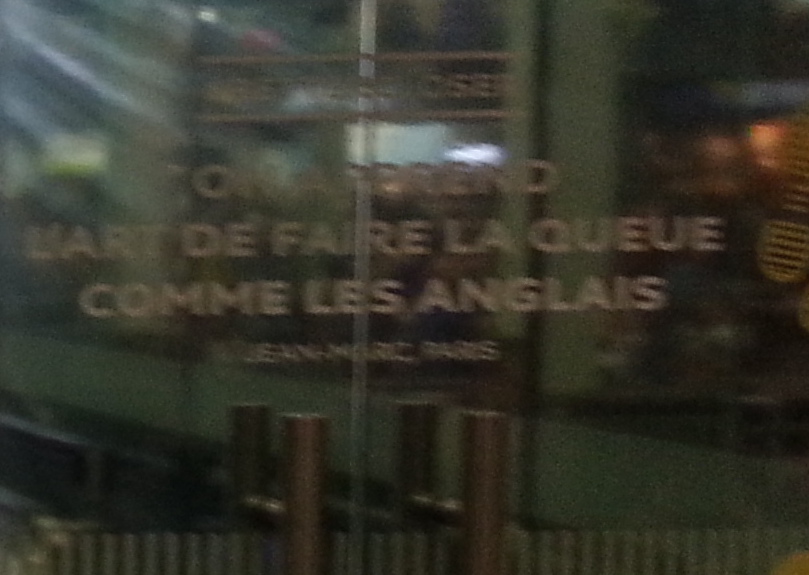
Queueing up to board the Eurostar in London recently, I saw these very conspicuous signs engraved in the doors leading to the platforms

On apprend l’art de faire la queue comme les anglais.

Attributed to “Jean-Marc, Paris”. There was also a translation, something like “We are learning the art of queueing up like the English”. Is this intended to shame the French passengers into behaving well in the queue? To flatter the English? To mock them?

Of course, while the English are very proud of their queueing habits, there are greater superlatives imaginable. Historical context is crucial, though. If the French develop their skills further (and if the Germans make more progress in dismantling the European economy), perhaps one day they will be able to say they have learned “the art of queueing up like the Poles (Communist era)”. Or even the Russians. If they get really advanced, they might learn the art of queueing up like Depression-era Americans.

And that’s the pinnacle. Presumably they’ll never have to learn to queue up like these people…

holocaust victims queueing for train

Backgrounds

A British politician gave a brave speech a few days ago, defying political correctness to name a pressing problem of British society that most would rather ignore. He said,

There is a danger in some of our communities that you can go your whole life and have little to do with people from other… backgrounds.

The prime minister’s response to this attack on his isolated Etonian upbringing was… no, wait, that was the prime minister himself who said it. And the words I left out — “other faiths and backgrounds” — make clear that he’s talking about Muslims. (He could also be talking about the insular Hasidic communities of London, but he’s probably not.) Those are the people in need of integration.

Just joking

Following up some references related to Thomas Malthus recently, I discovered that Carlyle’s notorious appellation “dismal science” for economics (or “political economy”) was not a reference to the pessimistic world view of Malthus and his descendants. This sobriquet first appeared in an essay “Occasional Discourse on the Negro Question”, in which he criticised the emancipation of Black slaves in the West Indies, leaving the unfortunate Blacks to wallow in disgraceful idleness. Carlyle attacked political economy for undermining natural hierarchies, for

declaring that Negro and White are unrelated, loose from one another, on a footing of perfect equality, and subject to no law but that of supply and demand according to the Dismal Science.

Here “dismal” is presumably not being used in the modern sense of “gloomy”, but in the older sense of “threatening” or “inauspicious”, as in Henry VI pt. 3:

Bring forth that fatal screech-owl to our house,
That nothing sung but death to us and ours:
Now death shall stop his dismal threatening sound,
And his ill-boding tongue no more shall speak.

Carlyle lumps the Dismal Science together with other unfortunate modern political innovations, such as “ballot boxes”, “universal suffrages” and “Exeter-Hall Philanthropy”.

Here I’d like to call attention to Carlyle’s framing device. The essay is attributed to a fictitious author with the absurd name Dr. Phelin M’Quirk. It begins

THE following occasional discourse, delivered by we know not whom, and of date seemingly above a year back, may, perhaps, be welcome to here and there a speculative reader. It comes to us — no speaker named, no time or place assigned, no commentary of any sort given in the hand-writing of the so-called “Doctor,” properly “Absconded Reporter,” Dr. Phelin M’Quirk, whose singular powers of reporting, and also whose debts, extravagances, and sorrowful insidious finance-operations, now winded up by a sudden disappearance, to the grief of many poor trades-people, are making too much noise in the police offices at present! Of M’Quirk’s composition, we by no means suppose it to be; but from M’Quirk, as the last traceable source, it comes to us; offered, in fact, by his respectable, unfortunate landlady, desirous to make up part of her losses in this way.

Together with some self-mocking references to some offended members of the fictional audience leaving in a huff, this sets up the cover story, particularly beloved of British racists and misogynists, that “I’m just joking”. You insult people with a wink, simultaneously spreading poisonous sentiments and confirming your superior power by forcing them to smile while you insult them — if they don’t, they are dismissed as “humourless”. Most recently there was Tim Hunt, whose defenders say that his disgraceful remarks on women in science were some kind of protected speech because he followed them with “Now seriously, I’m impressed by the economic development of Korea. And women scientists played, without doubt an important role in it.” “Now seriously” is the proof that he was just joking, so critics are joyless harridans.
Continue reading “Just joking”

Hannah’s sweets

The following problem appeared on one of yesterday’s GCSE maths exams, leading to considerable frustration and media attention:

Hannah has 6 orange sweets and some yellow sweets.

Overall, she has n sweets.

The probability of her taking 2 orange sweets is 1/3.

Prove that: n^2-n-90=0

^ is “to the power of”

Now, I am a professional probabilist, and I wasn’t immediately sure how to do it. Why not? Well, there’s something missing: The problem doesn’t tell us what Hannah’s options are. Did she pick sweets at random from the bag? How many? Are we asked the probability that she took 2 orange sweets rather than 3 yellow, given that she actually prefers the orange?  Did she choose between taking sweets out of the bag and putting it away until after dinner?

There should have been a line that said, “She picks two sweets from the bag, at random, without replacement, with each sweet in the bag equally likely to be taken.”

According to the news reports

Hannah’s was just one of the many supposed “real life” problems that the students were required to tackle.

This is just an example of the ridiculous approach to mathematical “applications” induced by our testing culture. It’s not a “real life” maths problem. It’s a very elementary book problem, decked out with a little story that serves only to confuse the matter. You are supposed to know a standard rule for decoding the chatter. If you try to make use of any actual understanding of the situation being described you will only be misled. (Richard Feynman described this problem, when he was on a commission to examine junior high school maths textbooks in California in the 1960s. His entertaining account is the chapter “Judging Books by their Covers” in Surely You’re Joking, Mr Feynman.)

Last refuge

Northern Ireland under pressure after Irish gay marriage referendum win

I’m looking forward to seeing the arguments they will use to resist the pressure. Perhaps Northern Ireland can present itself as a last refuge in Europe for the non-gay-marrying, Christian bakers and florists, antigay clerics. It will help if they can get a high profile asylum case. Maybe the straight son of two North London radical feminists fleeing an arranged marriage to another man.

In all seriousness, I doubt there is anyone who is not astonished at the rapid international progress on same-sex marriage. That includes, most especially, those of us who came of age when acceptance of same-sex relationships was the norm in our student environments and/or recognised the logical force of the argument decades ago. Logical coherence doesn’t usually carry the day in politics nor, I have to admit, should it necessarily. But here we see the power of ideology in political affairs, against those who suppose that politics is merely about balancing competing interests. It’s the ideology of marriage, which had changed enormously in the past two centuries. People like Andrew Sullivan recognised in the 1980s that people’s intuitive understanding of marriage, in Europe and its cultural confrères, had evolved to where it was actually quite hospitable to same-sex marriage. Those of us who felt little emotional attachment to marriage immediately recognised the coherence of this position, but assumed that it would take approximately forever to get over that emotional hurdle, at least everywhere but Holland.

And because I personally attached little weight to marriage, I was definitely among those who thought this an unpromising, because unnecessarily charged, ground to fight on for gay rights. I didn’t see what Sullivan saw, that marriage equality could be the linchpin of a coherent struggle that could overthrow the entire framework of homophobia.

Sikh and ye shall find

… a primary school place.

Apparently the government’s decision to wipe out new school construction and put huge amounts of the remaining schools budget into independently run “free schools” has led to some unexpected consequences:

More than 20 pupils have been allocated places at a Sikh-ethos free school in Leeds that they did not choose, amid a shortage of school places.

The school is not a faith school, but it is run with a Sikh ethos.

As someone with a child who had little option but to attend a Church of England school, that really was a “faith school” — secular options were much further away, even if they did have places — I wonder what the fuss was about.

On its website, the Khalsa Free School stresses it is not a faith school, adding: “We are firmly committed to developing our pupils’ understanding and appreciation of the diverse world in which they live.” It says: “We welcome all children regardless of their backgrounds or faiths and we aim to help all our children develop a lifelong love of learning, which will support them throughout their academic careers and beyond.” 
“For Sikhs, education not only prepares students for work and life in society but also supports spiritual growth. Education is understood by Sikhs to raise aspirations and personal standards, encourage self-awareness and humility, and inspire all to seek a greater purpose in life.”

Humility! Purpose! No wonder parents are outraged. What impact will self-awareness have on lifetime earnings? How will humility help them get in to Cambridge? Where is the acknowledgement of the divine imperative to maximise test scores?