
Yet another article pointing out how Donald Trump seems to be surrounded by antisemites. But none of these articles seems to recognise that they may just seem like antisemites by comparison, because of their proximity to the least antisemitic person you’ve ever seen (TM).
Tag: Trump
Trump: The new Caesar?
From Montaigne’s “The story of Spurina”:
Caton mesme avoit accoustumé de dire de [Caesar], que c’estoit le premier homme sobre, qui se fust acheminé a la ruyne de son pays.
Cato himself liked to say that Caesar was the first sober man who ever set out to ruin his country.
No daylight
In case there was any doubt that the Trump administration is stumbling about in the dark:
White House press secretary Sean Spicer on Wednesday denied reports that Attorney General Jeff Sessions and Secretary of Education Betsy DeVos clashed over an upcoming executive order expected to weaken protections for transgender students.
“There’s no daylight between anybody, between the President, between any of the secretaries,” Spicer told reporters at his daily press briefing.
As I have already made clear
I am fascinated by political rhetoric. And while I have been talking a lot about how Trump’s rhetoric breaks the bounds of normal US presidential rhetoric, I’m also interested in the ways in which he pushes the normal to its logical conclusion. To wit, the White House statement Monday on the wave of bomb threats against Jewish institutions:
Hatred and hate-motivated violence of any kind have no place in a country founded on the promise of individual freedom. The President has made it abundantly clear that these actions are unacceptable.
A typical reaction was that of CNN:
The White House on Monday denounced a spate of threats made against Jewish Community Centers around the country.
For context, this comes after the president explicitly refused to comment last week, and instead attacked the reporter for raising the question. Given that pressure has been placed on the president precisely because he has not made the position of his administration clear, this statement seems less a forthright condemnation of the threats than an explicit refusal to make the president’s position any more “abundantly clear” than he already has.
This is a common political trope, and I’m never sure how to interpret it. I guess it’s supposed to put to rest accusations that one has not yet denounced whatever one was supposed to denounce, while not thereby accepting the accusation that one has failed to denounce it in the past.
But it can come off seeming like another refusal, still giving comfort to those who were supposed to be denounced. That’s especially true in this case, where the statement also fails to say anything about the particulars of these incidents: It condemns violence — in fairly anodyne terms, it must be said — but not threats, which are the particular issue here, and once again refuses to explicitly mention Jews.
Debating Trump’s state visit
The House of Commons is now debating two petitions that both received more than the required 100,000 signatures to force a debate in parliament. One opposing a Donald Trump state visit (1.8 million signatures) and one supporting it (312 thousand). I couldn’t believe that the text given in favour of Trump’s visit in the newspaper so I checked on the official government website. The text was accurate. It’s just one (admittedly convoluted) sentence! Couldn’t they find someone to proofread it? Or was the text actually written by anti-Trump trolls eager to make the Trumpistas look like illiterate dunces?
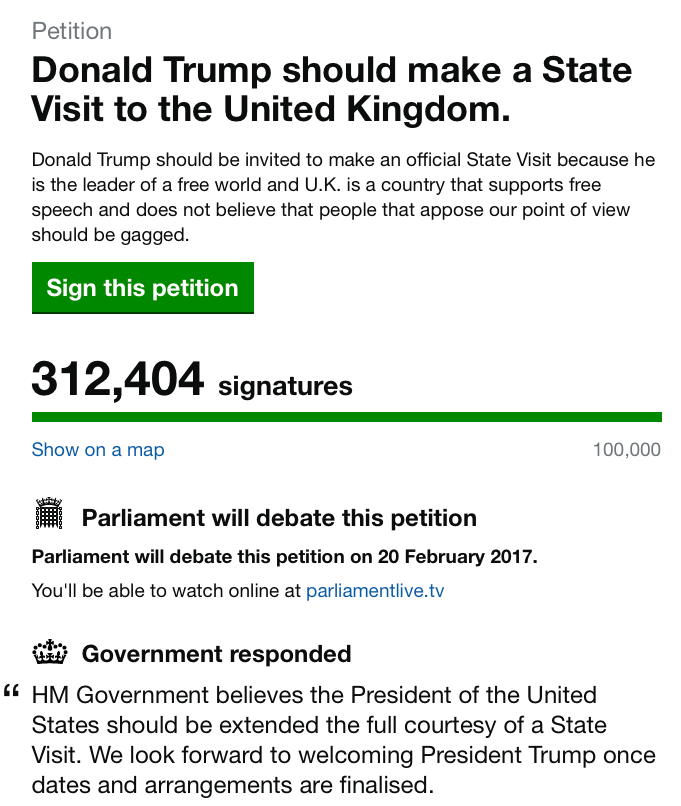
(I’m not sure whether “leader of a free world” counts as an error… Of course, “leader of the free world” is the traditional phrase. But maybe they want to leave open exactly which “free world” he is leading.)
“Who would believe this?”
This comment from Trump’s rally to launch his 2020 reelection campaign has gotten a lot of attention:
You look at what’s happening in Germany, you look at what’s happening. Last night in Sweden. Sweden, who would believe this? Sweden. They took in large numbers. They’re having problems like they never thought possible.
(I’ve repunctuated from my source, since “You look at what’s happening last night in Sweden” doesn’t work grammatically.) Narrow-minded commenters have obsessed over the fact that nothing out of the ordinary happened in Sweden. (Not than anyone has presented proof that nothing happened…) But he didn’t say anything unusual happened. All he did was to ask “who would believe this?” They took in large numbers. TRUE! It’s a testimony of faith that “they’re having problems like they never thought possible”. Every day, including last night. Trump is inviting the elect to testify to their belief. “Belief” is considered a good thing in church, why not in politics? John McCain, at least, is on the same page:
“Can Americans be confident that a Republican-controlled Congress can investigate this President thoroughly if necessary?” Chuck Todd asked McCain on NBC News’ “Meet the Press.”
“I hope so and I have to believe so,” McCain said. “More hope than belief.”
We have to believe! We believe in congressional action unseen. Just because you’re in the Senate does not mean that you are responsible for causing the action to occur. It will happen. We just have to believe.
Respected in the world
Donald Trump promised that he would win respect internationally, unlike that Kenyan interloper. Here is a sign I saw outside a taco shop in Oslo…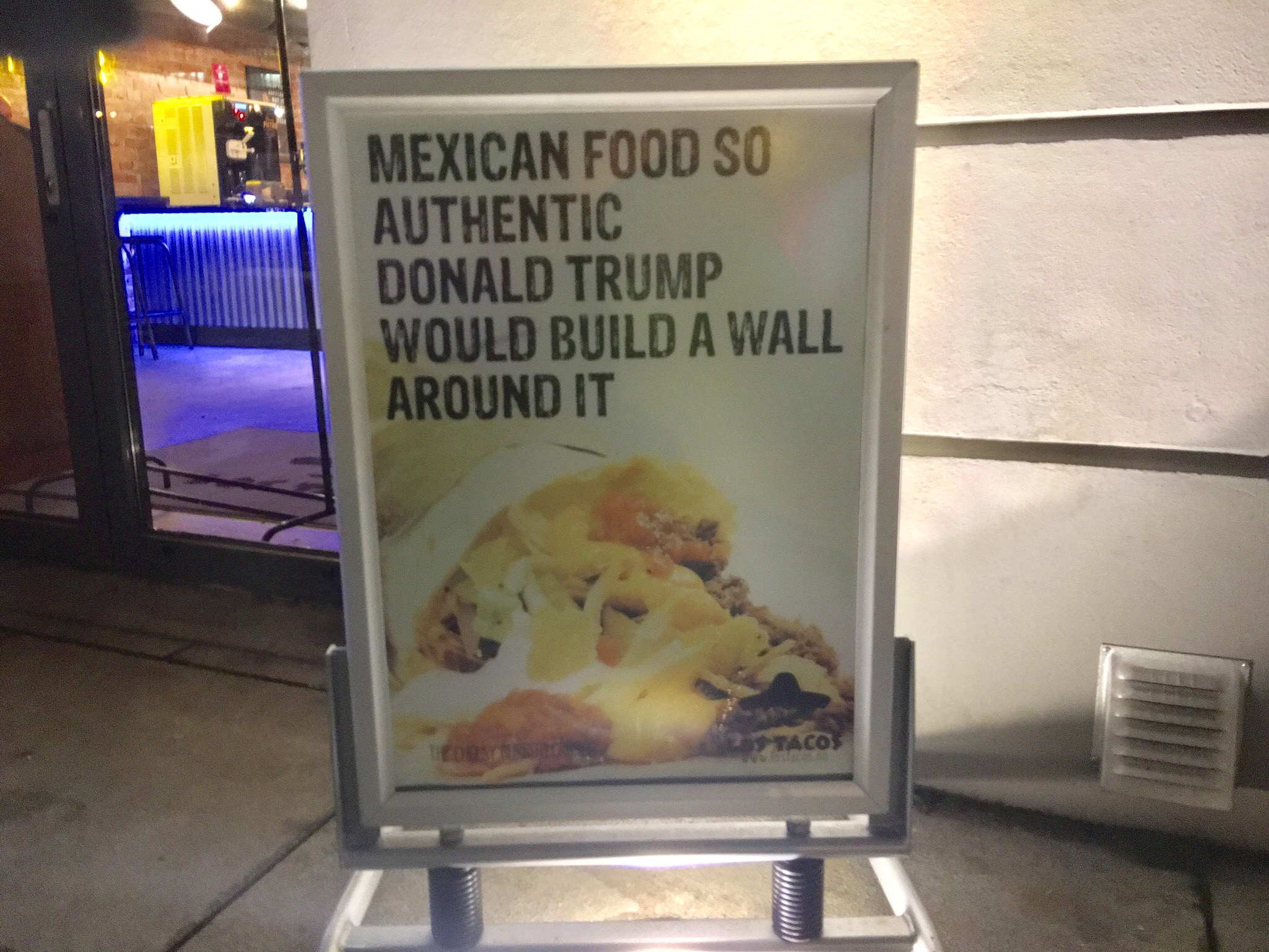
Defending the fraud
From the perspective of normal human psychology, everything about the Trump-Putin interaction seems off. As I remarked before, if Trump were really a Russian agent, you would expect Putin to advise him to be less conspicuous in advocating Russian interests, simply to preserve his usefulness.
On the other hand, imagine Trump as a naive businessman with generally russophile leanings. (I don’t know, maybe he read The Gambler at an impressionable age, and modeled his life on it.) He’s had no significant contact with the Russian leadership, but he once met Vladimir Putin at a beauty pageant, thinks he praised him (mistakenly), and thinks he could do some good for the world by relaxing tensions with the world’s second-largest nuclear power. He is convinced that he deserves to be president, but privately unsure the world will acknowledge his greatness. Now he receives intelligence briefings giving strong evidence that the Russians are attempting to interfere with the election in his favour. What would he do? Before the election maybe he keeps quiet and tries to suppress or discredit the claims. But you would expect him to be seething with fury, that the Russians threaten to taint his election. The help they’re giving is marginal, but the blowback is potentially enormous. It’s like a referee intentionally calling an unwarranted penalty in a football match. It probably won’t change the result, but it makes the favoured side look terrible. To do that without consent is an act of aggression against those you’re ostensibly helping. Continue reading “Defending the fraud”
The random correspondence theory of truth
Republicans may not believe in scientific reasoning, but Republican administrations seem to be the best for generating innovations in epistemology. The Bush administration brought us the taxonomy of “known unknowns”, etc.
Now presidential advisor Kellyanne Conway continues to press forward her creative truth-value confections. After coining the term “alternative facts” for what were formerly called “lies”, she is now attacking what might be called the curatorial conception of truth.
“You can talk about somebody almost making a mistake and not doing it,” Tapper said. “I’m talking about the President of the United States saying things that are not true, demonstrably not true. That is important.”
“Are they more important than the many things that he says that are true that are making a difference in people’s lives?” Conway replied.
It is not important, in her conception, for true statements to be statistically more common than false, or, presumably, even more common than background randomness. Only that they are there, and that they “make a difference”. The lies presumably make a difference as well.
Abstractly, statements can be generated by a machine, or a Magic 8 Ball, and there are approximately equal numbers of potential statements that are true as false. (Think Library of Babel.) We count on humans having a preference for truth, even an abhorrence of falsehoods. From Conway’s point of view, though, Trump has no obligation to make overwhelmingly true statements, as long as the truths that do crop up “make a difference”.
“The blood of our youth”
So, here’s racist US president Donald Trump, presenting his notorious racist new attorney general Jeff Sessions, with infamous genocidal racist president Andrew Jackson glowering in the background.
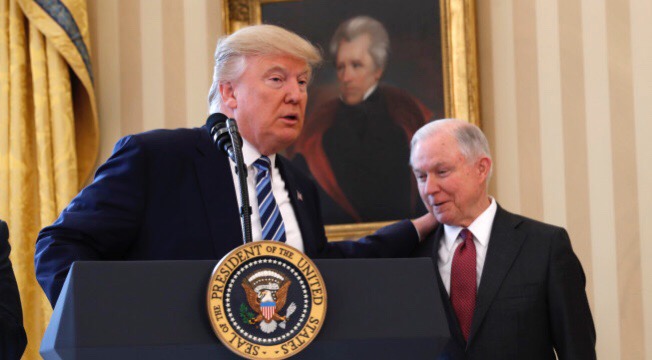
And Trump announced that he was directing the departments of Justice and Homeland Security to
break the back of the criminal cartels that have spread across our nation and are destroying the blood of our youth and other people.
This rhetoric doesn’t sound like usual presidential terminology, but it does sound familiar. What could it be? Maybe it reminds me of this:
Gift der Jüdischen Presse […] das ungehindert in den Blutlauf seines Volkes eindringen und wirken konnte
The poison of the Jewish press that penetrates without resistance and attacks the blood of the people
Or this
Er vergiftet das Blut des anderen, wahrt aber sein eigenes.
He [the Jew] poisons the blood of the others, but preserves his own.
From Mein Kampf.
 Common Infirmities