
How to do racist things with words

In contemplating the state of political discussion on the right wing of US politics, I found myself thinking about the celebrated work How To Do Things with Words, by the linguistic philosopher J. L. Austin.

I’ve been trying to understand the way Republicans talk about Donald Trump. For months mainstream Republicans have been predicting that Trump would “pivot” toward the general election and adopt a more “presidential” tone.  “Pivot”, a term that usually describes a turn away from the interests of ideological allies in ones own party toward emphasising more centrist positions, but in the special context of this presidential election means ceasing to make racist attacks and boasting about penis size.

Republicans don’t like Trump’s open racism. You might think they would then not support him. Or (and I’m not so naive as to miss their inescapable self-interest in continuing to support him) if they find his racism just embarrassing but not inherently a problem they might publicly condemn it, while privately encouraging him to tone it down, and hope that people will forget. Instead, though, they are publicly encouraging him to stop making racist comments. For example, Senate Majority Leader Mitch McConnell said “He needs to quit these gratuitous attacks on other Americans”, and said “Donald Trump has got a lot of good qualities, but he needs to put them forward and suppress some of these other actions.” Senator Bob Corker said Trump has “two or three weeks” to “pivot to a place where he becomes a true general election candidate.” Continue reading “How to do racist things with words”
Not half bad

Lauren Fox at TPM reports on Republican efforts to reassure voters that there’s no need to worry about President Trump’s authoritarian impulses, because he will be constrained by Congress and the courts. One of these comments includes an odd rhetorical slip. There is a family of expressions in English constructed in the form “If A is only half as X as they say, then Y.” The Y is some extreme outcome, the intended effect being to suggest that the reports are so uniformly extreme, that even if we discount half of it the result is still pretty strong — either positive or negative. If she’s only half as good as they say, she’ll beat everyone on our team. If the storm is only half as strong as the predictions suggest, this shack isn’t going to survive.

But Republican strategist John Feehery is quoted as saying

I am not of the opinion that the Republic would fail if the voters select somebody like Trump and if Trump turns out to be half as bad as some conservative pundits would have you believe, there are plenty of legal mechanisms to either contain his worse impulses (the Congress and the Supreme Court, for example) or remove him from office should his transgressions become too toxic.

It’s good to know that the Republic will survive if Trump turns out to be half as bad as some conservative pundits suggest. He’s not making any guarantees if Trump turns out to be three-quarters or even fully as bad as some conservative pundits suggest. And if he’s anything like what liberals expect, we’re doomed.

On a related matter, when I hear the Senate majority leader justifies his endorsement of a wannabe strongman by promising “No matter how unusual a personality may be who gets elected to office, there are constraints in this country”, I can’t help but be reminded of the famous comment of Franz von Papen, leader of the Centre Party in the Weimar Republic,

Wir haben ihn uns engagiert. … Was wollen sie denn? Ich habe das Vertrauen Hindenburgs. In zwei Monaten haben wir Hitler in die Ecke gedrückt, dass es quietscht…

We hired him to work for us. … What’s the problem? I’m the one who has [President] Hindenburg’s confidence. In these two months we have completely backed Hitler into a corner.

Revolution as entertainment

I was just reading this article about how the UK farming minister told the Guardian that British withdrawal from the EU, would be a godsend to the environment:

If we had more flexibility, we could focus our scientists’ energies on coming up with new, interesting ways to protect the environment…

“New and interesting” sounds good, but these hardly seem like essential criteria for environmental protection laws. “Safe” and “effective” seem more appropriate. I’m happy to leave it to Hollywood to entertain me, if EU environmental policy will just, you know, protect the environment.

An even more extreme example of the craving for politics to fill the boring spaces in an empty existence is this Bernie Sanders supporter who was quoted in a recent NY Times article:

Victor Vizcarra, 48, of Los Angeles, said he would much prefer Mr. Trump to Mrs. Clinton. Though he said he disagreed with some of Mr. Trump’s policies, he added that he had watched “The Apprentice” and expected that a Trump presidency would be more exciting than a “boring” Clinton administration.
“A dark side of me wants to see what happens if Trump is in,” said Mr. Vizcarra, who works in information technology. “There is going to be some kind of change, and even if it’s like a Nazi-type change, people are so drama-filled. They want to see stuff like that happen. It’s like reality TV. You don’t want to just see everybody be happy with each other. You want to see someone fighting somebody.”

You can’t say he’s not going into it with his eyes open.

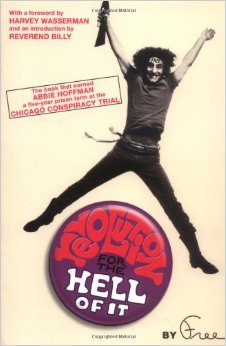
As usual, I blame Abbie Hoffman.Revolution for the Hell of It


Popularity contest

People talk about Hillary Clinton’s poll-reported unpopularity as though it represented some natural fact about her. A failure of character, or a judgement on her weakness as a politician or human being. But it hasn’t always been that way. Just to check my memory, I looked up Gallup’s record: In April 2013 64 percent of Americans surveyed had a favorable impression of her, as against 31 percent with an unfavorable impression. In May 2016 it was nearly reversed: 39 percent favorable, 54 percent unfavorable. Were there dastardly revelations about her character or public conduct in the interim?  Or did she just happen to be the frontrunner in an ideologically heated Democratic primary? (By pure coincidence, the last time her relative favorability was negative was October 2000. I can’t remember what was going on then…)

As for Donald Trump (“Businessman Donald Trump”, as Gallup terms him) there has been only one Gallup survey — in June 2005 — that gave him a positive margin (51 to 38, so it wasn’t even close). Otherwise, every Gallup survey since they first asked about him in 1999 has negative favorability, usually by a wide margin.

A quiet man

I was just reading this interview with former US Speaker of the House Newt Gingrich, about Donald Trump. You could see the cutting edge of Trump apologetics, on the way to determining that the Republican establishment has always been allied with Trump. The trick is to reinterpret Trump’s crude thinking as simply crude (or bold, down-to-earth) formulation of very clever, even sophisticated thinking. And then there’s this:

Isaac Chotiner: You were at a meeting on Monday with other Washington figures and Trump. What did you make of him?

Newt Gingrich: Well, Callista and I were both very impressed. In that kind of a setting he talks in a relatively low tone. He is very much somebody who has been good at business. And he listens well. He outlined the campaign as he saw it. I think he did a good job listening. He occasionally asked clarifying questions. He was very open to critical advice. I am not going to get into details, but I will say my overall impression was that in that setting he was totally under control…

Does none of Trump’s rhetoric about Mexicans or Muslims worry you or upset you?

I think he was too strong in talking about illegal immigrants in general, although if you look at the number of people who have been killed by people who aren’t supposed to be here, there is a fair argument on the other side too.

It makes him seem like a reasonable guy who occasionally gets carried away when speaking with the common folk.

Hitler comparisons are almost never useful, whether for insight or political rhetoric. Trump is not Hitler. Even among 1930s fascist dictators, Hitler is not the one Trump most resembles. Nonetheless, I couldn’t help but be reminded of something Albert Speer wrote, explaining why as a young academic he found himself drawn to Hitler:

What was decisive for me was a speech Hitler made to students, and which my students finally persuaded me to attend. From what I had read in the opposition press, I expected to find a screaming, gesticulating fanatic in uniform, instead of which we were confronted with a quiet man in a dark suit who addressed us in the measured tones of an academic. I’m determined one day to look up newspapers of that time to see just what it was he said that so impressed me. But I don’t think he attacked the Jews….

Change of venue

In the most recent Republican debate this exchange occurred:

TRUMP: If people — my plan is very simple. I will not — we’re going to have private — we are going to have health care, but I will not allow people to die on the sidewalks and the streets of our country if I’m president. You may let it and you may be fine with it…

CRUZ: So does the government pay for everyone’s health care?

TRUMP: … I’m not fine with it. We are going to take those people…

CRUZ: Yes or no. Just answer the question.

TRUMP: Excuse me. We are going to take those people and those people are going to be serviced by doctors and hospitals. We’re going to make great deals on it, but we’re not going to let them die in the streets.

Obviously, Trump recognized the trap of promising the great expense of keeping people from dying on the streets and sidewalks, so he quickly fell back to this compromise position: During the Trump presidency, poor people will be permitted to die on the sidewalks, but not in the streets. This leaves open the question of whether they will receive medical attention or merely cited by medical personnel to the sidewalk. It’s a win-win, since the dying would no longer impede the free flow of traffic.

It’s quite a bit like UK asylum policy: it would be unconscionable to send civilians back into a war zone, and we can’t just let them fend for themselves on the streets of London. So we need to make sure that as many as possible drown at sea, pour décourager les autres.

Of course, this may increase pressure to build barriers between the streets and sidewalks, at least in the vicinity of hospitals. Jobs!

The American Cavalieri

The British tend to view Donald Trump as an unprecedented only-in-America freak. Self-glorifying libertine billionaire turning his media ingenuity and unbounded reserves of cunning ignorance into a nativist political career. Racism and misogyny lightly disguised as heroic candour. The strongman allure, and the tendency of opponents to dismiss him as a buffoon. He’s the American Berlusconi. Which should serve as a warning to anyone who thinks he can’t possibly win.