
On foot and cycle in Berkeley and Oxford

Big-ChanningMLK3
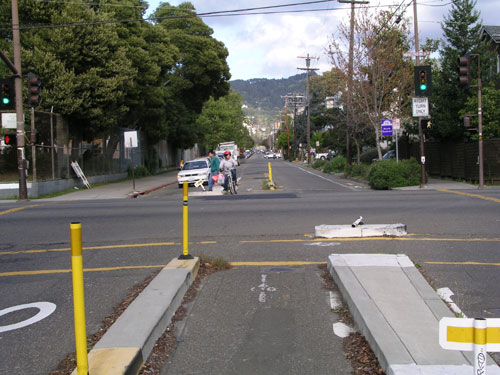
Berkeley bicycle boulevard.
628x471
Wide Berkeley sidewalk.

I’ve just returned from my sabbatical in Berkeley, and while I’ve written some harsh criticism of life in the US when it unfortunately intersects with the medical system, as long as you can stay healthy there are some conspicuous advantages to life in Berkeley. Particularly if you walk or ride a bicycle.

Some of it is no one’s fault: There’s obviously more space in Berkeley for wide sidewalks, and the crush of tourists on a few major boulevards, particularly in summer, is peculiar to Oxford. On the other hand, Oxford city council chooses to allow merchants to block half of the narrow pavement with advertising signs. Still, with the narrow, often one-way streets, Oxford is no paradise for drivers either.

And maybe that’s part of the reason why Oxford drivers are, there’s no way to prettify this, hateful toward non-drivers. (Presumably toward other drivers as well, but I haven’t had that experience.) Not all of them, of course, and not all the time, but enough to make cycling something I avoid when I have time to walk, and makes me feel on edge much of the time even when I’m walking. Berkeley drivers are sometimes thoughtless, of course, but the threatening incidents of recklessness still seem less frequent in Berkeley than the incidents of active aggression and rage in Oxford.

Cycle lanes are occasional and intermittent, and the average Oxford driver considers “cycle lane” to be just a fancy word for “free parking”. We don’t have as much of a problem with restaurants or constructions sites parking their dumpsters on the cycle lanes as they apparently have in Belfast, but here’s a cheeky comment on their difficulties.

I suspect that the better conditions in Berkeley are a good example of the civilising influence of the law. California law requires that drivers stop for pedestrians in any crosswalk, whether or not it is marked. And they do. Nearly always, except on high-speed highway-like urban roads, and even there if you make yourself conspicuous you’ll usually get someone to stop pretty quickly. This gets people into the habit of paying attention to slower travellers using the road, and frequently they’ll stop even when they are not required to, for instance, for pedestrians crossing in the middle of a block, or for cyclists on a cross-street.

In Oxford, as in all of England (I have been informed), cars are required to stop only at elaborately constructed official zebra-striped crosswalks with huge flashing lights overhead. Because of the elaborate construction these are rare, and even so are often ignored. And I can certainly count on the fingers of one hand the number of times in five years that any driver has stopped to let me cross the street as a pedestrian when it was not strictly required by law. It didn’t matter if it was snowing or pouring rain and I was out walking with a small child. In Berkeley I was more likely to be embarrassed by a car stopping for me to cross when I was merely loitering near to the crosswalk.

The Home Office strikes back

The UK government has been aggressively defending its decision to interrogate Glenn Greenwald’s partner David Miranda for his links to Edward Snowden’s purloined NSA files. The Guardian reports

A Home Office spokesperson said: “The government and the police have a duty to protect the public and our national security. If the police believe that an individual is in possession of highly sensitive stolen information that would help terrorism, then they should act and the law provides them with a framework to do that. Those who oppose this sort of action need to think about what they are condoning.”

Notably lacking from this utilitarian justification is a legal justification. As I remarked here, schedule 7 of the Terrorism Act 2000, which they seem to be using as their legal framework, interrogation is permitted only to determine whether the person is a terrorist, where a “terrorist” is specifically defined as a person who “is or has been concerned in the commission, preparation or instigation of acts of terrorism.”

Absent from this list is “possessing information that would help terrorism”. The rest is just a smear, and the insinuation of what the journalists are “condoning” is just disgusting, reminiscent of the “fellow traveller” smears of the 50s.

Observations on the Terrorism Act 2000 [Updated]

Despite the incredibly broad powers granted to the police by the infamous section 7 of the Terrorism Act 2000, British police seem to have managed to overstepped their authority in detaining David Miranda. They don’t need any reasonable suspicion of anything, but their actions may only be directed toward determining whether the person is a terrorist.

I’m no legal expert, but I looked at the official text of the law, and found that the paragraph of the infamous schedule 7 on “power to stop, question, and detain” begins by confining the power to a single purpose

An examining officer may question a person to whom this paragraph applies for the purpose of determining whether he appears to be a person falling within section 40(1)(b).

That paragraph, defining the people subject to detention under this act:

40 1) In this Part “terrorist” means a person who—

(b)is or has been concerned in the commission, preparation or instigation of acts of terrorism.

And yet, reports on the questioning of David Miranda say that they were not directed at linking him to any acts of terrorism, past or future:

The questions, [Miranda] said, were relentless – about Greenwald, Snowden, Poitras and a host of other apparently random subjects.

“They even asked me about the protests in Brazil, why people were unhappy and who I knew in the government,” said Miranda.

Note that the law seems (to the untrained eye) extremely specific about the permissible purpose of the detention and questioning. It is only for the purpose of determining if the person is a terrorist. Will the lawbreakers be brought to justice? Do we have to ask?

[Update 20 August, 4:30 pm] Joshua Foust has argued that, while the UK interrogation of David Miranda was regrettably extensive, they were probably legal under the Terrorism Act. I think he is confused here (though certainly I may be the one who is confused) about the distinction between the right of the police to detain someone. According to the Act,

An examining officer may exercise his powers under this paragraph whether or not he has grounds for suspecting that a person falls within section 40(1)(b).

So there is no question that they had the right to detain him, since they have the right to detain anyone at all. What is at issue is their goal, as expressed in their actions during the interrogation. So, while they don’t need any reason to think the person is a terrorist, in fact don’t even need to think that they are, and could interrogate people chosen at random, they can only do so, as stated in the section of the Act quoted above, “for the purpose of determining whether he appears to be” a terrorist. Foust suggests that threatening to expose GCHQ could count as terrorism, under the portion of the definition that includes activity that “is designed seriously to interfere with or seriously to disrupt an electronic system.” That sounds pretty far-fetched to me, but it is in keeping with the pattern that we have seen, where security officials demand sweeping powers, codified in vaguely formulated laws, and then proceed to push the boundaries of even those laws and reinterpret them (secretly) beyond all recognition.

It’s a bit like firing an employee in the US: You don’t have to have any reason, but you can’t have an illegal reason. It can be because you have indigestion, or because an angel told you to fire her, or because she’s too beautiful, but it can’t be because her skin colour clashes with your wallpaper or she’s pregnant or is in a wheelchair. And evidence for your illegal reasons are not just your explanation of the firing (or lack thereof) but other comments and actions surrounding it.

Exile, ctd.

I wrote before about US citizens being sent into exile. In looking for information about how the No Fly List works, I found this story reported by Glenn Greenwald:

In April of this year, Saadiq Long, a 43-year-old African-American Muslim who now lives in Qatar, purchased a ticket on KLM Airlines to travel to Oklahoma, the state where he grew up. Long, a 10-year veteran of the US Air Force, had learned that the congestive heart failure from which his mother suffers had worsened, and she was eager to see her son…

The day before he was to travel, a KLM representative called Long and informed him that the airlines could not allow him to board the flight. That, she explained, was because the US Department of Homeland Security (DHS) had placed Long on its “no-fly list”, which bars him from flying into his own country.

Long has now spent the last six months trying to find out why he was placed on this list and what he can do to get off of it. He has had no success, unable to obtain even the most basic information about what caused his own government to deprive him of this right to travel.

Given that there is really no other way to get from Qatar to the US than by flying, this is equivalent to exile. Without even a trial, or even any official notification. And no procedure for redress. (Supposedly there is a procedure, but it seems to consist only of his being assigned a “redress control number”. No other response was forthcoming from the government in 6 months, and the US embassy has offered no assistance.) Greenwald cites several other comparable cases, and says there are 21,000 names on the list, including 500 Americans. And things aren’t getting better:

The Obama administration “lowered the bar for being added to the list”. As a result, reported AP, “now a person doesn’t have to be considered only a threat to aviation to be placed on the no-fly list” but can be included if they “are considered a broader threat to domestic or international security”, a vague status determined in the sole and unchecked discretion of unseen DHS bureaucrats.