We’ve been here a few days. So far, everything has gone far more smoothly than I could have anticipated.
Weather: It’s always sunny in Britain
I’ve spent a total of about three weeks in England, and about six weeks in Scotland. While there was a bit of misty rain in the Hebrides, and occasional overcast, but nearly all of that time has been bright, warm, sunny weather. I have heard that it is sometimes otherwise, but I believe it is wisest to trust my own experience, and thus to expect that the weather will always be bright, warm, and sunny.
Travel
Two adults and one five-year-old took a seven-legged trip (see below) without losing any of our 13 pieces of luggage or our sanity. Actually, after days of preparation and much missed sleep, we slept much of the time on the plane and bus. This was not made easy by our Canadian budget airline, Zoom Airlines, whose commitment to cost-savings left me with a non-reclining seat (not that the recliners were actually recognisable to the naked eye), and whose devotion to cramming as many seats as possible into the cabin led to bathroom queues more reminiscent of stadium rock-concerts (and even flight attendants fighting with small children over priority for the facilities. We chose Zoom for its peculiar policy of selling one-way tickets. We had not thought very carefully about their meagre luggage allowance of 30 kg per person, which we exceeded by at least a third.
We thought we were headed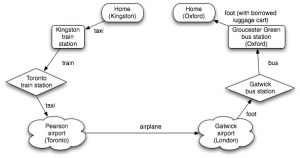 for a stiff fine when the grim-faced company apparatchik started weighing every bag carefully and toting up the results, and then turned to what I thought was a well-camouflaged small carry-on bag that was actually stuffed with personal papers and diaries that absolutely could not be checked in, and discovered that it nearly tripled the 5 kg carry-on limit. But in the end, whether she was worn down by my insistent questioning.(Is that a 5kg per item limit or 15 kg for the three of us? What exactly are the limits on a “personal item”?) and time-consuming repacking of bags, and the sheer variegated menagerie of luggage that we were presenting, or whether none of this was meant very seriously in the first place, she then just let it all through with no mention of fine or fee.
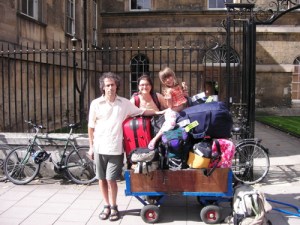
On arriving in Oxford (by bus), we were fortunate to obtain from the Worcester College porter the services of a very large luggage cart, to transport our 13 pieces of luggage from Gloucester Green to our home, about a 10 minute walk.
It will be interesting to see how the train system serves us on a more regular basis. Julia will be commuting to work in Coventry, about 45 minutes from Oxford, with train service once an hour. The prices are quite high: For less than the price of a year travelling second-class on this route, you could get a year of first-class travel on the entire German rail network. Another strange thing: It is cheaper to buy two tickets, Oxford-Banbury and Banbury-Coventry, than the single ticket Oxford-Coventry, despite the fact that it is a single train, operated by a single company. And everyone tells us that the rail service grinds to a halt as soon as there is a dusting of snow on the tracks, or even a surfeit of autumn leaves. We shall see.
School
in Kingston, I was somewhat uneasy to discover that there is very little by way of alternative schools in Oxford. Waldorf education is not very extensively established in the UK, as private schools in the UK (called “public schools”, as everyone knows, except that in practice many people do call them “private”, if not “independent” schools, perhaps for my benefit) seem to be very much about honing the children to a finer competitive edge. My general prejudice about the UK told me that the British had drunk deeply of the standardised testing Kool-Aid, that they were competitive and obsessed with “academic” achievement. The fact that “real school” starts at age 5 made the transition all the more frightening. I was made still more uneasy when I discovered that a significant portion of the state schools (technically called “maintained schools”), including our neighbourhood St. Barnabas Primary School, are operated at least in part by the Church of England.
I can’t say now how the education system matches up over all to my prejudice, but the St. Barnabas school seems now to be a real treasure. The headmistress and the teachers I’ve met seem competent and caring, and other local residents criticise the school for its lack of academic intensity and kindergarten-like atmosphere of the Level 1 class (Chaya’s), which from my point of view is a very positive sign. It is a highly multicultural school, as its catchment area pulls in a large number of Oxford University visitors. Actual variety among the students is a more reliable guarantee against proselytization or exclusion than any formal policy of supporting diversity. There is at least one other Jewish child in Chaya’s class, and a child fresh off the boat from Germany who doesn’t speak any English (a good opportunity for Chaya to play translator). That outweighs the crucifix in the gymnasium…
Banking
It seems bizarre that this should be a major topic, but with all the globalisation of capital and banking, access to bank accounts and credit remains a small but significant impediment to the free movement of people, which is the human side of “labour-market flexibility”. In two years in Canada we never managed to get a credit card. This isn’t just about credit, of course, but about being able to do any commerce by telephone or internet. (It baffles me that credit card companies are still the primary mode of online payment, taking a couple of percent off the vast quantities of money sluicing through the Internet.) We started with Scotia Bank, which lured us into opening an account with the promise of a “Welcome to Canada” credit card. The next day, when we returned to complete the credit card application, we were informed that “Welcome to Canada” is only for permanent residents. (Permanent residency in Canada takes several years, because of the overburdened bureaucracy.) The university tried (somewhat desultorily) to help, arranging a special application with CIBC for Queen’s University employees. Somehow, though, despite several (very positive) telephone conversations with representatives of the company, they seemed to keep losing my application, and indeed any record of my ever having applied. After that went on for several months I realised that they really were not interested in doing business with us. I don’t know if it was xenophobia, rigidity, or something else. It surprises me that banks, willing to extend credit cards right after a bankruptcy, would consider two university professors to be such a high risk that they would not offer credit cards under any conditions, simply because they are new immigrants. Of course, this is just one of many things that confuses me about modern credit. For instance, a person who has always lived within his means is considered a high credit risk, as compared with the person perpetually in debt, but managing to scrape up the payments. One wonders if the banks truly believe that credit is fundamentally different from the rest of a person finances? Are they unaware of the simple schemes — sometimes promoted by the banks themselves — by which people effectively lend money to themselves, then pay it back, and it shows up as positive credit on their reports. Not to mention the fact that anyone who knows a merchant with access to the credit-report databases can add positive information about herself.
Here in the UK we had a different problem. I went first to Barclay’s, where I was told first that they could not open a bank account for me without proof of address which, they insisted, by the 1993 money-laundering law, could only be a UK driving license, voter registration or a utility bill. This was a problem, since I don’t drive, I can’t vote, and we won’t be getting our first utility bill for three months. Furthermore, because I had only recently moved, they also would need a utility bill from my old address. (My Ontario health card, a government issued identity card with photo and address printed on it, was insufficient. It is not, after all, a utility bill.) They did slip me a sheet of paper with super-special information for Oxford University employees. They can have their department contact the university treasurer who will contact the bank who will set up an appointment at a more secluded branch of the bank, and the person at that branch is authorised to accept the treasurer’s letter as proof of address. I took the information, but went on to the next bank down the street, NatWest. My assumption that Barclay’s was simply being peculiar turned out to be unfounded. NatWest had no special arrangement with the university, and the only thing they could suggest was that perhaps my bank in Canada could send a statement with my new address. What would that prove? I asked. They only have this address because I gave it to them. It’s not as though the bank has any independent evidence of my true address. Yes, said the banker, but the bank is then vouching for your identity. (But the problem wasn’t about confirming my identity. It was my address.) And the utility bills that I could fake in five minutes on the computer? Well, she said, we could call the utility company to confirm the information.
But do they? Has British Gas set itself up with a full-time staff devoted to confirming background checks on every household in the UK? And if they have, why don’t they do these checks directly, rather than indirectly by way of these utility bills and bank statements? I suspect that the information is rarely, if ever, checked, but that they content themselves with the possibility that it could be checked. Why would the bank rather have an easily falsifiable utility bill as proof of address, rather than a letter signed by a senior official at Worcester College, who is actually providing me with the accommodations, and who could be personally contacted for verification? This is typical of the kinds of compromises that go into avoiding an honest political debate — in this case, about address registration and national identity cards. These systems work well in Germany and the Netherlands, but Anglo-Americans view them as inimical to personal liberty. But then, along comes money-laundering and terrorism, and something needs to be done, so they latch onto something informally in place which has the appearance of being voluntary: Driver’s licenses in the US and Canada, utility bills in the UK. The Departments of Motor Vehicles in the US are hijacked to serve as de facto registration authorities, without any clear plan: My non-driver identification in California was issued without a check on any of the information included on it, except my name and birthdate. Then people are shocked when terrorists are able to obtain illegitimate licenses from West Virginia. So they introduce the Real ID Act, leaving identification still in the hands of state DMVs, but imposing national standards. The voluntary nature of these identity cards is a sham, as I discovered fifteen years ago, when I spent several weeks hiking along back roads in New England. I was repeatedly stopped by police who wanted to see a driver’s license, and threatened to arrest me if I did not identify myself properly.)
Then, I discovered Lloyd’s TBS. It was a tip from another American I met. They did not ask for any proof of address. They said they don’t need to, because mine is a “private address”. Very odd. You would think that if they are trying to prevent terrorism by checking people’s addresses, you would not want to allow the customer (aka potential terrorist) to tell you that this is unnecessary. And it is very strange that one bank has such a different take on the legal requirements to the others. Still, I am happy to accept this back door. And once you have your foot in, there are no problems, since I now have plenty of bank statements with my address on them.
University
I am a lecturer for the department of statistics of the University of Oxford, and a tutor in statistics for Worcester College. How these things fit together I don’t yet really know. The university pays most of my salary, but most of my defined duties are for the college. Lectures are given under the auspices of the university, and are not compulsory, though I am told that nearly all students do attend lectures (differing in this from North American universities I have taught at, where lectures in principle were compulsory, and students did not attend). Most teaching takes place in tutorials, typically in groups of one or two, though I have been told that some colleges are cutting costs by increasing the size of tutorial groups.
I have rather sumptuous offices in both the department and the college. The college provides free (and quite elegant) lunches, as well as dinners if I didn’t have to be home in the evening, and if I had a dinner suit (tuxedo) and academic gown to wear. This may seem like an extravagant expense, though it actually makes good economic sense. Universities, particularly in the US, increasingly are being forced to compete for top research talent with ever more lavish salaries. An alternative is to attract academics with special perquisites that the university is specially suited to provide. In addition to tenure, which clearly provides a substitute for a considerable amount of salary, the lunchtime company of other academics is one of the cheap resources that universities have in profusion. The college gardens are another benefit peculiarly suited to intellectuals. That still leaves open the unanswerable question posed by my 11-year-old neighbour: “So they’re giving you a house and meals. Why are they paying you?”
Housing
One of the most important college perquisites is the housing allowance, which can take several forms, but which currently takes the form of a house, which the college is simply making available to us, to live in for five years. It is in the Jericho neighbourhood of Oxford, a currently very trendy area, sort of a peninsula bordered by a slight bend in the Oxford Canal, and Worcester College. Our house is in Nelson Street, with a backyard up against the Worcester College wall, with the college cricket field on the other side. It’s a lovely little terrace house, painted yellow, with two bedrooms on the upper floor, many skylights, and a small attic which will be attractive as a study, as long as the insulation material turns out not to be a health hazard (something we’re trying to find out).
Our house was blown up last week:

Prices
“Things are so expensive in England.” That’s what everyone says. A colleague in Kingston expressed sympathy for us moving to Oxford, telling us of friends of his who had made a similar move, and were forced to trade their half acre in Kingston for a two-bedroom apartment in Oxford, and their two splendid automobiles for two bicycles. In fact, while housing prices are quite high here, they are no higher than in Berkeley, where I used to live. In both places, high prices are largely a symptom of an attractive place to live. In the UK, this is exacerbated by longstanding greenbelt regulations that inhibit urban sprawl and protect open spaces, but also inhibit new housing construction. There can be little doubt that higher housing costs as a fee for preserving open space is at least money being spent on something worthwhile (even while one may haggle over the exact price, leading to compromises and corrections to the greenbelt program).
Certainly, the kinds of things that tourists are likely to encounter — hotel rooms, cafes, restaurant meals, train tickets, gasoline — are quite expensive here, compared with the US or Canada: The prices tend to be similar in pounds to their North American counterparts in dollars, making them effectively twice as high. Computer equipment seems to be 10-30% more expensive than in Canada, where they already seemed a bit pricier than in the US. On the other hand, cell phones and broadband internet service are a good deal cheaper than in Canada. In any case, these things make up a relatively small part of the average family’s budget when you’re living in a place. Supermarket food prices seem roughly comparable and, what’s more (and quite surprising to me), the quality is much higher. In particular, the fruits and vegetables are of a quality that we occasionally found in California, but never in Kingston. Delicious cheeses that you never see (and are probably illegal) in North America are readily available and not very expensive.
Synagogue
I was ritual committee chair for Congregation Iyr Hamelech, the reform congregation in Kingston, Ontario. There was a lot to quibble over, and the congregation suffered for not having a building, but there was a vibrant core of spiritually active reform Judaism, rather than the standard variety of conservative with ham. I’m interested to find out more about the Oxford Jewish Community (OJC), which purports to represent all Jews in Oxford. It remains to be seen how accurate this is. Certainly, as in every setting where there is supposed mutual respect between denominations, the Orthodox determine ritual matters, because they are the most sure of themselves. Thus, the soi-disant Orthodox are allowed to exclude women from Torah reading in their services (which are most of the services at the synagogue — Liberal services are only once a month), but woe if the Liberal Shabbat services include instrumental music.
On the other hand, our first impression is that the Hebrew school is very open, friendly, and competent, and Chaya very much enjoyed her first day there. I imagine we will find a modus vivendi. It is to their credit that they chose to site the synagogue just one block from our house.

 The 13th century University Church of St. Mary is an important Oxford landmark. It was the first building of the university, and stands as an imposing symbol of traditional Anglicanism on the High Street. And now, apparently, it is funded by the proceeds of gambling.

 Common Infirmities