
The death of irony: Snowden edition

I have commented before on the self-contradictions in the attempts by the US to portray Edward Snowden as a common criminal, while themselves taking an “everybody does it” approach to flouting other countries’ laws, and, indeed, its own Constitution.

Now comes a report in Der Spiegel, on a legal opinion presented by the US to a German parliamentary investigatory committee that is considering inviting testimony from Snowden:

Es sei bereits eine “strafbare Handlung”, so der US-Jurist, wenn der “Haupttäter” (gemeint ist Snowden, Anm. Redaktion) etwa durch deutsche Parlamentarier veranlasst werde, geheime Informationen preiszugeben. Gegebenenfalls könne das als “Diebstahl staatlichen Eigentums” gewertet werden. Je nach Faktenlagen könnten Strafverfolger gar von einer “Verschwörung” (conspiracy) ausgehen.

It would be in itself a “criminal offence”, according to the US lawyer, if the “offender” (meaning Snowden) were induced by, for example, German members of Parliament, to reveal secret information. This could be considered “theft of state property”. Depending on the exact circumstances, it could even be prosecuted as a “conspiracy”.

Are US intelligence services really advocating the principle that acquiring secret information from other governments is a criminal offence, one for which individual legislators or indeed an entire parliamentary committee (and why not the whole German Bundestag, and the government to boot?) could be prosecuted? I think it shows the extent to which the US government is, in the Age of Obama, sees international law as a set of rhetorical tricks for expressing the hopelessness of any resistance to US government interests, rather than any set of rules and principles to which all might be subject.

But maybe they really mean to establish the principle that asking for information is illegal. The only valid way to obtain information is theft or torture.

Of hockey sticks and statistics

[Updated at bottom] I recently read two books on climate science — or rather, two books on the controversies around climate science. One book was Michael Mann’s book The Hockey Stick and the Climate Wars; the other The Hockey Stick Illusion by Andrew Montford.

Now, I am, by inclination and tribal allegiance, of the party of Michael Mann, one of the world’s leading climate scientists. He and his colleagues have been subject to beastly treatment by political opponents, some of which is detailed in his book. And I only picked up the Montford book out of a sense of obligation to see what the opposing side was saying. And yet…

Montford’s book makes a pretty persuasive case. Not that climate science is bunk, or a conspiracy, or that anthropogenic global warming is a fiction — there is far too much converging evidence from different fields to plausibly make that claim (and indeed, Montford never makes such a claim) — but that a combination of egotism and back-scratching has seriously slowed down the process of evaluation and correction of sometimes sloppy statistical procedures, and tarnished the reputation of the scientific community generally.

I admit to a certain bias here: The attacks on Mann’s work that Montford describes are statistical in nature, and Mann’s response reminds me of the tone that is all too common when statisticians raise questions about published scientific work. Montford has a remarkable amount of technical detail — so much that I found myself wondering who his intended audience is — and the critiques he describes (mainly due to the Canadian mining engineer Steve McIntyre) seem eminently sensible. In the end, I don’t think they panned out, put they were genuine shortcomings in the early work, and McIntyre seems to have done the right things in demonstrating the failure of a statistical method, at least in principle, and to have earned for his trouble only incomprehension and abuse from Mann and his colleagues.

Continue reading “Of hockey sticks and statistics”

Somebody to blame

Jonathan Cohn — one of the best-informed voices on healthcare in American journalism — has a new article in The New Republic about the reductions in provider networks that insurers are imposing, due to constraints in the Affordable Care Act. Except, as he points out,

Even before Obamacare, employers and insurers were already moving in the direction of limiting networks and penalizing costly hospitals like Cedars. Kominski notes that his employer, the University of California system, aggressively restricted its provider network two years ago. The change affected thousands of employees—and was one of many such decisions employers made around the country. But it didn’t generate a national controversy. The city of Los Angeles just took Cedars off the network for one large plan in order to keep premiums for city employees low. And while it’s possible Obamacare accelerated a trend toward limited networks for direct consumers, it’s also possible that insurers would have made that switch anyway—and that they’re introducing these changes now, in one big wave, because Obamacare gives them a convenient excuse.

This is a genuine bias, particularly in American democracy, toward leaving problems unaddressed, because as soon as you start trying to deal with the problem, voters will hold you responsible for any remaining defects.

I remarked on this shortly after I came to the UK, that it seemed to me that the British underrate the NHS, because any health problem that occurs anywhere in the country, whether it’s unhygienic conditions in a hospital, or GP surgeries not being open at sufficiently convenient hours, is blamed on “the NHS”. That is a strength, but it’s also a temptation for politicians to offload the responsibility onto “the market”. The political culture hasn’t  gone that far in this country, but that’s why there’s a major US political party whose political philosophy is, conveniently, essentially “There’s nothing we can do”.

(Physicist David Deutsch has written a book-length quantum-utopian manifesto whose main lesson seems to be that the fundamental criterion for the progress potential of a political system is the extent to which it makes it clear, when things go wrong, who is to blame.)

This is a well-known problem in torts law — a public danger that has never been touched is nobody’s responsibility. If you try to make it safer, but cannot eliminate the danger entirely, suddenly it has become your responsibility if someone is injured. I first encountered this many years ago, when The Economist published a somewhat surprising plea for a planetwide defence against rogue asteroids. Like (I think) most people, on the rare occasions when I do think about asteroid strikes, I generally do not consider the legal implications. The article pointed out, though, that while an unmolested asteroid that obliterates London is an Act of God, as soon as some government tries to divert it, it becomes a legal liability.

This is an issue that I’ve never seen raised in the famous trolley problems that moral philosophers love to natter about. If you’re the trolley driver then you have a real moral dilemma. If you’re a bystander who happens to see a switch that could be thrown, you’d best call your lawyer first. She’ll tell you, under no circumstances should you touch anything. If 5 people die, that’s not your fault. If you save the 5 but kill one — if you even hurt the one’s finger — his family will sue you.

On-street parking

Matthew Yglesias has given a pithy summary of the case against free on-street parking:

Obviously people who currently get to occupy valuable urban space with their private vehicles would like to keep that privilege. But by the same token, I’d love it for the city government to just give me a free car or stop charging me property tax. That doesn’t mean it would be a good idea. There may be an argument that 30 to 40 parking spaces for cars is a better use for a given piece of land than protected bicycle lanes, but “Waaaah, don’t affect my parking” is not a very persuasive argument. The streets are public spaces and they need to be used for public benefit, not just the benefit of whoever happens to own a car on the block.

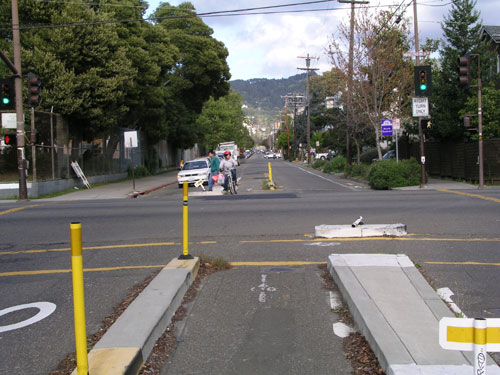
This is even more of an issue here in Oxford, where people with private cars get to take up not only the streets, but also substantial portions of the already quite narrow sidewalks. (Yglesias was discussing the debate over installing a new bicycle lane in Washington DC. I’m not sure if it would be quite so contentious here, since — as I discussed here — drivers don’t hesitate to park in bicycle lanes, and so far as I can tell the enforcement is zero. See, for example, the photograph below, of a typical local cycle lane.) [Update 5 Oct, 2013: Not quite zero. I actually saw a car in the cycle lane with a fixed-penalty notice on the windscreen. So there.]

People clearly have ideas about things that by right and nature ought to be free. Perhaps because I don’t drive a car myself, I cannot imagine why parking spaces should be one of them, particularly not residents’ parking. To be sure, residents’ parking is not free here. It’s £50 a car — just enough to create a sense of entitlement among those who have paid for it, not enough to come anywhere close to covering the real costs of providing

It’s not at all clear why people have any more right to 6 square metres of public road to semi-permanently store their automobiles than I have to store my surplus books. I would not be permitted to set out a storage shed by the side of the road. (I suppose I could use an automobile as a storage facility — some people clearly do, at least in Berkeley — but I would at least need a driver’s license and a car that was sufficiently functional to be registered.)

Bicycle lane on Iffley Road

Wrangling the 8-ton UNIVAC

I was reading Ariel Levy’s New Yorker profile of Edith Windsor, the plaintiff in the recent Supreme Court case challenging the constitutionality of the Defense of Marriage Act (and, by extension, of bans on same-sex marriage). I was struck by this passage:

She applied for a job as a research assistant, programming an eight-ton UNIVAC computer for the U.S. Atomic Energy Commission.

Why “eight-ton”? She wasn’t carrying the UNIVAC around with her. If she’d been a maintenance engineer at the Empire State Building I doubt Levy would would have bothered to mention the weight of the building. If the story had happened today I doubt she would have said “she applied for a job programming Google’s 8-ton server cluster.” The complexity of programming the UNIVAC — if that is what is supposed to be brought out — would be brought out by mentioning the number of switches and vacuum tubes, for example, something that is only indirectly related to its weighing 8 tons.

Maybe it’s just a bit of meaningless historical colour, but I couldn’t help thinking that this fit in with the general tone of the article, which portrays Windsor as the classic type of the crusty old lesbian. (She is quoted complaining about the women she danced with at gay bars in the 1950s: “Lesbians can’t lead.”) The image of her doing data entry at a modern computer workstation would have seemed too dainty. There might be a huge server farm and the whole Internet at the other end of your Ethernet cable, but that doesn’t change the fact that sitting at a keyboard and typing still seems prissily similar to the stereotypical 1950s secretarial pool. Wrangling an 8-ton electronic behemoth, on the other hand, that’s work for a kick-ass lesbian.

This provokes me to wonder about whether there are two fundamentally different modes of stereotypes excluding girls by from male-dominated fields: Type 1, perhaps best typified by philosophy, but earlier by medicine (before women took over), and perhaps by computing, girls and young women are warned off — and women in the field may be undermined — by a supposition that women couldn’t be very good at this. But if they do it, it doesn’t call their identity as women into question. In other professions — the military and professional sports most prominently, but perhaps also engineering, construction, plumbing, finance, etc. — there might be even more dissuasion by the dual message, not only are you probably not going to be very good at it because of your lack of masculine endowments, but if you are good at it, it will prove that you’re not really a woman.

Just speculating here, because I’m too lazy to read the research by people who think for real about these things.

Ambiguous Yids: The problem with speech bans

David Cameron has gotten himself onto the front page of the commuter newspaper Metro by commenting on the bizarre controversy over the use of the word “Yids” in English football.

Tottenham fans often chant the word, referring to themselves as “Yiddos” or “the Yid Army”. Some say it is a defensive gesture, to deflect abuse from opposition fans.
But the FA, backed by Jewish leaders, say it has no place in football and want it stopped.

The prime minister’s solomonic opinion is that the use of the word should be prosecuted only when it is used as an insult, not when people are applying it to themselves. The article quotes one Jewish supporter of a different team who says the word should be banned: “Yid is a race-hate word. It was daubed across the East End by Oswald Mosley’s Blackshirts.” And a Jewish Tottenham supporter who says “This is part of our identity. As a Jewish person, I always find it empowering. We have turned this word into a positive.”

(I recall that when I lived in the Netherlands in the 1990s there was a similar controversy around the AFC Ajax football team in Amsterdam, that had the nickname de Joden, and whose rivals would taunt the fans with antisemitic chants like “Hamas, Hamas, de joden aan het gas” (“Hamas, Hamas, Jews to the gas”). According to this Wikipedia article, supporters of Ajax would sometimes wave Star of David flags, and at one point Hava Nagila could be downloaded as a ringtone from the club’s official website.)

Maybe Cameron should have gone the extra step, to realise that trying to come up with a sensible set of criteria for banning speech based on its content is a fool’s errand. There’s no way to deal with all the shades of meaning, when one person hurls an insult, the victim appropriates the insult as a badge of honour (as has happened with gay, queer, Black, Quaker, and impressionist), and someone else comments on the verbiage ironically.

Information, which terrorists could use

If there are any terrorists reading this blog, I have to make a formal demand that you not read this post. Really. Terrorists must stop reading here. (You know who you are.)

According to an article in The Guardian

Following a ruling by Lord Justice Laws and Mr Justice Kenneth Parker, the police will now investigate whether possession of the seized material constitutes a crime under the Terrorism Act 2000, which prohibits possessing information that might be useful to terrorists and specifically “eliciting, publishing or communicating” information about members of the armed forces, intelligence agencies and police which terrorists could use.

That’s quite a broad mandate, and I think many people should be worried.

For instance, I happen to be in possession of information suggesting that the UK intelligence agencies and police and armed forces are led by incompetent politicians who have lost control of their own parties and are losing the support of the public, and who could themselves wind up in prison if the laws were fairly applied. It is easy to see how this information could be of use to terrorists if they knew. And now I have gone and published the information on this blog. (They may already know, but that is no defence under the law, so far as I can tell.)

If it comes to trial, I plan to argue that I couldn’t possibly have anticipated that terrorists would violate the terms of service of this blog by reading past the first line.

On foot and cycle in Berkeley and Oxford

Big-ChanningMLK3
Berkeley bicycle boulevard.
628x471
Wide Berkeley sidewalk.

I’ve just returned from my sabbatical in Berkeley, and while I’ve written some harsh criticism of life in the US when it unfortunately intersects with the medical system, as long as you can stay healthy there are some conspicuous advantages to life in Berkeley. Particularly if you walk or ride a bicycle.

Some of it is no one’s fault: There’s obviously more space in Berkeley for wide sidewalks, and the crush of tourists on a few major boulevards, particularly in summer, is peculiar to Oxford. On the other hand, Oxford city council chooses to allow merchants to block half of the narrow pavement with advertising signs. Still, with the narrow, often one-way streets, Oxford is no paradise for drivers either.

And maybe that’s part of the reason why Oxford drivers are, there’s no way to prettify this, hateful toward non-drivers. (Presumably toward other drivers as well, but I haven’t had that experience.) Not all of them, of course, and not all the time, but enough to make cycling something I avoid when I have time to walk, and makes me feel on edge much of the time even when I’m walking. Berkeley drivers are sometimes thoughtless, of course, but the threatening incidents of recklessness still seem less frequent in Berkeley than the incidents of active aggression and rage in Oxford.

Cycle lanes are occasional and intermittent, and the average Oxford driver considers “cycle lane” to be just a fancy word for “free parking”. We don’t have as much of a problem with restaurants or constructions sites parking their dumpsters on the cycle lanes as they apparently have in Belfast, but here’s a cheeky comment on their difficulties.

I suspect that the better conditions in Berkeley are a good example of the civilising influence of the law. California law requires that drivers stop for pedestrians in any crosswalk, whether or not it is marked. And they do. Nearly always, except on high-speed highway-like urban roads, and even there if you make yourself conspicuous you’ll usually get someone to stop pretty quickly. This gets people into the habit of paying attention to slower travellers using the road, and frequently they’ll stop even when they are not required to, for instance, for pedestrians crossing in the middle of a block, or for cyclists on a cross-street.

In Oxford, as in all of England (I have been informed), cars are required to stop only at elaborately constructed official zebra-striped crosswalks with huge flashing lights overhead. Because of the elaborate construction these are rare, and even so are often ignored. And I can certainly count on the fingers of one hand the number of times in five years that any driver has stopped to let me cross the street as a pedestrian when it was not strictly required by law. It didn’t matter if it was snowing or pouring rain and I was out walking with a small child. In Berkeley I was more likely to be embarrassed by a car stopping for me to cross when I was merely loitering near to the crosswalk.

The Home Office strikes back

The UK government has been aggressively defending its decision to interrogate Glenn Greenwald’s partner David Miranda for his links to Edward Snowden’s purloined NSA files. The Guardian reports

A Home Office spokesperson said: “The government and the police have a duty to protect the public and our national security. If the police believe that an individual is in possession of highly sensitive stolen information that would help terrorism, then they should act and the law provides them with a framework to do that. Those who oppose this sort of action need to think about what they are condoning.”

Notably lacking from this utilitarian justification is a legal justification. As I remarked here, schedule 7 of the Terrorism Act 2000, which they seem to be using as their legal framework, interrogation is permitted only to determine whether the person is a terrorist, where a “terrorist” is specifically defined as a person who “is or has been concerned in the commission, preparation or instigation of acts of terrorism.”

Absent from this list is “possessing information that would help terrorism”. The rest is just a smear, and the insinuation of what the journalists are “condoning” is just disgusting, reminiscent of the “fellow traveller” smears of the 50s.

What happens if you forget the key?

Courts in the US and the UK have recently been ruling that criminal suspects may be forced to reveal cryptographic keys that encode files that may include incriminating evidence. US courts have been divided on whether this infringes upon the otherwise absolute right to avoid self-incrimination. I’ve never taken that argument very seriously — it’s certainly not in the spirit of the right to refuse to assist in prosecuting oneself to allow people to hide documentary evidence of a crime, just because the revelation would be “speech”.  But while people may be compelled to testify in court, and in some democracies may be required to assist police by correctly identifying themselves, it’s not usual for people to be compelled by law to reveal particular information, particularly when they may not know it. While perjury charges may be brought against those who testify falsely, the inevitable unreliability of memory makes perjury convictions difficult, and I thought impossible when the subject simply pleads ignorance rather than testifying to a falsehood.

In fact, the strongest argument for a right not to reveal a password is that it’s not the hidden data that are protected by the right against self-incrimination, but rather the admission that you know the password, hence are at least in some way in control of and responsible for them, that cannot be compelled. According to the Regulation of Investigatory Powers Act 2000 (that was apparently a banner year for civil liberties in the UK), “failing to disclose an encryption key” is an offence in itself. In 2009 a man was jailed for 13 months for refusing on principle to provide encryption keys to the authorities, despite the fact that he was not suspected of any crime other than not cooperating with the police.

I have encrypted volumes on my laptop hard drive — with old exam papers — whose passwords I’ve forgotten. I probably should delete them, but I haven’t gotten around to it, and maybe I’ll remember one of these days. Even if I did delete them, they’d still be there on my hard drive unless I took exceptional measures. So if customs officials ever took an interest in my laptop while I was entering the UK, I could end up in prison for up to two years. The only thing I could do to protect myself is either to destroy the hard drive, or have it erased, which is itself suspicious.

Unlike most other criminal offences, the offence of withholding a cryptographic key is impossible to prove, but also impossible to disprove. It is even impossible for anyone but the accused even to know whether or not there has been any offence. And if there has been no criminal offence — if the accused does not, in fact, know the key — there is no way to prove that. It is the democratic state’s version of the plight of the man being tortured for information that he does not have, so that he has nothing to offer to end the suffering.

Along these lines, I was wondering about the current state of the right to silence in British law, and there came a revelation in the form of the British authorities (oddly, the news reports are all vague about which authorities it was; presumably the UK Border Agency, but maybe agents from a secret GCHQ data-mining task force) detaining the partner of journalist Glenn Greenwald under schedule 7 of the Terrorism Act 2000. According to the Guardian,

Those stopped under schedule 7 have no automatic right to legal advice and it is a criminal offence to refuse to co-operate with questioning,

This is pretty frightening, particularly when these laws are being so blatantly abused to settle political grudges.