Building confidence in public health

The NHS informs concerned parents about vaccines:

The 4-in-1 pre-school booster is very safe. Before it was granted a licence, the safety, quality and effectiveness of the pre-school vaccine, like all vaccines, was thoroughly tested. It does not contain thiosermal (mercury).

A lot of parents are (probably unnecessarily) worried about thiomersal in vaccines. The reassurance from NHS would probably be more persuasive if they knew how to spell it. (Thiomersal is, confusingly, called “thimerosal” in the US, but not “thiosermal”.)

Kids’ Kindness Krusade

So, there’s this president in America, and his job description definitely does not include “Defender of the Faith” or anything like that, and he’s getting bashed for having suggested that the Crusades — hundreds of years of Europeans hoisting aloft the banner of Christ and marching off to slaughter infidels and expropriate their lands, in case you’ve forgotten — might have raised some misapprehensions that Christianity is not 100% a religion of peace. He also made the (clearly revisionist) assertion, with no footnotes to back it up, that churches in the American South weren’t doing everything they possibly could to end slavery and later discrimination against Black Americans. Political and historical opponents aren’t taking these slurs lying down!
Maybe it’s because my ancestors were the first victims of lazy crusaders who thought they might as well start by killing the infidels closer to home (Rhineland Jews), but I’ve always found the Anglo-American use of “crusade” to mean an ardent struggle for a good cause — possibly hopeless, but usually a good thing (for example, the “crusade against rape culture” or against the REF), or even against equine colic). (I don’t know how it is used elsewhere. I can’t think that I’ve observed the corresponding German word used in a generic sense.
This dissonance particularly stood out for me when I saw, in an elementary school in Cambridge MA where I was doing some volunteer teaching, a poster announcing the “Kids’ Kindness Crusade”. Even without knowing the story of the Children’s Crusade (which may or may not have been a real historical event) it seems bizarre to me that people would think a “kids’ crusade” sounds like a positive thing. It seems as weird to me as promoting a “Parents’ Patience Pogrom”, or “Genocide against Germs”. Or, for that matter, “war on illiteracy and unnumeracy“.

A small majority

From SPIEGEL’s article about the Oxford PPE degree, where the rich and powerful met when they were only rich and young:

Tatsächlich kommt die Mehrzahl aller Oxford-Studenten von Privatschulen, die sich nur sehr wohlhabende Eltern leisten können: Obwohl nur sieben Prozent aller britischen Schüler auf Privatschulen gehen, machten sie 2013 in Oxford satte 44 Prozent der Studienanfänger aus.

Indeed, the majority of Oxford students come from private schools, that only very wealthy parents can afford: Although only seven percent of British children attend private schools, they were 44 percent of the matriculants at Oxford in 2013.

Even a government minister who studied PPE could tell that 44 percent isn’t a majority…

The article continues, quoting Danny Dorling, on Oxford Geographie-Professor in Oxford as saying

Vier Privatschulen und eine hochselektive staatliche Schule schicken mehr Studenten nach Oxford als die restlichen 2000 staatlichen zusammen genommen…

Four private schools and one highly selective state school send more students to Oxford as the remaining 2000 state schools put together…

I have to assume that this has been misquoted or mistranslated. There are not 2000 (or 2001) state secondary schools, but more than 3000. There are about 6600 undergraduates from state schools and 5200 from private schools. That would mean that at least 1400 undergraduates — about 400 a year — come from this one state school, and presumably a lot more.

My guess is, what he really said (or meant to say) is that these five schools send more students to Oxford than the bottom 2000 schools. Which doesn’t sound so strange, actually. The average number of Oxford places per school is less than one/year. In any given year most schools would send no one to Oxford. Even if schools were all equally good, if there are highly selective schools, they would be expected to send a large number of students to Oxford.

Up is down

I mentioned in an earlier post George Lakoff’s work on metaphorical language. One fascinating issue is the way same metaphorical target can be mapped onto by multiple conceptual domains, and sometimes these can come into conflict — or a metaphor can come into conflict with the literal meaning of the target. When the figurative-literal target conflict is particularly succinct, this tends to be called “oxymoron”. One of my favourites is the 1970s novel and subsequent film about a burning skyscraper, called The Towering Inferno.

This particular one depends on the conflict between the “UP is GOOD, DOWN is BAD” metaphor (an indirect  form of it, since it goes by way of DOWN is BAD is HELL is BURNING), conflicting with the literally towering skyscraper. Anyway, the UP-DOWN dichotomy gets used a lot, creating lots of potential confusion. For example, UP is DIFFICULT and DOWN is EASY, inspiring the famous allegory of Hesiod that inspired so many devotional images:

Vice is easy to have; you can take it by handfuls without effort. The road that way is smooth and starts here beside you, but between us and virtue, the immortals have put what will make us sweat. The road to virtue is long and steep uphill hard climbing at first.

Hence the uncertainty of the phrase “Everything’s going downhill.” Is it getting worse, or getting easier?

There is a triple ambiguity when numbers get involved. LARGE NUMBERS are UP (“higher numbers”, “low number”) when we are counting the floors of a building, but SMALL NUMBERS are UP when ranking (#1 is the winner and comes at the top of the list).

This brings us to the example that inspired this post. The BBC news web site this morning told us that “A&E waiting times in England have fallen to their worst level for a decade.” It’s hard to feel much sense of urgency about the fact that waiting times have “fallen”.
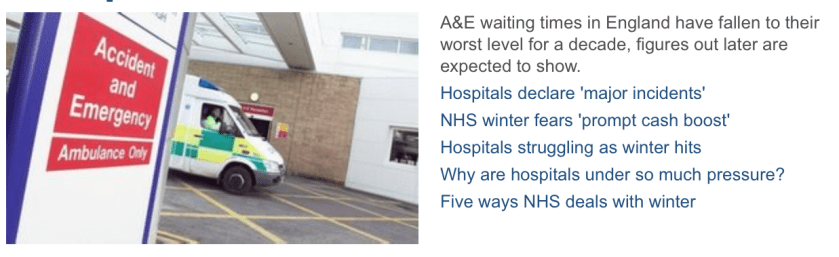
BBC website A&E morning


Presumably that’s why the text had changed in the afternoon:
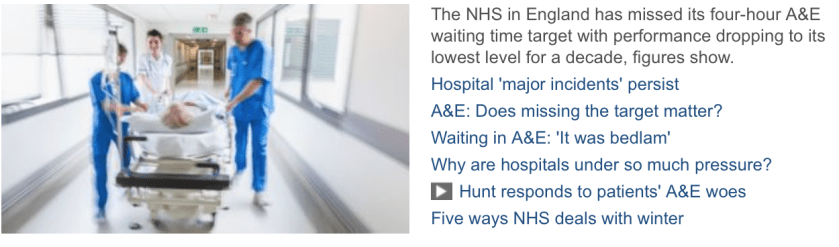
bbc website afternoon

Towers of Power

In the week after the September 11 attacks, my Berkeley colleague George Lakoff got rounded up in a dragnet of conservative outrage for a heartfelt reckoning with the meaning of towers and the violent destruction thereof. Whether or not you agree with his points — which were mostly anodyne applications of his general theory that all abstract thought is at base metaphorical, but which seemed to offend people mainly for the brief mention of one very traditional metaphor, the tower as phallus — it was almost a prototype for what people think a public intellectual should be doing: bringing the fruits of his technical research to bear in making sense of confusing events, and public responses.

Anyway, I’ve just been visiting Washington DC for the first time since I was a young child, and I was struck by the differing levels of security at the two monuments to great American presidents that stand on opposite ends of the reflecting pool. The towering Washington monument has airport+ level security: Metal detectors, no large bags, no food or drink. The squat Lincoln memorial has no security at all — not even the health-and-safety guardians whom one would expect at any modest monument — with people walking freely in or out. It doesn’t seem wrong. Somehow it feels intuitively obvious that a tower would attract political violence in a way that a squat temple would not.

It’s similar to the issue of why terrorists always like to hijack airplanes. There are more people on a big train than on any airplane, but still terror attacks on trains are rare, despite the vastly tighter security at airports.

When did you stop sexually assaulting women other than your wife?

It is a cliché of the legal trade: “Have you stopped beating your wife?” The paradigmatic damned-if-you-do-damned-if-you-don’t trick yes-or-no question. Everyone knows it. Thus it is with a sense of awe that I read of this comment by US Representative Steve Cohen:

“I don’t keep up with football, except college football, except Eli Manning or Peyton Manning. And Eli and Peyton don’t do sexual assaults against people other than their wives,” Cohen said during his rather perplexing response.

Amazingly, it appears that no sarcasm was intended:

“Congressman Cohen misspoke, abhors sexual violence of any kind, is a fan of both Manning brothers, and deeply regrets any confusion,” spokesman Ben Garmisa told The Tennessean. “His intention was simply to indicate that Eli and Peyton are committed to monogamous marriages.”

It seems like such a simple intention could have been realised more simply.

The origin of “tool” use

I always thought that the word “tool”, used to mean a fool easily manipulated, particularly by advertising or consumer marketing (though more recent usages have veered closer to “unfashionable” for those who don’t believe they follow fashions) was a recent neologism, derived from the 1960s phrase “capitalist tool”. The capitalist tool was the pendant to the “commie symp”, and there’s a nice parallelism in the way “tool” rhymes with “fool” (which rhymes with “pool”) and “symp” is like “simp”.

I just happened across a piece of 1760s political doggerel in Robert Middlekauf’s history of the American Revolution, an attack on Massachusetts state representative James Otis, Jr., called Jemmibullero:

And Jemmy is a silly dog, and Jemmy is a tool,

And Jemmy is a stupid curr, and Jemmy is a fool.

And Jemmy is a madman, and Jemmy is an ass,

And Jemmy has a leaden head and forehead spread with brass.

Alleged allegations

Do journalists even think about where they’re putting the word “alleged” as an incantation to ward off accusations that they might be making unproven accusations of criminality? Here’s a paragraph from today’s Guardian:

Scotland Yard has launched a criminal investigation into claims a child was killed by a paedophile ring alleged to have high-level connections to the establishment.

The Guardian understands the claim involves the alleged killing of a child during the alleged activities carried out by members of the ring.

There was an alleged killing during alleged activities. Shouldn’t that be “alleged members of the alleged ring”? If it turns out the members didn’t actually carry out any activities, then they wouldn’t really constitute a “ring”, would they? Conversely, if this was a “paedophile ring”, as the first sentence asserts, implicit in that is that there were activities, including paedophile activities, so why are they referred to as “alleged activities”? Perhaps “alleged child”, if it’s not yet clear if this particular crime has any basis in reality.

Journalist investigated to prove perjury exposed

From today’s Guardian:

The BBC pulled a planned exposé of Sun on Sunday journalist Mazher Mahmood, after a last-minute intervention from his lawyers…

I had great difficulty parsing this sentence. On the first go, my grammar module pegged “Sun” as the object of the exposé (but why not “The Sun”?), Sunday as a date — possibly the planned date of broadcast, or when the broadcast was cancelled — and journalist Mazher Mahmood presumably someone involved in the exposé or in announcing the cancellation — but then why did the clause end there? It all could have been made clear if Sun on Sunday had been put in italics.

I am reminded of a section in Steven Pinker’s book Words and Rules (I think he’s the best popular writer on linguistics — alas he tends to embarrass himself when tempted to write on other topics) where he describes “garden path sentences” — sentences that seem ungrammatical because of the way one is first inclined to parse them. The odd thing is that an informational context can make them grammatical, albeit awkward. For example

The horse raced past the barn fell.

Like the horse, the reader stumbles at the end. “Fell” looks like it’s just an excess verb tacked on. But it seems like a perfectly well-formed sentence if it is extended to

The horse raced past the barn fell. The horse walked past the barn proceeded safely.

Wi-fi jumprope

At a recent committee meeting, where the provision of wireless internet access in our college library was discussed, someone raised the question “What does ‘wifi’ mean, anyway?” As it happens, I’d looked into that about a decade ago, when I was brought up short by a bizarre comment in an article the East Bay Express (a generally excellent free weekly in the Berkeley-Oakland area):

In the East Bay, cities such as Concord, Hayward, San Pablo, and Walnut Creek are launching or planning on launching citywide wi-fi, which is short for wireless fidelity.

I’d been a fairly early adopter of wireless internet, having installed it at home in 2003, before it was available in many public places (though I’d first encountered it at the University of Copenhagen, when I attended a conference there in January 2003; at that time my Apple laptop didn’t have any built-in wireless connectivity) but I’d never paid much attention to the term “wifi”, which seemed silly to me. I assumed it was a meaningless back-formation from “hi-fi” — odd in a way, since that term itself was so outdated, and even in my childhood I knew it mainly as a joke, as in the Peanuts strip (which itself was more than a decade old at that point) where Lucy boasts to Charlie Brown that she has a “hi-fi jumprope” — which turned out to be true. But I found it hilarious that some journalists completed the cycle, assuming that if “hi-fi” was short for “high fidelity” and “wi-fi” is analogous to “hi-fi”, then “wi-fi” stands for “wireless fidelity”.