Up is down

I mentioned in an earlier post George Lakoff’s work on metaphorical language. One fascinating issue is the way same metaphorical target can be mapped onto by multiple conceptual domains, and sometimes these can come into conflict — or a metaphor can come into conflict with the literal meaning of the target. When the figurative-literal target conflict is particularly succinct, this tends to be called “oxymoron”. One of my favourites is the 1970s novel and subsequent film about a burning skyscraper, called The Towering Inferno.

This particular one depends on the conflict between the “UP is GOOD, DOWN is BAD” metaphor (an indirect  form of it, since it goes by way of DOWN is BAD is HELL is BURNING), conflicting with the literally towering skyscraper. Anyway, the UP-DOWN dichotomy gets used a lot, creating lots of potential confusion. For example, UP is DIFFICULT and DOWN is EASY, inspiring the famous allegory of Hesiod that inspired so many devotional images:

Vice is easy to have; you can take it by handfuls without effort. The road that way is smooth and starts here beside you, but between us and virtue, the immortals have put what will make us sweat. The road to virtue is long and steep uphill hard climbing at first.

Hence the uncertainty of the phrase “Everything’s going downhill.” Is it getting worse, or getting easier?

There is a triple ambiguity when numbers get involved. LARGE NUMBERS are UP (“higher numbers”, “low number”) when we are counting the floors of a building, but SMALL NUMBERS are UP when ranking (#1 is the winner and comes at the top of the list).

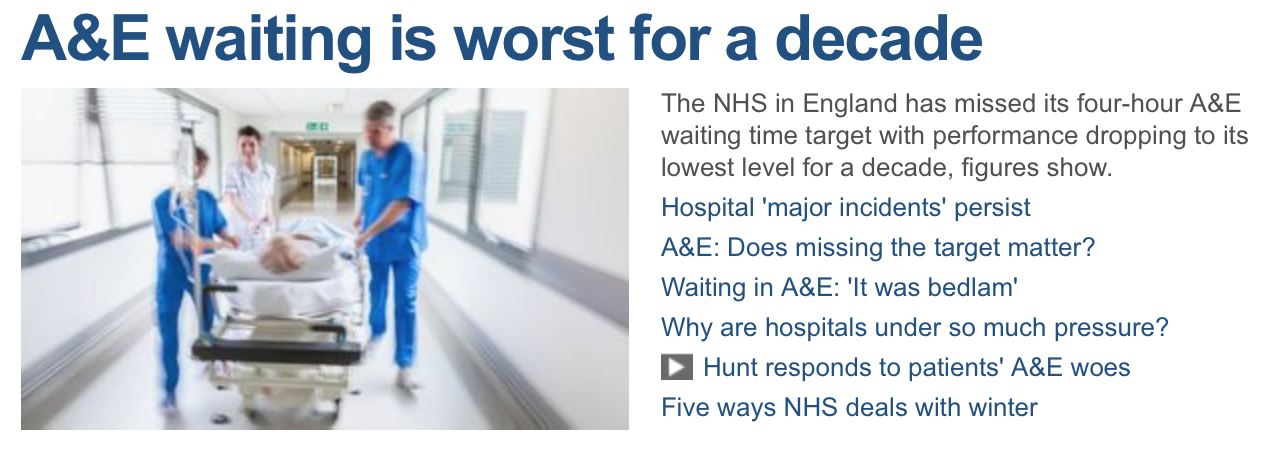
This brings us to the example that inspired this post. The BBC news web site this morning told us that “A&E waiting times in England have fallen to their worst level for a decade.” It’s hard to feel much sense of urgency about the fact that waiting times have “fallen”.

BBC website A&E morning


Presumably that’s why the text had changed in the afternoon:

bbc website afternoon

Quotation marks

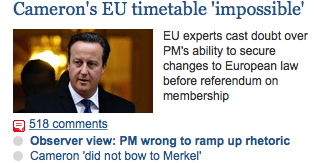
On the Guardian website front page right now is a headline

Cameron ‘did not bow to Merkel’

I found this wording interesting, for reasons that I’ll mention below, so I wanted to see who said it. But when I moved to the article, those words were nowhere mentioned. What it says is “The foreign secretary, Philip Hammond, has denied that David Cameron “backed off” over plans to cap migration from the EU after Angela Merkel told him she would not tolerate such an incursion into the principle of the free movement of workers.”

So, did Hammond say “bow”, or “backed off”, or something else entirely? When did quotation marks become acceptable for paraphrases? Or have I missed a subtle development in the distinction between single quotes and double quotes?

Screenshot 2014-11-30 10.26.42

I’m slightly intrigued by the issue of national leaders “bowing” to other leaders, which seems to be particularly influential in political cultures dominated by the culture of schoolboy taunts, as are those of the US and the UK — most especially the UK. I recall the scandal early in the Clinton presidency, when the new president was seen to have bowed to the Japanese emperor.

Administration officials scurried to insist that the eager-to-please President had not really done the unthinkable. “It was not a bow-bow, if you know what I mean,” said Ambassador Molly Raiser, the chief of protocol.

Of course, this was an emperor, not a head of state, and the suggestion was not that Clinton was bowing politically to foreign interests, but rather that he was showing too much obeisance to a monarch, not being true to America’s tradition of colonial independence and steadfast republicanism.

Who would have thought that, barely a decade later, a US president would be attacked by the right wing for his supposed “anti-colonial” roots?

The value of diagnosis

What is diagnosis worth, if there is no treatment? This is a perennial question in medical ethics. I recall a passage in Roy Porter’s history of medicine, The Greatest Benefit to Mankind, referring to the sardonic praise heaped upon the clinic in Vienna (I think it was), where the magisterial diagnoses were always “swiftly confirmed at the autopsy”.

An article in Salon recounts the revelation from autopsy that comedian Robin Williams was suffering from Lewy body dementia at the time of his recent suicide. The article quotes the programming director of the Lewy Body Dementia Association, saying “Though his death is terribly sad, it’s a good opportunity to inform people about this disease and the importance of early diagnosis.” I know this is the sort of thing that someone in her position is required to say, but given that there is no cure, and very little by way of effective treatment, I wonder what “importance of early diagnosis” she is referring to, and what she takes the relevance of this event in particular to be. That early diagnosis allows you to know what’s happening while you’re still fit enough to take your own life?

Holes in the Brussels underwear

One felicitous phrase that has long stuck in my mind, and even substantively affected my thinking, came at the end of an essay by Garrison Keillor, on the social value of hypocrisy. He told of a small town that lost multiple upstanding citizens, including the minister, to serial revelations of adultery. “Sinners are more important to a town’s economy than saintly people are, and they are better citizens. A gnawing sense of guilt makes them more willing to serve on committees.” He concludes with a paean to the communities built by

people with enough holes in their underwear to make them careful crossing streets.

I wonder if EU Commission president Jean-Claude Juncker may be just such a person. The Commission is under pressure to take action against tax avoidance schemes. He is being attacked by some for his role in making tax fraud the driving engine of the Luxembourg economy during his many years as prime minister. His embarrassment has become particularly acute since investigative journalists recently published secret Luxembourg government files on corporate tax affairs. But maybe this makes him just the person to oversee the cleanup. It’s not just the “takes a thief to catch a thief”, knowing-where-the-bodies-are-buried qualification. It’s that he’s sufficiently embarrassed by his past misdeeds to be seeking redemption through honourable work, and he knows that whatever he does will receive an extra measure of scrutiny.

While I’m on the topic, I just want to mention again how irritating I find the disclaimers that always appear in articles on this topic, that “These arrangements… are perfectly legal.” This is wrong for two reasons:
1. Often the laws pertaining to international tax arrangements allow certain transfers to be made for valid business reasons, but not for the purpose of avoiding taxes. Now, they are structured in such a way as to make it impossible to prove that tax avoidance was the purpose, so they can’t be convicted in court, but that’s different from “legal”. As I commented before, it’s like pushing someone off a cliff when no one else is around. No one can prove that it was murder, but that’s different from it being legal.
2. These arrangements are extremely complicated. Their legality depends upon the precise details of how they are structured. This means that only a very careful analysis of the details can determine whether they are indeed legal. What the journalists have found out is that Luxembourg basically rubber-stamped the reports, suggesting that the details have not been authoritatively vetted by anyone. If someone is making good-faith attempts to comply with the law, then it seems fair to treat the result as presumptively valid. If, on the other hand, he is making every effort to evade the intention of the law through technical compliance, then it seems fair to judge only the technical accomplishment of the task, and hammer him for any technical error, even it’s just a misplaced comma.
Live by the technicality, die by the technicality.

Alleged allegations

Do journalists even think about where they’re putting the word “alleged” as an incantation to ward off accusations that they might be making unproven accusations of criminality? Here’s a paragraph from today’s Guardian:

Scotland Yard has launched a criminal investigation into claims a child was killed by a paedophile ring alleged to have high-level connections to the establishment.

The Guardian understands the claim involves the alleged killing of a child during the alleged activities carried out by members of the ring.

There was an alleged killing during alleged activities. Shouldn’t that be “alleged members of the alleged ring”? If it turns out the members didn’t actually carry out any activities, then they wouldn’t really constitute a “ring”, would they? Conversely, if this was a “paedophile ring”, as the first sentence asserts, implicit in that is that there were activities, including paedophile activities, so why are they referred to as “alleged activities”? Perhaps “alleged child”, if it’s not yet clear if this particular crime has any basis in reality.

Journalist investigated to prove perjury exposed

From today’s Guardian:

The BBC pulled a planned exposé of Sun on Sunday journalist Mazher Mahmood, after a last-minute intervention from his lawyers…

I had great difficulty parsing this sentence. On the first go, my grammar module pegged “Sun” as the object of the exposé (but why not “The Sun”?), Sunday as a date — possibly the planned date of broadcast, or when the broadcast was cancelled — and journalist Mazher Mahmood presumably someone involved in the exposé or in announcing the cancellation — but then why did the clause end there? It all could have been made clear if Sun on Sunday had been put in italics.

I am reminded of a section in Steven Pinker’s book Words and Rules (I think he’s the best popular writer on linguistics — alas he tends to embarrass himself when tempted to write on other topics) where he describes “garden path sentences” — sentences that seem ungrammatical because of the way one is first inclined to parse them. The odd thing is that an informational context can make them grammatical, albeit awkward. For example

The horse raced past the barn fell.

Like the horse, the reader stumbles at the end. “Fell” looks like it’s just an excess verb tacked on. But it seems like a perfectly well-formed sentence if it is extended to

The horse raced past the barn fell. The horse walked past the barn proceeded safely.

Billions, schmillions: Immigration edition

The Telegraph writes in big text

New report shows immigration over the Labour government years cost the public purse billions of pounds, while recent migration from inside Europe generated a £4 million surplus.

Then, in the main article, the study found

that recent immigration from Europe – driven by the surge in arrivals from eastern European – gave the economy a £4.4 billion boost…

More billions schmillions.

Wi-fi jumprope

At a recent committee meeting, where the provision of wireless internet access in our college library was discussed, someone raised the question “What does ‘wifi’ mean, anyway?” As it happens, I’d looked into that about a decade ago, when I was brought up short by a bizarre comment in an article the East Bay Express (a generally excellent free weekly in the Berkeley-Oakland area):

In the East Bay, cities such as Concord, Hayward, San Pablo, and Walnut Creek are launching or planning on launching citywide wi-fi, which is short for wireless fidelity.

I’d been a fairly early adopter of wireless internet, having installed it at home in 2003, before it was available in many public places (though I’d first encountered it at the University of Copenhagen, when I attended a conference there in January 2003; at that time my Apple laptop didn’t have any built-in wireless connectivity) but I’d never paid much attention to the term “wifi”, which seemed silly to me. I assumed it was a meaningless back-formation from “hi-fi” — odd in a way, since that term itself was so outdated, and even in my childhood I knew it mainly as a joke, as in the Peanuts strip (which itself was more than a decade old at that point) where Lucy boasts to Charlie Brown that she has a “hi-fi jumprope” — which turned out to be true. But I found it hilarious that some journalists completed the cycle, assuming that if “hi-fi” was short for “high fidelity” and “wi-fi” is analogous to “hi-fi”, then “wi-fi” stands for “wireless fidelity”.

And then what happened?

The linguistic conventions of reporting on trials are sometimes confusing, because of the way reporters are required to appear to suspend judgement until the verdict. The BBC reports

A pensioner has been found guilty of murdering his partner and her daughter after he shot them both dead at his puppy farm in Surrey.

On first reading, I tried to figure out how he could have first murdered them, and then shot them dead…

The force of “overwhelming”

The New Republic has published a film review by Yishai Schwartz under the portentous title “The Edward Snowden Documentary Accidentally Exposes His Lies”. While I generally support — and indeed, am grateful — for what Snowden has done, I am also sensitive to the problems of democratic governance raised by depending on individuals to decide that conscience commands them to break the law. We are certainly treading on procedural thin ice, and our only recourse, despite the commendable wish of Snowden himself, as well as Greenwald, to push personalities into the background, is to think carefully about the motives — and the honesty — of the man who carried out the spying. So in principle I was very interested in what Schwartz has to say.

Right up front Schwartz states what he considers to be the central dishonesty of Snowden’s case:

Throughout this film, as he does elsewhere, Snowden couches his policy disagreements in grandiose terms of democratic theory. But Snowden clearly doesn’t actually give a damn for democratic norms. Transparency and the need for public debate are his battle-cry. But early in the film, he explains that his decision to begin leaking was motivated by his opposition to drone strikes. Snowden is welcome to his opinion on drone strikes, but the program has been the subject of extensive and fierce public debate. This is a debate that, thus far, Snowden’s and his allies have lost. The president’s current drone strikes enjoy overwhelming public support.

“Democratic theory” is a bit ambivalent about where the rights of democratic majorities to annihilate the rights — and, indeed, the lives — of individuals, but the reference to “overwhelming” public support is supposed to bridge that gap. So how overwhelming is that support? Commendably, Schwartz includes a link to his source, a Gallup poll that finds 65% of Americans surveyed support “airstrikes in other countries against suspected terrorists”. Now, just stopping right there for a minute, in my home state of California, 65% support isn’t even enough to pass a local bond measure. So it’s not clear that it should be seen as enough to trump all other arguments about democratic legitimacy.

Furthermore, if you read down to the next line, you find that when the targets to be exterminated are referred to as “US citizens living abroad who are suspected terrorists” the support falls to 42%. Not so overwhelming. (Support falls even further when the airstrikes are to occur “in the US”, but since that hasn’t happened, and would conspicuously arouse public debate if it did, it’s probably not all that relevant.) Not to mention that Snowden almost surely did not mean that he was just striking out at random to undermine a government whose drone policies he disapproves of; but rather, that democratic support for policies of targeted killing might be different if the public were aware of the implications of ongoing practices of mass surveillance. Continue reading “The force of “overwhelming””