
P.S.

My 8-year-old was telling me about a recent school lesson. The teacher was telling them (for some reason) about the use of the term P.S. Her explanation began “In the old times people didn’t have computers, so they had to write letters on paper…”

Of course, I know that my children have lived entirely in the age of personal computing, but it was still striking to hear it presented in such stark terms. I actually experienced the transformation exactly during my university studies. When I arrived at Yale in the fall of 1983 I had my Apple IIe, my roommate had a Compaq, and otherwise pretty much no one had a personal computer. Everyone else seemed to be writing their papers on a typewriter. (It was kind of unreasonable of me, actually, to expect the professors to read the low-resolution dot-matrix output that I turned in, but I wasn’t very considerate at the time.) The Macintosh appeared the next year, and by 1986-7 everyone was writing their senior essays on the Macintoshes in the college’s computer room.
Illegitimacy

I’m reflecting now on the various US presidential elections of my lifetime. I have always supported Democrats, and have tended to disparage Republican presidents and presidential candidates personally as well as disliking their policies. I thought it irresponsible of Republicans (and the new media) to cover for Reagan’s increasing mental deficiencies, particularly in his second term. I thought George W. Bush’s first election was tainted by the problematic vote in Florida and the ridiculous intervention of the Supreme Court, and that he owed it to the country to bend over backwards to govern in a moderate, middle-of-the-road manner. (At the same time, it was clear to me that there wasn’t really a clear winner to the election. The electoral system simply failed. Though I believed, and still believed, that the most legitimate resolution would be an absolutely scrupulous full recount of the state which, it turns out, according to later studies, would ultimately have given the election to Gore.)

But it is quite clear to me that I have never watched the impending installation of a new president with such fear and loathing. Genuine fear. I worry about social programs I care about in the US, but having lived outside the US for more than a decade, and without any likelihood of returning, I feel pretty detached from day-to-day politics in the US. What I feel is existential dread for the fate of a country that is still my own, and for the world, which seems generally more unstable than it has for a long time, and where the US still has overwhelming influence, and even more overwhelming destructive power.

Racism and forgiveness

It reminded me of the aphorism, popularised by the journalist Henryk Broder, attributed by him to an Israeli (commonly understood to be the psychoanalyst Zvi Rex), but without an identifiable original source:

Auschwitz werden uns die Deutschen nie verzeihen.

The Germans will never forgive us for Auschwitz.

One interesting lesson of the past year’s politics, particularly in the US, was learning how angry many white people seem to be about the legacy of slavery and racism. For example, when Michelle Obama spoke at the DNC about living “in a house that was built by slaves”, I had tears in my eyes, even as I rationally found it slightly mawkish and oversimplifying the trajectory of progress. Other people reacted differently, first doubting that that was true, calling it slanderous to mention the fact, and then dismissing the significance of the implicit criticism by saying that the slaves  “were well fed and had decent lodgings provided by the government.”
One typical survey in June 2016 showed that most white Americans — and 59% of white Republicans — believe that “too much attention is paid to race and racial issues”, with 32% of white Americans saying that President Obama has made race relations worse. According to the 2015 American Values Survey, only 46% of Republicans say there is “a lot” of discrimination against Black people in the US, while 30% (and 45% of “Tea Party” supporters) say there is a lot of discrimination against White people. 64% of Republicans agreed with the statement “Today discrimination against whites has become as big a problem as discrimination against blacks and other minorities.”

Land of the frei

Trends in rejecting democracy

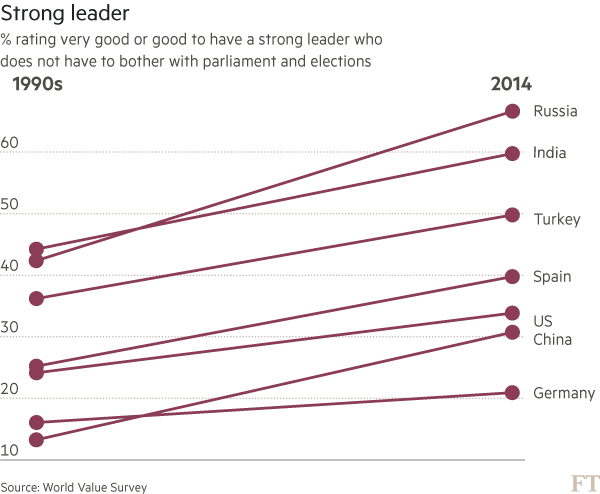
This plot from the Financial Times has been getting a lot of attention online. The data come from the World Values Survey (slightly incorrectly cited in the plot).

I don’t know what to make of it exactly, except to say that it supports my gut belief that Germany, more than any other country, understood after the Second World War, what it takes to cultivate a spirit of freedom and democracy. It was a long struggle, and they didn’t shy away from it. Education, the legal system, journalism: It’s the famous German thoroughness, applied to the problem of creating free citizens. The British, the Americans, and the French, each in their own way, considered democracy to be their inevitable birthright, and so have allowed relevant institutional arrangements and, even more importantly, the democratic spirit, to decay.

Maybe the Americans are just being more honest — in a Trumpian anti-PC way. Taboos are important. One important lessons that the Nazis understood was: Before you can commit unspeakable horrors, you need to find a way to make them speakable.

Good scandals

The US is just getting used to the idea of a president who will be running an international business marketing his name out of the Oval Office. Political journalists are fooling themselves in supposing that they’re going to have an easy time publicising scandals in the Trump administration. What’s a scandal, when the rulers are shameless? What could you find that would be worse than what has already come out during the campaign? And the mainstream will be pushing their carefully researched and reported evidence of malfeasance at the highest levels against social-network-distributed scandals on the other side, scandals about left-wing figures manufactured by Kremlin operatives or Macedonian teenagers. Of course, the made-up stories will be more piquant than the real ones. They are socially engineered to push every hot button, and so raise the public’s general shock threshold.

It seemed like a good time to repeat a post I wrote last year, about the importance for a healthy democracy to maintain its ability to be shocked: Continue reading “Good scandals”

Constraints

Maybe an opportune to repost something I wrote in June. Mitch McConnell had just remarked that Trump was no danger because “No matter how unusual a personality may be who gets elected to office, there are constraints in this country”. It reminded of the famous comment of Franz von Papen, leader of the Centre Party in the Weimar Republic, and the man who advised President Hindenburg to appoint Adolf Hitler as chancellor

Wir haben ihn uns engagiert. … Was wollen sie denn? Ich habe das Vertrauen Hindenburgs. In zwei Monaten haben wir Hitler in die Ecke gedrückt, dass es quietscht…

We hired him to work for us. … What’s the problem? I’m the one who has [President] Hindenburg’s confidence. In these two months we have completely backed Hitler into a corner.

He has such a wonderful way of connecting with the working class…

Being demographic

People have been saying for a long time that the Republican strategy of ethnic nationalism is running out of room, because of increasing proportions of ethnic minorities. I noted during the 2012 election how odd it was that some groups of people were considered to vote “demographically”, while others (white Protestant men) were assumed to vote on the basis of a broad array of concerns. According to the demographic fallacy, minority groups have special interests that are very important to them, but only of peripheral interest to the majority. Too much pandering can piss off the majority, but targeted appeals can motivate the minority, potentially to very high percentages, but there is no way to motivate the majority en bloc. After the 2012 election there were any number of comments of the sort “To win the presidency, Republicans need to make up their deficit among black and hispanic voters. They are losing them at such a level that (with changing povulation composition) a future Republican candidate would need to win the white vote at implausible levels to win a majority.” Now it appears that this argument is exactly wrong, for three reasons:

  1. As Trump correctly intuited, white people are also susceptible to ethnic appeals. And if you can motivate them as an ethnic group, they’re the biggest, baddest one of all. Meanwhile, the Democrats appeal to ethnic minorities was maxed out. The pervasive undercover racism of the Republican party gave Obama a huge edge among hispanics and blacks; naked racism, religious exclusion, and threats of deportation by Trump couldn’t move it any further, but could pull in vast numbers of white voters who share his racist world view and are relieved to hear it expressed openly. Those of us who move in educated circles should have taken more seriously the assertions early on that “Trump says what everyone really thinks”. Obviously, we didn’t know what people were thinking.
  2. Similarly for women. The model of what I called “demographic thinking” in politics is  I’m not the first to notice that women are not actually a minority. The power relations (yay intersectionality!) nonetheless seem to justify seeing the struggle for women’s rights as analogous to the struggle for rights of ethnic minorities.
    Feminists may have gotten suckered by a figure-ground second-sex fallacy with regard to women voters. If you think of males as the default, and women as the “minority”, then an openly misogynist candidate like Trump would seem to turn out the women to vote against him. But most of those women have been having to compromise with and make excuses for Trump-like figures in their lives — in their families — their whole lives. Some will recoil in horror, but most will continue to make excuses. And the women voters lost may be balanced by just as many men gained.
  3. It’s perfectly possible to maintain a semblance of democracy while entrenching the power of a minority to rule over the majority. Many countries have done this. With the single exception of 2004, the Republicans have not won a plurality in a presidential election since 1988. Democrats received a majority of the votes for representatives in 2012 and (probably) 2016. Nonetheless, the Republicans have attained unrestricted control over nearly the entire federal government, and very little stands in the way of further restricting voting rights to maintain their control and civil rights of minorities, expanding the political influence of the wealthy, to maintain their power indefinitely.

The electoral college was designed to leverage the 3/5 compromise to increase the power of southern slave-holding states in presidential election. Now, under very different circumstances, it is still serving this function.

Ulysses Obama

I’ve just been reading Ronald C. White’s wonderful new biography of Ulysses Grant, American Ulysses. Inspiring and depressing at the same time, it’s the story of a modest man with a peculiar foreign-sounding name. Possessed of enormous gifts of organisation and leadership, he rose from a decidedly modest background to become president. He was extremely popular during most of his eight years in office, and pursued vigorous high-minded policies as president, particularly focused on protecting civil rights of ethnic minorities, and repairing relations with other countries after a long war. At the end of his two terms he was still popular enough that he could easily have been re-elected for a third. 

His successors set about dismantling everything he had accomplished as president, and later generations judged his presidency an utter failure, partly in order to justify the racist policies that followed.

He was a talented writer, who wrote a celebrated memoir, but political opponents, who held his intellect in contempt, asserted without evidence that it had been ghost-written.

I’m not sure why this all seems relevant at the present moment.

Bullet not dodged

I thought I should post an email that I wrote yesterday morning, expressing my despair before the election, when I thought we might “dodge the bullet” of Trumpism, but still held out little hope for a political system that put us in front of the gun in the first place: Continue reading “Bullet not dodged”

Used and abandoned

Donald Trump has tried, with limited success it would appear, to convince African-Americans that they have been swindled by the Democrats, who use their votes but ignore their concerns. I don’t think that is actually true. We can argue about whether Democrats have done enough, or had the right priorities, and to what extent this is just another example of the Republicans blocking progress and then accusing the Democrats of not wanting it enough, not “leading” enough. But the needs of African-Americans — including affirmative action, housing integration, support for the poor — are clearly a significant concern of governing Democrats.

The people who were really used and abandoned by the Democrats were the white racists. The Democrats were happy to have their votes through the 1970s, and then abandoned them as the fraction of non-white voters made the racists seem electorally less significant. Shameful!