The paradoxes of adultery, Renaissance edition

An example that is frequently cited in elementary statistics courses for the unreliability of survey data, is that when people are surveyed about their sexual history, men report more lifetime female partners on average than women report male partners. (A high-quality example is this UK survey from 1992, where men reported 9.9 female partners on average, while women averaged 3.4 male partners. It’s possible to tinker around the edges with effects of changes over time, and age differences between men and women in sexual relationships, but the contradiction is really inescapable. One thing that is quite striking in this survey is the difference between the cross-sectional and longitudinal pictures, which I’ve discussed before. For example, men’s lifetime numbers of sexual partners increase with age — as they must, longitudinally — but among the women the smallest average number of lifetime sex partners is in the oldest group.)

In any case, I was reminded of this when reading Stephen Greenblatt’s popular book on the rediscovery of De rerum naturae in the early 15th century by the apostolic secretary Poggio Bracciolini, and the return of Epicurean philosophy more generally into European thought. He cites a story from Poggio’s Liber Facetiarum a sort of jokebook based on his experiences in the papal court, about

dumb priests, who baffled by the fact that nearly all the women in confession say that they have been faithful in matrimony, and nearly all the men confess to extramarital affairs, cannot for the life of them figure out who the women are with whom the men have sinned.

When to call it quits

Today is the day of the Scottish referendum. As I’ve commented before, I don’t really have a personal opinion about the question, though I think Scottish independence would probably make my life marginally worse. (To the extent that I have a coherent political view of the situation, it is mostly concurrent with that expressed with some eloquence by Charles Stross. I’d much prefer to see a federal UK. I guess that’s what happens when you let aliens with their strange ideas infiltrate the nation.)

The only sense in which I think I have relevant expertise is with regard to the way people are talking about risk. The whole thrust of the No campaign has been to conjure up dangers, known and unforeseeable, of Scottish independence. I think they’re probably right — in particular, I think the economists are right that Scots are being misled by those who claim that they can successfully keep the British pound as their currency. On the other hand, there are also risks of staying part of the UK. In particular, the risk of being taken out of the EU by an English public that is increasingly insular in its outlook (inlook?) Since everyone’s fond of divorce metaphors, we might see Scotland as a woman whose jealous husband is trying to force her to move with him away from her friends and family. There is a long tradition of Scotland using relations with the Continent as a balance against England. It’s not so much a question of whether Scotland wants to be part of a bigger nation or go it alone; it’s a question of whether Scotland wishes to confederate with England or with Europe. And despite a reasonably successful 307 year run with England the choice for the future is not so obvious.

And that raises what I think is the most irksome twist of the No campaign’s logic: The question of timing. If you protest early against a new arrangement, you can be told, “You haven’t given it enough of a chance”. But if you wait too long, you can be told it’s really been settled by custom and tradition. (To be fair, “you haven’t given it enough of a chance” wasn’t really the argument against the 18th century Scottish rebels, who tended to find English muskets doing the persuading.) Surely it’s reasonable to reconsider these sorts of arrangements after 300 years or so. England offered Scotland the opportunity to be a co-coloniser rather than a colony, and it accepted. Now that the imperial dream is not just dead but despised, isn’t it reasonable to ask a new generation whether the union is still meeting their needs?

Recruiting the dead

Former chief of the UK General Staff General Sir Richard Dannatt  has spoken up on the Scottish referendum, and what he has to say is deeply disgraceful:

Scottish soldiers have fought over several centuries and in so many campaigns to preserve the territorial integrity of their country from external threat, but in the Northern Ireland campaign more recently, they fought against internal threat, but what about today? Do the families of Scottish soldiers who lost their lives between 1969 and 2007 to preserve the territorial integrity of the United Kingdom now just say, “Well, it no longer matters”?

Now, interestingly, while he does go on to say “I cannot speak for them”, his essay includes not a single quote from a single one of these Scottish soldiers, living or dead. Putting aside the fact that some of them were probably just looking for steady pay or a certain kind of military camaraderie, I think it is extraordinarily condescending — and disrespectful — to enlist the dead to march in ones political campaign. And it is disgraceful to use the term “internal threat” to cover both the Northern Ireland campaign — where British soldiers battled against a terror campaign that sought to change the constitutional order by force — and the referendum campaign

There were many nationalists in Northern Ireland who themselves wished to dissolve the “territorial integrity” of the United Kingdom, but who also opposed the attempts to do so by force. The fact that General Dannatt cannot perceive a gap between seeking to accomplish political goals by referendum and seeking to accomplish it by force says all you need to know about the military mind at its most brutal.

In fact, as a matter of historical record, even their political masters at the time of the greatest turmoil in Northern Ireland, the government of Edward Heath, doesn’t seem to have been fighting to “preserve the territorial integrity of the United Kingdom”, so much as to prevent Northern Ireland from sinking into full-blown civil war. At least, the cabinet seems to have been willing to entertain the notion of British withdrawal from Northern Ireland, but ruled it out when it seemed certain only to exacerbate the chaos and violence.

The Return of the Ampelmännchen

I’m in Berlin now, for the first time in ten years. I lived here for much of the 1990s, and much has changed since then. But the change that I found most striking is in the Ampelmännchen, the anthropomorphic red and green traffic signals that tell you to walk or not walk. When I was first in Berlin, the backlash against Western triumphalism was just starting. With the unification of Germany, all kinds of things that had been standardised within each of the former countries now needed to be standardised between them. In principle, this would have involved some sort of consultation and compromise between the two sides. In practice, the East was treated like a colony, and the western standards were simply imposed. (I wrote a long essay at the time about my perceptions of the resentment in East Berlin.)

The resistance converged on the Ampelmännchen. The East had sort of jaunty 1950s-era conspicuously male figures, while the West had sleek, modern, gender-neutral figures. They looked like this:

berlinwalksignals

By the time I arrived, quite a few signals had already been changed in East Berlin, and the Rettet die Ampelmännchen campaign (“Save the  Ampelmännchen“) was fighting to stop the losses. They distributed stickers with images of the Eastern Ampelmännchen, and hoped to slow their destruction. It was an inspired choice, since these Eastern Ampelmännchen are just so adorable. The arguments for the others — in particular, gender neutrality — may be convincing, but it is hard to contemplate their utter extinction without a pang.

Now, 20 years after the struggle broke out, I find that the Ost Ampelmännchen are everywhere in Berlin, even in the West. So, something has been saved. The rulers of the GDR vowed to create a Neuen Menschen (new man), but their only enduring success was the creation of a Neues Ampelmännchen.

Helicopter parents avant la lettre

I’m always intrigued by the eternal present of “nowadays”: Trends that rise and rise like an Escher staircase. Just now I was coming to the end of Anna Karenina — which I had expected would be just Madame Bovary on the steppes, but it was vastly more — and found this passage:

“He assures me that our children are splendid, when I know how much that’s bad there is in them.”

“Arseny goes to extremes, I always say,” said his wife. “If you look for perfection, you will never be satisfied. And it’s true, as papa says,—that when we were brought up there was one extreme—we were kept in the basement, while our parents lived in the best rooms; now it’s just the other way—the parents are in the wash house, while the children are in the best rooms. Parents now are not expected to live at all, but to exist altogether for their children.”

“Well, what if they like it better?” Lvov said, with his beautiful smile, touching her hand. “Anyone who didn’t know you would think you were a stepmother, not a true mother… Well, come here, you perfect children,” Lvov said to the two handsome boys who came in…

The time when children knew their place, and parents could enjoy themselves, is just a generation past, and apparently it always was.

Metric overlap

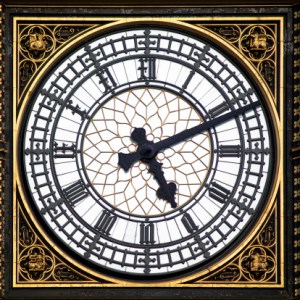
big ben faceI was just reading this article about the failure of the US to convert to the metric system in the 1970s — a review of the book Whatever Happened to the Metric System? by John Bemelmans Marciano. (About whose title I wonder, whatever happened to the phrase “what ever”? Isn’t “whatever” a completely different word? Whatever.)

It reminded me of my school days, when the units unit — the unit on converting between English and SI units — was a regular feature of every year’s math lessons. We were told that this would be important for the future, since everything was going to be converted to metric. Something to justify a lifetime of skepticism toward those

At the time, I thought it strange that so much time was being spent on converting between the old and the new units. Once you start using new units, you rarely need to convert to the old ones; and most of the conversion can be done with double-marked measuring utensils, like the measuring tapes that were then and still are ubiquitous. (I was fascinated when I first saw the 18th century clock faces that have the hours subdivided simultaneously into fours and into fives, the latter to accommodate the new-fangled minute hands, the former for the old one-handed system, where a single hand showed the time on a 12-hour or 24-hour scale (or 10-hour, if it was late 18th century Paris), with each hour subdivided into quarter hours. An example, from a much later date (mid-19th century, pictured above) is the face of Big Ben in London.

Emphasising conversions made it seem like metric requires hard math, as well as remembering things like 3.28 feet in a metre, or 454 grams in a pound, whereas it actually means you can stop remembering things like 5280 feet in a mile, or 4840 square feet in an acre, or 4 pecks in a bushel. But I remember being particularly struck at the time (the time being about 1980) by an argument I read, claiming that metric conversion would impose untold costs on the US economy, requiring the replacement of everything from shot glasses to wrenches. I found this claim very odd. Surely, I thought, the fact that we measure the size of drinks in millilitres rather than ounces doesn’t forbid us from making a drink have an odd number of millilitres, at least until the old glasses break.

It reminds me of when Deutsche Telekom, in the pre-competition days, proposed changing the basic unit of charging for local calls from three minutes to half a minute, or maybe it was even less. I remember listening to a call-in show on the radio where this was being discussed, and an elderly woman called to express her outrage. “Who would make a half-minute call? What can you discuss in so little time?”

Anyway, metric didn’t happen in the US, except for the 2-litre pop bottles, and gram bags of cocaine. But even where it did happen there remains an overlap of older units. In Britain, which has been metricated by law since EEC accession in the 1970s, house sizes are in square metres, petrol sold by the litre, and fruits are priced in pence per kilo, but beer is sold by the pint and distances between cities are generally measured in miles. People’s weights seem to be given equally in pounds, kilos, or stones (14 pounds). Commonly imperial units are given as alternatives to officially required metric units, suggesting that at least some portion of the public has a better intuitive grasp of the imperial units. But even in Germany, which had the metric system imposed by Napoleon more than 2 centuries ago, people still talk of “Ein Pfund Butter”, even if this “pound” of butter is a metricated pound, rounded to 500 grams.

Bayesian Fables: The Trojan Horse

I was talking recently to a friend who said he saw the story of the Trojan horse as an object lesson in the failure of governance. “Wasn’t there anyone who could say, wait a minute, maybe it’s just not a good idea to bring that horse in here, even if the Greeks seem to have all left?”

I said it was a fable about the inaccessibility of Bayesian reasoning. Laocoön warned them that the prior probability for a net benefit from a Greek gift was low (timeō Danaōs et dōna ferentēs). But the Trojans placed more credence in new information, particularly private information that they hold exclusively, particularly when they seem to have won the information at great effort, by their own ingenuity, by torturing the captured Sinon. (This lesson was learned by the British spies in WWII who conceived Operation Mincemeat.) Laocoön was punished for insisting on his strong prior, being crushed to death by the clever serpents sent by the Goddess of Worldly Wisdom. And the Trojans celebrated their ingenious victory, until they were overrun by reality, in the form of well-muscled Achaean warriors who were not impressed by their highly significant rejection of the likelihood of a subterfuge.

How Harold Wilson kept it together

One could spend the whole day and half the night recording the weird infelicities of expression that automatic spell-checking has wrought upon once-proud journalistic enterprises. But some are truly exceptional.

According tq The New Republic, his close associate Joseph Kagan (who was rumoured to be his KGB handler, by those who thought he was a Soviet mole) was a “clothing magnet”.

The New RepublicIt sounds like the kind of excuse a teenager caught shoplifting might use. “I don’t know how it got into my bag, your Honour. I seem to be a clothing magnet.”

Early 20th century MOOCs

It is always enlightening to see how some of the same breathless optimism derived from our newest innovations, the claims that perennial problems are going to be solved at last, were also derived from innovations a century or more old, when they were new. In particular, I was struck by Kevin Birmingham’s account (in his remarkable book on the genesis of James Joyce’s Ulysses) of the early days of Random House, and its Modern Library series:

Both within and beyond universities, people began thinking that certain books illuminated eternal features of the human condition. They didn’t demand expertise — one didn’t need to speak classical Greek or read all of Plato to benefit from The Republic — all they demanded was, as [Professor John] Erskine put it, “a comfortable chair and a good light.” […]

The Modern Library offered commodified prestige with the illusion of self-reliance. Readers could have the benefits of institutional culture without the institutions. They could rise above the masses by purchasing a dozen inexpensive books.

Replace “good light” by “fast internet connection”, and you have the promise of Coursera. Of course, that jibes well with the feelings that many skeptics have, who wonder why we need new technology to democratise education. As long as you’re lecturing to masses, where personal feedback is logistically impossible, doesn’t it suffice to have a well-stocked library?

Confessions

Reading Anne Applebaum’s Gulag: A History, I was struck by her formulation of a question that I had wondered about myself, and never seen explicitly stated:

Why the Soviet secret police were so obsessed with confession remains a matter for debate…

What is the motivation to force a prisoner to “confess”? Even if the interrogator believes the charge to be true, why is it important for the prisoner to say it? Surely a confession under duress is not going to convince anyone else. Of course, you may want to use a confession extracted under torture to deceive someone else into thinking this was a confession freely offered, but it is hard to see how that can be relevant to system where torture is standard.

Furthermore, in the pre-video era, it’s hard to see why anyone would go to the trouble of manufacturing a deception by torturing the prisoner to put his own signature on the confession, rather than simply forging the signature. And yet it was important enough for interrogators to spend months attempting to extract the “genuine” confession, and for prisoners to submit themselves to agonies to resist.

The officer investigating Vladimir Tchernavin, a scientist accused of “wrecking” and sabotage, threatened him with death if he refused to confess. At another point, he told him he would get a more “lenient” camp sentence if he confessed. Eventually, he actually begged Tchernavin to give a false confession. “We, the examining officers, are also often forced to lie, we also say things which cannot be entered into the record, and to which we would never sign our names,” his interrogator told him, pleadingly.

In the context of the Inquisition, at least, it is possible to believe in a certain sort of twisted altruism: Being convinced of the truth of the accusation, the inquisitor believes the unrepentant sinner’s soul to be forfeit to Hell. His life is of no account, but the soul can be rescued, if only said sinner can be moved to whole-hearted penitence. In this context, the confession has its own value, and it is clear why it must come from the heretic’s own lips.

Continue reading “Confessions”
