“No race problem”

Another interesting episode from Götz Aly’s book on 2/3 of a century of European antisemitism (1880-1945): At the conference convened in Évian, France in 1938, where representatives of the world’s democracies met to try to create a common policy on Jewish refugees, the Australian trade minister Thomas W. White explained Australia’s refusal to accept any Jewish refugees thus:

As Australia at present has no race problem at present, I think everyone will understand that we are in no hurry to import one.

From the perspective of modern race consciousness it is fascinating to see the Australia of 1938, with its marginalised and near-genocidally oppressed aboriginal population, seen as self evidently lacking a “race problem”, whereas the immigration of some thousands of Jewish refugees would self-evidently create one.

The Canadian prime minister Mackenzie King similarly believed that no good could come of tainting the pure Canadian race:

My own feeling is that nothing is to be gained by creating an internal problem in an effort to meet an international one… We must… seek to keep this part of the Continent free from unrest and from too great an intermixture of foreign strains of blood, as much the same thing as lies at the basis of the Oriental problem. I fear we would have riots if we agreed to a policy that admitted numbers of Jews.

(The exact quote comes from this paper.)

Mathematics and Meditation

Womb Realm Mandala

Sure, they’re both four-syllable words starting with M*, but do they have anything else in common?

Actually, quite a lot. They’re both ancient mental technologies for refining the mind’s ability to focus and grasp what is fundamentally ineffable: for mathematics this is space, motion, and quantity (or number); for meditation (I’m thinking here of Buddhist jhana meditation) it is the nature of mind and thought itself. Both require many years of intensive training and apprenticeship, often focusing on learning to solve a set of standard problems and carry out fixed exercises and incantations (QED, induction on n, proof by contradiction; buddham saranam gacchami). The practitioners of both are generally viewed as weird and otherworldly, and advanced practitioners demonstrate their mastery with bizarrely abstruse feats such as proving that all integers can be represented as a sum of a finite number of primes, or spending long periods of time in trance states, or levitating.

There is some direct overlap as well. Meditative practices often draw on geometric motifs — as in the mandala above — and arithmetic relations. Many chants are built on combinatorial principles. More specifically, the last of the five jhana factors is ekagatta, often translated as ‘one-pointedness’. This is typically interpretted as identification of mind and object, but the Pali word is purely geometric: eka (one) agga (point) ta (state). Viewed from a mathematical perspective you can see that the focusing of consciousness to a point can happen continuously, through contraction, or discretely, through reduction of dimension. It is possible to experience the mind as a geometric space, whose dimension can be reduced through concentration.

Presumably it’s just a coincidence, but I find it fascinating that the modern systematic approach to numbers is often attributed to the work of Euclid, in the early 3rd century BCE, shortly after Indian influences started to filter into Greek philosophy, particularly through the thought of skeptics such as Pyrrho of Ellis.

* Reminding me obliquely of the report I heard on the radio in Germany about 20 years ago about the efforts in Germany to establish mediation as an alternative path for dispute resolution. The expert bemoaned the lack of understanding that the general public had of mediation, claiming that many people thought it was some sort of esoteric process, because they confused the word with meditation. (The German words are the same as the corresponding English words.) That is, at least, a problem I’ve never had with the word mathematics.

The mythical pre-history of plant-based meat

In reading Matthew Cobb‘s fascinating new book on the history of ethics and genetic engineering I came across this quote from Martin Apple, president of the world’s first transgenic plant research institute, the International Plant Research Institute, in 1981:

We are going to make pork chops grow on trees!

Of course, long before the first soy latte was even a twinkling in the woke barrista’s eye, people were concerned with plant-based substitutes for meat and dairy for religious reasons. And this reminded me obliquely of the myth of the barnacle goose.

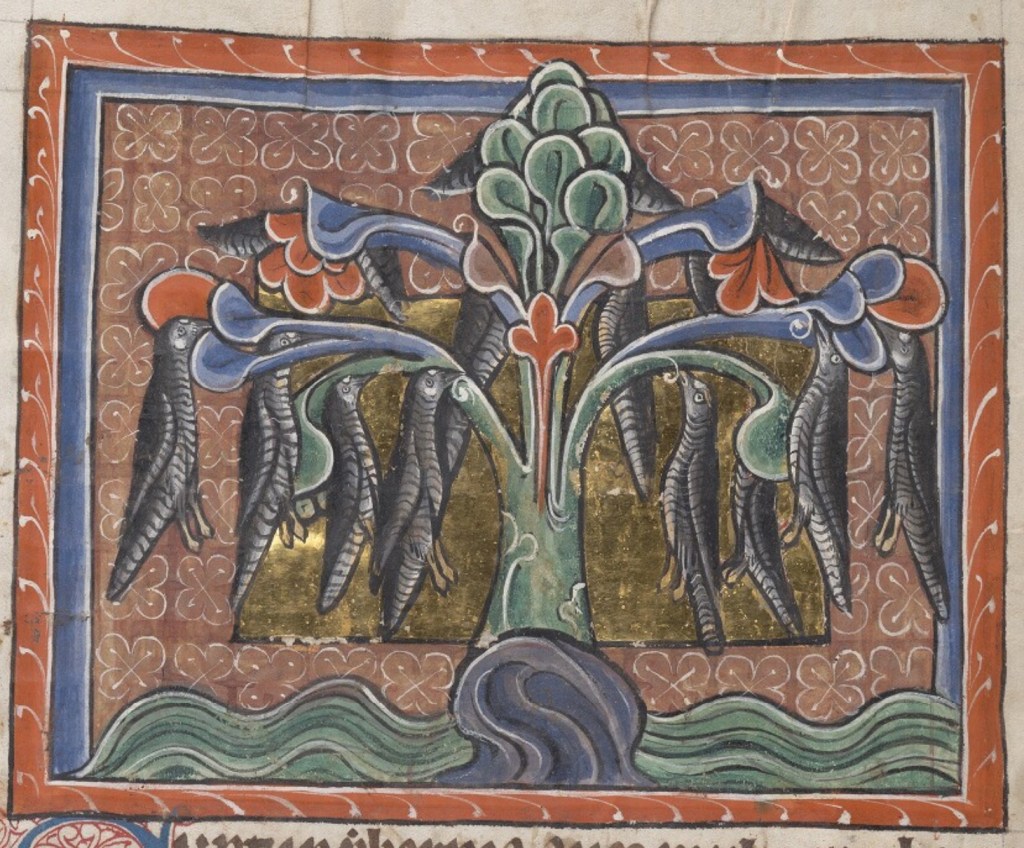
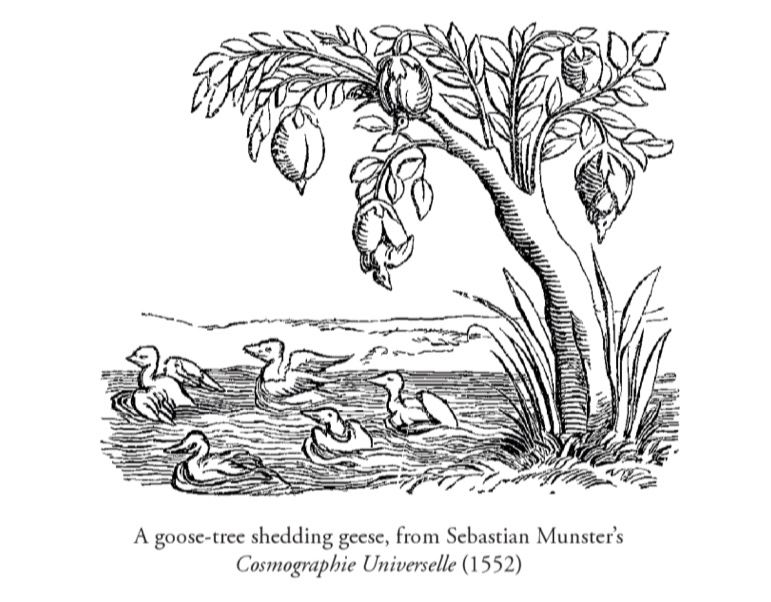
In the Middle Ages it was widely believed that this bird grew from its snout from trees hanging over the water, or out of a barnacle attached to the bottoms of ships or loose pieces of wood. This raised a conundrum for medieval rabbis: For purposes of kashrut, should these geese be classed as fish, meat, or something else?

Some authorities said they were neither fish nor fowl, but rather like shellfish were impermissible no matter how they were slaughtered. But Rabbi Mordechai ben Hillel Ashkenazi of Regensburg said that, effectively, they are fruits:

Regarding birds that grow on trees, there are those that say that they do not require shechitah [ritual slaughter], because they do not reproduce sexually and are like any wood. (Quoted in Sacred Monsters: Mysterious and Mythical Creatures of Scripture, Talmud and Midrash, Nosson Slifkin, p. 319.)

Truly the world’s first plant-based meat!

Strained historical comparisons: Holodomor edition

EU Commission president Ursula von der Leyen today condemned Russia, comparing its actions to Stalin’s brutal engineered famine in Ukraine in the 1930s, and promising to take action to… export thousands of tons of Ukrainian grain.

Stalin was all in favour of exporting Ukrainian grain!

This is clearly a positive development, but the analogy needs some work…

Scant progress

In the middle of an economic slowdown and a huge expansion in spending to reduce households’ winter fuel costs, the new UK government has just announced, in its new “mini-budget” its intention to drastically cut taxes on wealthy individuals and corporations. Not surprisingly, the price of UK bonds has plummeted, and interest rates have risen to their highest level since the 2008 financial crisis.

The Guardian quotes international market experts from ING saying this was a “perfect storm” for the UK, as “global markets shun sterling and gilts.” They continue

Price action in UK gilts is going from bad to worse. A daunting list of challenges has arisen for sterling-denominated bond investors, and the Treasury’s mini-budget has done little to shore up confidence.

“Little to shore up confidence” is such an elegant bit of English understatement, so extreme as to amount almost to deception. Like “the expanded hours for flight departures at Heathrow have done little to improve the noise pollution problem for residents near the airport” or “Herr Hitler’s new ‘Nuremberg Laws’ have done little to shore up confidence in fair treatment among Germany’s half million Jewish citizens.”

The alternative to NATO

Apologists for Putin’s Ukraine atrocity point to NATO’s eastward expansion as the original sin that provoked Russian aggression. Proponents of Western innocence argue that this is a matter of autonomy of independent states whose need for the protection of the NATO alliance has been confirmed by Russian aggression not only against Ukraine, but also against Georgia and Moldova. Realism wouldn’t allow expansion to include former Soviet republics (except the Baltic states), they argue, but Western Europe had an obligation to go as far as it could to defend newly aspiring democracies.

In this telling, NATO has done as much as it could, taking on the burden of defending Poland, Hungary, etc. It explicitly decided not to make a commitment to Ukraine, and so has no moral obligation there — though it has gratuitously chosen to go beyond any obligation in assisting in the current crisis. But I’ve just been wondering… I haven’t heard any discussion of the alternative to NATO expansion. I don’t know what was realistic at the time, but I could imagine that following a rejection for inclusion in Western defense arrangements, the non-Russia former Warsaw Pact might have formed some kind of defensive alliance of their own, aimed at deterring Russian aggression, but sufficiently separate from NATO as to be recognised as a neutral buffer. These countries collectively have comparable population to Russia, and significantly higher GDP.

In this telling, NATO would bear significant responsibility for the current plight of Ukraine, not because it provoked Russia, but precisely because it couldn’t afford to provoke Russia too much. This led it to absorb Ukraine’s natural allies into an alliance that could never plausibly include Ukraine. It is then plausibly the fault of NATO expansion that Ukraine seemed to Putin a tempting target, defenceless and alone.

Opine borders

Boris Johnson has aroused the ire of many classical historians for his dubious claim that the Roman Empire was destroyed by “uncontrolled immigration”. What is most striking is the unquestioned implication that when Romans moved outward, conquering and enslaving their neighbours, that was GLORY, and much to be lamented when it was (possibly) destroyed by their ultimate failure to prevent people from “the east” from migrating in the opposite direction. It seems to me, if there’s anyone who had a problem with uncontrolled migration from the east it was Carthage.

Jack and the Beehive

It suddenly struck me that the English word beanstalk and the German word Bienenstock (beehive) sound powerfully like cognates, even though they are not. There are quite a lot of faux amis between English and German, and they are usually cognate, even when the meanings are radically different — as between the English fabric and the German Fabrik (factory), or the English stuff and the German Stoff (fabric). They have a common root, from which they have evolved differently. Even the bizarre Gift meaning “poison” started out as something given, a dose of medicine (dosis also from the Latin root for “given”).

But beanstalk and Bienenstock are both compound words made up of parts that both seem like they could be cognates, but actually are unrelated. That beans and bees are unrelated is unsurprising. It took me a bit of work to convince myself that stalk is etymologically unrelated to Stock, which is indeed cognate to the English stick. The roots are quite different: Stalk from Old English stale, meaning a handle or part of a ladder; Stock originally a branch or a treestump, presumably then a stump that houses bees, either naturally or agriculturally.

Rivers of statues

When protestors attack perfectly innocent statues of philanthropists who really demonstrated their love of humanity in the high prices they were willing to buy and sell humans for, and dump them in rivers, people ask, Where will it End? Have these activists considered the environmental consequences — both on water quality and on riparian habitats — of dumping every monument to a notorious British racist in the nearest river? Not to mention the potentially catastrophic flooding.

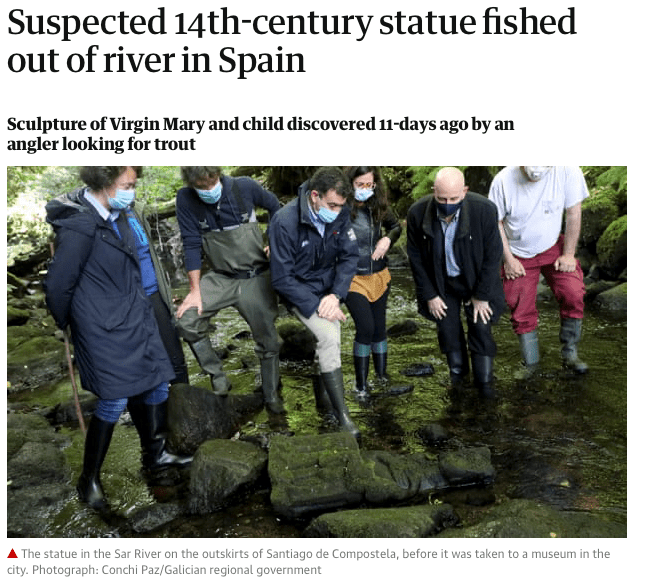
It’s a relief then to discover that at the same time other statues are being pulled out of rivers. In this case, a monument to unwed mothers that 14th-century cancel culture clearly found offensive. We may hope that the level of political statuary in our cities and in our rivers may reach a more or less stable equilibrium.

Capitalist omelettes

Communists are routinely stigmatised by association with the adage “You can’t make an omelette without breaking a few eggs”, which is taken to summarise their willingness to excuse present cruelty in the name of never-realised lofty future goals.. In the 1930s it was sufficiently widespread that the hero of Sinclair Lewis’s It Can’t Happen Here exclaimed

If I ever hear that ‘can’t make an omelet’ phrase again, I’ll start doing a little murder myself! It’s used to justify every atrocity under every despotism, Fascist or Nazi, or Communist or American labor war. Omelet! Eggs! By God, sir, men’s souls and blood are not eggshells for tyrants to break!

Sick of hearing this justification on a tour of the Soviet Union in the early days of Stalin’s rule, Panait Istrati famously retorted, “All right, I can see the broken eggs. Where’s this omelet of yours?”

Anyway, these days the true radical utopians are the capitalists, and so we have seen the right wing in the US — and elsewhere — following Donald Trump in obsessing over stock market declines in a pandemic. “Don’t let the cure be worse than the disease.” The deadly cure being a reduction in economic activity, and the disease being… an actual often fatal disease. The epitome of this tendency was the Lieutenant Governor of Texas proclaiming that the older generation — in which he includes himself, to be fair — needs to be ready to die in the current pandemic to avert destruction from the American economy: “keeping the America that all America loves for your children and grandchildren”. In other words, we need to break some elderly (and young immune-compromised) so our grandchildren can have the omelettes.

Except they’ll still have to eat their omelettes indoors, because the same people insist on boiling the planet. More eggs, more omelettes.

The bourgeoisie will not only sell the rope for their own hanging. On the scaffold they will try to underbid the hangman to take on the hanging themselves, and sell off part of the rope as really more than is strictly needed to carry out the task.

Capitalist utopianism, it might be mentioned, was beautifully summarised by Joe Hill in his song The Preacher and the Slave:

You will eat by and by
In that glorious land above the sky
Work and pray, live on hay
You’ll get pie in the sky when you die.