Land of the frei

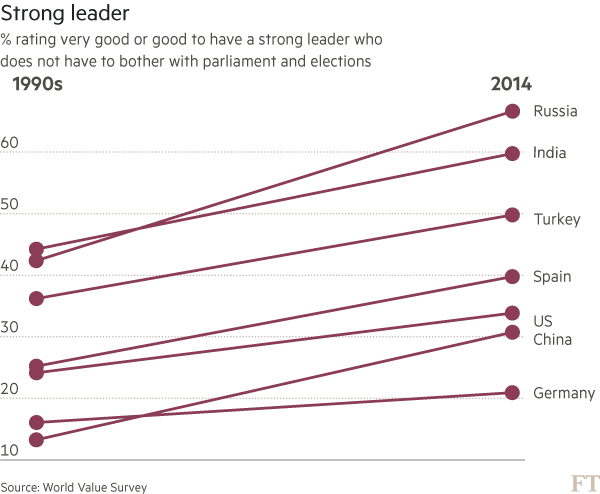
Trends in rejecting democracy

This plot from the Financial Times has been getting a lot of attention online. The data come from the World Values Survey (slightly incorrectly cited in the plot).

I don’t know what to make of it exactly, except to say that it supports my gut belief that Germany, more than any other country, understood after the Second World War, what it takes to cultivate a spirit of freedom and democracy. It was a long struggle, and they didn’t shy away from it. Education, the legal system, journalism: It’s the famous German thoroughness, applied to the problem of creating free citizens. The British, the Americans, and the French, each in their own way, considered democracy to be their inevitable birthright, and so have allowed relevant institutional arrangements and, even more importantly, the democratic spirit, to decay.

Maybe the Americans are just being more honest — in a Trumpian anti-PC way. Taboos are important. One important lessons that the Nazis understood was: Before you can commit unspeakable horrors, you need to find a way to make them speakable.

Good scandals

The US is just getting used to the idea of a president who will be running an international business marketing his name out of the Oval Office. Political journalists are fooling themselves in supposing that they’re going to have an easy time publicising scandals in the Trump administration. What’s a scandal, when the rulers are shameless? What could you find that would be worse than what has already come out during the campaign? And the mainstream will be pushing their carefully researched and reported evidence of malfeasance at the highest levels against social-network-distributed scandals on the other side, scandals about left-wing figures manufactured by Kremlin operatives or Macedonian teenagers. Of course, the made-up stories will be more piquant than the real ones. They are socially engineered to push every hot button, and so raise the public’s general shock threshold.

It seemed like a good time to repeat a post I wrote last year, about the importance for a healthy democracy to maintain its ability to be shocked: Continue reading “Good scandals”

Constraints

Maybe an opportune to repost something I wrote in June. Mitch McConnell had just remarked that Trump was no danger because “No matter how unusual a personality may be who gets elected to office, there are constraints in this country”. It reminded of the famous comment of Franz von Papen, leader of the Centre Party in the Weimar Republic, and the man who advised President Hindenburg to appoint Adolf Hitler as chancellor

Wir haben ihn uns engagiert. … Was wollen sie denn? Ich habe das Vertrauen Hindenburgs. In zwei Monaten haben wir Hitler in die Ecke gedrückt, dass es quietscht…

We hired him to work for us. … What’s the problem? I’m the one who has [President] Hindenburg’s confidence. In these two months we have completely backed Hitler into a corner.

He has such a wonderful way of connecting with the working class…

“Different methods”

Boris Johnson, proud of his subtle grasp of history, and of the Second World War in particular, has contributed to the Brexit debate by comparing the EU to the Third Reich:

“Napoleon, Hitler, various people tried this out, and it ends tragically,” he says. “The EU is an attempt to do this by different methods.”

I appreciate that goals and intentions are important, but one would tend to think that at some point, if the “methods” are sufficiently different, it does make a qualitative difference. Otherwise, one could attack the government’s attempts to calm ethnic tensions, and the grounds that Hitler also tried to resolve ethnic tensions through “different methods” (genocide rather than dialogue). Policies to ensure that businesses can find qualified workers? Sure, if you look at the details, improved education opportunities sound better than enslavement, but it’s really just quibbling over different methods.

Or plans to build motorways… well, I guess the methods weren’t particularly different, so that’s just fascist through and through.

Surfin’ NSDAP

I think we can all agree that the entire 20th century has conspired to make this sentence from the April 11 1933 NY Times the most bizarre political analogy since the New Jerusalem:

Screenshot 2016-05-12 09.28.28

Cleverly mixing his sports metaphors, Rev. Clinchy went on to say

Germany has been down for the count of nine and now she is arising to her feet and beginning to assert herself, and Hitler knows how to capitalize on that.

Hitler and Germany conducting a boxing match on a surfboard. The cartoon practically draws itself.

How to rid the world of genocide

One of my favourite Monty Python sketches is “How to do it“. It parodies a children’s show, teaching children how to do interesting and cool new things — in this case, “How to be a gynecologist… how to construct a box-girder bridge, … how to irrigate the Sahara Desert and make vast new areas of land cultivatable, and… how to rid the world of all known diseases.” The method described for the last is

First of all, become a doctor, and discover a marvelous cure for something. And then, when the medical profession starts to take notice of you, you can jolly well tell them what to do and make sure they get everything right, so there will never be any diseases ever again.

I think of this sketch often, when I hear a certain kind of blustering politician, most commonly (but not exclusively) of the US Republican variety. The classic sort of “How to do it” (HTDI) solution is the completely generic “I’d get the both sides into the room and tell them, c’mon guys, let’s roll up our sleeves and just get it done. We’re not leaving here until we’ve come up with a solution.” (That’s for a conflict; if it’s a technical challenge, like cancer, or drought, replace “both sides” with “all the experts”. Depending on the politician’s demeanor and gender this may also include “knocking heads together”.) The point is, they see solving complicated problems the way they might appear in a montage in a Hollywood film: Lots of furrowed brows, sleeves being rolled up, maybe a fist pounds on a table. It’s a manager’s perspective. Not a very intelligent manager. Of course, it sounds ridiculous to anyone who has ever been involved in the details solving real problems, whether political, technical, or scientific, but it sounds good to other people who have only seen the same films that the politician has seen. Continue reading “How to rid the world of genocide”

National typography

jekyllandhyde

I noticed this sign the other day in the Ruhr city of Hagen. It’s an Irish pub whose sign uses a sort of Gothic script that otherwise is used in Germany as a marker of conservative German gastronomy (as on this restaurant in Munich, since 1800), and that is used on pubs and restaurants elsewhere simply to signify “German”, particularly beer. Here, it’s Irish for some reason.

And on top of that, this Irish pub is named for a quintessentially London character (or is it two characters?) in a novel by a Scottish author. At least they got the shamrock right.

“I wish that I was a film comedian”

I’ve just been reading David C. Cassidy’s updated version of his Heisenberg biography, titled Beyond Uncertainty. He reports that in May 1925 Wolfgang Pauli, who was struggling together with Heisenberg to apply the new quantum theory to calculate the spectral lines of hydrogen, wrote in a letter

Physics is at the moment once again very wrong. For me, in any case, it is much too difficult, and I wish that I was a film comedian or something similar and had never heard of physics.

Here is a challenge for a young postmodernist film-maker: Produce the silent-film comedies that Wolfgang Pauli would have made, had he never heard of physics (or abandoned physics? Presumably they would have been different…)

Alternatively, a science fiction author could write about a universe governed by Charlie Chaplin’s quantum mechanics.

By their scandals you shall know them

I’ve always been impressed by German political scandals. More generally, I think that the quality of political scandals is an excellent indicator of the general health of a country’s political culture. More than 20 years ago I was in Germany during the Briefbogenaffäre, the “letterhead affair”, when the business minister and deputy chancellor Jürgen Mölleman was forced to resign after having used his department’s letterhead to tout a really banal business idea of his cousin (selling plastic chips to be used instead of one-mark coins to stick into supermarket trolleys as deposit), calling it a “pfiffige Idee” (clever idea). At the time I thought the whole thing seemed ridiculous, and simultaneously I was impressed at a political culture capable of being genuinely shocked by minor corruption. You couldn’t imagine an Italian minister being forced to resign over something like that.

Now there’s a new scandal, and Germany has again showed itself to be a country that takes democratic values seriously. About a week ago the blog netzpolitik.org, a major organ for German journalism about issues of internet freedom and privacy, received notification that the Generalbundesanwalt (GBA — basically, attorney general) that they were officially being investigated under suspicion of treason, for having published secret documents of the Bundesamt für Verfassungsschutz (BfV — the “Federal Agency for Defense of the Constitution”, the somewhat Orwellian name that Germany has bestowed on its internal secret police) relating to its new plans for mass internet surveillance with a special secret budget. The letter says that the investigation was provoked by a criminal complaint issued by the Verfassungsschutz.

What happened next was surprising. The Verfassungsschutz and the GBA were both strongly criticised in the press, with accusations that they were trying to stifle public criticism. Comparisons were drawn to the 1962 Spiegel Affair, a crucial event in postwar German history, where the government imprisoned journalists who had revealed secret documents showing weaknesses in German military preparedness, but was then forced to back down. Then the circular firing squad began. The justice minister criticised the decision as improper. The GBA office said they were obliged to act on the complaint from the BfV. The BfV said they only reported the facts to the GBA, they had no responsibility for the criminal investigation. Then the GBA fired back at the justice minister, saying his comments were an “intolerable interference” in the independence of the judicial system. Whereupon the justice minister fired him and had the investigation stopped.

It’s hard to imagine any important political or judicial figure in the UK or US losing his job because he was seen as being too aggressive in protecting state secrets against press freedom.

Quantum politics

According to The Guardian,

It is, perhaps, a measure of just how powerful she has become: Angela Merkelnow appears to be influencing youth slang. The compilers of Germany’s most popular dictionary say that the verb “merkeln” is on track to become the most popular “youth word” of the year… The word is none-too flattering, meaning being indecisive, or failing to have an opinion on something – behaviour that Germans often attribute to Merkel.

They attribute this characteristic to quantum physics:

Merkel observers put the chancellor’s approach down to her training in quantum physics, which leads her to work a problem through step by step like an experiment, rather than trying to predict its outcome in advance.

What’s weird is, first of all, that she’s not particularly an expert on quantum physics. Her doctorate is in physical chemistry, and while it did involve quantum mechanics, it also involved many other tools and methods equally well. Second, the characteristics they describe have nothing to do with quantum physics. They’re simply attributes of an experimental scientist (though I would have thought that scientists are more typically accused of being dogmatic and inflexible, more than of being indecisive).

Surely, if you’re attributing someone’s indecision to their training in quantum physics you have to make some reference to “uncertainty” or “quantum superposition”. Merkel is Schrödinger’s Kanzlerin.