Where USS puts its money

UK academics are all aware that the nationwide pension scheme, called the Universities Superannuation Scheme (USS), believes itself to have a huge budget shortfall, that can only be resolved with major cuts to pensions for future retirees (but no cut at all to current retirees, for some reason). So it was with some interest that I read about the recent crash of the national air traffic control system, caused by persistent underinvestment in critical infrastructure by the public-private company Nats:

Nats became a public-private partnership in 2001 under the last Labour government. It is 42% owned by Airlines Group, whose shareholders include the University Superannuation Scheme, British Airways, Monarch Airlines retirement benefit plan, easyJet, Virgin Atlantic, Deutsche Lufthansa, Thomson Airways and Thomas Cook Airlines.

Leopold Bloom’s speculations

I was just reading Ulysses for the first time in more than 20 years (actually, listening to the wonderful reading by Donal Donnelly), and among other things I was struck by the extent of Bloom’s scientific interests and speculations. But one other thing that jumped out at me was Bloom’s fantasy, as he is falling asleep, of schemes to raise money to become a country squire. One of those crazy hypnagogic schemes was similar to the scheme that I described as the reductio ad absurdum of financial technology, spending a large part of a billion dollars to reduce the communication time between New York and Chicago or London by several milliseconds:

A private wireless telegraph which would transmit by dot and dash system the result of a national equine handicap (flat or steeplechase) of I or more miles and furlongs won by an outsider at odds of 50 to 1 at 3 hr 8 m p.m. at Ascot (Greenwich time), the message being received and available for betting purposes in Dublin at 2.59 p.m. (Dunsink time).

Of course Bloom, being a sensible chap, puts this on a level with “A prepared scheme based on a study of the laws of probability to break the bank at Monte Carlo” and a plan to obtain riches by finding a lost dynastical ring “in the gizzard of a comestible fowl”. And winning a million pound prize for squaring the circle. And all of this he values primarily as an aid to sound sleep.

Tevye in the City

I recently read Sholem Aleichem’s Tevye stories (inspired by the wonderful book by Alisa Solomon, Wonder of Wonders: A cultural history of Fiddler on the Roof — they’re available now free from the Yiddish Book Center), and I was startled by several features. Tevye is a much more forward-looking figure than he appears in Fiddler on the Roof, which chose to emphasise the cultural divide between him and his daughters.

One thing that really caught my attention was that Tevye, before he got to marrying off his daughters, the travails of which are the basis for Fiddler on the Roof, lost all his savings in some vague financial schemes. The description is priceless, how his distant cousin Menachem Mendel

let me understand how he makes three rubles out of one, and from three — ten. First of all, he said, you invest a hundred rubles and then you order ten somethings — I’ve already forgotten what they’re called — to be bought for you; then you wait a few days until its price goes up. Then you send off a telegram somewhere with an order to sell, and with the money, to buy twice as much; then the price goes up again and you dispatch another telegram; this goes on until the hundred becomes two hundred, the two hundred — four hundred — eight, the eight — sixteen hundred, real “miracles and wonders”! There are people, he said, in Yehupetz, who just recently walked around barefoot, they were brokers, messengers, servants, today they live in their own brick houses, their wives complain of stomach ailments and go abroad for treatment. (Trans. Joseph Simon)

(Much of the imagery of the song “If I were a Rich Man” comes from this story.) As ever, finance was an extractive industry, fuelled by a steady stream of gullibility and greed, in varying proportions.

Anyway, this all reminded me, obliquely, that Tevye had an exact contemporary, who has recently been experiencing some great success on the small screen, having been updated and moved into modern London, namely Sherlock Holmes. I don’t mean to draw any comparison between the figures, but it seems to me that Tevye might do equally well in modern London. (Mad magazine moved him into the American suburbs in the 1970s, which was an obvious idea, but in some ways more foreign.) I could see him drudging away in a small hedge fund, trying to do the right thing, never getting to see his family, suffering with computer breakdowns, losing money through honest dealing, accepting the ups and downs of London real estate with his idiosyncratic proverbs, like

All life ends in death. We’ll all be dead some day, Golda. A man is like a carpenter: a carpenter lives and lives and dies, and a man lives and dies.

A plan to completely segregate British schools

It’s hard to believe this is not a cynical ploy:

The wealthiest parents should have to pay the same fees to send their children to a top state school as they would to an independent school, a leading headteacher has proposed.

Independent schools should also offer a quarter of their places to children from the poorest of backgrounds, according to Anthony Seldon, the master at Wellington College.

In a report published by the Social Market Foundation (SMF), Seldon calls for a radical wave of reforms to end the divide between state and independent schools, enhance social mobility and offer young people a more rounded education.

Maybe he’s just trying to “bring new money into the state system, as well as incentivise state schools to perform better”, as he says, while being too naive to understand the consequences. Seems unlikely. He also says his plans would “reduce the domination of places at the top state schools by the children of well-off parents”. Indeed it would, since children of well-off parents would be almost completely absent from state schools.

If you think the well-off aren’t paying enough for education, why not just raise their income taxes? Why specifically penalise them for sending their children to state schools? There is already a prejudice — often unfounded — that private schools provide superior education. Forcing out the upper classes — and that’s clearly what would happen, if they were to be charged the same fees for a school that is less exclusive, and thus apparently inferior. The only ones who would benefit would be the independent schools, which would no longer need to compete with the state sector on price. How convenient!

If you want to know what the benefits really are of British independent schools, a colleague made it clear to me a while back, when he said he sends his children to private school so that they learn “self confidence”. I was reminded of this recently when someone spoke to me about having heard about research about “perceived fair wages”. “Someone who’s earning £30,000 a year isn’t going to apply for a job with a £60,000 salary. He knows it’s out of his league, that he doesn’t have the skills for that.” Now, I’ve encountered this notion of “perceived fair wages” in the  analysis of wage inequality: in particular, that women often are paid less because they are conditioned to expect lower wages. (For example here.) But this fellow thought it was simply a matter of everyone having a good sense of their proper place.

So how do you get to be a self confident banker who refuses to roll over and let The Man cut his multi-million pound bonus? Presumably, that’s the job of the independent schools.

What is income?

A strange paradox has opened up in the magnificently cruel US healthcare system. The Affordable Care Act was supposed to subsidise people with modest incomes (above the federal poverty line) to purchase private health insurance. Those below the poverty line — in fact, 138% of the poverty line — were supposed to be moved onto free health insurance with Medicaid. But Medicaid is administered by the states, and quite unexpectedly many states with Republican governors have refused the Medicaid expansion, out of pure political spite, making a hash of this system: Now individuals in those states whose income is below the federal poverty line still don’t get Medicaid (unless they qualify for Medicaid under the old rules, which are much more restrictive), but they can’t get the health care subsidies because they don’t earn enough.

Ignoring the huge human suffering that is being intentionally inflicted, I find this situation fascinating, because it’s something that shouldn’t exist in the world imagined by quantitative finance. How can you have too little income to receive public assistance? After all, this isn’t about net income. They don’t have to do anything with the money. It just needs to be recorded as income. Someone can give me a cheque for $1000, in payment for “personal services”, and I can give it back to pay his bill for “financial services”. There. I’ve just gotten another $1000 in income. You’d have to put some extra organisational effort in to make sure that you don’t incur any tax obligations.

But the point is, in the world of high finance, there isn’t a category of “income”. There’s just money. And they don’t leave money on the table just because there’s not enough in one particular accounting category. But the poor don’t just lack money; they don’t have people to structure their transactions in beneficial ways.

Compute the interest

Another comment based on Sharon Ann Murphy’s wonderful book on 19th century life insurance in the US: She describes an 1852 case in which the American Mutual Insurance Company tried to renege on a claim, where a preëxisting condition was found in an autopsy.

Not surprisingly, the jury sided with the beneficiaries; they “were out thirteen minutes, just long enough to compute the interest” on the original claim.

Indeed, the verdict is not surprising. What is most surprising, however, is that the jury computed the interest. I wonder how likely it is that a jury of twelve today would include even a single person capable of computing compound interest.

Some questions about US debt default

Some things that genuinely confuse me about the looming (again) threat that the US will default on its debts:

1) Why is it the Democrats’ problem? Why is it President Obama’s problem? Who is taking whom hostage? A debt default doesn’t particularly affect Democratic constituencies. I’d expect that Republican business interests would be more directly concerned. Why can’t President Obama threaten to veto a bill raising the debt ceiling unless the Republicans agree to attach an infrastructure stimulus bill and raise the minimum wage? Is it just that the president has the direct responsibility for coping with the financial shitstorm that would follow breeching the debt ceiling?

2) Why doesn’t the looming government shutdown obviate the default threat? I see political commentators making arguments that a government shutdown will purge some of the Republican bile, and so make a debt default less likely. And Matt Yglesias points out that some people seem to think (erroneously) that not raising the debt ceiling will save the government money. But a government shutdown clearly does save a lot of money. So, as long as that’s going on, presumably government outlays will not exceed its income. Maybe it’s a technical problem, preventing debt from being rolled over at all. [Update below]

3) Why is it such a big deal? I don’t mean, why is it a big deal? I mean, why is it such a big deal. The standard belief, as summarised here, is that the US breaching its debt ceiling will have long-term repercussions for financial markets, only the least important of which would be permanently raising the cost of US government borrowing. I have commented earlier about the peculiar faith the bankers have that past defaults are uniquely significant for predicting future defaults. Surely if I’m thinking of lending money to the US Treasury, the fact that two hundred Republican firebrands blatantly take no responsibility for US debt repayments and think that playing chicken with debt repayments is a great way to score ideological points should make me uneasy. The fact that they have already pushed it over the brink would marginally increase my unease, but the total effect would depend on how that exercise came out. Did they get a good warm feeling out of it, or was the outcome shocking and unpleasant, so that they would be very unlikely to choose this tactic again in the near future. If the latter, then I’d be more inclined to focus on the fundamental solvency of the US government, which is obviously very good.

Obviously, I’m not a banker, but I wonder if they’re being rational, in at least the house-of-mirrors sort of “the value of a bond is what people think people think people think people think … people think it’s worth” way. Of course, once you’ve iterated ad infinitum pretty much any answer can come out.

[Update 30-9-2013: By way of Andrew Sullivan comes a link to this explanation (from Zeke Miller at Time): Continue reading “Some questions about US debt default”

Insider trading and the birth of America

In Walter Isaacson’s biography of Benjamin Franklin I’ve just encountered the following anecdote. Edward Bancroft was secretary to the American commissioners — Franklin, Silas Deane, and Arthur Lee — who were in Paris negotiating the crucial military alliance with France. The British were desperate to forestall this alliance with their own peace overtures:

The British sent to Paris the most trusted envoy they could muster, Paul Wentworth, their able spymaster. At the time, Wentworth was angry with his secret agent Bancroft for sending inside information to his stock-speculating partner before sending it to Wentworth, who was also a speculator. King George III, upset by the bad news that his spies were giving him, denounced them all as “untrustworthy stock manipulators”, but he reluctantly approved Wentworth’s secret mission.

And indeed,

years later, when he was haggling with the British over back pay, Bancroft wrote a secret memo, telling the foreign secretary that this was “information for which many individuals here would, for purposes of speculation, have given me more than all that I have received from the government.” In fact, Bancroft had indeed used this information to make money speculating on the markets. He had sent 420  pounds to his stock partner in England… and provided him word of the impending treaties, so that it could be used to short stocks… Bancroft ended up making 1000 pounds in the transaction.

I find it delicious to think that American independence was made possible, or was, at least, expedited by British agents’ clumsy insider trading.

(Anyone who is interested in the culture of speculation and market-manipulation driven by political information, and also enjoys a good philosophical yarn, should read Neal Stephenson’s Baroque Cycle.)

Gambling and finance: The 17th century view

I’ve commented on the peculiar dissipation in recent times of the moral stench of gambling, particularly as practiced by the quant elite, who seem at times to revel in their role as gamblers. But I discover now that I was preceded by more than 3 centuries by Daniel Defoe, in his brilliant Essay on Projects:

Wagering, as now practised by politics and contracts, is become a branch of assurances; it was before more properly a part of gaming, and as it deserved, had but a very low esteem; but shifting sides, and the war providing proper subjects, as the contingencies of sieges, battles, treaties, and campaigns, it increased to an extraordinary reputation, and offices were erected on purpose which managed it to a strange degree and with great advantage, especially to the office-keepers; so that, as has been computed, there was not less gaged on one side and other, upon the second siege of Limerick, than two hundred thousand pounds.

This last extraordinary remark, that people were wagering vast sums on the outcomes of sieges. (£200 thousand in the 1690s is probably like £20 million today, or $30 million.) And he goes on to use gambling on the outcomes of siege warfare to present a fascinating example of a sort of arbitrage called a “dutch book”: Combining different wagers with different parties so as to obtain a cumulative certain profit. (De Finetti’s “Dutch Book Theorem”, stating that you need to calculate with something indistinguishable from the standard rules of probability if you don’t want to fall victim to someone else’s dutch book, is the basis of certain approaches to the foundations of probability.) Continue reading “Gambling and finance: The 17th century view”

Geodesic finance

chicago_ny newcable

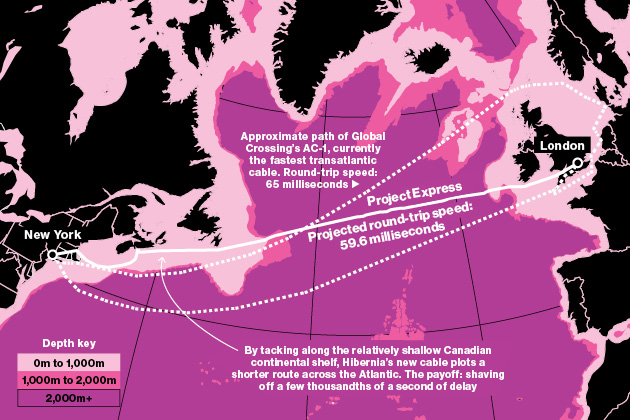
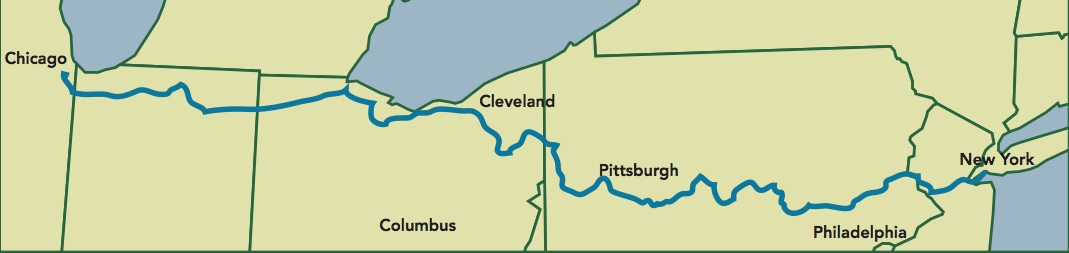
When I’ve written about the pernicious influence of high-tech finance, I’ve tended to emphasise the brain-drain and the flim-flam (the destructive influence on capital that gets drained into the pockets of the quants, and the embarrassing perversion of research priorities in mathematical sciences). But capital flows have no effect until they are realised in real-world allocation of resources. This is why I’ve been so dismayed by recent reports on investments being made in new fiber-optic lines connecting New York with Chicago and London. According to Businessweek private firm is spending $300 million to lay a transatlantic cable that is slightly shorter than the existing line, allowing round-trip transmission times to be reduced from 65 milliseconds to 59.6 milliseconds. And Forbes reported a few years back that another company was spending $300 million to reduce the New York-Chicago latency from 16 to 13 milliseconds.

What’s the point? Well, it’s pretty obvious that getting information quicker enables you to profit. Mark Twain was writing about this more than a century ago: In “Cecil Rhodes and the Shark“, where a young Cecil Rhodes makes his first fortune speculating in wool, based on foreknowledge of the Franco-Prussian war, gleaned from a newspaper found in the belly of a shark in Sydney, 50 days ahead of any ship-bound news reports from Europe. Continue reading “Geodesic finance”