
The British tend to view Donald Trump as an unprecedented only-in-America freak. Self-glorifying libertine billionaire turning his media ingenuity and unbounded reserves of cunning ignorance into a nativist political career. Racism and misogyny lightly disguised as heroic candour. The strongman allure, and the tendency of opponents to dismiss him as a buffoon. He’s the American Berlusconi. Which should serve as a warning to anyone who thinks he can’t possibly win.
Tag: Europe
The Shabbat automobile (and other regulatory subterfuges)
It reminds me of the questions that folklorist Alan Dundes raised in his book The Shabbat Elevator and other Sabbath Subterfuges: Why do Orthodox Jews adopt enormously rigid strictures on every element of their lives, and then devote enormous energy and creativity to evading them, as when they tie a string around a whole neighbourhood to make an eruv, defined to be a single residence for purposes of the law that bans carrying objects in a public domain.
One could well ask, if a set of customs is deemed overly oppressive, why not simply repeal or ignore them?
At least they can argue that repeal isn’t really an option when you’re talking about divine law. But what about automobile pollution regulations?
Amid all the attention focused on Volkswagen’s bizarre cheating on diesel emissions tests — which ought to, but probably won’t, lead to multiple executives spending long terms in prison — some interesting lessons about the general nature of regulations and testing threaten to be submerged. As many have pointed out, real diesel emissions are many times higher than those permitted by regulations. The tests are routinely evaded, if not always as creatively as Volkswagen has done. Some examples: Continue reading “The Shabbat automobile (and other regulatory subterfuges)”
Warnings
Suppose your football coach exhorts the team with all the great coach clichés: “We win or lose together”, “There’s no I in ‘Team'”, maybe “We can still win if we pull together and give 110 percent in the second half”. Would anyone say this was a “warning”? But when Angela Merkel says Europe needs to work together to deal with the current influx of migrants, we get this headline in the Guardian:

It reminds me of the peculiar set of mandatory texts that were introduced for cigarette packets in the US in 1981: Among the warnings of carbon monoxide and foetal injury was this one:
SURGEON GENERAL’S WARNING: Quitting Smoking Now Greatly Reduces Serious Risks to Your Health.
“Greatly reduces serious risks to your health” doesn’t sound like a warning to me.
National typography
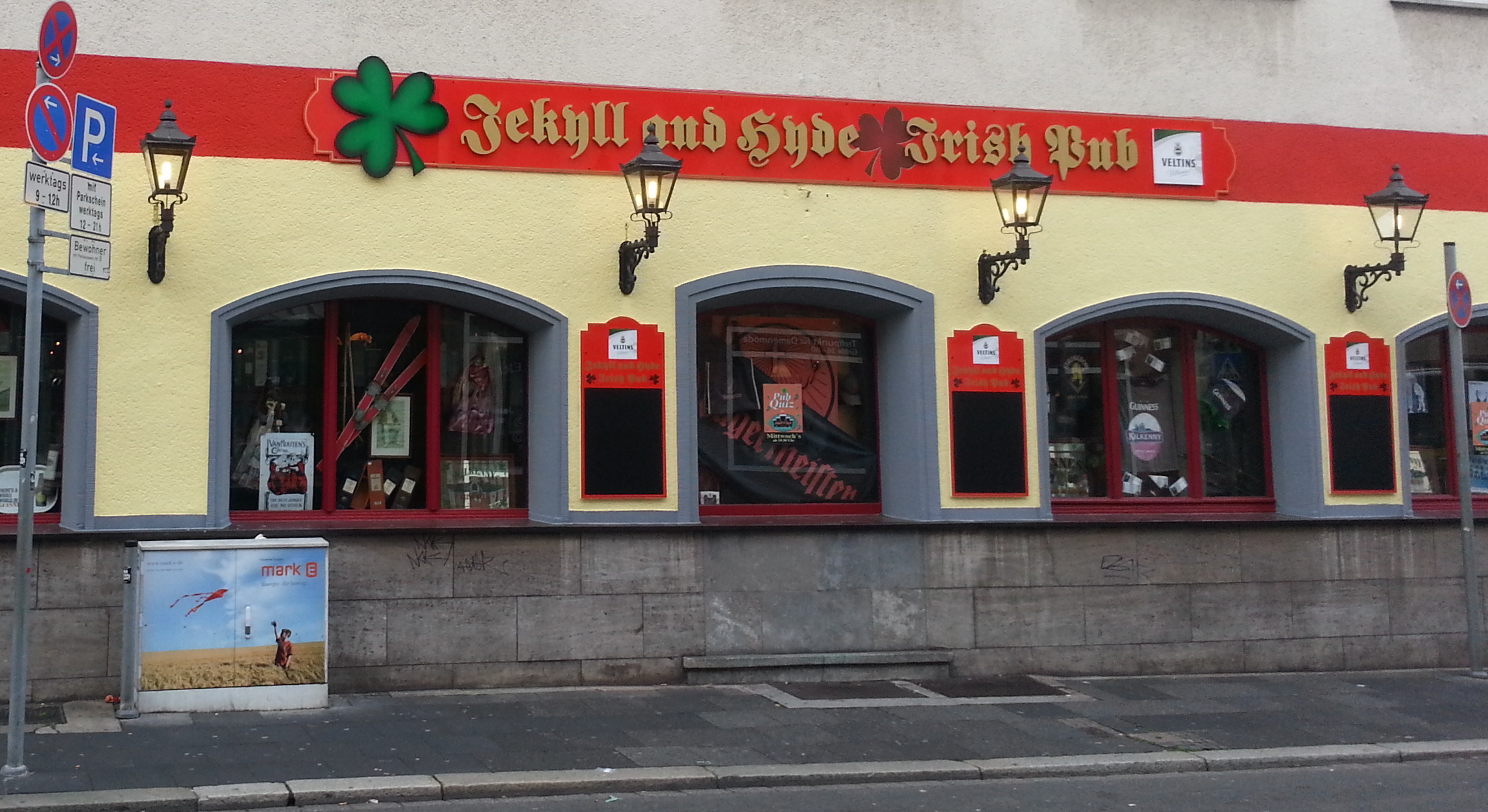
I noticed this sign the other day in the Ruhr city of Hagen. It’s an Irish pub whose sign uses a sort of Gothic script that otherwise is used in Germany as a marker of conservative German gastronomy (as on this restaurant in Munich, since 1800), and that is used on pubs and restaurants elsewhere simply to signify “German”, particularly beer. Here, it’s Irish for some reason.
And on top of that, this Irish pub is named for a quintessentially London character (or is it two characters?) in a novel by a Scottish author. At least they got the shamrock right.
The man with the Kalashnikov
Having been on a Thalys to Paris yesterday I took particular interest in the aborted attack the previous day. We hadn’t heard anything about it, but a conductor told us a bullshit story about how the news media got the story all wrong: the attacker was actually being followed by police, the capture was planned, and he didn’t have firearms.
But here’s what I’m wondering. According to the NY Times,
Less than an hour away from Paris, a French passenger got up from his seat to use the toilets at the back of the carriage. Suddenly, in front of him rose a slightly built man. Across the man’s chest, in a sling, was an automatic rifle of the kind favored by jihadists the world over: an AK-47.
The passenger threw himself on the man. The gun went off, once, twice, several times. Glass shattered. A bullet hit a passenger.
The man with the gun kept going down the carriage, holding his AK-47 and a Luger pistol. In a pocket was a sharp blade capable of inflicting grievous harm. He had at least nine cartridges of ammunition, enough for serious carnage.
So, they’re heroes. But if this had happened in the US, would they be the ones in prison? After all, up until the point where they attacked him, he was just another open-carry enthusiast celebrating his constitutional right to keep and bear arms. Once he was attacked, of course, by rowdy foreigners, it is perfectly understandable that he started firing. And even if he did fire a single shot first (the news reports disagree on this point), well, how could they have known that it wasn’t self defence. They should have waited until he’d shot at least two people before infringing on his civil rights.
Maybe that’s why they don’t have trains in Texas… (Actually, that’s not entirely true.)
Singing the Swedish national anthem
When someone speaks incomprehensibly, an English speaker will be inclined to reference Shakespeare’s Julius Caesar, saying “it was Greek to me”. But what does a Greek finance minister say when no one understands him at Eurogroup negotiations? From an interview with Yanis Varoufakis in the New Statesman:
There was point blank refusal to engage in economic arguments. Point blank. You put forward an argument that you’ve really worked on, to make sure it’s logically coherent, and you’re just faced with blank stares. It is as if you haven’t spoken. What you say is independent of what they say. You might as well have sung the Swedish national anthem – you’d have got the same reply.
Greece and the lessons of Versailles
After commenting on the fake “assistance” that the Euro countries have bestowed on Greece for the past five years — stabilising Greece just far enough to get international banks clear of the falling debris, and then pushing it off the cliff — it occurred to me that this ties in usefully with the discussion that has been bubbling up — from Thomas Piketty among others — of how chief scold Germany had its debts written off after both world wars. Or, rather, it defaulted on its WWI debts as preparation for initiating WWII; the world then decided to cancel most of its debts after WWII — including debts to Greece — at the London conference of 1953. It would be hard to say that Germany in 1953 was more deserving of international assistance or forgiveness than Greece today. In part, this reflects the predilection for strong villains: Germany was seen as inherently strong, if currently weakened; Greece is viewed with contempt, for its weak and corrupt political system. Having reduced much of Europe to rubble and murdered millions is just one of those misadventures that befall those with big plans. At least you knew, if you bailed out Germany, the money wouldn’t just be wasted…
European Seilschaften
The image of Seilschaften, of a group of mountain-climbers connected by a rope, is as frequently used in German political discourse (both verbal and visual) as cricketing terminology in British. One common use is to represent self-interested political actors who look out for each other reciprocally. But the Greek crisis puts me to mind of a different sense of the term. The nations of the EU climbing the mountain of prosperity. Greece is lagging, but is also stuck in a position where it is blocking other members of the party. So they offer generous assistance, just long enough to manoeuvre it into a place where they can cut the rope and let it fall into the chasm without taking anyone else with it. Of course, there’s the extra piquancy that Europe’s leaders were primarily protecting private banks rather than their citizens and taxpayers.
Plus ça change: Partition of Poland edition
If you wanted to refer to a paradigmatic example of wanton brutality in international affairs, the invasion and division of Poland by Nazi Germany and the Soviet Union in 1939 would likely spring to mind. That’s why I was struck by the 1903 remark on the Boer War cited by Richard Toye in his book on Churchill’s imperialism:
Bourke Cockran, Churchill’s Irish-born politician friend, thought the war to be “the greatest violation of justice attempted by any civilized nation since the partition of Poland.”
I suppose now you could say, “the partition of Poland was the greatest violation of justice since the last partition of Poland.” You’d leave out the “civilized nation” bit, not exactly because Nazi Germany and the Soviet Union wouldn’t qualify, but because the concept no longer seems to have much explanatory power.
Irritating false friends
According to Reuters the German Bundestag member Volker Kaude described the new proposals for the Greek financial crisis from European Commission president Juncker as “irritating”. It’s an odd word choice. It would be quite exceptionally blunt if he had said it. Of course, he didn’t.
Turning to German-language media we see that what he actually said was that he was “einigermaßen überrascht über die irritierenden Aussagen aus Brüssel”. “Fairly surprised by the odd comments from Brussels.” “Irritierend” looks like “irritating”, but its primary meaning — and clearly the one intended here — is something more like “puzzling”. It’s diplomatic for having a range of meanings from neutral to negative. I don’t get it, and I don’t think it’s entirely my fault.
Reuters might need to invest in something more sophisticated than Google for its translations.
 Common Infirmities

