Spying on the UN: The majestic equality of the law

One of the superficial arguments made against Edward Snowden is, He signed a contract, for crying out loud! He agreed not to reveal this information. And he broke the law. So, of course, he belongs in prison.

Let’s talk about some of the other people who violated the contracts they signed and broke the law. People like Barack Obama. Just to pick an example at random, we have today in Der Spiegel (odd that it hasn’t appeared yet in the English-language press, so far as I have seen):

The US clandestine service NSA has been spying not just on the European Union, but also on the United Nations Headquarters. That has been revealed by secret NSA documents that Spiegel has examined.

According to these, the NSA succeeded in the summer of 2012 in penetrating the videoconference system of the community of nations, and to break the encryption. This “dramatically improved the data received from video-teleconferences and the capacity to decrypt these data,” according to one secret NSA document. “These data transmissions deliver to us the internal video-teleconferences of the United Nations (yay!)”. Within three weeks the number of decrypted communications rose from 12 to 458.

The US is committed by treaty not to conduct clandestine operations against the UN or the national representations there. “yay!” indeed. It’s good to see that violations of international treaties are considered with an appropriate level of seriousness within the agency.

So Barack Obama — and his security agents — have violated solemn treaties, ratified by Congress, hence part of the “supreme law of the land”. So do those who break the law definitely belong in prison? What about those who have revealed information that they have pledged to keep secret? Or is there some wiggle room to consider justifications and rationales for breaking the law?
Can Russia stab us in the back?

Who knew that things had gotten so intimate between the erstwhile Cold War adversaries? Senator Charles Schumer (of New York) says

Russia has stabbed us in the back, and each day that Mr. Snowden is allowed to roam free is another twist of the knife.

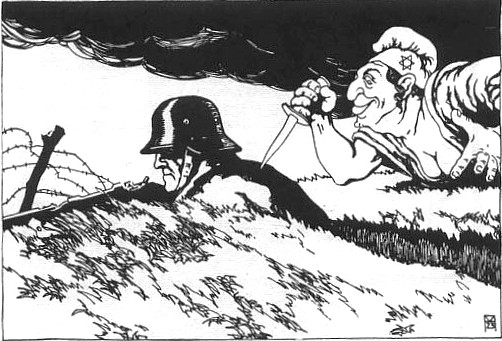
As Mr Schumer surely knows, the “stab in the back” is a favourite antisemitic trope, or more generally a reference to treacherous fellow citizens who are “behind us” because we think we can trust them, while our eyes are focused on the enemy across the border. They are the internal enemy, taking advantage of our attention focused on the external enemy.

1919 Austrian postcard.
In Schumer’s telling, Russia is the one on the right.

Now, Russia is a powerful nation, and I hope that the US has a reasonably cooperative diplomatic relationship to it, but I would never have thought it was a US ally.

So, what I want to know is, who screwed up and let the Russians have our backs?

Of course, we wouldn’t have this problem if Snowden (like Bradley Manning) was gay. Maybe we should stop giving security clearances to heterosexuals. It’s too easy for them to get asylum…

Politics and Plagiarism in Germany

There’s a new plagiarism scandal in the German Bundestag! [link in German]

“A nation reveals the nature of its political culture in its choice of scandals.” That’s not a maxim, but it ought to be. I first thought of it in 1992, when the German economics minister and vice-chancellor Jürgen Mölleman was forced to resign because of what was called the “Letterhead affair”: He had used departmental stationary to write in support of a relative’s business marketing to wholesalers a plastic chip that shoppers could keep in their wallets and use instead of a 1-mark coin as the deposit on a shopping trolley. “A clever idea!” he enthused. (“Eine pfiffige Idee.”) At the time I thought it reflected well on German politics, that they could hatch a scandal of such unrelieved banality; I compared it with Italy, where at the same time politicians in the pay of organised crime barely rated a mention in the national news unless underaged prostitutes were involved.

In the past couple of years the German government has been repeatedly roiled by plagiarism scandals. What? I hear you cry. How can a politician commit plagiarism? (Barack Obama refusing to admit that his first book was ghostwritten by Mumia Abu Jamal isn’t plagiarism.) Okay, there was Joseph Biden cribbing his stump speech from Neil Kinnock, but plagiarism is one of those crimes that only certain people can commit — like adultery, or violating the secrecy of the confessional — and those people are writers and academics. Politicians aren’t paid for original turns of phrase. Continue reading “Politics and Plagiarism in Germany”

In America everyone lives like royalty

Twice as well, actually, at least when giving birth. According to this article, the hyperluxury private hospital wing where the DoC gave birth to our new royal master, may have cost as much as £10,000, or $15,000. The average American woman gets twice as good a birth experience, worth $30,000 according to the bill, which must be a pretty goddamned awesome hospital suite. And then, because this is such an amazingly great country, she gets the price discounted so that only $18,000 has to be paid, on average. What a deal! It’s no wonder that Americans refuse to be reduced to the kinds of primitive, parsimonious conditions that even the future queen is subjected to in England.

Kate’s lucky she got out of there before they set the leeches on her.

Privacy rights in Germany

Unlike the US, Germany has a constitutional court that doesn’t kowtow as soon as the government yells “National Security”. Whereas the US Supreme Court has chosen to rewrite Catch 22 as a legal judgement, saying effectively that no one has standing to challenge secret government surveillance programs, because they are secret, hence no one can prove (using information the government will allow to appear in open court) that they have been affected.

Deutschlandfunk’s science programme Forschung Aktuell has been reporting this week on problems of information technology, security, and privacy, and today I learned (transcript in German)

In 2001 the police chief of Baden-Württemberg Erwin Hetger demanded a programme of advance data storage, by which all connection data of web surfers in Germany would be stored for six months.

“I think we cannot allow the Internet to become effectively a law-free zone. Hence my clear and unambiguous recommendation: Whoever moves about on the Internet must be willing to accept that his connection data are stored for a fixed period of time.”

The Bundestag did, in fact, pass such a law in 2007. But in 2010 the Constitutional Court annulled the law.

While such advance data storage is not necessarily impossible under the German constitution, the constitutional requirements for such an action would be very strict, and were not satisfied by the law that was passed.

The president of the Constitutional Court Hans-Jürgen Papier specifically emphasised that if such data were to be stored, it would have to be done in a more secure way than the law had required.

The comparison of this process — where the basic parameters of privacy rights and government snooping are set by the normal democratic process of legislatures passing laws that are then reviewed in publicly accessible court decisions — just makes clear how supine the US courts and Congress have been, as has been the UK parliament.
Continue reading “Privacy rights in Germany”

Though this be madness, yet there is method in it

One of the key lessons of emotional game theory is that madness — or, at least, the convincing appearance of madness, which may amount to the same thing — can be an effective strategy. You can win some otherwise unwinnable games (Chicken being a favourite example) by convincing your opponent that you are too fixated, angry, or suicidal to be persuaded by threats and/or appeals to what may seem to be mutual best interests.

This seems to me the only way to understand the response of the US government to Edward Snowden. If the most recent news reports are to be believed, the US has somehow persuaded European governments to practically kidnap the president of Bolivia, because they believe Snowden might be on the presidential plane, flying to asylum. The lesson to future whistleblowers is clear: There’s no point trying to game out the usual protocols, the law, or even what might seem to be too much trouble or too embarrassing for the Americans. If you embarrass the US government, and particularly its clandestine services, they will go full berserker.

That was something of the sense I had after 9/11: The torture, the pointless war in Iraq, it wasn’t so much a means to an end, as a direct demonstration that the US was not going to respond in any proportionate, rational, or even legal manner.

The actions of the Europeans are pretty shameful. At the same time that they are howling about the crimes that Snowden has uncovered, they are conniving at US attempts to treat him as a criminal, rather than a political dissident. Germany, among others, has dismissed Snowden’s application for asylum by saying that he first needs to get to Germany before it can be considered; but, of course, they won’t let him come now that the US has revoked his passport.

Freedom of religion in Britain and Germany

After the monarchy, state-sponsored religion is one of the strangest customs I’ve had to adapt to in the UK (and Germany, the other European country that I’ve lived in for a number of years). In the UK I’ve already written about the somewhat insidious role of state religion, such as the way it dictates which schools your children will be admitted to; that 26 bishops sit ex officio in the House of Lords (though it should be mentioned that the other state religion, Finance, has its own peculiar kind of special representation in the Commons); and that non-Anglican foreigners who wish to marry in the UK require permission of the Home Office, for which they must pay a substantial fee. (This Anglican exception may now have been rescinded; I know there was pressure from the European Court of Human Rights.) All UK state schools are required — following a Blair-era edict — to have daily Christian prayer (unless they are state-sponsored non-Christian religious schools, another Blair novum), though that law is not always followed, particularly in secondary schools — see par. 141 of this Ofsted report.

Germany is a federation in most respects, with wide variation in religion and religiosity, but a requirement for church-approved religious education (of two flavours, Catholic and Protestant) in the schools is anchored in the constitution. The federal government collects tax on behalf of the churches. And the churches, which control a significant portion of the hospitals, among other businesses and institutions — are allowed to discriminate against their employees in ways that would be forbidden, and indeed morally condemned, by any other employer. A recent court decision in Germany concerns a 60-year-old pediatric social worker, who worked for the Catholic organisation Caritas. Shocked and appalled by the extent of child-abuse perpetrated and covered up by the Church, he officially left the Church. (In other countries it’s not clear how you would officially stop being Catholic, other than by joining another church, but in Germany you just stop paying tax and you’re out. Reassignment of your soul’s eternal fate follows in 4 to 6 weeks.)

So the Church, which knows how to respond to a major breach of moral and ethical norms, clearly couldn’t stand for the scandal of a social worker in their employ taking a public stand against sexual abuse of children. And while being Catholic was apparently not a requirement of the job to begin, the courts agreed that being an ex-Catholic is forbidden, particularly one whose break with the Church was provoked by something so unseemly as individual conscience.

Beware the Dijsselbomb!

Why are rich people so squeamish about the truth?

Some very smart people have taken to the Internet to ridicule Eurogroup president and Netherlands finance minister Jeroen Dijsselbloem for his inappropriate attack of clear speech. He said that “the Cyprus deal will serve as a template for future bank restructurings in the euro zone.” Sounds like something to cheer: Deposit insurance has been affirmed, but implicit taxpayer guarantees for wealthy bank creditors have been repudiated.

But instead we have Matt Yglesias saying “That’s the kind of remark that it would be very sensible for, say, a blogger to make. But Dijsselbloem is president of the Eurogroup of eurozone finance ministers, and a guy in his role is supposed to be reassuring people. Instead he caused them to panic.” And so Meneer Dijsselbloem issued another statement saying that of course the Cyprus bailout isn’t a template for anything, because every financial crisis is a unique special flower and no other European tax haven is an island and you can’t step into the same river twice… Continue reading “Beware the Dijsselbomb!”

Pirates

500px-Flag_of_Edward_England.svg Piratenlogo

Outside of Germany, no one seems to have noticed the extraordinary efflorescence of a new party, Die Piraten, the Pirate Party. (Also, no one seems to have noticed that the German word PARTEI — political party — is an anagram of PIRATE.) It’s an international movement, of course, and I suppose it started in Sweden, with links to the Pirate Bay file-sharing site. As with many such political movements — fascism and the Green movement are just two examples — Germany has proved a particularly fertile ground, and the most recent state elections in Nordrhein-Westfalen found the Pirates winning 7.8% of the votes, nearly as many as the liberal FDP. Interestingly, that vote has drawn quite a bit of attention in the foreign press for its undermining the ruling coalition, but no one outside of Germany is talking about the Pirates.

There is a long tradition, going back to Cicero — and continuing through Gilbert and Sullivan — of invoking pirates as an ironic commentary on rapacious rulers, extended to rapacious capitalists by Bertolt Brecht and others. The association of piracy with illegal copying of artistic works goes back to the 17th century in England, as I learned from Adrian Johns’s magisterial book Piracy rights, where I also learned that the earliest designation of copying as piracy did not describe neglect of an author’s right to earn a living from his work (which right was nonexistent), but rather neglect of the king’s right to censor. A pirate was not someone who stole a poor scribbler’s hard-fought text, but rather one who arrogated to himself permission to publish without royal license. More recently, pirate radio expressed the opposition between piracy and censorship.

I find myself enormously encouraged by this movement. Their stated goals are ones I generally support: reform of intellectual property laws, data protection, civil rights and government transparency. But there’s not enough there to really make up a political program. I see it in generational terms. It may not be true that all property is theft, but it certainly seems that those who got into the world before us have gone out of their way to make sure that everything that exists has been carved up and allocated to owners, up to and including the land, the sea, their ideas, their music, and their genetic code.

German election poster
Greens: Every power needs something to drive it
Pirates: Strengthen education. Understand Physics.

Here’s an election campaign poster of the Piraten in NRW. The Greens on top with one of their solemn eco posters: Windmills and the slogan “Every source of power needs a driving force” (approximately), and then “Green makes the difference.” What does it mean? Damned if I know, but it sounds green!
Below it the Piraten put a graphically much cruder retort to this vaguely pious blather:
“Strengthen education. Understand physics.
You’d rather vote for the Pirates.”

Greek contagion

Since yesterday, news reports are full of comments like this:
Many economists fear that if Greece exits the euro, it could lead to financial contagion, as investors and ordinary bank depositors in other eurozone countries may fear that their own government will follow suit.

What does this mean? Are the Spanish looking to the Greeks as a model? That would be really weird. Esos griegos tenían un gran éxito con su incumplimiento de las deudasHagámos lo mismo. Or is it a matter of queueing up? Greece has first dibs on default, and Spain just has to wait its turn. Or is this setting up a resonance in a Sheldrakian morphic field of default patterns? Perhaps we are witnessing the final consummation of the marriage of 21st century mathematics and 20th century pseudoscience that finance has been tending toward for the past three decades (at least).

Surely the impact on investors will depend in part on the effects seen from a Greek euro withdrawal. At the very least If we think back to recent history, presumably any reasonable person would have thought, after the Lehman Brothers shit-storm, that the US financial authorities would be less likely to allow another similar bankruptcy to proceed. So, if Greece leaves the euro in a ball of flames, Spain will be unlikely to see it as a model. And if Greece’s exit from the euro isn’t so terrible then… maybe it’s just not so terrible.