
Scotland, England, and Europe

I have no clear opinion about the upcoming referendum on Scottish independence — on the one hand, as a citizen of another former English colony, I understand the emotional appeal of revolution. On the other hand, as a current resident of England I fear the ensuing chaos, and rationally I really don’t think the negative consequences will necessarily — or even primarily — be felt south of the border. Furthermore, a UK without Scotland will be more conservative (and Conservative) and more xenophobic and anti-Europe.

This last point does suggest, though, a convenient resolution to one of the sticking points of Scottish independence — membership of the EU. The current UK government claims that an independent Scotland would have to negotiate membership like any other new applicant, and so would certainly lose the opt-out from the Euro, and other benefits, if secession-fearing members like Spain don’t block Scottish membership altogether; the Scottish nationalists say they would be negotiating a change of terms from inside the EU. But the Conservatives — who would doubtless attain a majority in a Scotland-free Parliament — have promised a referendum on withdrawal from the EU in the near future. Perhaps these could be coupled, and Scotland could simply inherit the UK seat in the EU. It would save everyone a lot of strife.

But saying that, it makes me wonder about the outcome of the EU referendum. I’d always assumed that Scottish independence would guarantee the UK’s exit from the EU. But would politicians in London really be willing to see their counterparts in Edinburgh and Dublin making European policy, and themselves excluded? It seems hard to imagine.
“Continent cut off…”

The news this weekend is dominated by reports of how the entire EU failed last week to reach agreement with David Cameron on the next president of the EU Commission, and had to settle on a compromise candidate, Jean-Claude Juncker, supported only by the non-British faction of the EU. Only Hungary — despite its borderline fascist government — was able to garner Cameron’s support, while the remaining 26 EU members had to make do with the bare consolation of having their preferred candidate take office.

(This was right after soccer teams from many nations were brusquely snubbed by the England side, who could not be persuaded that the quality of the other team’s playing was such as to keep them from attending to other pressing engagements back home.)

Senior Conservatives were not magnanimous toward the defeated EU, accusing other national leaders of “cowardice” for refusing to publicly defame the EU leader whom they had agreed to, and would consequently be working with in the coming years, despite the fact that some of them had not at first considered him their favourite candidate.

Iain Duncan Smith, the Work and Pensions Secretary, said Britons “will be proud that at last they have a Prime Minister who has demonstrated that he puts the interests of Britain first — regardless of who or what is pitted against him.” Perhaps the leader most determined to assert British interests against Europe since King Harold II, who was also famous for keeping his eye fixed (on real reform). They were similarly disdainful of reports that Pope Francis has not completed a conversion to the Anglican Church, and are seeking further investigation of reports that a large ursine has been seen defecating in a forested tract. Continue reading ““Continent cut off…””

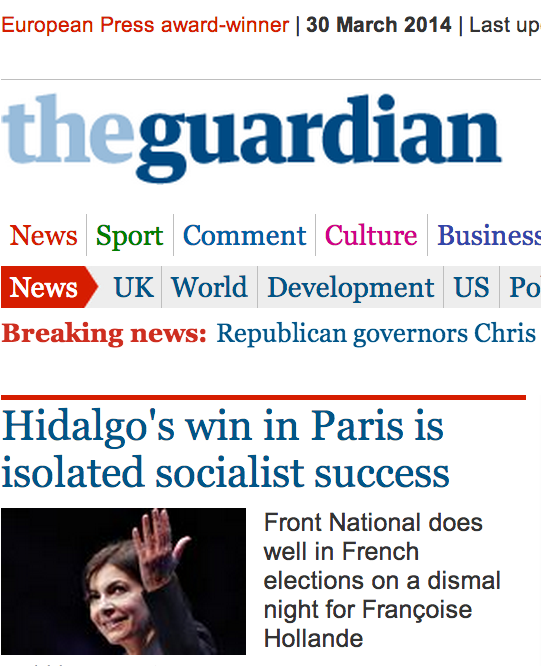
The Guardian got tired of waiting for France to elect a woman president

… so they decided to change the sex of the current one.

Guardian headline mentioning "Françoise Hollande"
Presumably Françoise is the one in the photo

I’m guessing that European Press Award they mention wasn’t for the excellence of their copyediting. I wonder if there’s some subliminally intentional slur in the way the Guardian made the French president a woman, while the NY Times made the German chancellor a man.

Tevye in the City

I recently read Sholem Aleichem’s Tevye stories (inspired by the wonderful book by Alisa Solomon, Wonder of Wonders: A cultural history of Fiddler on the Roof — they’re available now free from the Yiddish Book Center), and I was startled by several features. Tevye is a much more forward-looking figure than he appears in Fiddler on the Roof, which chose to emphasise the cultural divide between him and his daughters.

One thing that really caught my attention was that Tevye, before he got to marrying off his daughters, the travails of which are the basis for Fiddler on the Roof, lost all his savings in some vague financial schemes. The description is priceless, how his distant cousin Menachem Mendel

let me understand how he makes three rubles out of one, and from three — ten. First of all, he said, you invest a hundred rubles and then you order ten somethings — I’ve already forgotten what they’re called — to be bought for you; then you wait a few days until its price goes up. Then you send off a telegram somewhere with an order to sell, and with the money, to buy twice as much; then the price goes up again and you dispatch another telegram; this goes on until the hundred becomes two hundred, the two hundred — four hundred — eight, the eight — sixteen hundred, real “miracles and wonders”! There are people, he said, in Yehupetz, who just recently walked around barefoot, they were brokers, messengers, servants, today they live in their own brick houses, their wives complain of stomach ailments and go abroad for treatment. (Trans. Joseph Simon)

(Much of the imagery of the song “If I were a Rich Man” comes from this story.) As ever, finance was an extractive industry, fuelled by a steady stream of gullibility and greed, in varying proportions.

Anyway, this all reminded me, obliquely, that Tevye had an exact contemporary, who has recently been experiencing some great success on the small screen, having been updated and moved into modern London, namely Sherlock Holmes. I don’t mean to draw any comparison between the figures, but it seems to me that Tevye might do equally well in modern London. (Mad magazine moved him into the American suburbs in the 1970s, which was an obvious idea, but in some ways more foreign.) I could see him drudging away in a small hedge fund, trying to do the right thing, never getting to see his family, suffering with computer breakdowns, losing money through honest dealing, accepting the ups and downs of London real estate with his idiosyncratic proverbs, like

All life ends in death. We’ll all be dead some day, Golda. A man is like a carpenter: a carpenter lives and lives and dies, and a man lives and dies.

The meaning of inversion

Probably some clever semiotician has written about this, but the recent bizarre affair of La Quenelle got me to wondering: “When is an inversion not a significant inversion?” Or rather, when does a physical inversion not invert the signification?

The lewd gesture, invented by the French comedian Dieudonné M’bala M’bala (described by The Independent as a “black French comedian”, for some reason)  is described by The Independent thus

An arm with an outstretched finger is pointed at the ground. The other arm is folded across the chest. The hand is placed on the first arm, showing how far up your enemy’s backside you wish to slide your “quenelle”. This hand is sometimes moved suggestively upwards.

Anyway, the gesture has been described as anti-semitic, and the above-linked article describes how a footballer has been punished for performing the gesture on the field. How can a gesture be anti-semitic? one wonders. Is this like the joke about the woman who calls the police to complain about the man who whistles bawdy tunes when he walks past her house? Continue reading “The meaning of inversion”

New functions for old clichés: Conditions for passing through an open door

Mixed cliches are nothing unusual for journalists, but the interview this morning on Deutschlandfunk with their Brussels correspondent about the EU stance toward the current protests in the Ukraine, and the failure of democracy there, offered an unusually innovative abuse of cliché.

Speaking of the negotiated association treaty that has already been negotiated between the EU and Ukraine, she says

Die Tür bleibt offen. Die Bedingungen, dass durch diese offene Tür gegangen werden kann… die bleiben die gleichen.

The door is open. The conditions for being permitted to pass through the door remain as they were.

Now, in reality I could have an open door — the front door of my house, say — and nonetheless impose conditions for people being allowed to pass through the door. (In Texas I might even be permitted to shoot people who pass through the open door.) But is a metaphorical open door with conditions still an open door? Is the “open door” in this sentence actually serving any function? Perhaps it is best described as a “hurdle”. Or she might have said, the door to finalising this agreement has been shut, until certain conditions have been met.

I imagine some further applications of this principle:

Yes, this issue is a hot potato. But no one minds grasping it, because it happens to be sheathed in asbestos.

The jury is still out on that… But it has already delivered its verdict in writing.

He is on Death’s doorstep. Fortunately, it appears that Death is currently subletting the property to a less lethal tenant just now.

Vintage paranoia

The NYTimes has just published one of its brilliant series of debates, this time on the question of whether it is appropriate to spy on allies. The writers line up more or less two for, two against. Within the for camp there is a split between the world-weary cynical academic Rhodri Jeffreys-Jones, and Bush-era senior Homeland Security official Stewart Baker’s raving paranoia. His headline is “Allies aren’t always friends”, but what he really means is, there are no friends, only enemies we’re not at war with yet. The world is divided up into current enemies and future enemies. He writes

Even the countries we usually see as friends sometimes take actions that quite deliberately harm the United States and its interests. Ten years ago, when the U.S. went to war with Iraq, France and Germany were not our allies. They were not even neutral. They actively worked with Russia and China to thwart the U.S. military’s mission. Could they act against U.S. interests again in the future – in trade or climate change negotiations, in Syria, Libya or Iran?

This is, to put it briefly, insane. It’s like saying, “You’re not my friend. You actively worked to take away my car keys and thwart my plan to drive home from the party yesterday,” after you managed to get the keys back and then ran the car into a tree. Anyone who followed the discussion in France in Germany at the time of the Iraq war would have to acknowledge that “harming the United States and its interests” was nowhere part of the justification for opposing the war. It wasn’t even a matter of seeing the US and Europe as having opposing interests that demand a compromise, that of course can happen between friends. The general belief was that the US and Europe had one common interest, and the US was screwing it up with its obsession with the “military mission”.

Now, the public debate may have been a charade. Perhaps Mr Baker has seen NSA-procured films of clandestine meetings between Schröder and Chirac, with Chirac twirling the thin moustache that he had specially attached by state cosmeticians for such meetings, and saying, “Of course, you are right, cher Ger’art, my plan to deploy the Force de Frappe to obliterate Washington and that freedom-loving Bush and the ‘orrible MacDo, lacks sufficient, how you say, finesse. Far better to allow our good friend Saddam ‘ussein do our dirty work.” And then they pinned the European Star, first class, to Osama bin Laden’s robe, and apologised that his great service could not yet be publicly acknowledged, but that he would be shining beacon to enemies of freedom down through the ages.

It’s a shame that they can’t publish that. Everyone would understand then why spying on our not-yet-enemies is so important. Until then, our spies will have to remain sadly misunderstood.

Blood libels we can believe in

If mamma, sir, sold the baby
To a gypsy for half a crown;
If a gentleman, sir, was a lady,—
The world would be Upside-down!

— “Topsy-Turvy World“, by William Brighty Rands (1823-82)

It’s fascinating how every new generation re-invents the old blood libels, in a form that seems plausible and worlds away from the old-fashioned superstitious hatreds. Just now Europe is experiencing a wave of gypsy baby abductions. No, sorry, we’re experiencing a wave of reports of Roma families having dishonestly come into possession of whiteness. In Italy (a few years ago), and this week in Greece and Ireland, we’ve seen authorities removing children from their families because of what seemed to some hobby eugenicists strange disparities between the skin colours of parents and children, whereas children normally have exactly the same skin colour as their parents.

The report in the Times (behind a paywall) was a veritable fount of racist conjecture. They constantly refer to the adults who have raised the child as her “parents” (their scare quotes), and her as their “daughter”. A “consultant” at a hospital “told detectives it would be unusual for Roma parents to have a blonde-haired child.” Well, thank you for that expert opinion!

Why would poor parents with multiple children of their own be abducting children anyway? They quote the head of the “Smile of the Child” “charity” with another expert opinion:

Maria may have been abducted because of her striking blonde hair so she could be used to beg in the streets.

Of course! What else would they do with them? Weirdly, the article then proceeds to report that

In July 2011, more than a dozen people were arrested for arranging for pregnant Bulgarian Roma women to give birth in Greece and then sell their babies for illegal adoption.

The careful reader will note that this example — the only actual case of child abduction, or something like it, that they can find involving Roma — it was Roma children being illegally adopted by middle-class white Europeans.

In the end, it’s turned out that the families were all telling the truth. The Irish child is the biological child of her mother. The Greek child was left with the parents by the biological mother — also Roma, so the mysteriously Arian appearance is still unexplained — who left for Bulgaria and couldn’t afford to take the baby with her. She’s said she would like to have her daughter back, but one suspects that the transfer from one poor Roma family to another would warm the hearts of the public longing to see the child returned to the bosom of the white race.

East-west school gap in Germany

I’ll admit it. When I saw the Spiegel headline warning of an “alarming performance gap in maths and science between pupils in East and West”, I assumed this was just another one of those depressing reports on the economic failure of the poor Ossis. But no:

The East has the top pupils: Saxony and Thüringen lead in the national school comparison in maths and science. The losers are the city-states [Bremen, Hamburg, and Berlin] and North-Rhine Westfalia [the largest state, in the West]. Pupils there are as much as 2 years behind.

[Der Osten hat die Musterschüler: Sachsen und Thüringen führen beim bundesweiten Schulvergleich in Mathematik und Naturwissenschaften. Schlusslichter sind die Stadtstaaten und NRW. Dort liegen Schüler um bis zu zwei Jahre zurück.]

The five states comprising the former East Germany are the five leaders (out of 16) in biology, chemistry, and physics, and are among the top six on the mathematics test (with only Bavaria sneaking in to third place.

So, nearly 25 years after reunification, can it be that we’re seeing the continuing cultural effect of the positive Russian and East European influence on East German education, in particular their cultivation of and respect for mathematics?

German politics in one sentence

In the context of the ongoing coalition negotiations in Germany, Spiegel quoted Mike Mohring, the leader of the CDU (center-right, the party of Angela Merkel, with a near-majority of the Bundestag seats) in the state of Thüringen speaking in favour of a coalition with the Greens, the environmental party, that started out as an insurgent far-left party in the 70s, but is now a disciplined party of the intellectual left. (Hence the need for the Pirate Party to fill the gap in the political spectrum by focusing on more up-to-date issues (not that the environment is ever not an important issue, but the well-heeled environmentalism of today’s Greens can shade into NIMBYism). Sadly, the Pirates didn’t clear the hurdle to make it into the Bundestag this time.)

Anyway, Mohring summarised the move of the Greens toward their “realistic” (Realos, contrasted to the Fundis, the leftist fundamentalists) wing by saying

Ein Großteil der Wähler der Grünen ist fest im Bürgertum verwurzelt.

A large portion of the Green voters is securely rooted in the middle class.

“Middle class” is only a weak translation for the German Bürgertum, with its undertones of right-thinking and class struggle. And the Greens (or rather, their voters) have not only made it, they are even “rooted”. There’s enough condescension to power a whole revolution right there (except that the Greens and their voters are too middle-class to revolt).