
How do you tell the difference between eavesdropping and ineptitude?

So, apparently, the Nassau County (New York) Police have a “joint terrorism task force”, and they can monitor residents’ web searches in more or less real time. And they paid a visit to a family that had searched for pressure cookers and backpacks online, as well as having revealed interest in news about the Boston bombing. I’m not an expert, but I don’t think it’s a good idea to go telling everyone that law enforcement is monitoring the contents of web activity. Aside from the fact that the monitoring itself is probably illegal, revealing operational capabilities tends to get people stranded in the holding area of foreign airports, where Americans get stabbed in the back. And it doesn’t matter what your motivations were for revealing the information. (Pressure cookers? Really? The whole reason for using pressure cookers to make bombs is that there are millions of them around, a very large fraction of which will likely never be used to kill or maim civilians. And backpacks.)

The next Edward Snowden should avoid contacting a journalist directly. Instead, he can just tip off local law enforcement to an important national security journalist’s involvement in some nefarious plot, and then feed them with the appropriate keywords that he’s trying to communicate. He’ll probably get a medal.

The story, as reported by the aspiring terrorist herself, has some delightful details that sound like they came from Monty Python:

Meanwhile, they were peppering my husband with questions. Where is he from? Where are his parents from? They asked about me, where was I, where do I work, where do my parents live. Do you have any bombs, they asked. Do you own a pressure cooker? My husband said no, but we have a rice cooker. Can you make a bomb with that? My husband said no, my wife uses it to make quinoa. What the hell is quinoa, they asked.

Again, I’m no expert on interrogation, but I’m just going to hazard a guess that “Can you make a bomb with that?” is not the sort of question that frequently leads to actionable intelligence.
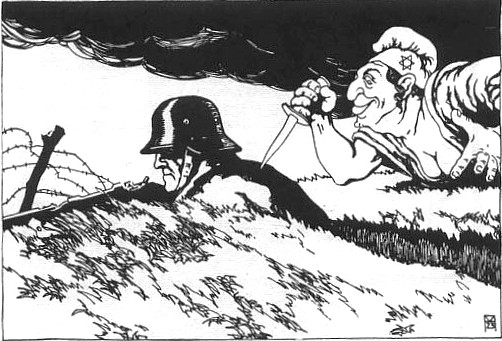
Can Russia stab us in the back?

Who knew that things had gotten so intimate between the erstwhile Cold War adversaries? Senator Charles Schumer (of New York) says

Russia has stabbed us in the back, and each day that Mr. Snowden is allowed to roam free is another twist of the knife.

As Mr Schumer surely knows, the “stab in the back” is a favourite antisemitic trope, or more generally a reference to treacherous fellow citizens who are “behind us” because we think we can trust them, while our eyes are focused on the enemy across the border. They are the internal enemy, taking advantage of our attention focused on the external enemy.

1919 Austrian postcard.
In Schumer’s telling, Russia is the one on the right.

Now, Russia is a powerful nation, and I hope that the US has a reasonably cooperative diplomatic relationship to it, but I would never have thought it was a US ally.

So, what I want to know is, who screwed up and let the Russians have our backs?

Of course, we wouldn’t have this problem if Snowden (like Bradley Manning) was gay. Maybe we should stop giving security clearances to heterosexuals. It’s too easy for them to get asylum…

Privacy rights in Germany

Unlike the US, Germany has a constitutional court that doesn’t kowtow as soon as the government yells “National Security”. Whereas the US Supreme Court has chosen to rewrite Catch 22 as a legal judgement, saying effectively that no one has standing to challenge secret government surveillance programs, because they are secret, hence no one can prove (using information the government will allow to appear in open court) that they have been affected.

Deutschlandfunk’s science programme Forschung Aktuell has been reporting this week on problems of information technology, security, and privacy, and today I learned (transcript in German)

In 2001 the police chief of Baden-Württemberg Erwin Hetger demanded a programme of advance data storage, by which all connection data of web surfers in Germany would be stored for six months.

“I think we cannot allow the Internet to become effectively a law-free zone. Hence my clear and unambiguous recommendation: Whoever moves about on the Internet must be willing to accept that his connection data are stored for a fixed period of time.”

The Bundestag did, in fact, pass such a law in 2007. But in 2010 the Constitutional Court annulled the law.

While such advance data storage is not necessarily impossible under the German constitution, the constitutional requirements for such an action would be very strict, and were not satisfied by the law that was passed.

The president of the Constitutional Court Hans-Jürgen Papier specifically emphasised that if such data were to be stored, it would have to be done in a more secure way than the law had required.

The comparison of this process — where the basic parameters of privacy rights and government snooping are set by the normal democratic process of legislatures passing laws that are then reviewed in publicly accessible court decisions — just makes clear how supine the US courts and Congress have been, as has been the UK parliament.
Continue reading “Privacy rights in Germany”

Blackmailing Uncle Sam

Glenn Greenwald, the Guardian journalist responsible for the NSA disclosures, may be going a bit too far into spy noir territory. In a recent interview he announced that

Snowden has enough information to cause harm to the U.S. government in a single minute than any other person has ever had. The U.S. government should be on its knees every day begging that nothing happen to Snowden, because if something does happen to him, all the information will be revealed and it could be its worst nightmare.

I am not making moral judgements. I find this rhetoric understandable, though clearly, whatever Snowden’s motives — and no one in politics has unmixed motives, nor should they be expected to have — by placing this dangerous information in the hands of persons unknown with some kind of dead-man’s trigger, he’s clearly increased the likelihood of it being released accidentally, which is quite a responsibility to take upon oneself.

But I’m thinking about Greenwald’s position. So far, despite the wish of some grandstanding congressmen to criminalise his role, Greenwald has clearly been a journalist. The Obama administration seems eager to draw some kind of line between “real journalists” and everyone else to prevent his administration’s witchhunting from completely gutting press freedom, so they might have played along. But they seem eager to prosecute national security leaks to the extent that they can find a bright line separating a given case from the bulk of journalism. Greenwald has given it to them, and I would be surprised if there were not a secret grand jury preparing charges against him for attempting to pervert the course of justice, or whatever the US federal term is for that.

However he meant it, Greenwald’s announcement sounds an awful lot like the language of blackmail, and that’s surely plenty of a hook for them to hang him on. This moves him from being a reporter to being a participant or, as I’m sure they’ll phrase it in the indictment, a co-conspirator. Blackmailing the feds is a pretty heavy game to play.

[Update 7/15: Greenwald has commented on his remarks, and it definitely looks as though Reuters has gone out of its way to frame a defence of Snowden’s motivations — he has held on to a lot of information that could be of great value to enemies of the US which he has not divulged, though he could reap significant rewards for it — in the theatrical argot of a mobster’s shakedown. That doesn’t change the fact that it’s not hard to imagine creative prosecutors twisting this story into a noose for an uncomfortable journalist; and that Snowden is playing a very dangerous game — just to make one obvious point, not everyone who might be in a position to harm him is opposed to his info bomb being detonated. Beginning with his current hosts…)
Continue reading “Blackmailing Uncle Sam”

Framing the question on electronic surveillance

Quinnipiac has published a poll purporting to find the following facts:

  • 55 percent of Americans say Edward Snowden is a “whistle-blower”, as opposed to 34 percent calling him a “traitor”;
  • voters say 45 – 40 percent the government’s anti-terrorism efforts go too far restricting civil liberties, a reversal from a January 10, 2010 survey … when voters said 63 – 25 percent that such activities didn’t go far enough to adequately protect the country.
  • While voters support the phone-scanning program 51 – 45 percent and say 54 – 40 percent that it “is necessary to keep Americans safe,” they also say 53 – 44 percent that the program “is too much intrusion into Americans’ personal privacy”.

Now, the most striking thing to me is that 88 percent of the people surveyed in January 2010 thought they knew enough about the government’s intrusion on personal privacy to even formulate an opinion — in particular, that 63 percent thought they knew enough about the scope to say that it didn’t go far enough.

But even more interesting is the formulation of the question that got 54% to agree that “the phone-scanning program” is “necessary”. (It is noteworthy that at least 4% of those surveyed both support the program and believe that it is “too much intrusion”. They must have a different concept than I have of either the word “support” or “too much”.) What they were asked was

Do you support or oppose the federal government program in which all phone calls are scanned to see if any calls are going to a phone number linked to terrorism?

Now, if you put it that way, I’d kind of support it myself. “Scanning” sounds pretty innocuous, and “phone numbers linked to terrorism” sound pretty ominous. But that’s only a small part of what’s being done. They are receiving all metadata — that’s a lot more than just a phone number — and storing them, presumably, forever. They are data-mining to try to identify patterns. They are already, or are preparing to, store the content of all communications, so they may be examined in depth if there is sufficient reason in the future.

And how much of this is this about terrorism? We don’t know. And even if it is about terrorism right now, it won’t take long before enthusiastic or corrupt government officials think of all kinds of other legitimate purposes of government that could be promoted by just breaking down some of the petty bureaucratic restrictions on use of the data.

To put it in the crassest terms: This sort of unfocused big-data espionage may be marginally useful for catching terrorists, but it seems certain to be far more useful for pressuring or destroying political opponents of the anti-terror policies.

Though this be madness, yet there is method in it

One of the key lessons of emotional game theory is that madness — or, at least, the convincing appearance of madness, which may amount to the same thing — can be an effective strategy. You can win some otherwise unwinnable games (Chicken being a favourite example) by convincing your opponent that you are too fixated, angry, or suicidal to be persuaded by threats and/or appeals to what may seem to be mutual best interests.

This seems to me the only way to understand the response of the US government to Edward Snowden. If the most recent news reports are to be believed, the US has somehow persuaded European governments to practically kidnap the president of Bolivia, because they believe Snowden might be on the presidential plane, flying to asylum. The lesson to future whistleblowers is clear: There’s no point trying to game out the usual protocols, the law, or even what might seem to be too much trouble or too embarrassing for the Americans. If you embarrass the US government, and particularly its clandestine services, they will go full berserker.

That was something of the sense I had after 9/11: The torture, the pointless war in Iraq, it wasn’t so much a means to an end, as a direct demonstration that the US was not going to respond in any proportionate, rational, or even legal manner.

The actions of the Europeans are pretty shameful. At the same time that they are howling about the crimes that Snowden has uncovered, they are conniving at US attempts to treat him as a criminal, rather than a political dissident. Germany, among others, has dismissed Snowden’s application for asylum by saying that he first needs to get to Germany before it can be considered; but, of course, they won’t let him come now that the US has revoked his passport.

If you don’t have anything to hide, why don’t you speak English?

The NSA documents that have gotten the most attention in the German press are the ones that divide the world into 3 categories of reliability (and hence relative freedom from US espionage). Class 1 is the US itself (though the Snowden affair should lead them to question their own reliability). Class 2 comprises the UK, Canada, Australia, and New Zealand. Class 3, subject to presumably no restrictions and given no trust, includes everyone else.

Naturally, the Europeans are offended to be in the same category as the Chinese and Iranians, but really, you have to wonder why they’re encoding all their communications in these weird non-English forms of communication. Trustworthy partners speak plain English!

“I hope the Russians love their secrets too…”

Remember back in the 1980s, when Sting and Prokofiev teamed up to extol the blessings for world peace that would flow from recognising that Americans and Russians deep down shared the same basic needs? Now the headlines read

Russia’s Putin tells Snowden to stop US secrets leak.

Okay, the cynics will say that east-west agreement on imprisoning political dissidents isn’t really on a level with “loving their children”, noble-sentiments-wise, but when former enemies can work together to cover up each other’s spying on their allies — well, when you get right down to it, how far is that from lions-lying-down-with-lambs territory? Put this together with the climate catastrophe, and we must truly be living at the end of days…

That this heartwarming rapprochement is happening just as Cold-War so-called allies are betraying the US, on  the pretext of protesting against being themselves the targets of NSA espionage — WHAT DO THEY HAVE TO HIDE?! — is all the more poignant. Sniff. I think I have to go drown my Weltschmerz tears in shots of Freedom Vodka (TM). За нашу дружбу!

The Socratic whistleblower

Cybersecurity law expert Joel Brenner says (hat tip to Andrew Sullivan) Eric Snowden is a wimp because he didn’t stay to face the legal consequences of his whistleblowing. In fact, it’s not civil disobedience at all unless you stay and drink the hemlock.

From Socrates through Thoreau, Gandhi, and King, the great theorists and practitioners of this form of resistance to law have told us in words and actions that civil disobedience requires the disobedient citizen to suffer the legal consequences of his or her unlawful act. In Socrates’s case, the consequence was death at the hands of the Athenian authorities. For Thoreau, Ghandi, and King, the consequence was jail. Through their suffering and example, they sought to undermine the moral position of law they found objectionable. Because unless the disobedient citizen takes the legal consequences of his unlawful action – he’s nothing but a criminal or a rebel.

Now, I love Thoreau, and he invented the term “civil disobedience”, but he spent one night in his hometown jail and then let a friend pay his fine. As with his roughing-it-in-the-cabin-but-don’t-miss-Sunday-dinner-with-the-folks stay at Walden, Thoreau knew better than anyone how to leverage a minimum of physical discomfort into a maximum of moral example. It’s hard to compare him to Snowden, who would have to at least take seriously the possibility that falling into the hands of US authorities would result in him being tortured and/or incarcerated permanently without trial.

But this is also completely wrong as regards Socrates, for a different reason: He precisely refused to flee so as not to undermine the moral position of the law. To put it simply, Socrates (as reported in the Crito) imagines the Law addressing him as follows: Continue reading “The Socratic whistleblower”

PRISM and leaks

Plenty of people commenting on the revelations of secret US government acquisition of vast quantities of personal data on telephone calls and other communications (my comments here and here) suggest that this is all overblown, even paranoid. William Saletan wrote about the telephone surveillance

Chill. You can quarrel with this program, but it isn’t Orwellian. It’s limited, and it’s controlled by checks and balances.

David Simon compares it to wiretapping payphones and calls The Guardian’s reporting “the heights of self-congratulatory hyperbole”.

So here’s just one example of how far-reaching the negative impact of this sort of surveillance could be — even if it is never misused. There has been much discussion of the Obama administration’s stepped up attacks on leakers, and on the journalists who publish leaks. Imagine you are a government employee in possession of significant evidence of official crimes or corruption. You would like to turn it over to a journalist, but you also know that once you do, the government will be able to trawl through all of the journalist’s email and telephone calls — not just prospectively, but going back years into the past, and find all contacts and contacts of his contacts. They will have plenty of private and embarrassing information that they can use to pressure you or the journalist, or his boss.

Now that the leaker has revealed himself, Farhad Manjoo put the case against the NSA’s power-grab succinctly: The very fact that such an unexceptional 29-year-old was able to gain access to so much information by itself disproves their claim that “you can trust us to do the right thing with your data”. The question you need to ask yourself is not, do I trust the president with this surveillance capacity? The question is, do I trust the most frustrated (or bored) FBI agent or NSA contractor with a top security clearance with this capacity.