
Hackers will be hackers

Guardian reporter Luke Harding has published some background material on the reporting for his new book The Snowden Files. Apparently someone in the security services decided to play with his mind while he was reporting on them. Not only did he and other reporters have laptops stolen (including from a locked hotel safe), not only did both the Guardian offices in London and in Washington, as well as the New York home of their US editor in chief suddenly have sections of pavement being dug up and replaced, but when Harding was texting his wife from Rio de Janeiro

“The CIA sent someone to check me out. Their techniques as clumsy as Russians.” She replied: “Really? WTF?” I added: “God knows where they learn their spycraft.” This exchange may have irritated someone. My iPhone flashed and toggled wildly between two screens; the keyboard froze; I couldn’t type.

And then, while writing the book at home in Hertfordshire,

I was writing a chapter on the NSA’s close, and largely hidden, relationship with Silicon Valley. I wrote that Snowden’s revelations had damaged US tech companies and their bottom line. Something odd happened. The paragraph I had just written began to self-delete. The cursor moved rapidly from the left, gobbling text. I watched my words vanish. When I tried to close my OpenOffice file the keyboard began flashing and bleeping.

Over the next few weeks these incidents of remote deletion happened several times. There was no fixed pattern but it tended to occur when I wrote disparagingly of the NSA.

Now, this isn’t the worst abuse of human rights in recorded history. It’s just a prank. But exactly for that reason, it underscores a point I made back at the beginning of l’affaire Snowden: Fear of the techniques the NSA and its confederates have been developing, and in the data they gather, depends not on their being villains with nefarious intentions. It depends on their being careless mortals who have no idea what use their techniques and their data will be put to.

I doubt that there was any senior official who thought that tipping off a Guardian reporter to their real-time computer manipulation capabilities would be a brilliant idea. My guess is, some bored hacker assigned to monitor Harding’s computer got cocky, and decided to show off his electronic muscles. (It’s pretty intimidating, though. Presumably it would be child’s play for them to remotely plant child pornography on the hard drive of someone they’re eager to shut down. At least in the old days, the spies needed to break into your home to plant drugs.)

GCHQ and the NSA can’t exist without hiring hackers, but getting hackers to work on your security problems is like the old lady who swallowed the spider to catch the fly. (She’s dead, of course.) I like hackers, by and large. But I like them as scrappy underdogs. The combination of arrogant macho hacker culture with essentially unlimited resources and military organisation is, to put it bluntly, terrifying. And if the leaders of our security services think they can keep the hackers under control, they’re delusional.
Spying on allies

Reading about President Obama’s speech on the significant but minimal changes he is planning to make to US intelligence gathering in the wake of (but in no way as a consequence of, it goes without saying) the Snowden revelations, I found myself wondering: How much shit are US allies expected to take? I don’t mean their leaders (who have been promised a personal exemption from espionage). I mean the average people, who have put legal regimes in place that prevent their own governments from spying on them. Why should they be more accepting of spying by the US?

And it’s not as though there’s nothing they can do about it. The solution would be to limit the role of American companies in the European market, particular with regard to sales of computer technology and collecting private information. As well as monitoring US embassies and diplomats more closely for engagement in illegal espionage. The US is assuming they won’t dare, because of the economic power of the US, the goverments’ reliance on US military and diplomatic power. That’s probably true, in the short term, but it’s clearly going to be an expensive, ongoing drain on US influence.

And then there’s the recent full court press by US legislators on the various intelligence committees to assert that Edward Snowden is a foreign agent — a pretty egregious assertion to be making publicly, since it would potentially make him liable to the death penalty. For example, here’s Michael McCaul, chairman of the House committee on homeland security:

Hey, listen, I don’t think … Mr Snowden woke up one day and had the wherewithal to do this all by himself. I think he was helped by others. Again, I can’t give a definitive statement on that … but I’ve been given all the evidence, I know Mike Rogers has access to, you know, that I’ve seen that I don’t think he was acting alone.

What’s most interesting is that, for all the bluster about “evidence”, it sounds like the claim he’s making is, the NSA couldn’t possibly be so incompetent that some random guy could just come in and walk off with their complete files. Since Snowden is obviously not a master criminal, it can only be that he was being steered by brilliant, nefarious foreign intelligence services.

It’s not hard to guess who put the idea in his head that the NSA couldn’t possibly be so incompetent…

Who is allowed to spy?

A common response to the revelations of unbridled electronic surveillance by the NSA and its anglophone Five Eyes compadres (don’t they have two each? Is this some Graeae thing, where Obama keeps all the eyes locked up in the Oval Office and shares them out as needed? He certainly keeps charge of the tooth…) has been that those who are shocked were simply naïve, and those who weren’t naïve are only pretending to be shocked, for political show, to fool the rubes who are shocked. After all, they say, everyone knows that it’s just the job of spy agencies to suck up all the information they can. Political leaders like Angela Merkel know perfectly well the extent of electronic surveillance, even if some details — like the fact that they themselves were targets — escaped their notice.

So, what are the ethics of espionage?

I understand that appeals to naked power and self-interest are perfectly conventional in international relations*; if Obama and Cameron want to say, we’re big and tough, we have nuclear bombs and world-shaking economies (except for Cameron), so we get to listen in on your phone calls just because we want to, and you should return our runaway spy who revealed what we were doing because you don’t want to face our wrath, we could consider that argument on its own terms.

But Obama and Cameron and their lickspittles claim to be making a moral case: NSA and GCHQ are law-bound agencies, protecting decent people from the forces of darkness, and Edward Snowden is an outlaw, and a dirty traitor to boot.

But imagine a different Edward Snowden. This one was born to Ivan Snowdinsky, who changed his name to John Snowden when he came to the US in the 1970s as a KGB spy. Young Edward pretended to be an ordinary American, but secretly he burned with love for Mother Russia. He directed his career to develop the skills that he could use to infiltrate the dastardly American espionage services. Finally, at age 29, he got the job he wanted. He took all the files he could find and fled for Russia, turning all of  his thumb drives over to Vladimir Putin personally in a secret GRU award ceremony. All of them. Not just the public-interest stuff that our pusillanimous journalists have published. Operations. Methods. Technical data. Everything.

Do we suppose that David Cameron would have said, “Good on you. That’s great espionage you did there.” And would have mocked anyone who said it was unethical to lie to putative allies, violate their laws, and steal their confidential information, all for the purpose of attaining a military or commercial advantage? “Everyone does it,” our alternative-world David Cameron would say, in a joint press conference with the US president. At which Obama would add. “The good ones don’t get caught. Those Russians are the best. We need to learn from their methods.”

Just as the moral case for free access of medical personal to troubled regions is undermined when the CIA smuggles in agents disguised as doctors dispensing vaccines, so the moral case for international cooperation in law enforcement — incredibly important as it is for our security — is powerfully undermined when international power politics masquerades as law enforcement.

* Lewis Thomas’s essay ‘The Iks”, in his book The Lives of a Cell, is an intriguing meditation on the differences between conceptions of morality in the interpersonal and international contexts.

Adversaries “rubbing hands with glee”

… can’t they use moisturiser like everyone else? I’m sure I’ve seen this movie:

Sir John Sawers, head of MI6, said: “The leaks from Snowden have been very damaging… It is clear our adversaries are rubbing their hands with glee.”

In other reports, enemies of Britain are said by security experts to be “cackling maniacally”. And intelligence sources have reported that leading terrorist operatives have been heard gloating over our failure to stop their brilliantly contrived schemes for world domination.

“Give me the appearance of liberty or give me death…”

Patrick Henry

… if David Cameron were Patrick Henry, that would have been his impassioned cry.

Here’s what he did say to parliament:

We have a free press, it’s very important the press feels it is not pre-censored from what it writes and all the rest of it.

I don’t want to have to use injunctions or D notices or the other tougher measures. I think it’s much better to appeal to newspapers’ sense of social responsibility. But if they don’t demonstrate some social responsibility it would be very difficult for government to stand back and not to act.

We would like the press to feel it is not pre-censored. But they must be in fact pre-censored, otherwise the government will have to resort to “the other measures”. But not to worry. The only people who might be subject to these other measures are in thrall to ‘a “lah-di-dah, airy-fairy view” (that was really Cameron’s expression) about the dangers of leaks.

Why am I not reassured in this government’s willingness to carefully weigh the different interests in the secrecy debate? Nothing speaks “careful analysis” like presenting your opponents’ view as”lah-di-dah, airy-fairy”.

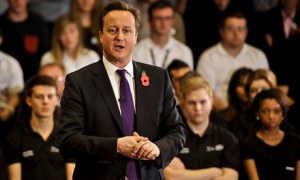
Cameron tours the Mini car plant in Oxford.

The secret government

According to Spiegel, Obama has told Angela Merkel that he knew nothing of “possible eavesdropping” by the NSA on her cell phone — which has been going on for over 10 years — and that he would have stopped it immediately had he known. So we have to assume one of three possibilities:

  1. Obama has decided to double down on the diplomatic affront by baldly lying to the leader of Germany.
  2. Cynics are right: Everyone spies on everyone, and everyone in the higher echelons of government knows about it, so Angela Merkel has felt obliged to collude with Obama to deceive the media and the public.
  3. Obama owes Edward Snowden an apology. The NSA was not working for the US government. It was out of control, slipping the leash of democratic control. Obama was himself naïve to think that he could simply order an investigation. Think back to what Obama said in August about the NSA and Snowden:

And if you look at the reports — even the disclosures that Mr. Snowden has put forward — all the stories that have been written, what you’re not reading about is the government actually abusing these programs and listening in on people’s phone calls or inappropriately reading people’s emails. What you’re hearing about is the prospect that these could be abused… If you are outside of the intelligence community, if you are the ordinary person and you start seeing a bunch of headlines saying, U.S.-Big Brother looking down on you, collecting telephone records, et cetera, well, understandably, people would be concerned. I would be, too, if I wasn’t inside the government…

But people may have better ideas and people may want to jigger slightly sort of the balance between the information that we can get versus the incremental encroachments on privacy that if haven’t already taken place might take place in a future administration, or as technologies develop further…. And so those are the kinds of things that I’m looking forward to having a conversation about.

It’s a typical insider fallacy. He has access to secret information, so he assumes he understands everything that’s going on, far better than the deluded privacy obsessives who have the misfortune of being “outside of the intelligence community”.

So, maybe the president should consider whether it might not have been important after all for a concerned citizen to take matters into his own hands, if even he needed the German news media to let him know what his spooks were up to.

Vintage paranoia

The NYTimes has just published one of its brilliant series of debates, this time on the question of whether it is appropriate to spy on allies. The writers line up more or less two for, two against. Within the for camp there is a split between the world-weary cynical academic Rhodri Jeffreys-Jones, and Bush-era senior Homeland Security official Stewart Baker’s raving paranoia. His headline is “Allies aren’t always friends”, but what he really means is, there are no friends, only enemies we’re not at war with yet. The world is divided up into current enemies and future enemies. He writes

Even the countries we usually see as friends sometimes take actions that quite deliberately harm the United States and its interests. Ten years ago, when the U.S. went to war with Iraq, France and Germany were not our allies. They were not even neutral. They actively worked with Russia and China to thwart the U.S. military’s mission. Could they act against U.S. interests again in the future – in trade or climate change negotiations, in Syria, Libya or Iran?

This is, to put it briefly, insane. It’s like saying, “You’re not my friend. You actively worked to take away my car keys and thwart my plan to drive home from the party yesterday,” after you managed to get the keys back and then ran the car into a tree. Anyone who followed the discussion in France in Germany at the time of the Iraq war would have to acknowledge that “harming the United States and its interests” was nowhere part of the justification for opposing the war. It wasn’t even a matter of seeing the US and Europe as having opposing interests that demand a compromise, that of course can happen between friends. The general belief was that the US and Europe had one common interest, and the US was screwing it up with its obsession with the “military mission”.

Now, the public debate may have been a charade. Perhaps Mr Baker has seen NSA-procured films of clandestine meetings between Schröder and Chirac, with Chirac twirling the thin moustache that he had specially attached by state cosmeticians for such meetings, and saying, “Of course, you are right, cher Ger’art, my plan to deploy the Force de Frappe to obliterate Washington and that freedom-loving Bush and the ‘orrible MacDo, lacks sufficient, how you say, finesse. Far better to allow our good friend Saddam ‘ussein do our dirty work.” And then they pinned the European Star, first class, to Osama bin Laden’s robe, and apologised that his great service could not yet be publicly acknowledged, but that he would be shining beacon to enemies of freedom down through the ages.

It’s a shame that they can’t publish that. Everyone would understand then why spying on our not-yet-enemies is so important. Until then, our spies will have to remain sadly misunderstood.

Public relations advice for GCHQ (from Wolf Biermann)

If you don’t speak German you probably have never heard of Wolf Biermann, who many people (I am one of them) would consider to be the greatest, or at least one of the greatest, political songwriters of the 20th century. Unfortunately, text-heavy songwriting doesn’t cross borders well, so he is almost unknown outside the German-speaking world. But he is an extraordinary poet and musician, and I’m not sure who could compare to his blend of wit, righteous anger and political sophistication.

At the moment, I’m particularly thinking of his 1974 Stasi Ballade, a sarcastic paean to the internal security service (Staatssicherheit, or Stasi) that had kept him constantly under surveillance since the early 1960s, when his communist idealism had been pegged as politically deviant. I’ve included the whole German text below (certainly a copyright sin, but perhaps a venial one). A crude translation of parts of it give a sense of Biermann’s text:

I feel myself somehow entwined
with the poignant Stasi swine
who watch my house, who come and go
in pouring rain and sleet and snow.
Who installed a microphone
to listen in on all my moaning,
songs and jokes and mild bitching
on the toilet, in the kitchen:
Brothers from Security —
You alone know all my grief!

…..

Words that would have disappeared
are stored by you on eight-inch reels,
and I know how, now and then,
you sing my songs at night in bed!
For years I’ve been depending on
the Stasi as my Eckermann.

When I come home late at night
from the pub tired, maybe tight,
And some crude peasants were to lurk
in the darkness by my door,
and they attacked most vulgarly
to do, I don’t know what, to me –
But that’s impossible today.
The comrades in their battle grey
from the Stasi would — I’d bet you! —
Prohibit an assault or battery

Because the papers in the West
Would try to blame the crime — I’d bet you! —
on the Communists …
The Stasi is — I must regard it
as my loyal bodyguard!

Or we could reflect a while
upon my foolish carnal freestyle –
My habit, such a source of strife,
that always discomposed my wife –
This monstrous, mad, and reckless tempt-lure
pulling me toward new adventure.
Since I know how Argus-eyed
the comrades watch, I haven’t tried
to pick my cherries anymore
from the trees on other shores.

I know I’d risk that such events
would be recorded, and soon be sent
to my wife with clear intent –
Such a huge embarrassment!
And so I skip these sideways swerves
so save my strength, my time, my nerves –
And there’s no question that this spark
I save redounds to fire my work!
I say, in short: the Security
Secures my immortality!

So, let’s summarise: Biermann thanks the Stasi surveillance for three services:

  1. Recording his words. Assuring that they will never be forgotten, and that someone is paying attention. Of course, it’s not clear how much attention GCHQ is allowed to pay, according to current law, but they could do a lot more to win over the hearts and minds of the public on the other score. Imagine GCHQ Backup. Never lose another file. If you have a disagreement about what was said in a telephone conversation, just use the webform to contact GCHQ’s round-the-clock service representatives, who will be happy to provide you with the recording. Maybe they’ll even get people to agree to leave their webcams on at all times, in return for cataloguing and backing up their non-telephonic conversations.
  2. Protection from crime. They’ve emphasised this so far. I’m not sure that there is more to be gotten plausibly, at current funding levels.
  3. Preserving morals. This one is delicate, but may have the greatest potential for development. Of course, it’s implicit in the argument that people make, that those who have not committed crimes have nothing to fear from surveillance. We know that the NSA has already been experimenting with the use of electronic surveillance to control sexual deviance. They could offer a service that automatically mails to your partner the content of any conversations that include certain keywords. The application is not limited to sexual morals, of course. Employers could be alerted when their employees discuss company secrets (or theft of company property). Or maybe you’re a Muslim youth who is worried that you might be tempted into islamist terrorism. The problem is, some people don’t want to be prevented from having affairs, or consorting with islamists, or whatnot. This part still needs work.

Continue reading “Public relations advice for GCHQ (from Wolf Biermann)”

Tech executives still lying

Marissa Meyer, CEO of Houyhnhnm? [Correction, that’s “Yahoo!”] has faced charges that her company (and other tech companies) undermined democracy and betrayed their customers’ trust by secret collusion with US espionage. She attempts to win back this trust by telling big lies. In a recent interview she claimed that

Releasing classified information is treason and you are incarcerated.

Nine words, and two (or maybe three) false statements.

First, the easy one: Treason is clearly defined in the US constitution.

Treason against the United States shall consist only in levying war against them, or in adhering to their enemies, giving them aid and comfort.

She is confusing the United States government with the 18th Century British monarchy, that classed that any release of information not authorised by the state is treason.

What her company may or may not have been constrained by is called a National Security Letter (NSL), that typically comes with a gag order. (Whether this counts as “classified information” I am not sure. I’d take her word for it if she weren’t lying about everything else.) The constitutional scope of these gag orders has been challenged in court, but I don’t know what the current status is.

But is it true that if you disclose the receipt of an NSL “you are incarcerated”? In fact, the Department of Justice — not the American Society for Feelgood Antiauthoritarianism — writes in its fact sheet on the Patriot Act Reauthorization that this act

Discourages unauthorized disclosures by providing a criminal penalty for knowing and willful violation with intent to obstruct an investigation or judicial proceeding.

Until this reauthorisation, apparently there was no specific penalty legislated for disclosing NSLs. And afterward, it’s still not clear. It would clearly — and properly — be a punishable offence if Marissa Meyer found out that her college roommate was having her Houyhnhnm? account searched because she retweeted a suspicious number of posts from Sheikh Omar’s Twitter feed, and tipped her off. But to alert the public for reasons of improving democratic accountability most likely is not illegal at all, and is the sort of calculated risk that many journalistic organisations take on a daily basis. With far less money to back them up.

I don’t doubt that some investigator fed her that line about treason and incarceration. That’s what interrogators do, they help people out of their scruples. But presumably she could afford a lawyer to give her independent advice. She could even have looked up the US Constitution and the PATRIOT act, if she knows how to use a search engine.

And I don’t expect Marissa Meyer or Sergey Brin to blow the cover off government surveillance and flee to Russia. But they clearly have decided — unlike, say, the New York Times — that they are a merely commercial organisation, with no public responsibility, and that a legal struggle would hurt their profits. That is why their customers need to make sure to align their incentives, by boycotting or simply avoiding companies that don’t show sufficient civil courage on their own.

And telling lies is not a way to rebuild trust.

Outsourcing espionage

In the light of recent developments, including the vast trove of NSA documents downloaded by Booz Allen employee Edward Snowden, and the revelation from those documents that the US has been systematically violating its treaty obligations by spying on the SWIFT international financial transactions system, some comments by Janine Wedel in her book Shadow Elite take on new significance:

Through SWIFT the US Treasury Department sought and gained access to large numbers of financial and communications records. Treasury then established the Terrorist Finance Tracking Program, run out of the CIA, to analyze the SWIFT data and later shared it with the CIA and FBI. It also hired Booz Allen as an “independent” auditor, which, along with SWIFT, reviewed Treasury’s logs of information searches… As Barry Steinhardt, Director of the ACLU’s Technology and Liberty Project, put it: “It is bad enough that the administration is trying to hold out a private company as a substitute for genuine checks and balances on its surveillance activities. But of all companies to perform audits on a secret surveillance program, it would be difficult to find one less objective and more intertwined with the US government security establishment.”

To sum up that interaction: A private company, given “government” access to sensitive and private data about citizens of the United States and other countries, not only worked alongside government to analyze the data, but then also (supposedly) oversaw the process.

Is there any surprise, then, that the self-watching watcher had no safeguards in place to prevent a newly hired employee from walking off with all these super-secret data?

There have always been those who have claimed that capitalism is inimical to tyranny. Usually some ideological affinity between capitalism and democracy, or in a practical sense that tyranny is bad for business, which depends on the initiative of many well-informed independent actors (rather in the same way that European economic integration in the early 20th century made war self-defeating for the economic elites, hence impossible; or, so it was argued). But maybe there is some truth to this claim in the Leninist sense: When we come to hang the capitalists, they will bid on the contract for the rope. Given opportunity to accumulate vast secret power through spying, or to make vast profits by outsourcing the espionage, at the risk of exposing the secret government, American elites couldn’t resist the lure of the cash. Stalin would never have made that mistake.

I suspect that Stalin would have done very well on the marshmallow test, for what it’s worth.